Introduction
Organizations today are expected to manage quality alongside environmental performance, worker safety, information security, and energy use. Managing these areas through separate systems can create duplicated documents, overlapping responsibilities, repeated audits, and unnecessary administrative work.
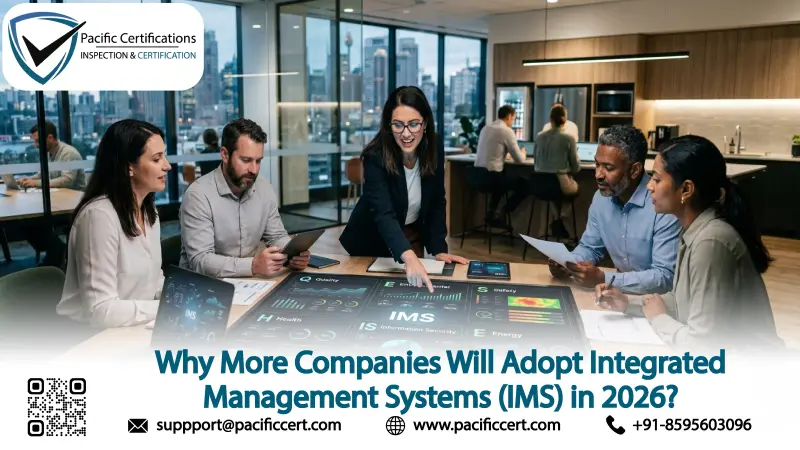
An Integrated Management System (IMS) brings compatible management systems into a coordinated framework. Organizations may integrate standards such as ISO 9001, ISO 14001, ISO 45001, ISO/IEC 27001, and ISO 50001 while continuing to meet the specific requirements of each standard.
A well-designed IMS can simplify risk management, internal audits, management reviews, documentation, objectives, and performance monitoring. It can also give leadership a clearer view of how quality, safety, environmental, security, and energy-related risks affect overall business performance.
Integration does not remove or reduce the requirements of individual standards. Organizations still need appropriate controls, records, competent personnel, and objective evidence to demonstrate conformity during a third-party certification audit.
For organizations considering integrated certification, Pacific Certifications can develop an ISO audit plan based on the certification scope, applicable standards, locations, activities, and level of management system integration.
Quick summary
An Integrated Management System (IMS) combines multiple ISO standards into one coordinated framework, reducing duplicate procedures, audits and documentation. Standards such as ISO 9001, ISO 14001, ISO 45001, ISO/IEC 27001 and ISO 50001 can share processes for risk management, internal audits, corrective actions and management reviews. This approach helps organizations improve efficiency, align objectives and gain clearer oversight of quality, safety, environmental, security and energy performance. As businesses face multiple compliance and customer requirements, IMS offers a more practical way to manage several ISO standards together.
Why integrated management systems are gaining importance?
Institutions now operate with complex risks and obligations across several areas at the same time. Customers want proof of quality and data security. Communities expect responsible environmental behaviour and safe workplaces. Running separate systems for each standard is costly and confusing, especially when the same people must handle all of them.
An IMS allows leadership to set one direction, one policy framework and one set of core objectives that link quality, safety, environment and information security. Instead of parallel systems competing for attention, the IMS encourages departments to align their efforts. This leads to clearer priorities, better internal communication and easier reporting to senior management and external stakeholders.
An integrated management system turns multiple compliance demands into a single, organized way of working that supports long-term performance.
IMS components and example standards
What are the requirements for implementing an IMS?
Moving to an IMS means aligning different management systems under one structure. Before creating an integrated framework, institutions should understand which standards they want to combine and which processes are already shared. The aim is not to rebuild everything but to join areas that overlap. Below are the key requirements:

Define the scope of the IMS and list the standards to be integrated.
Map existing processes for each standard and identify overlaps.
Develop an integrated policy that covers quality, environment and other selected areas.
Conduct a single context and interested party analysis for the whole IMS.
Align risk and opportunity assessments across different disciplines.
Create integrated procedures for document control, training and internal audits.
Harmonize objectives and KPIs across departments where possible.
Assign clear roles and responsibilities for IMS ownership and reporting.
Combine nonconformity and corrective action processes into one system.
Plan for one integrated management review covering all included standards.
Tip: Create a single risk and opportunity register that includes quality, safety, environment and information security risks in one place, with common owners and due dates.
How to prepare for integrated certification?
Preparation for IMS certification involves moving from separate documents and audits to one cross-functional system. Institutions that plan this transition carefully find it easier to maintain and improve their system in the long term.
Conduct a gap analysis to compare current systems with an integrated structure.
Decide which standards will be integrated in the first phase and which can follow later.
Merge duplicate procedures such as internal audits, corrective actions and training.
Align objectives so that quality, safety and environmental goals support each other.
Update process maps to show how each process addresses multiple standards.
Train managers and staff on the concept of IMS and their shared responsibilities.
Run an internal integrated audit before inviting an external certification body.
Certification audit for an IMS
Stage 1 audit: Reviews integrated documentation, policies and process structure.
Stage 2 audit: Verifies that the integrated system is operating across all functions.
Nonconformities: Must be corrected with shared actions and evidence under the IMS.
Management review: Confirms that leadership reviews all standards in one meeting.
Final certification: Issued for the integrated scope once all criteria are met.
Surveillance audits: Conducted annually to monitor the performance of the IMS.
Recertification audits: Performed every three years to renew integrated certification.
What are the benefits of adopting an IMS?
An Integrated Management System does more than reduce paperwork. It changes how institutions plan, manage and review their performance across several standards at the same time. Once the IMS is in place, organizations often find it easier to explain their system to auditors, customers and internal teams. Below are the key benefits:
Reduced duplication of procedures, forms and audit plans.
One combined internal audit cycle instead of separate audits for each standard.
Shared management reviews with clear cross-functional decisions.
Better alignment of quality, safety, environment and data protection objectives.
Lower risk of conflicting procedures between departments.
Easier introduction of new standards into an existing structure.
Stronger, clearer performance monitoring through shared KPIs.
More consistent communication across teams and locations.
KPIs: audit closure time, cross-functional objective completion rate, incident trend across disciplines.
SLAs: corrective action closure period, document update cycle, management review schedule adherence.
Market Trends
More organizations are moving from single-standard certification to integrated frameworks that group quality, safety, environment and information security into one system. Digital tools now make it easier to manage shared risk registers, dashboards and document libraries. Institutions are also using integrated systems to support tender responses, supplier approvals and ESG reporting, since one system can supply evidence for several areas at once.
In the coming years, IMS adoption is likely to grow across manufacturing, logistics, healthcare, technology and public services. As buyers ask for multiple ISO certifications, institutions will find it more practical to operate one integrated model rather than maintaining isolated systems. Integrated dashboards, AI-supported risk analysis and shared performance reporting will make IMS a natural choice for leadership teams that want clear visibility across several disciplines. Over time, integrated audits and combined surveillance visits will become a standard path for organizations that hold more than one ISO certificate.
Training and courses
Pacific Certifications provides accredited training designed for integrated managementsystems based on standards such as ISO 9001, ISO 14001, ISO 45001, ISO/IEC 27001 and ISO 50001:
Lead Auditor Training: For professionals who want to perform integrated audits that cover several standards within one system.
Lead Implementer Training: For individuals responsible for designing and maintaining an IMS that brings together quality, environment, safety and other disciplines.
How Pacific Certifications can help?
Pacific Certifications provides accredited integrated certification and audit services for organizations that wish to combine multiple ISO standards under one management system. Our auditors review integrated processes, risk assessments, documentation and performance monitoring to confirm alignment with each applicable standard.
We issue Certificates of Conformity after impartial integrated audits and do not provide consultancy or system design services.
Contact Us
For an IMS certification roadmap, scope discussion, or audit proposal, contact support@pacificcert.com or visit www.pacificcert.com.
Author: Alina Ansari
Also read:Implementing an Integrated ISO 9001, ISO 14001 & ISO 45001 IMS