ISO/IEC 27701 Certification in 2026: Privacy Management System & GDPR Compliance Guide
Introduction
By 2026, privacy will sit at the centre of how customers, regulators and business partners judge digital services. Banks, insurers, e-commerce platforms, hospitals, SaaS providers, telecom operators and cloud-based analytics platforms all handle large volumes of personal and sensitive data across borders and suppliers. Any failure to control that data can trigger fines, legal disputes, reputational damage and lost deals.
ISO/IEC 27701 builds on ISO/IEC 27001 and ISO/IEC 27002 to create a Privacy Information Management System (PIMS) that supports GDPR compliance and connects information security with privacy governance. It gives organizations a structured way to manage personal data, define roles for controllers and processors, handle privacy risks and keep records that support audits and investigations.
If your organization wants to align privacy, cybersecurity and management systems for 2026, request an ISO/IEC 27001 and ISO/IEC 27701 certification audit plan from Pacific Certifications to get ISO 27701 certified fast. We will discuss scope, timelines, evidence requirements and an integrated privacy governance implementation roadmap.
Quick summary: ISO/IEC 27701 certification in 2026 for privacy compliance
ISO/IEC 27701 certification in 2026 will be a key signal that an organization has turned privacy into a managed system rather than a collection of policies. It extends ISO/IEC 27001 to cover personal data, privacy roles, lawful bases for processing, data-subject rights, processor oversight and record-keeping. For finance, healthcare, retail, logistics, SaaS and public services, ISO/IEC 27701 certification in 2026 will show that privacy, security and risk management are handled together, with clear controls and evidence.
Why ISO/IEC 27701 certification matters for privacy-driven organizations in 2026?
Data-driven products and services now rely on customer profiles, transaction histories, location data, health records, device identifiers and behavioural analytics. Payment providers, hospitals, e-commerce platforms, mobility apps and HR outsourcing firms all operate under increasingly strict privacy rules and contract clauses.
Without a system, privacy work can become scattered: one team writes policies, another team handles security, while marketing, HR, product and IT make daily decisions without a shared set of rules. Data subject access requests, regulatory investigations, or enterprise client privacy questionnaires then become difficult to answer quickly.
ISO/IEC 27701 matters because it connects privacy roles, risk assessment, technical and organisational controls, third-party oversight and documentation into one PIMS. It helps cloud services, data processors, joint-controllers and group-level functions demonstrate compliance by showing how personal data is collected, used, shared, stored and deleted. For many sectors, especially finance, healthcare, retail, telecom and SaaS, ISO/IEC 27701 certification in 2026 will support access to enterprise contracts, international tenders and cross-border data transfers.
ISO/IEC 27701 requirements checklist: Privacy management system implementation
ISO/IEC 27701 does not replace GDPR or privacy laws, but it gives a management-system structure that supports compliance. It extends ISO/IEC 27001 with specific clauses and controls for controllers and processors who handle personal data. Below are some of the key requirements:
- Define the scope of the Privacy Information Management System, including business units, locations, IT systems, cloud services and data-processing activities that involve personal information.
- Identify whether you act as a controller, joint-controller or processor (or several of these) for each major processing activity, and document the role and responsibilities clearly.
- Build and maintain a data-processing inventory that maps categories of personal data, purposes, lawful bases, retention periods, locations, recipients and processor relationships.
- Assess privacy risks using a structured method that considers likelihood and impact on individuals, including special-category data, profiling, cross-border transfers and large-scale processing.
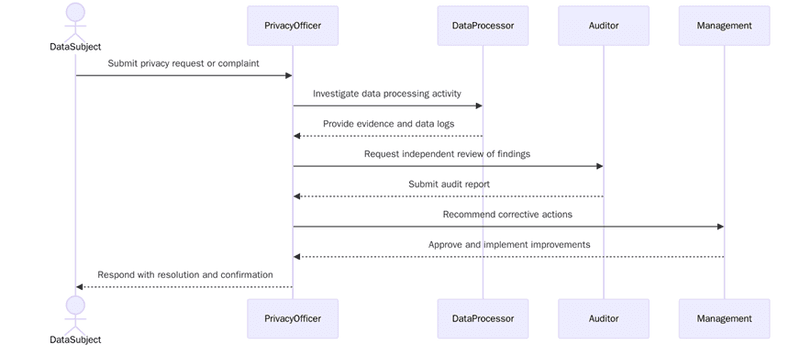
- Define and apply controls for data-subject rights handling, including access, rectification, objection, restriction, portability and erasure, with clear channels and deadlines.
- Maintain incident and breach-management procedures that cover detection, triage, impact analysis on individuals, notification decisions and communication with clients and authorities.
- Run internal audits and management reviews that include privacy objectives, privacy risks, control performance, complaints, incidents and planned improvements.
How to prepare for ISO/IEC 27701 certification: Implementation steps
Preparation for ISO/IEC 27701 should start with a clear view of where personal data sits in your services, systems and supplier chain. Many organizations already have an ISO/IEC 27001 information security management system, a privacy policy and some legal reviews, but they are not fully joined. The goal is to turn that into an integrated security-and-privacy framework that supports GDPR compliance and daily operations. Below are some of the key preparation steps:
- Confirm your ISO/IEC 27001 certification status, scope and risk-assessment approach, since ISO/IEC 27701 builds directly on this foundation.
- Map personal-data flows for key services, including customer onboarding, billing, support, marketing, HR, partner integrations, analytics pipelines and mobile apps.
- Classify processing activities by role (controller or processor), purpose, data categories, lawful bases and locations, and identify where records or clarity are missing.
- Train key roles—such as privacy officers, security leads, product managers, HR managers, marketing leads and system owners—on ISO/IEC 27701 expectations.
- Align incident-response procedures so that they cover both security and privacy impacts, including how to log, assess and escalate suspected personal-data breaches.
- Plan internal audits that include sampling across business units, systems and processing activities, checking both documentation and actual practice.
- Prepare for management review by deciding which privacy KPIs, major risks, complaints, incidents and improvement plans will be presented to leadership.
ISO/IEC 27701 certification audit process: Stage 1, Stage 2 & recertification timeline
Stage 1 audit – readiness review: Review of ISO/IEC 27001 and ISO/IEC 27701 scope, controller and processor roles, context analysis, privacy-risk assessment methods, data-processing inventory, key policies, data-subject rights procedures, processor-management approach, documented processes and readiness for Stage 2.
Stage 2 audit – implementation verification: Verification of ISO/IEC 27701 implementation across selected business units, systems, cloud platforms and processing activities, including evidence of risk treatment, privacy controls in projects, processor oversight, incident-handling records.
Nonconformities: Must be corrected with clear root-cause analysis, updated processes or controls, improved documentation and records showing that the new practices are in active use across relevant teams and systems.
Recertification audits: Required every three years to review the full system, including new processing activities, business models, countries, partners and technology platforms that affect personal data.
Benefits of ISO/IEC 27701 certification: Business value, privacy risk reduction & competitive edge
When ISO/IEC 27701 certification sits on top of ISO/IEC 27001, organizations gain one unified structure for security and privacy compliance instead of separate frameworks. Below are some of the key benefits:
- Clearer visibility of where personal data lives in systems, APIs, cloud services, files and partner platforms, which reduces the chance of overlooked processing.
- Stronger control over high-risk processing such as profiling, health data, payment data and cross-border transfers through defined risk reviews and approval steps.
- Better ability to respond to client due-diligence checks, GDPR compliance questionnaires and vendor-risk assessments, since ISO/IEC 27701 clauses and records align closely with what enterprise buyers ask.
- Faster, more consistent handling of data-subject requests across support, HR, legal and product teams, supported by documented procedures and logs.
- Increased trust from enterprise customers, public-sector clients and partners who look for privacy assurances before signing long-term or high-value contracts.
- Improved readiness for investigations or complaints from authorities, because decisions, risk assessments and controls are documented within a recognised framework.
- Closer cooperation between security, legal, IT and business teams, as privacy topics are embedded in the same audit, review and improvement cycles as information security.
Market Trends
Looking toward 2026, ISO/IEC 27701 certification is likely to be adopted more widely by SaaS providers, cloud platforms, data processors and multinational groups that must respond to different privacy regimes with one internal system. Many organizations will present ISO/IEC 27001 and ISO/IEC 27701 certification together as proof of security-and-privacy governance and GDPR compliance in RFPs and vendor-risk portals. Data-heavy sectors such as fintech, health-tech, ad-tech, HR-tech and mobility platforms will lean on ISO/IEC 27701 to frame privacy-by-design, data-minimisation and retention rules. Organizations that get ISO 27701 certified early in 2026 will find customer audits, GDPR compliance reviews, regulatory questions and cross-border data transfers easier to manage.
ISO/IEC 27701 training and courses: Lead auditor & lead implementer
Pacific Certifications provides accredited ISO training programs that support privacy and information-security alignment across sectors such as finance, healthcare, e-commerce, telecom, SaaS and public services.
ISO/IEC 27701 Lead Auditor Training: Supports professionals auditing integrated information-security and privacy management systems. It covers ISO 27001 auditing for information assets and controls, ISO 27701 auditing for controller and processor requirements and cross-domain risk assessment in data-driven environments.
ISO/IEC 27701 Lead Implementer Training: Supports implementation teams building or upgrading integrated management systems for information security and privacy governance. It covers ISO 27001 implementation, ISO 27701 implementation, privacy-risk framework design and aligned control structures across business units and suppliers.
How Pacific Certifications can help you get ISO 27701 certified?
Pacific Certifications provides accredited ISO/IEC 27001 and ISO/IEC 27701 certification services for information security and privacy management. We assess scope, information assets, personal-data inventories, controller and processor roles, privacy-risk assessment methods, AI or analytics use cases, selected controls, documented processes, technical safeguards, supplier oversight, internal audits and management reviews. We support ISO/IEC 27001 and ISO/IEC 27701 integration with other ISO standards where organizations want a unified management system for security, privacy and compliance. We issue Certificates of Conformity following impartial audits, and we do not provide consultancy or system-design services.
To get your free ISO/IEC 27701 certification quote, integrated privacy-governance audit plan, or discuss how to get ISO 27701 certified for your organization, contact [email protected] or visit www.pacificcert.com.
Ready to get ISO/IEC 27701 certified?
Contact Pacific Certifications to begin your certification journey today!
Author: Alina Ansari
Suggested Certifications –
Read more: Pacific Blogs