ISO Certifications in USA - What Businesses Need In 2026!
Introduction
By 2026, businesses in the USA will face tighter vendor checks, more digital risk and closer review from customers and partners. Buyers now ask how you manage quality, data security, continuity, safety and environmental impact before they sign a contract or renew a long-term deal. ISO certifications have become a simple way for American organizations to show that these topics are managed through a clear system, not only individual effort.
For US companies, ISO systems are no longer just for large manufacturers. Software firms, healthcare providers, logistics companies, fintech platforms, service providers and public bodies are using ISO standards to unlock tenders, support growth and reduce the chaos that comes with fast expansion.
If your organization in the USA wants to plan ISO certification for 2026, you can request an audit plan from Pacific Certifications to discuss scope, timelines and evidence requirements.
Quick summary
In 2026, US businesses will need ISO certifications that support quality, information security, business continuity, environment, health and safety, food and medical reliability and AI governance. The most common standards include ISO 9001, ISO 14001, ISO 45001, ISO/IEC 27001, ISO 22301, ISO 22000, ISO 13485, ISO/IEC 42001, ISO 50001 and sector-specific schemes such as ISO/IEC 17025 and ISO 41001. A focused mix of standards helps American organisations win contracts, manage risk and keep operations steady as technology and customer expectations move quickly.
Why ISO certifications matter for US businesses?
In the US market, many customers now use ISO certifications as a shortcut to judge reliability. Enterprise buyers, government agencies and international partners often expect at least ISO 9001 for quality and ISO/IEC 27001 for information security. In regulated sectors such as medical devices, food, energy and finance, ISO certification supports smoother approval and lower risk of supply chain disruption.
For management teams, ISO certifications bring discipline to processes that are already happening but may be inconsistent across teams or locations. This can be especially useful for US companies that are growing fast, working with remote staff and using many cloud services.
Applicable ISO standards for US organizations
Different sectors in the USA will prioritize different standards, but some appear repeatedly in contracts, vendor questionnaires and partner discussions.
ISO 9001 – Quality management for manufacturing, services, software and logistics.
ISO 14001 – Environmental management for plants, warehouses, construction, energy and industrial services.
ISO 45001 – Health and safety for factories, construction, utilities, transportation and field maintenance.
ISO/IEC 27001 – Information security management for cloud providers, SaaS companies, banks, healthcare, retail and any data-driven business.
ISO 22301 – Business continuity for finance, telecom, critical infrastructure, data centers and service companies with high uptime needs.
What are the ISO certification requirements for US businesses?
ISO certification requirements are similar worldwide, but US organizations must align them with local laws, sector rules and multi-site operations. Below are some of the key requirements:
Define the scope of certification, including locations, products, services and support processes that affect customers and risk.
Establish policies and measurable objectives for each chosen standard, such as quality, security, safety or environmental performance.
Analyse internal and external context, including US regulations, customer types, supply chains and technology platforms.
Identify interested parties, such as customers, regulators, staff, unions, investors and key suppliers and understand their needs.
Map core processes end to end, from order or request through production or delivery to billing and support.
How to prepare for ISO certification in the USA?
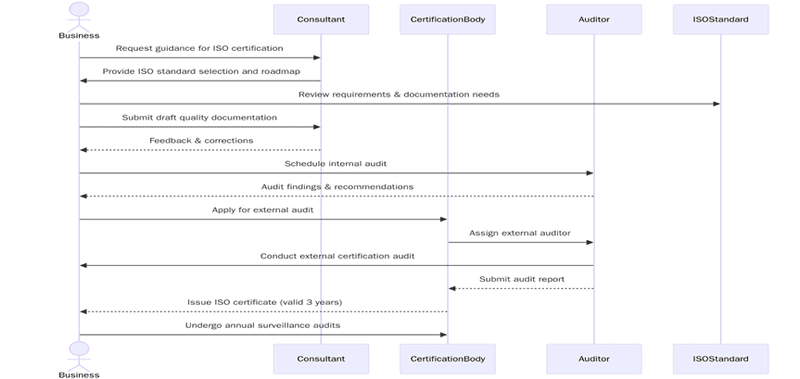
Preparation for ISO certification in the USA should focus on aligning the standard with your current way of working and local regulatory context. Many US businesses already follow industry rules; ISO helps pull those requirements into one coordinated system. Below are some of the key preparation steps:
Decide which ISO standards matter most for your contracts, risk profile and growth plans in 2026.
Choose a realistic scope that covers high-impact products, services and sites without trying to include everything at once.
Perform a gap analysis against the chosen standards, using your existing procedures, SOPs, manuals and system tools as a starting point.
Run internal audits on the most important processes and locations to test evidence readiness before the external audit.
Create a time-bound action plan to close gaps, assign responsibilities and track progress towards certification.
Certification audit
Stage 1 audit: Review of scope, context, documented system structure, policies, objectives, risk methods, process descriptions and readiness for Stage 2 across US sites and remote operations.
Stage 2 audit: Verification of implementation across selected processes, departments and locations, including sampling of records, on-site observations, remote interviews, system logs and supplier records.
Nonconformities: Must be corrected with clear root cause analysis, updated processes or controls, improved records and evidence that new practices are used in day-to-day work.
Recertification audits: Required every three years to review the full system, extended scope, new products, new regulations and major changes in structure or markets.
What are the benefits of ISO certification for US organizations?
ISO certification gives US organizations a clear story when customers, investors or partners ask how they manage risk and reliability. Instead of building separate responses for each client, the certified system becomes the reference.
Before choosing standards, American businesses should think about how certification can support sales, operations and risk control at the same time. Below are some of the key benefits:
Stronger credibility in US and global tenders because ISO certificates reduce uncertainty about how you run key processes.
Shorter vendor onboarding for American suppliers as ISO evidence answers many standard questions on quality, security or continuity.
Clearer internal roles and responsibilities, which makes it easier to onboard new staff and manage growth.
Lower chance of repeated mistakes because nonconformities and incidents feed into defined corrective action steps.
Better visibility of risks linked with data, safety, environment and supply chain, supporting more informed decisions.
Market Trends in USA
In the USA, demand for ISO certifications is moving beyond traditional manufacturing into software, fintech, logistics, healthcare, e-commerce and professional services. Customers expect suppliers to manage data, continuity and safety with the same seriousness as product quality. Remote work, cloud-heavy architectures and complex logistics networks are pushing more US companies toward ISO/IEC 27001, ISO 22301 and ISO 28000, alongside ISO 9001 and ISO 14001.
Large US buyers often prefer suppliers with integrated systems where quality, environment, health and safety and information security are managed together. There is also rising interest in newer topics such as AI management, diversity and inclusion guidance and resilience frameworks. Organizations that build ISO systems now with digital evidence and supplier coverage in mind will find it easier to respond to these market shifts through 2026 and beyond.
Training and courses
US organizations that want to build or maintain ISO systems will benefit from structured training for key roles. Training should be practical, linked to real processes and focused on how ISO requirements apply inside the business rather than only theory.
Lead Auditor Training: supports professionals who need to audit ISO systems in depth and interpret findings for management.
Lead Implementer Training: supports teams responsible for designing or upgrading management systems that meet ISO requirements.
Pacific Certifications provides accredited training programs. If your organization in the USA is looking for ISO training, our team is equipped to help you. Contact us at [email protected].
How Pacific Certifications can help?
Pacific Certifications is an accredited certification body that provides audit and certification services for ISO standards to organizations in the USA and worldwide. We review your scope, process controls, records, internal audits and management reviews to see how well your system meets the chosen standard. Our role is to assess and certify; we do not offer consultancy or build your system.
To request an ISO audit plan or discuss certification needs for your US business in 2026, contact [email protected] or visit www.pacificcert.com.
Contact Us
If you need support with ISO certification in USA, contact us at [email protected].
Read More at: Blogs by Pacific Certifications
Author: Alina Ansari