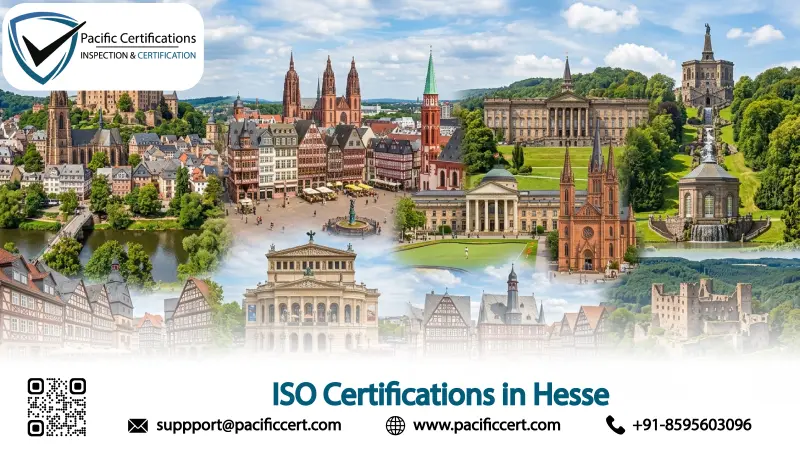
ISO Certifications in Hesse, Popular Standards, Requirements and Benefits
Introduction
Hesse stands as one of Germany's most economically powerful and internationally connected federal states, combining Frankfurt's position as the financial capital of continental Europe with a dense industrial base in automotive, chemicals, pharmaceuticals, logistics, aviation, and advanced manufacturing. As the state that contributes approximately 8.5% of German GDP with a total output of EUR 368 billion in 2024, Hesse hosts organizations ranging from global financial institutions and multinational chemical groups to precision engineering SMEs and pharmaceutical innovators, all of which operate within demanding EU and international governance frameworks.
ISO certification in Hesse gives organizations the structured documentation, auditable controls, and performance evidence that procurement bodies, regulatory authorities, and institutional lenders rely on during supplier assessments.
Quick Summary
The most widely pursued ISO standards in Hesse include ISO 9001 for quality management, ISO 14001 for environmental management, ISO 45001 for occupational health and safety, ISO 27001 for information security, and ISO 22000 for food safety management. Organizations across Hesse's manufacturing, financial services, IT, healthcare, logistics, and chemicals sectors gain competitive advantages in EU procurement, international supply chain qualification, and investor credibility through certification. Key challenges include maintaining multi-site documentation consistency, embedding audit discipline in financial and digital services firms, and sustaining system rigor between annual surveillance cycles.
Economic Context and Industry Overview
Hesse's economic profile is defined by an exceptional concentration of financial services, a globally significant air freight and passenger hub at Frankfurt Airport, strong chemical and pharmaceutical manufacturing, automotive supply chain activity, and advanced IT and logistics infrastructure. The financial services sector alone employs approximately 72,000 people in Frankfurt, which hosts over 250 financial institutions including the headquarters of the European Central Bank (ECB), the Bundesbank, the Frankfurt Stock Exchange, and EUREX. From 2025, Frankfurt also becomes the headquarters of the new EU Anti-Money Laundering Authority (AMLA), further deepening the regulatory governance environment in which Hessian financial firms operate.
In 2024, Hessian companies generated over EUR 68.3 billion in international revenues, with an export ratio that reflects a manufacturing and services base deeply embedded in global value chains. Around a third of Hessian gross value added is generated in financing, insurance, real estate, and business services, while trade, transport, and telecommunications contribute a further 23%. Chemical and pharmaceutical clusters in Frankfurt, Hoechst, Darmstadt, Wiesbaden, and Kassel sit alongside automotive suppliers, precision machinery manufacturers, and defense technology firms that drive significant demand for ISO 9001, ISO 14001, ISO 45001, and sector-specific management standards.
Why ISO Certifications Matter in Hesse?
Hessian organizations operate in one of the most governance-intensive business environments in Europe, where EU regulatory frameworks, DIN standards, and international buyer compliance requirements create a dense web of quality, safety, environmental, and data security obligations. ISO certification provides the auditable management system infrastructure that multinational chemical buyers, automotive OEM procurement teams, financial services regulators, and federal government contracting bodies expect from Hessian suppliers and service providers during qualification and periodic compliance reviews.
For Frankfurt's financial sector, ISO 27001 and ISO 22301 address the information security and business continuity governance requirements that institutional clients, regulatory bodies such as BaFin, and EU financial supervision frameworks impose on banks, fintech firms, and financial data processors. For chemical and pharmaceutical manufacturers in Hesse, ISO 9001 and ISO 14001 support both EU supply chain sustainability requirements under the Green Deal and the quality governance expectations of multinational buyers qualifying German suppliers across European and international procurement programs. Construction contractors, logistics operators, and healthcare organizations benefit from the structured risk management, process discipline, and performance monitoring that ISO frameworks embed into daily operations.
Important Standards Often Requested by buyers in Hesse
Popular ISO Standards in Hesse
ISO 9001:2015 - Quality Management Systems in Hesse
ISO 9001:2015 remains the foundational management standard across Hesse's diverse industrial and services base, helping organizations govern product and service quality through documented process controls, competence management, and performance monitoring. For automotive supply chain firms, precision machinery manufacturers, chemical processors, and professional service organizations, the standard produces the quality evidence that procurement officers verify during supplier qualification reviews and periodic audits. Germany as a whole ranks fifth globally in ISO 9001 certification volumes with 45,983 active certificates as of the 2024 ISO Survey, reflecting the country's deep quality culture, and Hesse's industrial density places it among the highest-certified states within Germany.
Read more about ISO 9001
ISO 14001:2026 - Environmental Management Systems in Hesse
ISO 14001:2026 gives Hessian organizations a structured framework for governing their environmental footprint through legal compliance monitoring, impact assessment, objective-setting, and systematic improvement. For chemical manufacturers in the Rhine-Main region, pharmaceutical producers, construction contractors, and logistics operators, certification provides the auditable environmental governance evidence that EU procurement bodies, ESG-focused investors, and multinational buyers increasingly require from German suppliers. Hesse's industrial clusters operate under Germany's stringent environmental legislation as well as EU environmental directives, making the management system discipline embedded by ISO 14001 both a compliance support tool and a commercial differentiator.
Read more about ISO 14001
ISO 45001:2018 - Occupational Health and Safety in Hesse
ISO 45001:2018 provides a systematic framework for identifying workplace hazards, implementing controls, and building durable safety governance across all sectors and organizational sizes. In Hesse, the standard is directly relevant to chemical plants, construction sites, manufacturing facilities, healthcare environments, and airport operations where worker safety incidents carry regulatory, financial, and reputational consequences under Germany's strict occupational safety framework. Certification demonstrates that safety governance operates through an auditable management system aligned with German labor law obligations and the safety governance expectations of multinational project owners, prime contractors, and development finance institutions.
Read more about ISO 45001
ISO 27001:2022 - Information Security Management in Hesse
Hesse's concentration of financial institutions, data centers, fintech firms, managed service providers, and government agencies creates one of the most demanding information security governance environments in Europe. ISO 27001:2022 is the internationally recognized standard for demonstrating that security risks are identified, treated, monitored, and reviewed through a structured management cycle that satisfies the requirements of BaFin, EU financial regulation, GDPR, and the IT security frameworks applied by institutional clients and federal procurement bodies. Real-world adoption in Hesse includes organizations like eurodata AG, which holds combined ISO 9001, ISO 27001, and ISO 22301 certifications audited by TÜV Hessen, reflecting the multi-standard approach that is increasingly standard practice in the state's technology and financial services sectors.
Read more about ISO 27001
ISO 22000:2018 - Food Safety Management in Hesse
ISO 22000:2018 integrates HACCP principles with a full management system approach to food safety, covering hazard analysis, prerequisite programs, corrective actions, and supply chain traceability from production through distribution. Hesse's food and beverage processing sector, including meat, dairy, bakery, beverage, and specialty food operations supplying German retail chains and export markets, relies on documented food safety management to satisfy the governance requirements of major European retailers and EU food safety regulations. The standard supports compliance with Germany's food hygiene legislation and EU food safety directives, helping Hessian processors reduce non-conformance risks in regulatory inspections and retail supply chain audits.
Read more about ISO 22000
ISO 22301:2019 - Business Continuity Management in Hesse
Business continuity management is a governance priority in Hesse that extends well beyond the IT sector, driven by the concentration of systemically important financial institutions, critical logistics infrastructure, and essential public services in the Rhine-Main region. ISO 22301:2019 provides the framework for identifying critical business functions, establishing recovery capabilities, and demonstrating resilience to regulators, institutional clients, and rating agencies. Frankfurt's banks, insurance groups, exchanges, and payment processors operate under European Central Bank and BaFin expectations that align closely with the business continuity governance requirements embedded in ISO 22301.
Read more about ISO 22301
ISO 50001:2018 - Energy Management Systems in Hesse
ISO 50001:2018 helps organizations systematically reduce energy consumption, improve operational efficiency, and demonstrate energy governance to investors and buyers applying EU sustainability criteria. Hesse's energy-intensive sectors including chemical manufacturing, automotive components production, data center operations, and large logistics hubs face meaningful energy cost pressures and EU energy directive obligations, making structured energy management both a compliance support tool and a commercially important efficiency program.
Read more about ISO 50001
ISO 13485:2016 - Medical Devices Quality Management in Hesse
ISO 13485:2016 specifies quality management system requirements for organizations involved in the design, manufacture, and supply of medical devices and related services. Hesse hosts a significant cluster of life sciences, pharmaceutical, and medical technology companies, particularly around Frankfurt, Darmstadt, and Marburg, that supply EU and international healthcare markets where EU MDR compliance and quality management certification are regulatory market access prerequisites. Certification enables Hessian manufacturers to demonstrate compliance with quality governance requirements associated with EU MDR and US FDA quality system regulations, supporting faster regulatory review processes and broader international market access.
Read more about ISO 13485
Certification Process in Hesse
Gap Analysis - Assess current operations against the requirements of the chosen ISO standard and document compliance gaps across processes, documentation, and performance monitoring in Hesse's sector-specific context
Documentation Development - Build or revise policies, procedures, work instructions, and records to reflect actual Hessian operational practices aligned with the standard and applicable German and EU regulations
System Implementation - Roll out the management system across relevant departments and sites, integrating controls into routine workflows
Employee Training - Equip staff with the knowledge, tools, and competencies needed to operate and sustain the management system
Internal Audit - Run a structured internal audit cycle to identify non-conformities and prepare corrective actions before the external certification audit
Management Review - Conduct a formal leadership review covering audit findings, performance data, risk assessments, and improvement priorities
Stage 1 Certification Audit - Submit to the accredited certification body's documentation review and readiness assessment
Stage 2 Certification Audit - Undergo the on-site conformity audit verifying full system implementation across all in-scope functions
Certificate Issuance - Receive the three-year ISO certificate following successful audit completion and corrective action closure
Surveillance and Recertification - Maintain certificate validity through annual surveillance audits and a full recertification audit at the three-year mark
What are the Requirements of ISO Certifications in Hesse?
Organizations in Hesse must address the following to achieve and sustain ISO certification:
Leadership accountability requires top management to own the system, set direction, and review performance. Active involvement is essential for effective implementation.
A documented management system must reflect real operations and comply with ISO standards and German/EU laws. Policies, procedures, and records should be accurate and updated.
Risk and context assessment should address EU regulations, supply chains, cybersecurity, and energy costs. Actions must be based on identified risks.
Process-level controls must be defined for sectors like chemicals, finance, pharma, and food. This ensures safety, quality, and compliance.
Legal compliance must align with labour laws, GDPR, BaFin rules, food safety, and environmental regulations. Evidence must be maintained.
Standard-specific records such as HACCP logs, SoA, and environmental registers are required. These support control and traceability.
Performance tracking requires monitoring KPIs to support decisions and improvement. Results should be regularly reviewed.
Internal auditing must be conducted by trained auditors across all departments. This ensures system conformity.
Corrective action management must address non-conformities through root cause analysis. Actions should prevent recurrence.
Continual improvement through the PDCA cycle must be demonstrated. Organizations should show ongoing system and performance improvement.
For expert guidance on ISO certification requirements for your organization in Hesse, contact us at support@pacificcert.com.
Benefits of ISO Certifications in Hesse
EU procurement qualification improves as certification meets quality and safety requirements for vendor approvals. This supports participation in German and EU tenders.
Multinational supply chain access increases with ISO 9001 and ISO 14001 compliance. Hessian firms can qualify for automotive, chemical, and pharma contracts.
Financial regulatory credibility strengthens with ISO 27001 and ISO 22301. It supports compliance with BaFin and builds trust with institutional clients.
ESG and investor confidence improves through ISO 14001 and ISO 50001. Organizations can provide auditable environmental and energy performance data.
Reduced operational variability through process controls ensures consistent quality and service delivery. This improves efficiency across multi-site operations.
Regulatory compliance support aligns businesses with German laws on safety, data protection, food, and environment. This reduces legal and compliance risks.
Energy cost management improves with ISO 50001 by reducing waste and inefficiencies. This is critical in Germany’s high energy cost environment.
Customer confidence and retention increases with consistent and reliable processes. This helps build long-term client relationships.
Workplace safety improvements under ISO 45001 reduce incidents and liabilities. It also meets strict German safety requirements.
Staff development and accountability improve through structured training and competency frameworks. This enhances workforce performance.
Medical device market access with ISO 13485 supports EU MDR compliance. It accelerates approvals for life sciences exporters.
Continuous improvement culture through PDCA cycles strengthens long-term resilience. Organizations can adapt to evolving market and regulatory demands.
Market Trends
ISO certification demand in Hesse is growing steadily across all major sectors as EU regulatory requirements tighten and international buyer governance expectations intensify. Germany as a whole holds 45,983 active ISO 9001 certificates as of the 2024 ISO Survey, ranking fifth globally and reflecting a deeply embedded national quality culture of which Hesse is a disproportionately significant contributor given its industrial and services density. Globally, ISO 9001 certification volumes reached 1,479,165 certificates in the 2024 survey, representing a 76.7% increase over the prior year when China had withheld data, and a more measured 50% growth when comparing 2022 to 2024 figures.
Frankfurt's financial sector is driving accelerating ISO 27001 and ISO 22301 adoption as DORA (Digital Operational Resilience Act) requirements come into force across EU financial institutions, adding a new regulatory dimension to information security and business continuity certification in a city that is home to over 250 banks and the ECB. Sustainability certification is a particularly fast-growing area across Hesse's chemical, pharmaceutical, and manufacturing sectors, with ISO 14001 and ISO 50001 adoption rising as EU Green Deal supply chain obligations and EU energy efficiency directives create new documentation requirements for export-facing industrial operators.
Hesse's pharmaceutical and life sciences cluster around Darmstadt, Marburg, and Frankfurt is generating strong ISO 13485 certification demand as manufacturers respond to EU MDR transition timelines and tightening quality governance expectations from international healthcare procurement bodies. The state's logistics and air freight sector, anchored by Frankfurt Airport handling 45% of Germany's total air freight volume, creates consistent ISO 9001 and ISO 14001 certification demand among freight forwarders, warehousing operators, and ground handling organizations. Emerging standards including ISO 42001 for AI management systems are attracting early interest from Frankfurt's fintech and financial technology ecosystem, where AI governance documentation is beginning to appear in client due diligence and regulatory review processes.
Challenges Faced in Germany and Hesse
Organizations across Hesse face several practical implementation challenges when pursuing ISO certification. Large manufacturing groups and financial conglomerates with multi-site operations across Hesse's industrial districts face complexity in standardizing documentation, audit schedules, and corrective action processes across geographically distributed facilities with varied operational profiles.
Fast-scaling fintech, SaaS, and cloud firms in Frankfurt often struggle to embed formal management system documentation and audit discipline into agile delivery environments where development velocity is prioritized. SMEs in construction, food processing, and professional services frequently lack dedicated quality management personnel, placing implementation burdens on operational managers managing full production and commercial workloads. Sustaining surveillance audit readiness between annual cycles demands organizational discipline that can be difficult to maintain during peak chemical production, financial reporting, or construction delivery seasons. Multi-standard certification programs combining ISO 9001, ISO 14001, ISO 45001, and ISO 27001 simultaneously add documentation and training complexity that requires careful phasing and project management.
Cost of ISO Certifications in Hesse
The investment for ISO certification in Hesse depends on multiple operational factors rather than a fixed amount. Key cost drivers include organization size, number of employees, complexity of operations, number of sites, and the specific ISO standard(s) selected. Highly regulated sectors such as manufacturing, chemicals, and financial services may require more detailed system implementation.
The overall investment typically covers gap assessment, documentation development, staff training, internal system preparation, and certification body evaluation activities. Organizations implementing multiple standards together can benefit from efficiencies through integrated systems and combined assessments.
For a free customized quote for your organization, contact us at support@pacificcert.com.
Timeline for ISO Certification in Hesse
Lean Hessian organizations with straightforward operations typically complete the certification process within four to eight weeks of beginning a structured implementation program. Mid-sized manufacturers, chemical processors, or technology firms generally require two to four months, accounting for documentation development, staff training, and internal audit completion. Large organizations or those pursuing simultaneous multi-standard certification across multiple Hessian sites should allow three to six months for thorough implementation. Organizations targeting certification ahead of specific EU tender submissions, OEM supplier qualification deadlines, or regulatory compliance timelines should begin implementation well in advance and engage consultants with sector-specific German and EU regulatory expertise.
How Pacific Certifications Can Help?
Pacific Certifications is an ABIS-accredited certification body with experience supporting organizations across manufacturing, automotive supply chains, chemicals, pharmaceuticals, financial services, IT, logistics, healthcare, and construction sectors. Our audit teams bring sector-relevant knowledge to each engagement and understand the governance expectations of EU regulatory bodies, multinational OEM buyers, German financial regulators, and international institutional clients.
Pacific Certifications provides:
Certification audits for ISO 9001, ISO 14001, ISO 45001, ISO 22000, ISO 27001, ISO 22301, ISO 50001, and ISO 13485
Multi-site certification for organizations operating across Hessian industrial and commercial regions
Surveillance and recertification audits maintaining ongoing certificate validity
Internationally recognized certificates accepted by EU procurement bodies, OEM buyers, BaFin-regulated institutions, and global institutional partners
Accredited Training Programs
Pacific Certifications offers training programs designed to build lasting internal ISO competency within Hessian organizations, reducing dependence on external consultants and embedding quality, safety, security, and sustainability governance into organizational culture.
Contact us
If you need support with your ISO Certification process in Hesse, contact us at support@pacificcert.com or +918595603096
Author: Ashish
Read More at: Blogs by Pacific Certifications