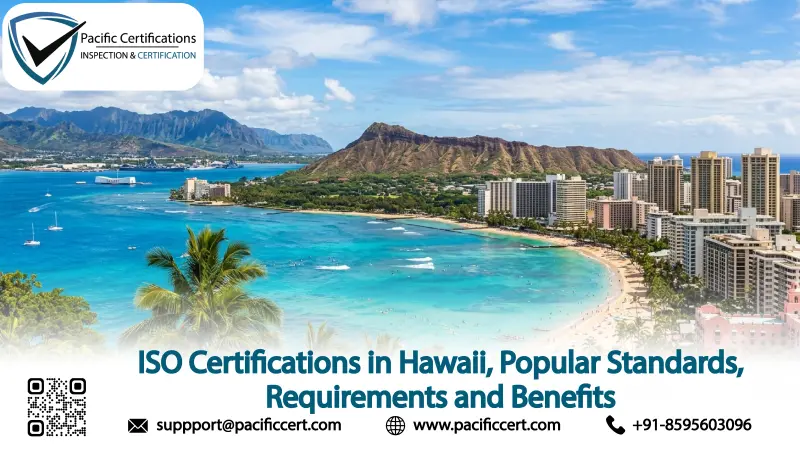
ISO Certifications in Hawaii, Popular Standards, Requirements and Benefits
Introduction
Hawaii occupies a unique position in the United States as the only island state, with an economy shaped by tourism and hospitality, renewable energy, agriculture, construction, defense, healthcare, and maritime logistics. While itgeographic isolation creates distinct operational dynamics, Hawaiian businesses operating in federally regulated industries, international supply chains, and export markets face the same governance and compliance expectations as organizations across the continental US. ISO certification gives Hawaiian organizations the structured documentation, process controls, and performance evidence that procurement officers, regulators, and international buyers rely on when assessing supplier credibility.
For Hawaiian businesses seeking to grow into mainland US, Asia-Pacific, and global markets, certification provides a recognized signal of operational quality that accelerates buyer qualification and contract approvals.
Quick Summary
The most widely pursued ISO standards in Hawaii include ISO 9001 for quality management, ISO 14001 for environmental management, ISO 45001 for occupational health and safety, ISO 27001 for information security management, and ISO 22000 for food safety. Certified Hawaiian organizations gain stronger positioning in federal and state procurement, tourism supply chains, defense contractor qualification, and Asia-Pacific export markets. Key challenges include sustaining internal audit programs in smaller organizations, managing documentation across seasonal operations, and maintaining system compliance between annual surveillance cycles.
Economic Context and Industry Overview
Hawaii's economy is built on several interconnected pillars, with tourism and hospitality generating the largest share of state GDP through visitor spending across hotels, resorts, tour operators, and food and beverage services. The state hosts a significant US military presence across Army, Navy, Air Force, Marine Corps, and Coast Guard installations on Oahu, Maui, the Big Island, and Kauai, making defense contracting and defense-related supply chains a major source of economic activity where quality management certification is a standard procurement requirement.
Agriculture, while a smaller portion of GDP, produces macadamia nuts, coffee, tropical fruits, flowers, and specialty food products that are marketed at premium price points in mainland US, Japanese, and Asian markets where quality and traceability documentation matter. Renewable energy is a priority sector for the state, with Hawaii pursuing ambitious clean energy goals supported by solar, wind, and geothermal development projects. Construction and real estate, healthcare and biotechnology, maritime logistics through the Port of Honolulu, and a small but growing technology services sector complete Hawaii's economic profile.
Why ISO Certifications Matter in Hawaii?
For Hawaiian businesses seeking contracts with federal government agencies, military installations, and mainland US corporate buyers, ISO 9001 certification is a practical qualification tool that demonstrates process discipline and reduces the administrative burden of repeated supplier audits. Defense and government contractors operating in Hawaii face procurement requirements that closely mirror those applied to contractors elsewhere in the US, with quality management system credentials regularly evaluated during vendor approval processes.
The tourism and hospitality sector benefits from ISO 9001 and ISO 14001 by formalizing the service quality and environmental responsibility practices that increasingly influence purchasing decisions among corporate travel buyers and sustainability-conscious visitors. For food and agriculture exporters, ISO 22000 provides the HACCP-based food safety documentation that Japanese importers, US mainland retailers, and Asia-Pacific buyers require before approving Hawaiian specialty food products. In renewable energy and construction, ISO 14001 and ISO 45001 address the environmental and safety governance expectations of project financiers and state regulatory bodies.
Important Standards Often Requested by Buyers in Hawaii
Popular ISO Standards in Hawaii
ISO 9001:2015 - Quality Management Systems in Hawaii
ISO 9001:2015 helps Hawaiian organizations install disciplined quality management systems that govern process consistency, defect prevention, and customer satisfaction across hospitality, defense contracting, construction, and manufacturing. For defense contractors and federal agency suppliers, the standard creates the documented quality controls and competence frameworks that contracting officers verify during supplier qualification and periodic performance reviews. Tourism and hospitality operators benefit from ISO 9001 by formalizing service delivery processes that improve guest experience consistency and operational reliability across hotel, resort, and tour operations.
Read more about ISO 9001
ISO 14001:2026 - Environmental Management Systems in Hawaii
Few US states carry a stronger environmental identity than Hawaii, and ISO 14001:2026 gives organizations a structured way to govern and verify their environmental practices through documented monitoring, objective-setting, and corrective action. For renewable energy developers, construction contractors, resort operators, and agricultural producers, certification translates Hawaii's environmental reputation into auditable evidence that satisfies the sustainability governance requirements of mainland US buyers, international tourism companies, and ESG-focused investors. The standard supports alignment with Hawaii's environmental legislation, state clean energy mandates, and the sustainability reporting expectations of federal grant programs and development finance institutions funding Hawaiian infrastructure projects.
Read more about ISO 14001
ISO 45001:2018 - Occupational Health and Safety in Hawaii
ISO 45001:2018 provides a systematic framework for identifying workplace hazards, implementing controls, monitoring safety performance, and building a durable safety culture across all organizational types. In Hawaii, the standard is particularly relevant to construction, defense contracting, agricultural operations, utilities, and maritime logistics, where workplace safety incidents carry OSHA regulatory consequences and can directly affect contract eligibility with federal buyers.
Read more about ISO 45001
ISO 27001:2022 - Information Security Management in Hawaii
Hawaii's defense contractor community, healthcare networks, financial services firms, and growing technology sector operate within a complex information security landscape shaped by federal requirements including NIST frameworks, CMMC for defense contractors, and HIPAA for healthcare organizations. ISO 27001:2022 provides the internationally recognized management framework for demonstrating that security risks are identified, treated, monitored, and reviewed through a disciplined governance cycle. For technology firms, healthcare providers, and government service contractors in Honolulu and across the state, certification increasingly serves as a baseline qualification credential in competitive procurement processes.
Read more about ISO 27001
ISO 22000:2018 - Food Safety Management in Hawaii
ISO 22000:2018 integrates HACCP controls with a full management system covering hazard analysis, prerequisite programs, corrective actions, and supply chain traceability from production through export distribution. Hawaiian specialty food producers, including coffee processors, macadamia nut manufacturers, seafood processors, and tropical fruit exporters, depend on documented food safety management to satisfy the traceability and safety governance requirements of Japanese importers, mainland US retail buyers, and Asia-Pacific distribution partners. The standard supports compliance with FDA Food Safety Modernization Act requirements and reduces product rejection risks at mainland US and international border inspection points.
Read more about ISO 22000
ISO 50001:2018 - Energy Management Systems in Hawaii
Hawaii has among the highest energy costs in the United States, making systematic energy management a commercially important priority for any organization with significant consumption in manufacturing, hospitality, or data infrastructure. ISO 50001:2018 provides the structured energy review, performance indicator, and improvement cycle framework that helps organizations identify and eliminate energy waste while supporting ESG reporting requirements from investors and alignment with Hawaii's clean energy mandates.
Read more about ISO 50001
ISO 13485:2016 - Medical Devices Quality Management in Hawaii
ISO 13485:2016 specifies quality management system requirements for organizations involved in the design, manufacture, and supply of medical devices and related services. Hawaii's healthcare sector, which serves both the resident population and medical tourism visitors, includes hospitals, diagnostic centers, and medical supply organizations that benefit from ISO 13485 by meeting the quality governance requirements of federal healthcare procurement programs and international health supply chains. Certification supports alignment with US FDA quality system regulations and strengthens credibility with health technology procurement bodies sourcing medical supplies for federal and international distribution channels.
Read more about ISO 13485
ISO 17025:2017 - Testing and Calibration Laboratories in Hawaii
ISO 17025:2017 establishes competence requirements for testing and calibration laboratories to produce results that are accepted by regulatory bodies, buyers, and international partners. In Hawaii, laboratories supporting food export compliance, environmental monitoring, water quality testing, and construction materials assessment rely on ISO 17025 accreditation to issue test reports accepted by US federal agencies, Japanese import authorities, and international buyers. Accreditation through a recognized national accreditation body is a prerequisite for Hawaiian laboratories issuing results used in export certification and regulatory compliance filings.
Read more about ISO/IEC 17025
Certification Process in Hawaii
Gap Analysis - Assess current operations against the requirements of the chosen ISO standard and document compliance gaps across processes, documentation, and performance monitoring
Documentation Development - Build or revise policies, procedures, work instructions, and records to reflect actual Hawaiian operational practices in line with standard requirements
System Implementation - Roll out the management system across relevant departments and operational sites, integrating controls into routine workflows
Employee Training - Equip staff with the knowledge, tools, and competencies needed to operate and sustain the management system
Internal Audit - Run a structured internal audit cycle to identify non-conformities and prepare corrective actions before the external certification audit
Management Review - Conduct a formal leadership review covering audit findings, performance data, risk assessments, and improvement priorities
Stage 1 Certification Audit - Submit to the certification body's documentation review and site readiness assessment
Stage 2 Certification Audit - Undergo the on-site conformity audit verifying full system implementation across all in-scope functions
Certificate Issuance - Receive the three-year ISO certificate following successful audit completion and corrective action closure
Surveillance and Recertification - Maintain certificate validity through annual surveillance audits and a full recertification audit at the three-year mark
What are the Requirements of ISO Certifications in Hawaii?
Organizations in Hawaii must address the following to achieve and sustain ISO certification:
Leadership Accountability - Top management must own the management system, including setting policy, providing resources, and reviewing performance outcomes, not simply endorsing the initiative from a distance
Documented Management System - Policies, procedures, records, and evidence files must reflect how the organization actually operates and comply with both the ISO standard and applicable federal and Hawaii state regulations
Context and Risk Assessment - Organizations must identify Hawaii-specific risks including geographic isolation, seasonal tourism cycles, federal procurement requirements, energy supply constraints, and cybersecurity threats relevant to the standard being pursued
Process-Level Controls - Core operational processes must be governed by documented controls appropriate to Hawaii's operational context including resort service delivery, agricultural food safety, defense contractor quality requirements, and digital data handling
Legal and Regulatory Compliance - Documentation must align with OSHA regulations, FDA food safety requirements, HIPAA healthcare obligations, Hawaii state environmental legislation, and sector-specific federal and state obligations
Standard-Specific Records - HACCP and CCP logs for ISO 22000, Statement of Applicability and risk treatment files for ISO 27001, aspect-impact registers for ISO 14001, and energy performance indicators for ISO 50001
Performance Tracking - Measurable KPIs must be defined, monitored, and used as the basis for management decisions and improvement actions
Internal Auditing - A trained internal auditor or audit team must deliver periodic conformity reviews across all in-scope departments and sites
Corrective Action Management - Non-conformities must be addressed through root cause analysis and verifiable corrective actions within defined timelines
Continual Improvement - The PDCA cycle must be demonstrably active, with evidence of ongoing improvement in system effectiveness and operational performance
Benefits of ISO Certifications in Hawaii
Federal and Military Contract Qualification - Certification meets quality and safety governance baselines evaluated during federal and defense procurement vendor approval processes
Tourism Supply Chain Credibility - ISO 9001 and ISO 14001 provide corporate travel buyers and international tourism operators with verifiable evidence of service quality and environmental responsibility
Food Export Market Access - ISO 22000 supports access to Japanese, mainland US, and Asia-Pacific food retail and import channels where HACCP documentation is a non-negotiable trade condition
Data Security Assurance - ISO 27001 gives enterprise clients, healthcare partners, and federal agencies verifiable evidence that information security risks are governed through a structured management framework
Energy Cost Reductions - ISO 50001 helps resort operators, manufacturers, and data center operators identify and eliminate energy waste, directly addressing Hawaii's high energy cost environment
Environmental Reputation Protection - ISO 14001 converts Hawaii's environmental brand into an auditable governance claim that satisfies sustainability due diligence requirements from buyers and investors
Workplace Safety Improvements - ISO 45001 reduces incident rates, cuts insurance exposure, and satisfies OSHA and federal contractor safety requirements across construction, defense, and agricultural operations
Operational Consistency - Documented process controls reduce variability in product quality, service delivery, and safety outcomes across all certified operations regardless of seasonal staff fluctuations
Risk Management Infrastructure - ISO frameworks provide proactive risk identification and treatment processes that reduce the likelihood and impact of operational, regulatory, and safety incidents
Staff Development and Engagement - Competency frameworks and training records create structured development pathways, improve accountability, and build a more engaged and capable workforce
Asia-Pacific Market Positioning - Hawaii's geographic and cultural proximity to Asia-Pacific markets makes ISO certification a practical tool for establishing governance credibility with Japanese, Korean, and Australian buyers
Continuous Improvement Culture - PDCA-based improvement cycles build long-term organizational resilience and adaptability as market conditions, regulatory requirements, and visitor expectations evolve
Market Trends
ISO certification demand in Hawaii is growing steadily across defence contracting, tourism and hospitality, food and agriculture, renewable energy, and healthcare sectors as federal procurement requirements tighten and international buyer governance expectations rise. Globally, ISO 9001 remains the most widely adopted management standard with over 1.1 million certificates issued worldwide, reflecting sustained momentum across service and manufacturing economies that closely mirrors Hawaii's own industry profile.
Defense and federal government contracting in Hawaii is driving consistent ISO 9001 and ISO 45001 certification demand, with military branch procurement offices and federal agency contracting vehicles increasingly referencing quality management credentials in vendor prequalification requirements. The renewable energy sector is emerging as one of the fastest-growing certification markets in the state, with solar, wind, and geothermal project developers responding to state mandate timelines and ESG investor governance requirements. Food and agriculture exports are seeing growing ISO 22000 and FSSC 22000 adoption as Hawaiian specialty food producers targeting Japanese and Asia-Pacific premium markets face tightening food safety import requirements.
Sustainability certification is gaining particular momentum given Hawaii's environmental identity and policy agenda. ISO 14001 adoption is rising among construction contractors, resort operators, and agricultural businesses responding to state sustainability regulations and the environmental sourcing criteria of mainland US and international buyers. ISO 50001 is attracting growing interest from resort groups, hospital campuses, and commercial facilities responding to Hawaii's electricity pricing and the state's 100% renewable energy target by 2045. Emerging standards including ISO 42001 for AI management systems may attract early attention from Hawaii's technology and healthcare sectors as AI-enabled services enter federal and healthcare procurement channels.
Challenges Faced in Hawaii
Hawaii's geographic isolation creates a set of practical certification challenges that do not apply to the same degree on the US mainland. Logistics costs for bringing consultants and certification auditors to the islands can add to overall investment, and the limited pool of locally resident ISO consultants with sector-specific expertise means organizations in niche industries often need to engage remote or mainland US-based support.
Many Hawaiian businesses, particularly in tourism, agriculture, and construction, are SMEs with lean management structures where implementation responsibility falls on operational managers already carrying full commercial workloads. Internal audit programs are difficult to staff effectively in small organizations. Seasonal workforce patterns in tourism and agriculture create documentation maintenance challenges between audit cycles, and the turnover of trained staff after each high season means competency and training record management requires sustained attention. Building genuine management system culture, rather than simply generating documentation for audit purposes, also requires consistent leadership commitment that can be difficult to sustain during peak visitor or harvest seasons.
Cost of ISO Certifications in Hawaii
The investment for ISO certification in Hawaii depends on several operational and logistical factors rather than a fixed price. Key cost drivers include organization size, number of employees, scope of operations, number of sites, and the specific ISO standard(s) selected. Due to Hawaii’s geographic location, audit logistics and travel considerations may also influence the overall effort required.
The certification process typically includes components such as gap assessment, documentation development, staff training, internal system preparation, and certification body evaluation activities. Organizations implementing multiple standards together often benefit from efficiencies through integrated systems and combined evaluations.
For a tailored proposal based on your scope and operations, you can reach out at support@pacificcert.com.
Timeline for ISO Certification in Hawaii
Lean Hawaiian organizations with straightforward operations typically complete the certification process within four to eight weeks of beginning a structured implementation program. Mid-sized operations in hospitality, construction, or food processing generally require two to four months, accounting for documentation development, staff training delivery, and internal audit completion. Organizations pursuing multi-standard certification or operating across multiple islands should allow three to six months for thorough implementation. Timing relative to Hawaii's tourism and harvest seasons matters significantly, and organizations are advised to begin implementation during lower-intensity periods to ensure staff availability for training and audit preparation.
How Pacific Certifications Can Help?
Pacific Certifications is an ABIS-accredited certification body serving organizations across tourism and hospitality, defense contracting, food and agriculture, renewable energy, construction, healthcare, technology services, and maritime logistics sectors. Our audit teams understand the operational realities of geographically distinct markets and bring sector-relevant knowledge to each engagement. We deliver internationally recognized certificates accepted by federal procurement bodies, US mainland and Asia-Pacific buyers, project financiers, and enterprise clients.
Pacific Certifications provides:
Certification audits for ISO 9001, ISO 14001, ISO 45001, ISO 22000, ISO 27001, ISO 50001, ISO 13485, and ISO 17025
Multi-site certification for organizations operating across Hawaiian islands
Surveillance and recertification audits maintaining ongoing certificate validity
Internationally recognized certificates accepted by federal agencies, military procurement bodies, and global institutional clients
Accredited Training Programs
Pacific Certifications offers training programs designed to build lasting internal ISO competency within Hawaiian organizations, reducing dependence on external consultants and embedding quality, safety, and security governance practices into organizational culture.
Contact us
If you need support with your ISO Certification process in Hawaii, contact us at support@pacificcert.com or +918595603096.
Author: Sony
Read More at: Blogs by Pacific Certifications