ISO Certifications for Courier and Delivery Services, Requirements and Benefits
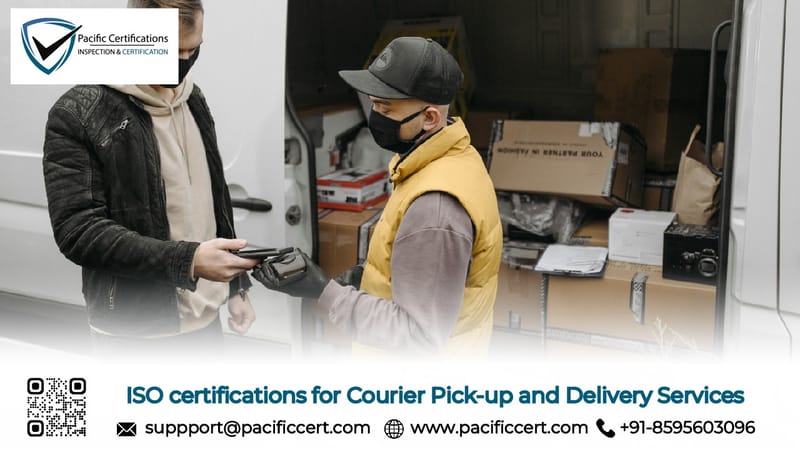
In today's fast-paced world, courier pick-up and delivery services play a crucial role in ensuring the smooth flow of goods and documents across cities, countries, and continents.
The rise of e-commerce, global trade, and just-in-time delivery models has placed tremendous pressure on these services to be more efficient, reliable, and secure. To meet these demands and maintain a competitive edge, courier companies are increasingly turning to ISO certifications.
ISO certifications are globally recognized standards that outline the requirements for various management systems, processes, and products. These certifications are not just about compliance but are also tools for improving quality, enhancing customer satisfaction, and driving operational excellence.
For courier pick-up and delivery services, ISO certifications can be a game-changer by helping companies streamline their operations, reduce risks, and build trust with customers and partners.
Need ISO certification for your Courier Pick-up and Delivery Services? Reach out to us at [email protected] or call us at +91-8595603096.
Applicable ISO Standards for Courier and Delivery Services
Several ISO standards are particularly relevant to courier pick-up and delivery services. These standards address various aspects of the business, from quality management and environmental responsibility to information security and occupational health and safety. Here are some of the key ISO standards applicable to this industry:
ISO 9001:2015 Quality Management System (QMS)
ISO 9001 is the most widely recognized quality management standard globally. It provides a framework for organizations to consistently meet customer and regulatory requirements and enhance customer satisfaction.
ISO 14001:2015 Environmental Management System (EMS)
ISO 14001 helps organizations manage their environmental impacts, reduce waste, and improve resource efficiency. For courier companies, this standard can help in minimizing the carbon footprint associated with transportation and packaging, thereby contributing to sustainability goals.
ISO 45001: Occupational Health and Safety Management System (OHSMS)
ISO 45001 provides a framework for managing occupational health and safety risks, ensuring a safe working environment, and reducing the likelihood of workplace accidents.
ISO 27001: Information Security Management System (ISMS)
Courier services handle sensitive information, including customer addresses, payment details, and confidential documents. ISO 27001 helps organizations protect this information by establishing an effective information security management system.
ISO 22301: Business Continuity Management System (BCMS)
ISO 22301 provides a framework for identifying potential threats and developing strategies to ensure that critical services can continue or recover quickly in the event of an emergency.
Click here to find out more applicable standards to your industry
Looking to achieve ISO certification for your courier services? Contact us today at [email protected] or phone +91-8595603096.
How We Can Help?
At Pacific Certifications, we are committed to helping courier pick-up and delivery services achieve their ISO certification goals. As a leading certification body, we offer audit and certification services across a range of ISO standards. Our role is to assess your organization's compliance with the relevant standards and issue certification upon successful completion of the audit process.
We understand that the process of obtaining ISO certification can be complex and challenging. That's why we offer a clear and transparent certification process, tailored to meet the specific needs of your business. Our experienced auditors work closely with your team to ensure that your management systems are fully aligned with the requirements of the chosen ISO standards.
Important Note: Please note that our services are limited to auditing and certification. We do not offer consultancy, gap analysis, training, or implementation services. Our objective is to maintain impartiality and ensure that your certification process is carried out with the highest level of integrity.
Elevate your Courier Pick-up and Delivery Services with ISO certification. Email us at [email protected] or give us a call at +91-8595603096.
Requirements of ISO Standards for Courier Pick-up and Delivery Services
Each ISO standard has specific requirements that organizations must meet to achieve certification. Here are the key requirements for some of the applicable ISO standards for courier pick-up and delivery services:
ISO 9001: Quality Management System Requirements
- Leadership and Commitment: Top management must demonstrate leadership and commitment to the quality management system, including setting quality objectives and promoting a customer-focused culture.
- Process Approach: Organizations must adopt a process approach, where each process is clearly defined, monitored, and continuously improved.
- Risk-Based Thinking: ISO 9001 requires organizations to identify and address risks and opportunities that could impact the quality of their services.
- Customer Focus: Meeting customer requirements and enhancing customer satisfaction is a central requirement of ISO 9001.
ISO 14001: Environmental Management System Requirements
- Environmental Policy: The organization must establish an environmental policy that reflects its commitment to environmental protection and compliance with legal requirements.
- Environmental Aspects: Identifying and managing environmental aspects, such as energy use, emissions, and waste management, is a key requirement.
- Legal Compliance: The organization must comply with applicable environmental laws and regulations.
- Continuous Improvement: ISO 14001 emphasizes the need for continuous improvement in environmental performance.
ISO 45001: Occupational Health and Safety Management System Requirements
- Hazard Identification: Organizations must identify and assess workplace hazards and implement controls to minimize risks.
- Legal and Regulatory Compliance: Compliance with occupational health and safety laws and regulations is mandatory.
- Employee Participation: Engaging employees in health and safety management, including consultation and participation, is a key requirement.
- Incident Investigation: The organization must have processes in place to investigate incidents and take corrective actions to prevent recurrence.
ISO 27001: Information Security Management System Requirements
- Risk Assessment: Organizations must conduct a thorough risk assessment to identify information security risks and implement appropriate controls.
- Security Policies: Developing and maintaining comprehensive information security policies is essential.
- Access Control: ISO 27001 requires strict control over access to sensitive information, ensuring that only authorized personnel have access.
- Incident Management: The organization must have a process for managing and responding to information security incidents.
ISO 22301: Business Continuity Management System Requirements
- Business Impact Analysis: Conducting a business impact analysis to identify critical activities and the potential impact of disruptions is a key requirement.
- Continuity Plans: Organizations must develop and implement business continuity plans to ensure the continuation of critical services.
- Testing and Exercises: Regular testing and exercises are required to validate the effectiveness of the business continuity plans.
- Recovery Strategies: ISO 22301 requires organizations to develop recovery strategies to restore services after a disruption.
For ISO certification tailored to your Courier Pick-up and Delivery Services, get in touch with us at [email protected] or call +91-8595603096.
- Benefits of ISO Standards for Courier Pick-up and Delivery Services
ISO standards provide organizations with structured frameworks to improve their operations, manage risks, and achieve specific goals. Below are the benefits of the specific ISO standards you mentioned:
- ISO 22301 ensures that your organization is prepared for potential disruptions, allowing you to maintain essential operations during unforeseen events.
- ISO 27001 helps safeguard sensitive information, reducing the risk of data breaches and cyber-attacks.
- ISO 45001 focuses on creating a safe and healthy work environment, reducing the risk of workplace accidents and illnesses. Helps organizations comply with occupational health and safety regulations, avoiding fines and legal issues.
- ISO 14001 helps organizations reduce their environmental impact by managing waste, reducing resource consumption, and minimizing pollution. Ensures that your organization meets environmental regulations, reducing the risk of fines and legal actions.
- ISO 14001 certification can attract environmentally conscious customers and partners, providing a competitive advantage.
- ISO 9001 focuses on meeting customer requirements and improving customer satisfaction through consistent service or product quality.
- The standards encourage a process-oriented approach, leading to streamlined operations, reduced waste, and lower costs.
These ISO standards collectively help organizations enhance their performance, manage risks, ensure compliance, and achieve long-term sustainability and growth.
Secure your ISO certification for Courier Pick-up and Delivery Services. Contact our experts at [email protected]or +91-8595603096.
Market Trends
As we move through 2024, the courier pick-up and delivery services industry continues to evolve in response to changing market dynamics, technological advancements, and environmental concerns. One of the significant trends shaping the industry is the increasing focus on sustainability.
According to recent research, customers are becoming more environmentally conscious, and there is a growing demand for green delivery options.
In response to this trend, many courier companies are investing in electric vehicles, optimizing delivery routes, and adopting eco-friendly packaging solutions. Additionally, the rise of e-commerce and same-day delivery services has led to increased competition and the need for more efficient and reliable operations.
As a result, more courier companies are seeking ISO certifications to enhance their service quality, reduce risks, and stay competitive in the market.
Moreover, the COVID-19 pandemic has highlighted the importance of business continuity planning. Many courier companies faced disruptions due to lockdowns, supply chain issues, and increased demand for contactless deliveries.
ISO 22301 has gained prominence as companies recognize the need for robust business continuity plans to ensure they can maintain operations during unexpected events.
Ready for ISO certification? Enhance your Courier Pick-up and Delivery Services by contacting us at [email protected] or calling +91-8595603096.
Certification Process for ISO Standards for Courier Pick-up and Delivery Services
The process of obtaining ISO certification for courier pick-up and delivery services involves several key steps. Here is an overview of the certification process:
Initial Inquiry and Application
The certification process begins with an initial inquiry, where you express your interest in obtaining ISO certification. We will provide you with detailed information about the applicable ISO standards and the certification process.
Stage 1 Audit (Document Review)
- The Stage 1 audit involves a review of your organization's documentation, including policies, procedures, and records related to the chosen ISO standards. This audit is conducted to assess your readiness for the certification process and to identify any gaps that need to be addressed.
- We will provide you with a report outlining the findings of the Stage 1 audit, including any areas that require improvement.
Stage 2 Audit (Online/On-site Assessment)
- The Stage 2 audit is an on-site/online assessment where our auditors evaluate the implementation of your management system against the requirements of the chosen ISO standards.
Certification Decision
- Based on the findings of the Stage 2 audit, our certification team will make a certification decision. If your organization meets the requirements of the chosen ISO standards, we will issue an ISO certificate. If there are any non-conformities identified during the audit, you will be required to address them before the certification can be granted.
Surveillance Audits
- To maintain your certification, you will need to undergo regular surveillance audits.
Recertification Audit
- ISO certificates are typically valid for three years. At the end of this period, a recertification audit is required to renew your certification.
Contact us today to learn more about how we can help you achieve ISO certification for your courier services. Let's work together to build a stronger, more resilient, and customer-focused organization.
Ready to get ISO certified?
Contact Pacific Certifications to begin your certification journey today!
Suggested Certifications –
Pacific Certifications is accredited by ABIS, in case you need support with ISO certification for your Courier and Delivery business, please contact us at [email protected] or +91-8595603096.
Read more: Pacific Blogs