Introduction
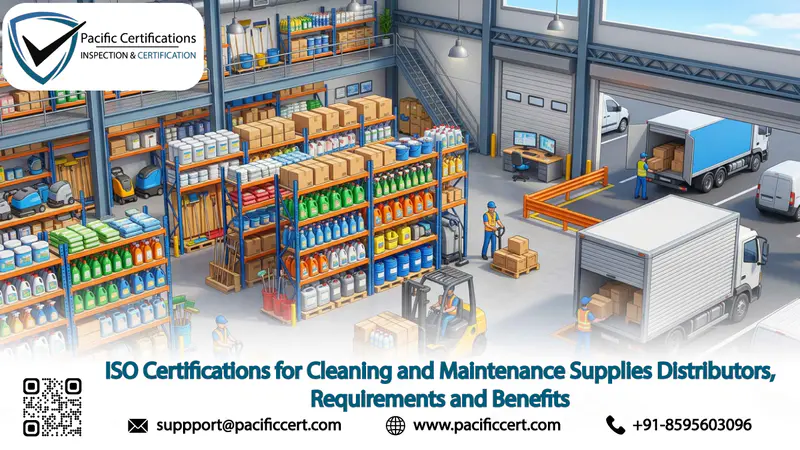
Cleaning and maintenance supplies distributors manage the sourcing, storage, and delivery of chemical cleaning products, janitorial equipment, and related supplies to commercial, healthcare, institutional, and industrial customers. Their operations often include supplier management, hazardous and non-hazardous inventory control, warehouse handling, order processing, and large-volume distribution.
These businesses face important operational and compliance risks, including the storage of incompatible chemicals, incorrect product handling, inventory and order inaccuracies, and delays in time-sensitive deliveries. Failures in chemical safety, product quality, labeling, segregation, or regulatory compliance can lead to workplace incidents, customer complaints, legal scrutiny, supply chain disruptions, and reputational damage.
For businesses in this sector, cleaning and maintenance supplies distributors ISO certifications have shifted from optional credentials to practical business requirements. International regulatory standards and institutional procurement frameworks increasingly require documented evidence of quality management, worker safety, and environmental responsibility from suppliers and distributors before awarding contracts.
ISO standards give distributors a structured and globally recognized way to manage risk, demonstrate accountability to clients, and respond to supply chain audits with verified third-party evidence rather than unsubstantiated claims. For businesses competing on product integrity, reliability, and long-term institutional partnerships, ISO certification is the clearest signal that operational discipline runs through the entire business.
In cleaning and maintenance distribution, what you deliver matters as much as how safely and responsibly you deliver it.
Quick Summary
The article explains how ISO certifications help cleaning and maintenance supplies distributors improve product quality, chemical safety, warehouse operations and supply chain reliability. It highlights key standards such as ISO 9001 for quality management, ISO 14001 for environmental management, ISO 45001 for occupational health and safety, ISO/IEC 27001 for information security and ISO 22301 for business continuity. By implementing these standards, distributors can reduce operational risks, strengthen compliance, improve customer confidence and maintain consistent, efficient distribution processes.
Applicable ISO Standards for Cleaning and Maintenance Supplies Distributors
Below are the most relevant ISO standards applicable to chemical cleaning product distributors, janitorial and hygiene supplies wholesalers, industrial maintenance equipment distributors, and facility management supply chain providers:
ISO 45001: Occupational Health and Safety Management Systems
Warehouse workers in cleaning and maintenance supplies distribution handle some of the most chemically complex product ranges in the entire supply chain. Risks include chemical inhalation from damaged product packaging, skin contact with corrosive cleaning agents, musculoskeletal injuries from manual handling of heavy bulk containers, and vehicle-related hazards in busy loading bays. ISO 45001 requires distributors to document every one of these hazards, assign practical controls, train workers in safe handling procedures, and verify safety performance through regular internal audits.
ISO 14001: Environmental Management System (EMS)
The environmental footprint of a cleaning and maintenance supplies distributor extends well beyond the warehouse walls. Chemical product spills, packaging waste, expired product disposal, and fleet vehicle emissions all create measurable environmental impacts that need active management. ISO 14001 gives distributors a structured system to identify their most significant environmental aspects, set reduction targets for waste and energy use, and maintain documented evidence of compliance for client sustainability audits.
ISO 9001: Quality Management Systems (QMS)
Order accuracy and delivery reliability are the two most visible measures of quality for any cleaning and maintenance supplies distributor. Clients managing large facilities depend on receiving the right products in the right quantities on schedule, and a single fulfillment failure can damage a long-term relationship. ISO 9001 addresses this by requiring distributors to document every critical process from supplier intake through to final delivery confirmation, and to build corrective action systems that investigate fulfillment failures and prevent recurrence.
ISO 27001: Information Security Management Systems (ISMS)
Cleaning and maintenance supplies distributors manage significant volumes of commercially sensitive digital data. Customer order histories, institutional pricing agreements, preferred supplier contracts, and inventory management system access all represent information assets that require active protection. As distribution businesses invest in ERP platforms, e-commerce order portals, and cloud-based logistics tools, their information security exposure grows alongside their digital capability.
ISO 22301:2019 – Business Continuity Management Systems
Institutional clients in healthcare, hospitality, and facility management depend on uninterrupted supply of cleaning and maintenance products to maintain operational hygiene standards. A warehouse flood, supplier failure, key staff absence, or IT system outage can break the supply chain at exactly the moment clients need it most. ISO 22301 requires distributors to identify their most critical supply and fulfillment functions, define acceptable recovery timeframes, and maintain tested continuity plans that have been reviewed against real disruption scenarios.
ISO 31000:2018 - Risk Management
Risk in cleaning and maintenance supplies distribution spans multiple dimensions at the same time. Chemical compatibility failures in storage, supplier quality failures, regulatory changes affecting chemical classifications, and demand volatility from large institutional contracts all represent risks that can materialize quickly. ISO 31000 provides a principles-based risk management framework that distributors can apply across the entire business to identify threats, assess their potential impact, and implement proportionate controls.
What are the Requirements of ISO Certifications for Cleaning and Maintenance Supplies Distributors?
Cleaning and maintenance supplies distribution businesses seeking ISO certification must establish and maintain documented policies, procedures, and records aligned with the selected ISO standards. Key requirements include the following:
ISO 9001:2015 – Quality Management Systems Requirements
Define a documented quality policy with measurable objectives linked to order fulfillment accuracy, on-time delivery performance, and customer complaint resolution rates across all distribution channels.
Control supplier intake processes through documented acceptance criteria covering product labeling, chemical data sheets, packaging integrity, and quantity verification before goods enter warehouse inventory.
Manage customer order processing through defined procedures covering order confirmation, pick and pack accuracy checks, delivery scheduling, and post-delivery confirmation for institutional and commercial clients.
Implement a nonconformance and corrective action system that captures product complaints and fulfillment failures, traces root causes to specific process gaps, and verifies that corrective actions prevent recurrence.
Monitor customer satisfaction through structured feedback processes at the account management level and use findings to inform continuous improvement priorities within the quality management system.
ISO 45001:2018 – Occupational Health and Safety Management Systems Requirements
Conduct documented hazard identification and risk assessments covering all warehouse activities including chemical product storage, bulk container handling, forklift operations, loading bay activities, and dispatch processing.
Establish documented safe handling procedures for chemical products with high hazard profiles, covering spill response, personal protective equipment requirements, incompatible product segregation, and emergency decontamination procedures.
Implement an incident reporting system that captures injuries, near-misses, chemical exposures, and equipment-related events, with formal investigation procedures and corrective actions linked to each recorded event.
Maintain records of safety training for all warehouse, logistics, and customer service staff covering chemical hazard communication, emergency response, manual handling techniques, and site-specific safety rules.
Assess contractor safety risks through a documented induction process that applies to delivery drivers, maintenance contractors, and temporary workers operating within the distribution facility.
ISO 14001:2015 – Environmental Management Systems Requirements
Identify and document all significant environmental aspects across distribution operations including chemical spill risk, packaging waste generation, expired product disposal, vehicle emissions, and energy consumption in warehousing facilities.
Establish documented procedures for the segregation and disposal of chemical waste streams including damaged product, expired stock, contaminated packaging, and wash-down effluent from spill cleanup operations.
Set measurable environmental objectives with defined reduction targets for packaging waste, fleet fuel consumption, and chemical disposal volumes with review periods and assigned responsibility owners.
Monitor environmental performance through scheduled internal audits and maintain documented records that demonstrate ongoing compliance with the established environmental management controls and improvement targets.
ISO/IEC 27001:2022 – Information Security Management Systems Requirements
Conduct a documented information asset inventory covering customer order databases, institutional pricing data, supplier contract records, and all access credentials for ERP and inventory management platforms.
Implement role-based access controls for distribution management systems ensuring that sensitive client pricing agreements and supply chain data are restricted to authorized personnel through verified authentication processes.
Assess information security risks arising from third-party logistics software integrations, e-commerce order portals, and cloud-based inventory tools through formal vendor security evaluation procedures.
Establish an incident response procedure for data breaches or unauthorized access events that covers containment, client notification, forensic review, and post-incident corrective actions to prevent recurrence.
ISO 22301:2019 – Business Continuity Management Systems Requirements
Identify the distribution functions with the highest impact on institutional client supply commitments and define maximum tolerable downtime thresholds that would trigger a formal business continuity response.
Document a business continuity plan addressing disruption scenarios specific to cleaning and maintenance distribution including warehouse damage, key supplier failure, primary fleet breakdown, and critical IT system outage.
Test continuity plans through scheduled tabletop exercises or operational simulations and update procedures after each test or real disruption to close gaps in the recovery process.
Tip: Start your ISO certification journey by bringing together warehouse managers, health and safety officers, procurement leads, customer service supervisors, and IT staff in a structured gap analysis session. Map current documented procedures against the relevant ISO requirements and record what exists, what is missing, and what needs strengthening.
What are the Benefits of ISO Certifications for Cleaning and Maintenance Supplies Distributors?
ISO certifications provide cleaning and maintenance supplies distributors with strong operational and commercial advantages. Listed below are the key benefits:
Improved order fulfillment accuracy and delivery reliability through ISO 9001 process controls that reduce picking errors and build the kind of consistent service performance
Stronger eligibility for commercial and government tender processes as institutional buyers in healthcare, hospitality, and facility management require ISO certification as a baseline qualification criterion before awarding distribution contracts
Enhanced workplace safety performance through ISO 45001 implementation that reduces chemical handling injuries and warehouse incidents in physically demanding distribution environments and lowers associated insurance and compensation costs
Reduced environmental liability through ISO 14001 controls over chemical waste disposal, packaging waste streams, and spill management
Better protection of institutional client data and pricing agreements through ISO/IEC 27001 controls that govern access to ERP systems and customer management platforms used across the distribution operation
Greater operational resilience through ISO 22301 business continuity planning that ensures distribution recovery plans are tested and ready before a disruption event impacts the supply commitments made to key clients
Reduced energy operating costs through ISO 50001 systems that target consumption across warehouse refrigeration, lighting, fleet vehicles, and distribution center equipment and generate measurable cost reductions per unit of product distributed
Higher supplier credibility in international procurement processes where ISO-certified distributors are viewed as lower-risk partners by manufacturers, logistics providers, and institutional buyers evaluating supply chain integrity
Streamlined client audits as ISO certificates provide third-party verified evidence of management system quality that reduces the frequency and burden of buyer-conducted on-site supplier assessments
Market Trends
The global cleaning products market was valued at approximately USD 163.45 billion last year and is projected to reach USD 254.54 billion by 2032, growing at a compound annual growth rate of 6.53% over the forecast period. The commercial segment accounts for approximately 56.5% of total market share in 2025, driven by rising demand from healthcare, hospitality, facility management, and institutional sectors that rely heavily on reliable distribution partners. The household cleaning tools and supplies segment adds further scale, valued at USD 34.3 billion last year and expected to grow to USD 57.9 billion by 2035 at a CAGR of 5.4%. Over the next decade, e-commerce distribution channels are expected to grow fastest as institutional buyers shift toward digital procurement platforms that demand real-time inventory visibility and verified supplier credentials. Distributors that lack documented management systems will find it increasingly difficult to compete effectively in these digital procurement environments.
Looking ahead, the key pressures shaping the competitive position of cleaning and maintenance supplies distributors are sustainability accountability, chemical safety regulation, cybersecurity risk, and supply chain resilience. Businesses that have embedded ISO management systems report measurably better audit outcomes, fewer chemical handling incidents, and stronger retention rates among institutional clients who conduct annual supplier review processes.
How Pacific Certifications Can Help?
Pacific Certifications, accredited by ABIS, acts as an independent certification body for cleaning and maintenance supplies distribution businesses by conducting impartial audits against applicable ISO standards. Our role is to objectively assess whether documented management systems and distribution-specific practices, including chemical handling controls, warehouse safety procedures, environmental waste management records, and order quality systems, conform to international ISO requirements based strictly on verifiable evidence and operational records.
We support cleaning and maintenance supplies distribution providers through:
Independent certification audits conducted in accordance with ISO/IEC 17021 to ensure audit integrity and global recognition of all issued certificates
Practical assessment of real distribution operations covering warehouse management, chemical product handling, fleet logistics, customer order processes, and supplier management controls
Clear audit reporting that reflects conformity status, nonconformity findings, and certification decisions based entirely on documented evidence and observed operational practices
Internationally recognized ISO certification upon successful demonstration of compliance with all applicable standard requirements
Surveillance and recertification audits to maintain ongoing certification validity and verify continual improvement across all certified management systems
Contact Us
If you need support with ISO certification for your cleaning and maintenance supplies distribution business, contact us at support@pacificcert.com or +91-8595603096.
Author: Ashish
Read more: Pacific Blogs

