Why Certification Matters for Contact Centers?
A call center or BPO company that cannot demonstrate an audited, internationally recognized certification portfolio is eliminated from consideration before its operational performance is assessed.
ISO certifications provide independently verified assurance across the four dimensions that enterprise clients care most about - service quality, data security, operational resilience and staff welfare and demonstrate that an organization is governed by documented, auditable management systems rather than informal practices.
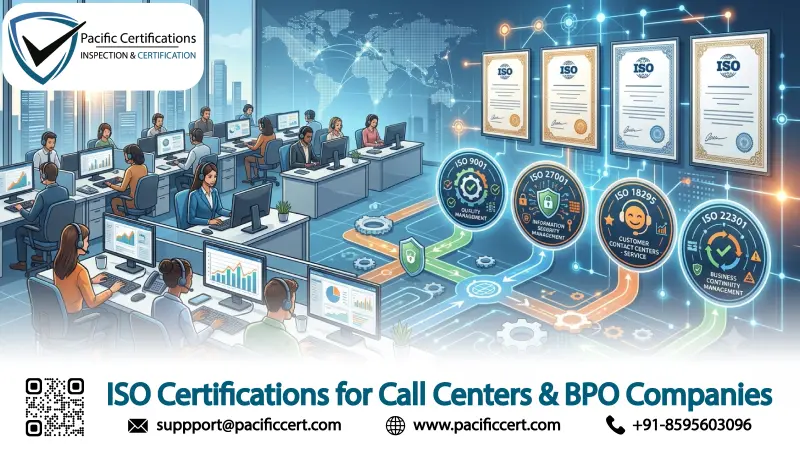
ISO certifications help call centers and BPO companies turn service quality, data protection, continuity and client expectations into measurable operating controls - Pacific Certifications
ISO 18295 - The Call Center Standard
It is the most operationally specific and commercially relevant certification for call centers and contact centers operating in competitive B2B markets.
Two-Part Structure
The standard comes in two parts with distinct but complementary scopes. ISO 18295-1:2017 specifies service requirements for customer contact centers (CCCs) - covering the management framework, performance metrics, staff management, technology and quality monitoring systems that the contact center itself must implement. ISO 18295-2:2017 specifies the requirements for the client organizations that commission and mandate contact center services - defining what clients must specify in their contracts and how they must manage their CCC service providers to achieve consistent service quality outcomes.
Key Requirements Under ISO 18295-1
ISO 18295-1 specifies requirements across the following operational domains:
KPI framework: Defined performance metrics must be established and monitored - including service levels, first contact resolution rates, customer satisfaction scores and quality monitoring scores. The standard specifies KPIs as mandatory where they are critical to service outcome assessment
Staff management: Requirements for recruitment, training, competency assessment, ongoing development and workforce welfare - reflecting the recognition that contact center agent performance and retention are primary drivers of service quality
Quality monitoring: Systematic call quality monitoring, evaluation and coaching programs that drive continual improvement in agent performance and customer experience
Complaint handling: Structured complaint and escalation processes - directly connected to the ISO 10002 complaint handling standard
Technology requirements: Systems and infrastructure that reliably support service delivery across all channels and enable performance measurement at the required granularity
Customer requirements fulfillment: The contact center's core obligation to consistently meet or exceed customer needs across all interaction types
Practical Tip: Use ISO 18295 to control contact center performance through service requirements, staff competence, quality monitoring and customer experience metrics.
ISO 9001 - Service Quality Management
While ISO 18295 governs the contact center-specific operational requirements, ISO 9001 provides the management system infrastructure within which those operations are planned, controlled, monitored and improved.
Relevance to Call Center and BPO Operations
Call center and BPO operations are process-intensive service environments - where service quality is determined by the consistency of process execution across hundreds or thousands of agents, shifts and interaction types. ISO 9001 directly addresses this operational reality: its process approach, documented procedures, performance monitoring, internal audit and nonconformity and corrective action requirements create the governance structure that ensures processes are defined, followed, measured and improved consistently.
For BPO companies specifically, ISO 9001 certification demonstrates to enterprise clients that:
Service processes are documented - call handling procedures, escalation workflows, quality monitoring processes and SLA management processes are written, version-controlled and consistently applied
Performance is measured - KPIs are defined, monitored and reported; customer satisfaction is systematically measured; process performance data drives management decisions
Nonconformances are managed - service failures, SLA breaches and quality issues are captured, analyzed for root cause and subjected to documented corrective action
Continual improvement is structured - objectives are set, improvement initiatives are tracked and management reviews assess QMS effectiveness at defined intervals
ISO 9001 and ISO 18295 Integration
For call centers pursuing both ISO 18295 and ISO 9001 certification - the most effective and commercially valuable combination in the contact center sector - the two standards are complementary rather than overlapping. ISO 9001 provides the management system framework; ISO 18295 provides the contact center-specific operational requirements.
Writer’s view: ISO 9001 helps BPO teams reduce service variation by turning call handling, escalation, SLA tracking and corrective action into controlled processes.
ISO/IEC 27001 - Information Security Management
BPO environments are inherently high-risk from an information security perspective: agents access multiple client systems simultaneously, call recordings contain sensitive customer information, authentication processes handle customer credentials and data flows cross organizational and geographic boundaries.
Why ISO 27001 Is Critical for BPO?
Enterprise clients handling sensitive customer or financial data are under regulatory obligation to ensure that their outsourced service providers implement adequate information security controls. ISO/IEC 27001 is the internationally recognized standard that provides independently audited evidence that an information security management system (ISMS) is in place and effective. Without ISO/IEC 27001 certification, BPO companies face:
Enterprise client loss - procurement compliance requirements eliminate uncertified vendors from consideration for contracts involving sensitive data
Regulatory exposure - data protection regulators increasingly expect evidence of ISMS implementation when investigating data breaches at outsourced processors
Higher contractual risk - contracts with certified competitors are preferred because certified providers provide stronger data security indemnity positions for clients
Key ISMS Controls for Contact Centers
ISO/IEC 27001 implementation in a call center or BPO context must address the following critical control areas:
CRM and client system access control - least-privilege access, role-based permissions and multi-factor authentication for agent access to client systems
Call recording security - encryption, access controls and retention management for call recording archives containing sensitive customer information
Clean desk and screen policies - physical security controls preventing unauthorized access to visible customer data in the agent environment
Bring-your-own-device and remote agent security - additional controls for work-from-home and remote agent environments, including endpoint security, VPN and home network security requirements
Third-party and sub-processor management - security requirements for technology vendors, cloud service providers and other suppliers with access to client data
Incident response - documented detection, reporting and response procedures for security incidents including data breaches, with notification timelines aligned to GDPR and applicable data protection laws
For BPO companies, ISO/IEC 27001 should protect CRM access, call recordings, remote agents, client systems and customer data as one ISMS.
ISO 22301 - Business Continuity Management
For enterprise clients with critical service delivery dependencies on their outsourced contact center providers, business continuity capability is a fundamental procurement requirement - particularly for financial services, healthcare, utilities and government sector clients.
BPO-Specific Continuity Risks
Call center and BPO operations face a distinct set of continuity risks that must be addressed in the BCMS:
Infrastructure failures - telecoms outages, power failures, internet connectivity disruptions and data center incidents can instantly incapacitate a contact center operation
Technology platform failures - CRM system outages, telephony platform failures and cloud service provider incidents directly prevent service delivery
Pandemic and mass absence events - as demonstrated in 2020, mass agent absence events require rapid transition to remote working models with maintained security and quality controls
Physical facility incidents - fire, flood, or other physical events at call center premises require rapid activation of alternate delivery locations or remote working capability
Cyber incidents - ransomware and other cyber attacks targeting BPO operators can simultaneously disable operations and compromise client data
ISO 22301 requires that recovery time objectives (RTOs) are defined for each critical service, that recovery strategies are tested at defined intervals and that business continuity plans are maintained in a current and exercised state - providing clients with contractually supportable continuity assurances.
Practical Tip: Define recovery time objectives, alternate working models and tested continuity plans before a telecom, platform or facility disruption occurs.
ISO 10002 - Complaint Handling
For call centers and BPO companies where complaint handling is both a core service function and a critical quality indicator, ISO 10002 certification demonstrates that complaint processes are governed by an internationally recognized standard rather than ad hoc procedures.
ISO 10002 certification is particularly valuable for: BPO companies delivering complaint management services on behalf of clients in regulated industries; contact centers where complaint KPIs - first contact resolution, complaint closure rates, escalation management - are contractually defined; and organizations seeking to align their complaint process with the contact-center-specific requirements of ISO 18295-1.
Final Remark: ISO 10002 gives call centers a structured way to manage complaints, escalations and customer dissatisfaction with measurable follow-up.
ISO 45001 - Workforce Safety and Wellbeing
High-volume call center work involves sustained screen time, headset use, sedentary postures, repetitive cognitive tasks and exposure to emotionally demanding interactions - all of which create documented occupational health risks including musculoskeletal disorders, hearing damage, psychological stress and burnout.
ISO 45001 certification in a call center context demonstrates systematic management of: ergonomic workstation design and assessment; noise exposure management for headset-wearing agents; mental health and psychological wellbeing programs; management of shift patterns and break schedules to reduce fatigue; and support programs for agents handling emotionally challenging call types - such as vulnerable customer interactions, complaints and distress calls.
Writer’s view: Call center safety should include ergonomics, headset use, screen time, stress, shift patterns and psychological wellbeing, not only physical hazards.
Certification Process for BPO Companies
Step 1: Gap Analysis
The certification process begins with a gap analysis - a structured assessment of the organization's current management practices, documentation and controls against the requirements of the target standard.
For call centers pursuing multiple certifications simultaneously, the gap analysis is most efficiently conducted as an integrated exercise - identifying the common infrastructure needed across standards (policy framework, internal audit program, management review, nonconformity management) alongside the standard-specific gaps.
Step 2: Management System Development
Based on the gap analysis findings, the management system documentation and controls are developed - including policy documents, procedure documentation, risk assessments, objectives and targets and operational controls.
Step 3: Implementation and Internal Audit
The documented management system is implemented across all in-scope operations - staff are trained, procedures are embedded in day-to-day practice and performance monitoring systems are activated.
An internal audit is conducted before the Stage 2 certification audit - assessing the implemented management system against all standard requirements and identifying any remaining nonconformities for correction before the external audit.
Step 4: Stage 1 Audit (Document Review)
The Stage 1 audit is a desk-based review by the certification body auditor - assessing the completeness and adequacy of the organization's management system documentation and confirming readiness for Stage 2.
The Stage 1 audit identifies any significant gaps that must be addressed before proceeding to Stage 2.
Step 5: Stage 2 Audit (On-Site Certification Audit)
The Stage 2 audit is an on-site assessment - the auditor evaluates the management system implementation by interviewing staff, reviewing records and evidence, observing processes and testing controls against all requirements of the standard.
Step 6: Certificate Issuance and Surveillance
Upon successful completion of the Stage 2 audit, the certificate is issued - valid for three years subject to annual surveillance audits. Surveillance audits assess continued conformance and improvement in the certified management system. A full recertification audit is conducted at the end of the three-year certificate cycle.
Practical Tip: A smooth certification process starts with gap analysis, management system development, staff training, internal audits and complete implementation records.
Audit Preparation
Documentation Completeness
Ensure that all required documented information - policies, procedures, risk assessments, performance records, training records and audit records - is complete, current, version-controlled and accessible.
Staff Awareness and Competency
Auditors interview front-line agents, team leaders, quality managers, IT staff and senior management. All staff in scope must understand the management system that applies to their work - including their individual responsibilities, how they contribute to system objectives and how to report nonconformances, security incidents, or health and safety concerns.
Records of Implementation
The Stage 2 audit assesses implementation, not just documentation - and the primary evidence of implementation is operational records. For call centers this includes: quality monitoring call evaluation records; complaint handling records; SLA performance data; training completion records; internal audit reports and corrective action records; security incident logs; and management review minutes.
Pre-Audit Internal Review
A structured internal audit against all standard requirements, conducted 4 to 8 weeks before the Stage 2 audit, identifies remaining nonconformities and provides time for correction. Organizations that approach their Stage 2 audit without a completed internal audit cycle consistently experience more observations and conditions than those that have completed a full internal audit and addressed its findings.
Audit preparation is strongest when documents, agent awareness, performance records, security logs and corrective actions are ready before Stage 2.
Business Benefits
Commercial and Competitive Benefits
RFP qualification - ISO certifications are mandatory criteria in enterprise procurement processes across financial services, telecommunications, healthcare, government and technology sectors; certified providers advance past compliance screening while uncertified competitors are eliminated
Premium contract positioning - certified BPO providers command stronger contract positions, longer contract terms and in many markets price premiums over uncertified competitors
Client retention - certified management systems demonstrate the governance maturity that enterprise clients require for long-term strategic outsourcing relationships
Operational Benefits
Process consistency - documented, audited procedures reduce agent-to-agent and shift-to-shift variability in service quality - the primary source of customer satisfaction variance in high-volume contact center operations
Reduced rework and escalations - systematic quality monitoring, nonconformance management and root cause analysis reduce repeat contacts, complaints and escalations
Staff retention - ISO 45001-governed workforce welfare programs reduce agent turnover - one of the highest cost drivers in contact center operations
Incident cost reduction - ISO/IEC 27001-governed security controls reduce the frequency and severity of security incidents and data breaches
Final Remark: ISO certification helps BPO companies qualify for RFPs, strengthen client retention, reduce service failures and improve operational discipline.
Recommended Certification Roadmap
Practical Tip: Start with ISO 9001 and ISO/IEC 27001, then add ISO 18295, ISO 22301, ISO 10002, ISO 45001 and ISO/IEC 27701 as client needs grow.
Certification Cost
Multi-site BPO organizations with remote working agent populations require a larger audit scope than single-site operations, reflecting the geographic distribution of the management system implementation.
Integrated audit programs covering ISO 9001, ISO/IEC 27001 and ISO 18295-1 simultaneously reduce total audit days by 25 to 35 percent compared to separate certifications - and produce a more coherent governance credential for presentation to enterprise clients. Pacific Certifications provides transparent, fixed-fee proposals covering all certifications in scope.
For calculating cost of your certifications for free, click here.
Cost planning should consider site count, employee strength, remote agent population, selected ISO standards and whether an integrated audit is possible.
How Pacific Certifications Can Help?
Accredited by ABIS, Pacific Certifications conducts impartial, evidence-based audits in full conformance with ISO/IEC 17021 - issuing internationally recognized certificates that are accepted by enterprise procurement teams, regulators and clients globally. Our services for call center and BPO organizations include:
Independent certification audits for ISO 18295-1, ISO 9001, ISO/IEC 27001, ISO 22301, ISO 10002, ISO 45001 and ISO/IEC 27701
Integrated management system audits covering multiple standards in coordinated, efficient audit visits
Practical operational assessment in live contact center environments - evaluating real agent interactions, quality monitoring systems and security controls
Clear, transparent audit reports with conformity findings and certification decisions
Annual surveillance and triennial recertification audits to maintain certificate validity
Pacific Certifications does not provide consultancy - our role is strictly that of an independent auditor, ensuring your certificate carries full credibility with every enterprise client and procurement team you engage.
Contact Us
To get started with your certification program or initiate your audit, contact us at support@pacificcert.com or +91-8595603096.
For training programs, contact us at trainings@pacificcert.com.
Also Read: ISO certification for BPO services and ITES operations