Post by Alina Ansari | July, 2026
What Is ISO 20471?
Published by ISO under ISO/TC 94/SC 14, it is the globally recognized technical reference for high-visibility personal protective equipment (PPE) used wherever workers face risk from moving vehicles - including road construction, rail infrastructure, logistics, emergency services and utilities.
ISO 20471:2013 superseded the earlier EN 471:2004+A1:2007 standard in Europe - harmonized as EN ISO 20471:2013+A1:2016 - and now represents the single internationally aligned standard for high-visibility clothing. The 2013 revision introduced significant technical changes: mandatory retroreflective tape on all Class 1 garments, the elimination of sleeveless garments from Class 3 classification and a revised washing durability methodology requiring combined wash-and-dry cycles to more accurately replicate real-world garment care.
The standard governs garments - vests, jackets, trousers, overalls and coveralls - intended for workers in risk environments. It does not cover accessories such as gloves, footwear, or headgear, nor does it govern hi-vis clothing for lower-risk internal environments, for which EN 17353 - the standard for enhanced visibility clothing - is more appropriate.
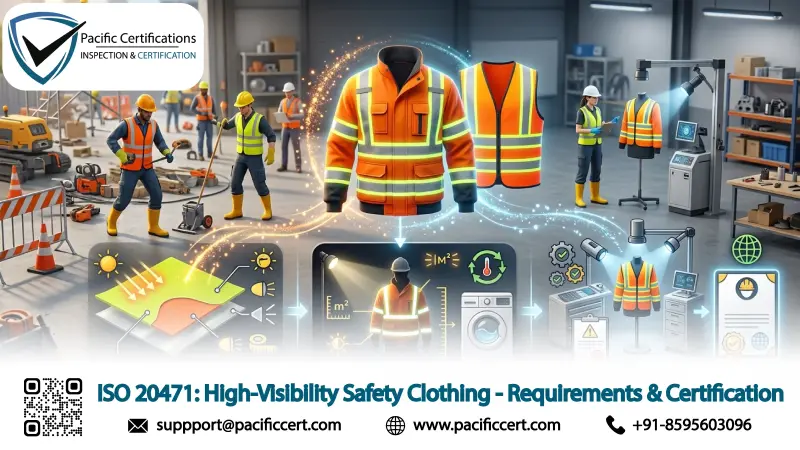
ISO 20471 helps organizations verify that high-visibility safety clothing provides reliable worker conspicuity in vehicle, traffic and low-light risk environments - Pacific Certifications
Garment Classes 1, 2 and 3
Class selection must be determined by a risk assessment of the specific work environment - considering traffic speed, worker proximity to live traffic, duration of exposure and ambient lighting conditions.
Class 1 provides the minimum conspicuity level appropriate for environments where vehicle speeds are low and worker exposure to traffic is limited - warehouse operations, car park attendants and controlled site logistics.
Class 1 garments are most commonly trousers or jackets with the required minimum fluorescent and retroreflective areas.Class 2 is the most widely deployed classification in standard industrial and construction use - appropriate for workers on public roads and construction sites with traffic moving up to 60 km/h.
Class 2 vests, jackets and coveralls must carry retroreflective bands on the torso and arms where applicable and must meet the significantly higher minimum fluorescent area requirements of 0.50 m².Class 3 is the highest classification and is mandatory for workers in the most hazardous traffic environments - those working within close proximity to roads where traffic speeds exceed 60 km/h.
All Class 3 garments must cover the torso and must incorporate either full-length sleeves or full-length trouser legs - or both - fitted with retroreflective bands. Sleeveless garments cannot be certified as Class 3 under ISO 20471:2013.
Practical Tip: Select Class 1, 2 or 3 garments through a workplace risk assessment based on traffic speed, exposure time, lighting and worker proximity to moving vehicles.
Fluorescent and Retroreflective Material Requirements
Fluorescent Background Material
Fluorescent material absorbs ultraviolet light and re-emits it as visible light - significantly enhancing the wearer's daytime visibility, particularly in low-contrast environments, overcast conditions and at dawn and dusk when ambient light levels are reduced.
ISO 20471 specifies three permitted fluorescent background colours: fluorescent yellow-green, fluorescent orange-red and fluorescent red. Performance requirements cover chromaticity - colour coordinates that must fall within defined reference limits when measured colorimetrically - and luminance factor, which quantifies how bright the material appears relative to a perfect diffuse reflector.
Retroreflective Material
Retroreflective material reflects light directly back toward its source - returning vehicle headlight illumination to the driver to make the wearer visible in darkness and in conditions of reduced visibility where fluorescent material alone provides insufficient conspicuity.
ISO 20471 requires that retroreflective material achieves defined minimum values of coefficient of retroreflection (R_A), expressed in cd·lx⁻¹·m⁻², at defined observation angles and entrance angles representing realistic vehicle-lighting geometry at operational distances.
Combined Performance Material
Combined performance material meets both fluorescent and retroreflective performance requirements simultaneously - functioning as background material that also retroreflects.
Its use contributes to both the fluorescent and retroreflective area calculations when determining class compliance, subject to defined limits on the proportion of the retroreflective area requirement that may be met by combined performance material rather than dedicated retroreflective tape.
Writer’s view: High-visibility clothing works only when fluorescent material supports daytime visibility and retroreflective material supports visibility in darkness or reduced light.
Testing Methods
Colorimetric Testing: Fluorescent background material colour is assessed by measuring chromaticity coordinates and luminance factor using calibrated colorimetric instrumentation.
Testing must be conducted on new specimens and after conditioning - including xenon arc lamp UV weathering exposure simulating environmental degradation - to verify that colour performance remains within the specified limits after use.Retroreflectivity Testing: Retroreflective performance is measured using a retroreflectometer - measuring the coefficient of retroreflection at defined observation and entrance angle combinations specified in the standard.
Testing is conducted on new specimens and after defined conditioning treatments including washing, abrasion and flexing cycles - verifying that retroreflective performance is maintained under the mechanical and thermal stresses experienced in normal garment use.Washing Durability Testing: ISO 20471:2013 requires that both fluorescent and retroreflective performance are verified after a defined number of combined wash-and-dry cycles.
Each cycle consists of a complete machine wash followed by tumble drying, replicating the real-world care regime of industrial garments.Dimensional Area Measurement: The total area of fluorescent background material and retroreflective material incorporated in the garment is calculated and verified against the applicable class minimum requirements.
The measurement methodology defines how material areas are calculated for different garment types, how placement requirements relative to defined body reference points are assessed and how the contributions of multiple materials to the total area are aggregated.
Testing should confirm color performance, retroreflectivity, washing durability and material area before garments are placed into real workplace use.
Labelling Requirements
Mandatory label content includes:
Standard reference - ISO 20471 or EN ISO 20471 - with the applicable class number displayed as the ISO 20471 class symbol
Manufacturer's name or registered trademark
Garment size designation
Fabric composition
Care instructions in standard textile care symbols covering washing, drying, ironing and dry cleaning
Maximum number of cleaning cycles after which performance can no longer be guaranteed - where the manufacturer has established and disclosed this limit
CE marking with the Notified Body identification number - required in Europe for Category II PPE garments
The class designation on the label is the primary compliance reference for buyers, procurement managers, safety officers and site inspectors. Labels must be permanently attached to the garment and must remain legible throughout the service life of the garment under normal wearing and care conditions.
Practical Tip: A compliant ISO 20471 label should clearly show the standard reference, garment class, care instructions, manufacturer details and performance limits.
Industries That Require Compliant Clothing
Road construction and maintenance: Workers on public roads and motorways - including flaggers, road surface crews and site supervisors - require Class 2 or Class 3 garments depending on traffic speed and working proximity to live carriageways
Rail infrastructure: Track inspection, maintenance and construction personnel represent among the most demanding users of Class 3 garments - operating in environments combining high-speed train movements, low-light conditions and constrained escape routes
Emergency services: Police officers at road incidents, paramedics, fire service personnel and roadside recovery operators require Class 3 garments when working in live traffic environments
Logistics and warehousing: Workers in forklift environments, loading dock operations and large distribution centres require appropriate Class 1 or Class 2 garments in vehicle movement zones
Airport ground operations: Ground crew, aircraft marshallers, baggage handlers and refuelling staff operate in high-risk aircraft and vehicle movement environments requiring ISO 20471-compliant garments
Utilities and telecoms: Electricity, gas, water and telecoms field engineers working on or adjacent to public roads require Class 2 or Class 3 garments as standard operational PPE
Mining and quarrying: Surface and near-surface mining operations involving heavy mobile plant require high-visibility garments to maintain worker conspicuity for equipment operators in dusty, low-contrast conditions
Ports and marine terminals: Stevedores, terminal logistics operators and port safety officers working in high-vehicle-movement container terminal environments require appropriate class garments
ISO 20471 clothing is most critical where workers operate near roads, rail lines, airports, ports, warehouses, utilities, mines or emergency traffic zones.
ISO 20471 Certification Path
Step 1: ProductDevelopment and Pre-Compliance Testing
The manufacturer develops the garment to meet ISO 20471 requirements - selecting fluorescent background material and retroreflective material meeting the standard's performance specifications, designing the garment layout to achieve the minimum material areas for the target class and specifying construction details, care instructions and label content.
Step 2: Application to Notified Body
The manufacturer submits the garment for EU Type Examination (Module B) by a Notified Body - a third-party conformity assessment body designated by an EU member state to conduct PPE conformity assessment. The submission package includes the complete technical file - design drawings, material specifications, test reports, risk assessment, instructions for use and label content - together with representative garment samples for examination and formal testing.
Step 3: EU Type Examination
The Notified Body conducts a technical assessment of the garment design and documentation against ISO 20471 requirements and the EU PPE Regulation essential health and safety requirements. The Notified Body conducts or commissions laboratory testing to verify colorimetric, retroreflectivity and washing durability performance.
Step 4: Production Quality Assurance
Category II PPE production conformity must be maintained under either Module C2 - internal production control with Notified Body product checks at random intervals - or Module D - production quality assurance involving a quality management system audit by the Notified Body. Most garment manufacturers use Module D.
Step 5: CE Marking and Declaration of Conformity
Following successful Type Examination and production conformity assessment, the manufacturer applies the CE mark and Notified Body number to each garment and issues a signed EU Declaration of Conformity declaring conformity with EN ISO 20471 and the EU PPE Regulation.
Step 6: Ongoing Surveillance
The Notified Body conducts periodic surveillance of the production facility and product - typically on an annual basis - to verify continued conformance with the approved design and production quality system. Any material change to garment design, materials, or production process that could affect compliance must be notified to the Notified Body and may require re-examination before implementation.
Practical Tip: A strong certification path starts with compliant garment design, accredited testing, technical documentation, Type Examination and controlled production evidence.
ISO 20471 Certification Cost
A specialist manufacturer with a focused product range and a single production facility will have a contained audit investment. Manufacturers operating multiple sites, sourcing materials internationally across different fabric, fluorescent material and retroreflective tape suppliers, or producing a broad garment portfolio covering multiple classes and customer specifications will require proportionally more audit effort.
For employers pursuing ISO 45001 certification to govern their PPE program - within which ISO 20471 garment selection, provision and maintenance is documented - audit scope and cost reflects the total workforce covered and the diversity of work environments and risk profiles included. An integrated audit covering ISO 9001 and ISO 45001 simultaneously reduces total audit days by 20 to 30 percent compared to separate certifications and is the most commercially efficient approach for manufacturing organizations with both product quality and worker safety obligations.
Adding ISO 14001 for environmental management extends the integrated program with minimal additional audit investment relative to a standalone environmental audit. Pacific Certifications provides transparent, fixed-fee proposals covering all certifications in scope, ensuring full cost visibility before the process begins.
Cost planning should consider garment class, product range, testing needs, employee count, production sites, material suppliers and selected management system standards.
ISO 20471 Certification Timeline
This includes 2 to 4 weeks for gap analysis and management system documentation development, 6 to 10 weeks for implementation covering procedure documentation, document control system setup, production control records, incoming material inspection procedures and finished product testing documentation and 2 to 3 weeks for Stage 1 and Stage 2 certification audits.
Manufacturers expanding an existing quality system to cover new production sites or additional product lines should plan for 4 to 7 months. For employers pursuing ISO 45001 certification to govern their PPE and worker safety program, the implementation and certification process runs approximately 3 to 6 months from initial gap analysis through certificate issuance.
The PPE risk assessment and provision documentation required by ISO 45001 - identifying the need for ISO 20471-compliant garments, selecting the appropriate class through risk assessment, establishing inspection and replacement procedures and maintaining provision records - feeds directly into the Stage 2 audit evidence base.
Integrated programs covering ISO 9001 and ISO 45001 simultaneously can typically be completed within 4 to 6 months from gap analysis through certificate issuance, with the combined audit scheduled to cover both standards in a single coordinated visit.
A Practical Tip from Pacific Certifications: Manufacturers can avoid delays by preparing technical files, test reports, label artwork, production controls and audit records early.
How Pacific Certifications Can Help?
Accredited by ABIS, Pacific Certifications conducts impartial, evidence-based audits against applicable ISO standards in full conformance with ISO/IEC 17021. Our services for high-visibility clothing manufacturers and employers include:
Independent certification audits for ISO 9001, ISO 45001, ISO 14001 and ISO 22301
Integrated management system audits covering multiple standards in coordinated, efficient audit visits
Stage 1 and Stage 2 audit execution across manufacturing facilities and employer organizations
Clear, transparent audit reports with conformity findings and certification decisions
Issuance of internationally recognized ISO certificates upon successful audit completion
Annual surveillance and triennial recertification audits to maintain certificate validity
Pacific Certifications does not provide consultancy - our role is strictly that of an independent auditor, ensuring your certificate carries full credibility with customers, procurement authorities, Notified Bodies and regulators in every market you operate in.
Contact Us
To get started with your management system certification program or initiate your audit, contact us at support@pacificcert.com or +91-8595603096.
For training programs, contact us at trainings@pacificcert.com.
Also read: What Are the 7 Elements of ISO 45001?