Post by Alina Ansari | July, 2026
What Is ISO 17088?
Published by ISO under ISO/TC 61/SC 14 - the technical committee on biotic degradation and composting - it defines the four key characteristics that a plastic material or plastic product must demonstrate to be designated as compostable: biodegradability, disintegration during composting, absence of negative effects on the composting process and absence of negative effects on the quality of the resulting compost.
The standard applies to plastics intended for composting under managed composting conditions - industrial or municipal composting facilities - and covers plastics that are either inherently biodegradable or have been modified with additives or coatings to achieve biodegradability. ISO 17088:2021 is the third edition of the standard, superseding ISO 17088:2012, with the 2021 revision providing updated test requirements and expanded guidance on the specification of compostable plastics across a broader range of applications. It provides the technical reference that enables manufacturers, composting facility operators, regulators and consumers to distinguish genuinely compostable plastics from products making unsubstantiated biodegradability claims - addressing one of the most prevalent forms of greenwashing in the materials sector.
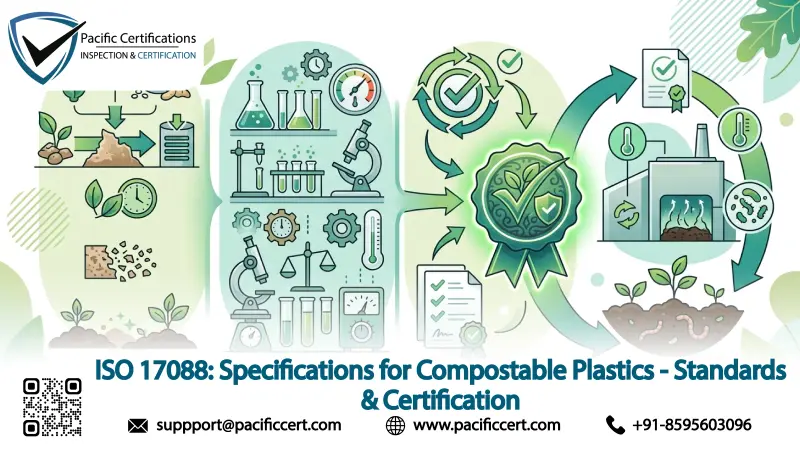
ISO 17088 helps manufacturers prove compostability through verified biodegradation, disintegration, chemical characterization and ecotoxicity controls - Pacific Certifications
Compostable Plastic Specifications
Criterion 1: Chemical Characterization
The plastic material must be fully characterized - identifying all constituents including polymers, additives, colorants, processing aids and any other components - and the concentration of each constituent must be documented.
Heavy metal content must be assessed against defined threshold limits: the total heavy metal concentration in the material must not exceed 50% of the limits specified in the standard for compost quality, covering elements including zinc, copper, nickel, cadmium, lead, mercury, chromium, molybdenum, selenium, arsenic and fluorine.
Criterion 2: Biodegradability
The material must demonstrate a defined minimum level of biodegradation under controlled composting conditions within a defined timeframe. ISO 17088 requires that the plastic achieves at least 90% biodegradation - measured as the percentage conversion of organic carbon to carbon dioxide - within 6 months when tested using the method specified in ISO 14855-1 (determination of the ultimate aerobic biodegradability of plastic materials under controlled composting conditions).
Criterion 3: Disintegration
The material must disintegrate sufficiently during composting so that it does not interfere with the composting process and does not leave significant fragments in the finished compost.
ISO 17088 requires that after 12 weeks of composting under the conditions specified in ISO 16929, no more than 10% of the original dry weight of the material remains on a 2 mm sieve.
Criterion 4: Ecotoxicity
The compost produced from composting the plastic material must not exhibit ecotoxicity - it must not have adverse effects on plant growth or on soil organisms.
ISO 17088 requires that plant growth tests conducted on compost containing the plastic material demonstrate that germination rate and plant biomass are not significantly reduced compared to compost produced without the plastic material.
Practical Tip: Treat compostability as a technical claim that must be supported by material composition, biodegradation results, disintegration evidence and compost quality testing.
Testing Parameters
ISO 14855-1 - Ultimate Aerobic Biodegradability
This is the primary biodegradation test method referenced by ISO 17088 - measuring the rate and extent of aerobic biodegradation of plastic materials under controlled composting conditions, determined by measuring the carbon dioxide evolved during the test.
Test conditions are tightly controlled: temperature at 58 ± 2°C representing active composting conditions, defined inoculum from mature compost, defined test material particle size and loading and a test duration of up to 6 months.
ISO 16929 - Disintegration of Plastic Materials Under Defined Composting Conditions
This test method evaluates the disintegration of plastic materials in a pilot-scale composting test - a more representative simulation of real-world industrial composting conditions than purely laboratory-scale tests.
Test specimens are composted for 12 weeks under defined conditions, after which the remaining material is screened on a 2 mm sieve to determine what proportion of the original material has disintegrated below the 2 mm threshold.
ISO 20200 - Determination of the Degree of Disintegration of Plastic Materials Under Simulated Composting Conditions
ISO 20200 provides an alternative disintegration test method using simulated composting conditions in a laboratory-scale system - offering a faster and more resource-efficient assessment of disintegration performance that may be used in combination with ISO 16929 during material development.
Ecotoxicity Testing
Plant growth tests are conducted using standard plant species under defined conditions - comparing germination index and biomass production in compost containing the test material against a blank compost control. The specific test protocols reference OECD guidelines and ISO methods for terrestrial plant testing.
Testing should be planned early because biodegradation, disintegration, ecotoxicity and chemical characterization each require controlled methods and reliable evidence.
Biodegradation and Disintegration
Understanding the distinction between biodegradation and disintegration - and why both must be demonstrated independently - is fundamental to understanding the ISO 17088 specification and why it is technically more rigorous than many simpler biodegradability claims.
Biodegradation
Biodegradation is a chemical process - the metabolism of the plastic material by microorganisms in the composting environment, converting the organic carbon of the material into carbon dioxide, water, biomass and inorganic salts.
True biodegradation means that the molecular structure of the plastic is broken down by microbial enzymatic activity - not merely fragmented into smaller pieces of the same polymer.
Disintegration
Disintegration is a physical process - the breakdown of the material into fragments sufficiently small that they do not interfere with the composting process and are not visible or detectable as plastic in the finished compost.
A material may disintegrate rapidly - breaking into small fragments under the thermal and mechanical conditions of composting - without having fully biodegraded at the molecular level.
The Significance of Both Criteria Together
The requirement to demonstrate both biodegradation and disintegration independently is what distinguishes ISO 17088 from weaker environmental claims.
A material that only passes the disintegration criterion - breaking into fragments smaller than 2 mm - could be a conventional plastic that has simply fragmented into microplastics.
Writer’s view: A compostable plastic must both biodegrade chemically and disintegrate physically, because fragmentation alone can create misleading environmental claims.
ISO 17088:2021 vs EN 13432:2000
Final Remark: ISO 17088 provides the broader international reference, while EN 13432 is mainly used for compostable packaging compliance in European markets.
Applications in Packaging
Food Service Packaging
Single-use food service packaging - cups, bowls, plates, cutlery, straws and food containers - is the largest application segment for ISO 17088-compliant compostable plastics.
In contexts such as stadium catering, event catering, quick service restaurants and institutional food service, compostable packaging enables organic waste and food-contaminated packaging to be collected together in a single stream for industrial composting.
Fresh Produce and Food Packaging
Films, bags and wrapping materials for fresh fruit, vegetables and bakery products represent a major application segment - where compostable films enable pack-and-compost systems that reduce food waste by maintaining product freshness while providing an end-of-life pathway that is compatible with organic waste infrastructure.
Bin Liners and Compostable Bags
Compostable bin liners for food waste collection - used in residential food waste collection programs and in commercial catering operations - are one of the most widely deployed applications of ISO 17088-compliant compostable plastics.
Agricultural Mulch Films
Agricultural mulch films - used to suppress weeds, retain soil moisture and moderate soil temperature in crop production - represent a significant application for compostable plastics where the impracticality of recovering thin plastic films from agricultural land after use makes biodegradable alternatives highly attractive.
Practical Tip: Compostable packaging works best where the product, food waste stream and industrial composting infrastructure are aligned from the start.
Certification Process of ISO 17088:2021
Step 1: Material Characterization and Documentation
The manufacturer prepares a complete chemical characterization of the plastic material - documenting all constituents and their concentrations, confirming that heavy metal content is within the defined threshold limits and assembling the technical documentation needed for the certification application.
Step 2: Laboratory Testing
The material is submitted to an accredited laboratory for testing against the full ISO 17088 test suite - biodegradation testing per ISO 14855-1, disintegration testing per ISO 16929 and ecotoxicity testing.
Testing must be conducted at accredited laboratories following the defined test conditions and reporting requirements.
Step 3: Application to Certification Programme
The manufacturer submits the complete technical file - chemical characterization documentation, laboratory test reports and product description - to the chosen certification programme operator. The programme operator reviews the submission for completeness and technical adequacy.
Step 4: Technical Review and Certification Decision
The certification programme operator conducts a technical assessment of the submitted documentation and test results against the programme's certification requirements.
Where all criteria are met, a certification decision is issued and the manufacturer is licensed to apply the programme's compostability certification mark to the product.
Step 5: Surveillance and Renewal
Compostability certificates are issued for a defined validity period - typically one to three years - subject to annual surveillance.
Surveillance may include review of updated production documentation, confirmatory testing of production samples and assessment of any material or formulation changes that could affect compostability performance.
A smooth certification process starts with complete material characterization, accredited laboratory testing, technical file preparation and review of formulation changes.
ISO 17088:2021 Certification Cost
For manufacturers with multiple product variants based on the same base polymer formulation, some certification programmes allow shared testing data across variants - reducing the per-product testing cost where formulations are sufficiently similar.
For management system certifications, ISO 14001 audit cost for a compostable plastics manufacturer is determined by the number of employees in scope, the number of manufacturing sites and the complexity of the environmental aspects of the manufacturing operation. Manufacturers pursuing integrated ISO 9001 and ISO 14001 certification simultaneously - the most common and commercially efficient approach for manufacturing organizations with both quality and environmental obligations - benefit from integrated audit programs that reduce total audit days by 20 to 30 percent compared to separate certifications. Pacific Certifications provides transparent, fixed-fee proposals covering all management system certifications in scope.
Cost planning should consider product variants, testing scope, laboratory requirements, technical documentation, certification program fees and any related ISO 14001 or ISO 9001 audits.
ISO 17088:2021 Certification Timeline
When pre-certification planning, chemical characterization and laboratory submission are completed efficiently, the full product certification process from initial material characterization through certification mark issuance typically takes 8 to 14 months - with the majority of that time occupied by the biodegradation test duration.Organizations that have already completed or can leverage existing biodegradation test data from previous testing programs can significantly compress this timeline.
Since the management system certification process operates independently of the product testing timeline, the two processes can run concurrently - enabling an organization to achieve ISO 14001 certification well within the period occupied by biodegradation testing. Integrating ISO 9001 into the program extends the timeline by 4 to 6 weeks for a combined integrated management system program. Assigning a dedicated environmental management and certification coordinator, beginning the ISO 14001 gap analysis at the same time as laboratory testing is initiated and aligning the internal audit program with the Stage 2 certification assessment schedule are the most effective ways to manage the parallel workstreams efficiently.
A Practical Tip from Pacific Certifications: Manufacturers can avoid delays by collecting formulation data, supplier declarations, heavy metal evidence and prior biodegradation test records early.
How Pacific Certifications Can Help?
Accredited by ABIS, Pacific Certifications conducts impartial, evidence-based audits against applicable ISO standards in full conformance with ISO/IEC 17021. Our services for compostable plastics and sustainable packaging organizations include:
Independent certification audits for ISO 14001, ISO 9001, ISO 50001, ISO 45001 and ISO 22301
Integrated management system audits covering multiple standards in coordinated, efficient audit visits
Stage 1 and Stage 2 audit execution across manufacturing and product development organizations
Clear, transparent audit reports with conformity findings and certification decisions
Issuance of internationally recognized ISO certificates upon successful audit completion
Annual surveillance and triennial recertification audits to maintain certificate validity
Pacific Certifications does not provide consultancy - our role is strictly that of an independent auditor, ensuring your certificate carries full credibility with customers, retailers, regulators and extended producer responsibility scheme operators in every market you operate in.
Contact Us
To get started with your management system certification program or initiate your audit, contact us at support@pacificcert.com or +91-8595603096.
For training programs, contact us at trainings@pacificcert.com.
Also Read: ISO 14020: Environmental Labels & Declarations, Types & Certification