Post by Alina Ansari | July, 2026
What Is ISO 14006?
Ecodesign is the practice of incorporating environmental performance criteria into product design decisions - alongside the traditional design parameters of function, cost, aesthetics and manufacturability - with the objective of reducing the adverse environmental impacts of a product across its full lifecycle.
ISO 14006:2020 is the second edition of the standard, superseding ISO 14006:2011. The 2020 revision aligned the standard with the High-Level Structure common to all ISO management system standards, updated it to reflect the revised ISO 14001:2015 EMS framework, particularly the strengthened life cycle thinking requirement and made it more independent of the specific clause structure of ISO 14001.
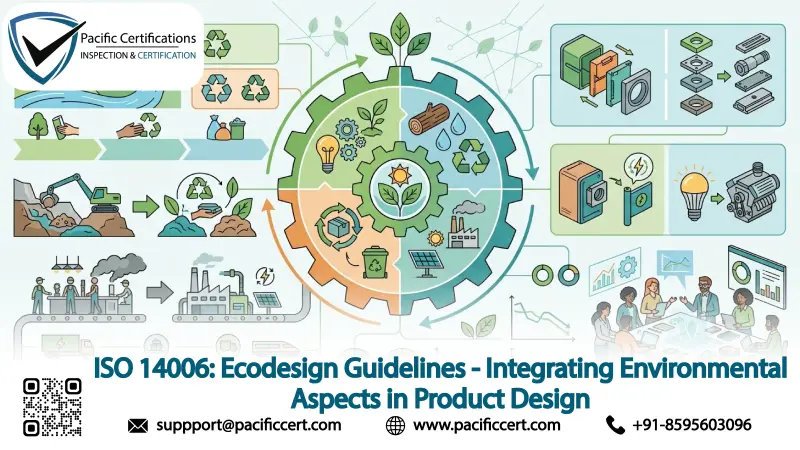
ISO 14006 helps organizations integrate environmental thinking into product design so lifecycle impacts are reduced from the earliest design stage - Pacific Certifications
ISO 14006 Ecodesign Principles
Prevention Rather Than Cure
The most fundamental principle of ecodesign is that environmental impacts are most effectively and economically addressed at the design stage - not after a product has been commercialized. Once a product design is fixed, its material composition, energy consumption profile, repairability, recyclability and end-of-life characteristics are largely determined. Changing these parameters after product launch requires costly redesigns, supply chain changes and potentially product recalls.
Life Cycle Perspective
Ecodesign decisions must be based on an understanding of the product's environmental impacts across its complete lifecycle - from raw material extraction and component manufacturing through product use and end-of-life disposal or recovery. A design decision that reduces impact at one lifecycle stage may inadvertently increase impacts at another.
ContinuousImprovement
Ecodesign is not a one-time activity applied to a single product revision - it is a continuous improvement discipline embedded in the product development process. Each product generation provides an opportunity to improve environmental performance relative to its predecessor - using lessons learned from the previous design, new materials and technologies to achieve measurable reduction in environmental impact over time.
Stakeholder Engagement
Effective ecodesign requires engagement across the full value chain - including suppliers who provide materials and components with their own environmental profiles, customers whose use behavior determines use-phase impacts and end-of-life operators whose capabilities determine what recovery and recycling is realistically achievable.
Integration with Business Objectives
Ecodesign is most effective when it is embedded in the mainstream product development process. ISO 14006 places top management responsibility for ecodesign at the center of its framework, reflecting the recognition that environmental performance improvement in product design requires the same strategic commitment, resource allocation and performance measurement as any other product development objective.
Practical Tip: Treat ecodesign as a design requirement, not as a sustainability review added after the product is already developed.
Life Cycle Thinking
The Product Lifecycle Stages
A product's environmental lifecycle begins with raw material extraction - mining, forestry, agriculture, or petrochemical processing to obtain the materials that will become product components. It continues through material processing and component manufacturing, product assembly, packaging and distribution.
The use phase - which may last months to decades depending on the product - typically dominates the total lifecycle environmental impact for energy-using products such as appliances, vehicles and electronics.
Life Cycle Assessment as the Analytical Tool
Life Cycle Assessment (LCA) - conducted in accordance with ISO 14040 and ISO 14044 - is the quantitative methodology that underpins life cycle thinking in ecodesign.
LCA calculates the environmental impacts associated with each lifecycle stage across a defined set of impact categories - including climate change, ozone depletion and toxicity, enabling designers and engineers to understand where the most significant environmental hotspots in the product lifecycle are located and which design parameters have the greatest leverage on total lifecycle impact.
Hotspot Analysis and Design Prioritization
Life cycle thinking in ISO 14006 is practically applied through hotspot analysis - identifying the lifecycle stages, materials and processes that contribute most significantly to the product's total environmental impact and prioritizing ecodesign effort on the design parameters that influence those hotspots.
For an electronic product, the hotspot analysis typically reveals that the use-phase energy consumption and the production of key electronic components dominate the lifecycle - directing ecodesign effort toward energy efficiency improvement and responsible material sourcing.
Writer’s view: The strongest ecodesign decisions consider raw materials, manufacturing, transport, product use, repair, reuse, recycling and end-of-life impact together.
Design-Stage Environmental Considerations
Material Selection
Material selection decisions at the design stage determine the embodied environmental impacts of the product - the energy, water, land and emissions associated with producing the materials that make up the product.
Ecodesign principles applied to material selection include selecting materials with lower embodied carbon and environmental impact intensity, avoiding materials containing hazardous substances that create end-of-life toxicity risks, preferring materials with established recycling or recovery pathways over those that go to landfill.
Energy and Resource Efficiency
For energy-using products, use-phase energy consumption is typically the dominant lifecycle environmental impact - and design decisions governing motor efficiency, insulation performance, standby power consumption and operational modes directly determine the use-phase energy profile of the product.
ISO 14006 requires that energy efficiency is considered as a primary ecodesign parameter for energy-using products, alongside the efficiency of energy and resource use in the manufacturing process.
Design for Durability and Longevity
Product lifespan is a critical environmental parameter - products that last longer provide more functional value per unit of material and energy consumed in their production.
Ecodesign considerations for durability include: designing for mechanical robustness and resistance to failure; selecting materials with appropriate fatigue and corrosion resistance for the expected service environment; designing for repairability.
Design for Disassembly and End-of-Life
End-of-life recyclability and recovery is determined almost entirely by design decisions made during product development - the material combinations used, how components are joined, whether hazardous materials are accessible for removal before shredding and whether material types are labelled for sorting.
Packaging Design
Product packaging represents a significant material stream in many consumer product categories - and ecodesign principles applied to packaging include: minimizing packaging weight and volume while maintaining protection adequacy; specifying packaging materials with established recycling pathways; avoiding mixed-material laminates that are difficult to separate for recycling; and providing clear sorting and recycling guidance on the packaging.
Consider environmental impact at the earliest design stage, not after the product is finalized. Material choice, energy efficiency, durability, packaging and end-of-life recovery are easier and cheaper to improve before production begins.
How ISO 14006 is related to ISO 14001?
Where ISO 14001 Ends and ISO 14006 Begins
ISO 14001 requires organizations to consider the lifecycle perspective when determining the environmental aspects of their products - but it does not provide specific guidance on how environmental considerations are to be integrated into the product design and development process.
ISO 14001 Clause Mapping
ISO 14006's guidelines align directly with the key clauses of ISO 14001:2015 where design-related requirements appear. Clause 6.1 of ISO 14001 - identification of environmental aspects and evaluation of significant environmental aspects - is extended by ISO 14006 to cover product-related environmental aspects across the full lifecycle, not only the aspects of the organization's own operations.
Clause 8.1 of ISO 14001 - operational planning and control - is extended to cover the design and development process as a controlled operation through which product-related environmental objectives are pursued.
EMS as the Enabling Framework
The ISO 14001 EMS provides the organizational infrastructure that makes ecodesign sustainable over time - top management commitment, documented procedures, competence and training, internal audit, management review and nonconformity and corrective action processes.
Without this governance infrastructure, ecodesign activities depend on individual champions and are vulnerable to being deprioritized when commercial pressures increase
Practical Tip: Use ISO 14006 to extend ISO 14001 controls into product design, so environmental objectives influence materials, lifecycle impacts, supplier choices and end-of-life planning.
ISO 14006 Implementation in Manufacturing
Step 1: Top Management Commitment and Ecodesign Policy
ISO 14006 places top management at the center of ecodesign governance - requiring that leadership takes responsibility for the integration of ecodesign objectives into the organization's strategic direction, product development planning and resource allocation.
Step 2: Environmental Aspect Identification for Products
The organization must identify and evaluate the environmental aspects associated with its products across the full lifecycle - mapping significant environmental impacts to specific lifecycle stages and design parameters.
This typically involves a combination of screening LCA, material flow analysis and energy profiling - producing a prioritized list of the design parameters with the greatest environmental leverage that becomes the focus of the ecodesign program.
Step 3: Setting Ecodesign Objectives and Targets
Based on the environmental aspect analysis and the organization's environmental policy, ecodesign objectives and targets must be established - defining measurable environmental performance improvements to be achieved in the next product generation.
Step4: Integrating Ecodesign into the Design Process
Ecodesign activities must be integrated into the organization's existing product design and development process - not operated as a parallel process.
ISO 14006 requires that environmental requirements are defined as design inputs alongside functional, cost and regulatory requirements; that design outputs are evaluated against environmental criteria alongside functional performance; and that design review, verification and validation activities include environmental performance assessment.
Step5: Supplier and Supply Chain Engagement
Many of a manufactured product's most significant lifecycle environmental impacts are upstream - in the extraction and processing of the raw materials and components sourced from the supply chain.
ISO 14006 requires organizations to engage their supply chain in ecodesign - communicating environmental requirements to key suppliers, requesting environmental data on materials and components for use in lifecycle assessment and working collaboratively with suppliers to identify material substitutions and process improvements that reduce upstream impacts.
Step 6: Monitoring, Measurement and Review
The environmental performance of products against ecodesign objectives must be monitored and measured - using defined indicators that track progress over successive product generations.
Management review of ecodesign performance - integrated with the ISO 14001 management review process - ensures that ecodesign objectives remain aligned with the organization's strategic direction, that resources are adequate and that lessons learned from completed design projects are applied to future programs.
Final Remark: ISO 14006 implementation works best when design, procurement, production, quality and environmental teams collaborate from the beginning.
What are the Benefits of ISO 14006 Certification?
Environmental Benefits
Systematic reduction in product-related greenhouse gas emissions across the full lifecycle - including upstream supply chain emissions, use-phase energy consumption and end-of-life recovery
Reduced use of virgin and hazardous materials through design optimization and material substitution
Improved end-of-life recyclability and recovery rates through design for disassembly
Lower packaging material consumption and improved packaging recyclability
Commercial Benefits
Reduced material and energy costs through efficiency improvements identified by lifecycle analysis - ecodesign frequently delivers cost reduction alongside environmental improvement
Improved product competitiveness in markets where environmental performance is a procurement criterion - including public sector tender requirements and enterprise customer sustainability programs
Stronger brand differentiation and customer loyalty in sustainability-conscious market segments
Regulatory and Market Access Benefits
Structured preparation for compliance with the EU Ecodesign for Sustainable Products Regulation (ESPR) - which is progressively expanding mandatory ecodesign requirements to a broad range of product categories
Support for Environmental Product Declaration (EPD) preparation under ISO 14025 - providing verified lifecycle environmental data for procurement and market communication
Alignment with ISO 14001 EMS requirements for lifecycle thinking - demonstrating to certification auditors that the EMS addresses product-related environmental aspects systematically
Use ISO 14006 to reduce lifecycle impacts, improve resource efficiency, support regulatory readiness and make product sustainability decisions easier to prove.
ISO 14006 Implementation Examples
Consumer Electronics Manufacturer:A manufacturer of household appliances uses ISO 14006 to structure its product development process - incorporating lifecycle thinking from the concept stage of each new product program.
Hotspot analysis identifies use-phase energy consumption and end-of-life electronic waste as the dominant lifecycle impacts. Ecodesign objectives for the next product generation target a 20% reduction in use-phase energy consumption and a 15% improvement in material recyclability.Packaging Manufacturer:A packaging producer implements ISO 14006 to drive reduction in the material intensity and improve the recyclability of its packaging portfolio. Life cycle assessment of key product lines identifies the production of virgin polymer as the dominant environmental hotspot.
Ecodesign objectives target increasing recycled content to 30% across the portfolio within three years and eliminating multi-material laminates that are not recyclable in standard household recycling streams..Industrial Equipment Manufacturer:A manufacturer of heavy industrial equipment uses ISO 14006 guidelines to systematically address the design for repairability and longevity of its product range - recognizing that the long operational service lives of industrial equipment mean that repairability and spare parts availability over 20+ year product lives are the most significant lifecycle environmental parameters.
Ecodesign objectives target a minimum 25-year guaranteed spare parts availability and a modular design approach that enables key wear components to be replaced in the field without specialist tooling.
Writer’s view: ISO 14006 becomes practical when teams apply ecodesign to real products, such as reducing packaging, improving repairability, selecting lower-impact materials or designing for recycling.
ISO 14006 Certification Cost
Organizations with extensive product ranges requiring multiple lifecycle assessments and complex supply chains with significant upstream environmental impacts will have a broader EMS scope than organizations with simpler product and supply chain profiles - and this scope breadth is reflected in audit investment.
Adding ISO 50001 to an existing ISO 14001 program is typically the most incremental extension - the energy management system shares significant overlap with the environmental management system infrastructure. Pacific Certifications provides transparent, fixed-fee proposals covering all certifications in scope.
Cost planning should consider product complexity, design scope, lifecycle assessment needs, supplier involvement, sites and existing ISO 14001 maturity.
ISO 14006 Certification Timeline
This includes 2 to 4 weeks for gap analysis covering both ISO 14001 requirements and the ISO 14006 lifecycle thinking and design integration guidelines, 6 to 10 weeks for management system development covering environmental aspect identification for products, ecodesign procedure documentation, lifecycle assessment framework setup and supplier environmental engagement procedures and 2 to 3 weeks for Stage 1 and Stage 2 certification audits.
Assigning a cross-functional ecodesign program owner with authority across design, engineering, procurement and environmental functions, completing the product lifecycle hotspot analysis before beginning ecodesign objective-setting and aligning the internal audit program to cover both quality and environmental design controls before the Stage 2 assessment are the most effective ways to keep the integrated program on schedule.
A Practical Tip from Pacific Certifications: Organizations can avoid delays by preparing product lifecycle data, design records, environmental objectives and internal review evidence early.
How Pacific Certifications Can Help?
Accredited by ABIS, Pacific Certifications conducts impartial, evidence-based audits against applicable ISO standards in full conformance with ISO/IEC 17021. Our services for organizations implementing ecodesign programs include:
Independent certification audits for ISO 14001, ISO 9001, ISO 50001 and ISO 45001
Integrated management system audits covering multiple standards in coordinated, efficient audit visits
Stage 1 and Stage 2 audit execution across manufacturing and product development organizations
Clear, transparent audit reports with conformity findings and certification decisions
Issuance of internationally recognized ISO certificates upon successful audit completion
Annual surveillance and triennial recertification audits to maintain certificate validity
Contact Us
To get started with your management system certification program or initiate your audit, contact us at support@pacificcert.com or +91-8595603096.
For training programs, contact us at trainings@pacificcert.com.
Also read: ISO 14020: Environmental Labels & Declarations