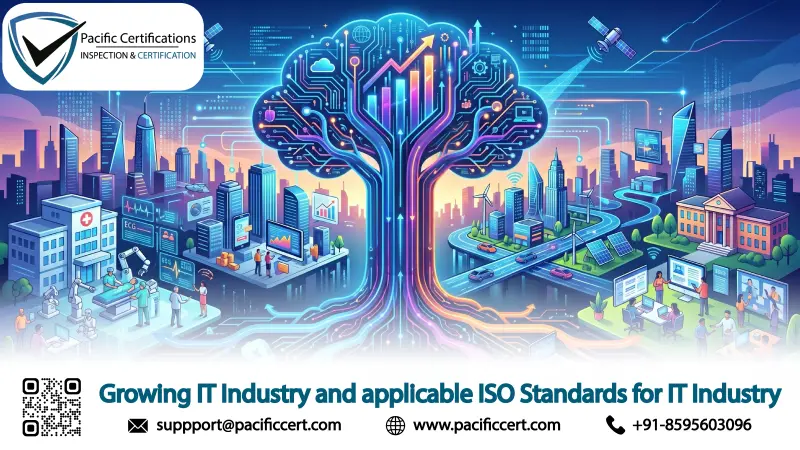
Growing IT Industry and applicable ISO Standards for IT Industry

Growing IT Industry and applicable ISO Standards for IT Industry

Introduction

The information‑technology (IT) sector continues to expand at a remarkable pace, driven by digital transformation, cloud adoption, artificial intelligence, and the rise of global capability centers. As the market swells, IT firms face mounting pressure to deliver secure, reliable, and high‑quality services while meeting increasingly stringent regulatory and customer expectations. Internationally recognized ISO standards provide a proven framework for managing information security, service delivery, quality, and risk, helping IT organizations turn growth into sustainable competitive advantage.

Core ISO Standards Frequently Applied by IT Companies

Standard

Primary Focus

Relevance to IT Firms

ISO 9001:2015

Quality Management System (QMS)

Provides a baseline for consistent service delivery, document control, internal audits, and continual improvement across all IT processes (development, support, consulting).

ISO/IEC 27001:2022

Information Security Management System (ISMS)

The cornerstone for protecting data, applications, infrastructure, and cloud services through risk assessment, access control, cryptography, incident management, and supplier security.

ISO/IEC 20000‑1:2018

IT Service Management (ITSM)

Sets requirements for a service‑management system that covers service design, transition, operation, continual improvement, and alignment with business needs—ideal for MSPs, SaaS providers, and internal IT departments.

ISO/IEC 27017:2015

Cloud‑specific security controls

Offers guidance on securing cloud environments, including shared responsibility, VM hardening, API security, and tenant isolation—essential for IaaS/PaaS/SaaS vendors.

ISO/IEC 27018:2019

Cloud privacy for personal data

Aligns with GDPR‑like principles (purpose limitation, data minimization, transparency, breach notification) for organizations handling personal data in the cloud.

ISO 22301:2019

Business Continuity Management Systems

Ensures IT services remain available during disruptions via business‑impact analysis, recovery strategies, crisis communication, and plan testing.

ISO/IEC 27701:2019

Privacy Information Management System (PIMS)

Extends ISO 27001 to manage personally identifiable information (PII) controllers and processors, helping meet privacy regulations.

ISO 31000:2018

Risk Management

Provides principles and guidelines for managing risk across strategic, operational, and project levels—useful for IT risk assessments and project planning.

ISO/IEC 38500:2015

IT Governance

Outlines principles for effective, efficient, and acceptable use of IT within organizations, guiding boards and senior management on IT investment decisions.

ISO/IEC 29110 (parts 1‑5)

Software Development Lifecycle for Very Small Entities

Tailors software‑engineering processes for micro‑organizations and start‑ups, supporting agile, lean, or V‑model approaches.

ISO/IEC 27032:2012

Cybersecurity

Offers a framework for addressing cyber‑risks, stakeholder cooperation, and information sharing across sectors.

ISO/IEC 42001:2023

AI Management System

Provides requirements for governing AI‑based products and services, covering ethics, transparency, robustness, and lifecycle management—becoming increasingly relevant as AI adoption accelerates.

ISO 14001:2015 (optional)

Environmental Management System

Allows IT firms to manage the environmental impact of data centers, e‑waste, and energy consumption, aligning with sustainability goals.

Why ISO Standards Matter for IT Companies?

ISO standards offer a risk‑based, process‑oriented approach that helps IT firms:

  • Protect information assets – Controls for confidentiality, integrity, and availability reduce the likelihood of data breaches and cyber‑attacks.

  • Deliver consistent service – Defined service‑management processes improve incident response, change control, and SLA compliance.

  • Meet regulatory and contractual requirements – Many governments, regulators, and large customers mandate ISO‑based proof of competence (e.g., GDPR, PCI‑DSS, sector‑specific security rules).

  • Enhance customer trust – Certification signals independent verification of security, quality, and reliability, often shortening sales cycles and winning enterprise contracts.

  • Drive continual improvement – The Plan‑Do‑Check‑Act cycle embedded in most ISO standards fosters ongoing refinement of processes, tools, and skills.

  • Enable integration – The high‑level structure (Annex SL) shared by ISO 9001, ISO/IEC 27001, ISO/IEC 20000‑1, ISO 22301, etc., allows organizations to maintain a single, unified management system rather than multiple siloed frameworks.

How IT Companies Benefit from ISO Certification?

  1. Reduced security incidents – ISO 27001‑based risk assessments and controls lower the frequency and impact of data breaches, ransomware, and insider threats.

  2. Improved service reliability – ISO 20000‑1 standardizes incident, problem, change, and release management, leading to faster resolution times and higher SLA compliance.

  3. Market access and tender eligibility – Many government contracts, financial‑sector RFPs, and multinational supplier lists require ISO 27001, ISO 20000‑1, or ISO 9001 as pre‑qualification criteria.

  4. Customer confidence – Independent audit reports and certificates act as tangible proof of compliance, often influencing purchase decisions and reducing due‑diligence effort for buyers.

  5. Operational efficiency – Documented procedures, clear role definitions, and performance metrics cut rework, optimise resource utilisation, and enable better capacity planning.

  6. Continual improvement culture – Regular internal audits, management reviews, and corrective‑action loops drive incremental enhancements in technology stacks, staff skills, and service offerings.

  7. Facilitated integration – The shared Annex SL structure allows organizations to combine, for example, ISO 9001, ISO 27001, and ISO 20000‑1 into a single integrated management system, reducing audit duplication and administrative overhead.

  8. Enhanced reputation – Certification demonstrates a commitment to best practices, which can be leveraged in marketing, employer branding, and investor relations.

Practical Path to ISO Certification for IT Firms

While each standard has unique clauses, the overall certification journey follows a similar pattern:

  1. Leadership Commitment & Scope Definition – Top management defines the purpose (e.g., protect customer data, ensure service availability), allocates resources, and determines which sites, services, or product lines are in scope.

  2. Gap Analysis – Compare existing policies, procedures, and controls against the chosen ISO standard(s) to identify missing documents, undefined responsibilities, uncontrolled risks, and inadequate monitoring.

  3. Documentation Development – Create or update a quality manual (or integrated manual), SOPs, work instructions, and record templates (e.g., risk‑assessment registers, incident logs, change‑request forms, service‑level agreements, backup‑verification logs).

  4. Implementation & Training – Deploy the documented controls across projects and operations; conduct role‑specific training for developers, service‑desk staff, security analysts, and managers.

  5. Internal Audits – Schedule regular audits (quarterly or semi‑annual) to verify compliance, capture non‑conformities, and initiate corrective actions.

  6. Management Review – Senior leadership reviews audit results, KPIs (mean‑time‑to‑detect/respond, SLA compliance, security incidents), customer feedback, and improvement opportunities; updates objectives and resources.

  7. Select an Accredited Certification Body – Choose a body accredited by a recognized forum (e.g., NABCB, UKAS, ANAB, ABIS) that has experience auditing IT‑sector standards.

  8. Stage‑1 (Document Review) Audit – Auditor examines documentation for conformity; gaps are reported for correction.

  9. Stage‑2 (On‑Site/Remote) Audit – Auditor observes processes, interviews staff, and checks evidence (e.g., access‑control logs, change‑approval records, incident‑response reports, privacy impact assessments) against the standard’s requirements.

  10. Corrective‑Action Closure – For each major non‑conformity, submit a plan with owners, timelines, and verification evidence; the certification body reviews and accepts the closure.

  11. Certification Issuance – Once all findings are closed, the organisation receives the ISO certificate (typically valid for three years).

  12. Surveillance & Recertification – Annual surveillance audits confirm ongoing conformity; a full recertification audit is required at the end of the cycle to renew certification.

Common Challenges and Practical Solutions

Challenge

Why It Occurs

Mitigation Strategy

Documentation overload

Teams view ISO as “paperwork‑heavy.”

Keep SOPs concise, flow‑chart driven, and linked to existing templates; use a cloud‑based document‑management system with version control and search.

Resistance to change

Engineers may perceive new procedures as restrictive.

Involve technical leads in procedure design; highlight how standards reduce production incidents and improve defect detection; recognize compliance achievements publicly.

Resource constraints

Small IT firms lack dedicated compliance staff.

Priorities high‑impact clauses (e.g., access control, change management) first; consider phased implementation; leverage free ISO guidance documents and webinars.

Maintaining evidence

Auditors request logs scattered across multiple tools.

Centralize evidence in a shared repository or GRC platform; automate collection where possible (e.g., pull API‑access logs from SIEM into audit folders).

Keeping up with standard updates

ISO standards are revised periodically (e.g., ISO 27001:2022).

Assign a compliance officer to monitor ISO newsletters, attend relevant webinars, and schedule a gap review when a new edition is released.

Integrating multiple standards

Overlap can cause confusion (e.g., ITSM processes in both ISO 20000‑1 and ISO 27001).

Develop an integrated manual that maps each clause to the relevant standard; use a matrix to show where a single procedure satisfies several requirements.

  • AI‑focused standards – ISO/IEC 42001 (AI Management System) is gaining traction as organizations seek to govern AI ethics, bias, and safety.

  • Zero‑Trust and Cloud‑Native Security – ISO/IEC 27017 and 27018 are being interpreted to support zero‑trust architectures, container security, and serverless functions.

  • DevSecOps Integration – ISO 20000‑1 and ISO 27001 are being aligned with continuous‑integration/continuous‑deployment (CI/CD) pipelines, embedding security and service‑management controls into automated workflows.

  • Supply‑Chain Security – Increased focus on evaluating subcontractors and third‑party dependencies under ISO 27001’s supplier‑security clause, driven by high‑profile software‑supply‑chain attacks.

  • Sustainability and Green IT – Pairing ISO 14001 with ISO 27001 and ISO 20000‑1 to measure and reduce data‑center energy consumption and e‑waste.

  • Digital Credentials – Some certification bodies are experimenting with tamper‑proof digital certificates on distributed ledgers, enabling instant verification for global clients.

Staying attuned to these trends helps IT firms anticipate client needs and keep their ISO‑based management system relevant.

Conclusion

The IT industry’s rapid expansion, evidenced by double‑digit growth in spending, AI, IoT, and cloud markets, creates both tremendous opportunity and heightened exposure to security, reliability, and compliance risks. ISO standards such as ISO 9001, ISO/IEC 27001, ISO/IEC 20000‑1, ISO/IEC 27017, ISO/IEC 27018, ISO 22301, ISO/IEC 27701, ISO 31000, ISO/IEC 38500, ISO/IEC 29110, ISO/IEC 27032, and the emerging ISO/IEC 42001 provide a robust, internationally recognized framework for managing quality, information security, service delivery, continuity, privacy, governance, and AI risk.

By pursuing the appropriate ISO certifications—through a disciplined process of gap analysis, documentation, implementation, internal audit, and assessment by an accredited certification body—IT organizations can protect their assets, meet regulatory and customer expectations, improve operational efficiency, and differentiate themselves in a crowded marketplace. The result is not just a certificate on the wall, but a living management system that drives continual improvement, builds trust, and turns growth into lasting competitive advantage.

Contact us

For more information, contact us at support@pacificcert.com or +91-8595603096

Author: Ashish

Read More: Pacific Blogs

Pacific Certifications
Growing IT Industry and Applicable ISO Standards for IT Companies

Frequently Asked Questions

What is ISO certification for IT companies?
ISO certification for IT companies is an internationally recognized standard that demonstrates commitment to quality management, information security, and operational efficiency. It helps IT organizations prove they adhere to accepted international best practices and manage risks effectively.
Why do IT companies need ISO certification?
IT companies handle sensitive data, so ISO certification is essential to demonstrate trustworthiness and security measures to clients. It enhances business performance, improves customer satisfaction, provides competitive advantage, and opens doors to new business opportunities.
Which ISO standards are most applicable to IT companies?
The most relevant standards include ISO 27001 for Information Security Management, ISO 9001 for Quality Management Systems, ISO 20000-1 for IT Service Management, ISO 22301 for Business Continuity Management, and ISO 27017 and ISO 27018 for cloud security and data privacy.
What is ISO 27001 and why is it important for IT organizations?
ISO 27001 is the international standard for information security management systems that helps organizations manage security of assets like financial information, intellectual property, and client data. It enables IT companies to identify risks and implement controls to protect confidential information.
How does ISO 9001 benefit IT companies?
ISO 9001 helps IT organizations ensure they meet customer and regulatory requirements, streamline processes, improve operational efficiency, enhance customer satisfaction, and consistently deliver quality products and services. It focuses on continuous improvement and evidence-based decision making.
What is ISO 20000-1 and its relevance to IT service providers?
ISO 20000-1 outlines requirements for establishing and maintaining a service management system specifically designed for IT service management. It ensures consistent and reliable service delivery, which is vital for IT companies providing managed services and maintaining customer trust.
What are the benefits of ISO certification for IT companies?
Benefits include enhanced data security and protection, improved business resilience, increased customer confidence, better risk management, streamlined processes, compliance with regulations, reduced operational costs, and competitive advantage in the marketplace.
What is the difference between ISO 27017 and ISO 27018?
ISO 27017 provides security controls for cloud services and creates a safer cloud environment, while ISO 27018 focuses specifically on protecting personally identifiable information in public clouds. Both are extensions of ISO 27001 designed for cloud service providers.
How long does it take to achieve ISO certification for IT companies?
The timeline varies based on organization size, complexity, and current system maturity. The implementation process can take several months, and the management system must be fully operational for at least three months before the initial certification audit.
Can IT companies integrate multiple ISO standards?
Yes, IT companies can integrate multiple ISO standards through an Integrated Management System using Annex SL framework. This allows organizations to manage quality, security, environmental, and safety objectives within a single cohesive framework, reducing redundancies and optimizing performance.
Pacific Certifications

Pacific Certifications

Looking for ISO Certification? Get in touch now!

Pacific Certifications

Pacific Certifications is an independent, internationally recognized certification body providing third-party audit and certification services for management system standards such as ISO 9001, ISO 14001, ISO/IEC 27001, ISO 45001, and other ISO standards. We also provide product certification services and training and personnel certification programs designed to support organizational and professional competence.