# Top ISO Certifications Explained: ISO 9001, ISO 14001, ISO 45001, ISO/IEC 27001
Author: Pacific Certifications
Author URL: https://blog.pacificcert.com/author/pacific-certifications/
Published: 2026-01-22
Meta Title: Top ISO Certifications 2026 Explained | 9001, 14001, 27001, 45001
Meta Description: Master the 2026 ISO updates. Guide to ISO 9001:2026, 14001:2026, 45001, and 27001. Learn about the mandatory Climate Action Amendments and 2026 revisions.
Tags: ISO 14001, ISO 45001, ISO IEC 27001:2022, iso 9001
Tag URLs: ISO 14001 (https://blog.pacificcert.com/tag/iso-14001/), ISO 45001 (https://blog.pacificcert.com/tag/iso-45001/), ISO IEC 27001:2022 (https://blog.pacificcert.com/tag/iso-iec-270012022/), iso 9001 (https://blog.pacificcert.com/tag/iso-9001/)
URL: https://blog.pacificcert.com/top-iso-certifications-explained-iso-9001-14001-45001-27001/
## Introduction
ISO certifications have **grown** into much more than simple quality stamps, they show that a company takes its processes, safety, data security, and environmental impact seriously. No matter what field you’re in, whether that’s manufacturing, tech, healthcare, or services, these standards create a shared language of reliability recognized worldwide. By Implementing ISO standards, organizations not only make their operations stronger, but also build trust with customers, **open up** new business opportunities, and set themselves up for lasting success.
Check ISO Certification Cost
## **Quick summary**
ISO certifications are international benchmarks developed by the International Organization for Standardization. They standardize practices across quality management, environmental protection, occupational health and safety and information security. The most recognized standards include [**ISO 9001**](https://pacificcert.com/iso-9001-2015-quality-management-system-certification/) (Quality Management), [**ISO 14001**](https://pacificcert.com/iso-14001-2015-environmental-management-systems/) (Environmental Management), [**ISO 45001**](https://pacificcert.com/iso-45001-2018-health-safety/) (Occupational Health and Safety) and [**ISO/IEC 27001**](https://pacificcert.com/iso-iec-27001-2022-information-security-management-systems/) (Information Security Management). These certifications are applicable to organizations of all sizes and industries, improving both compliance and credibility _._
[Assess the case for an integrated management system](https://pacificcert.com/contact-us/): Look at opportunities to combine processes, audits, and documentation for quality, environment, safety, and information security under one structure.
## **Why ISO certifications matter for modern organizations?**
For organizations operating in an **increasingly** regulated and competitive world, ISO certifications are more than compliance - they are proof of consistency, accountability and trust. Global markets, investors and customers now demand evidence that companies follow reliable systems to manage quality, environment, safety and security. These standards ensure every process is controlled, monitored and continuously improved.
When a company gets ISO certified, it’s not just about recognition. It means **fewer** mistakes, less waste, stronger supply chain results, and more stability during audits or periods of uncertainty. Customers see certification as a signal that they can rely on the business, while employees benefit from clear expectations, measurable targets, and a stronger sense of responsibility throughout the organization.
Many organizations ask us about the key differences and combined benefits of ISO 9001, ISO 14001 and ISO 45001, so this guide compares these standards to help you choose the right certification path.
Review ISO Certification Requirements
> “ _ISO certifications translate best practices into measurable, repeatable systems that build long-term business trust_.”
## **Key ISO standards and What they mean?**
**Standard**
**Focus Area**
**Purpose**
**Who Needs It**
ISO 9001
Quality Management
Standardizes process control, customer satisfaction and continual improvement
All industries
ISO 14001
Environmental Management
Focuses on reducing waste, emissions and environmental impact
Manufacturing, construction and energy sectors
ISO 45001
Occupational Health and Safety
Reduces workplace incidents and promotes employee well-being
All workplaces, especially industrial sectors
ISO/IEC 27001
Information Security
Protects data through structured risk assessment and security controls
IT, finance, healthcare and data-driven companies
ISO 22301
Business Continuity
Ensures business stability during disruptions
Financial, IT, logistics and critical services
ISO 50001
Energy Management
Promotes energy efficiency and cost reduction
Manufacturing, transport and infrastructure industries
ISO 22000
Food Safety Management
Addresses food safety from production to delivery
Food processing, packaging and catering sectors
## **What are the common requirements of ISO certifications?**
Achieving ISO certification requires an organization to design, implement and maintain a system that follows structured policies, risk management and measurable performance. Certification readiness involves leadership commitment, documentation and internal evaluation. Below are the key requirements:
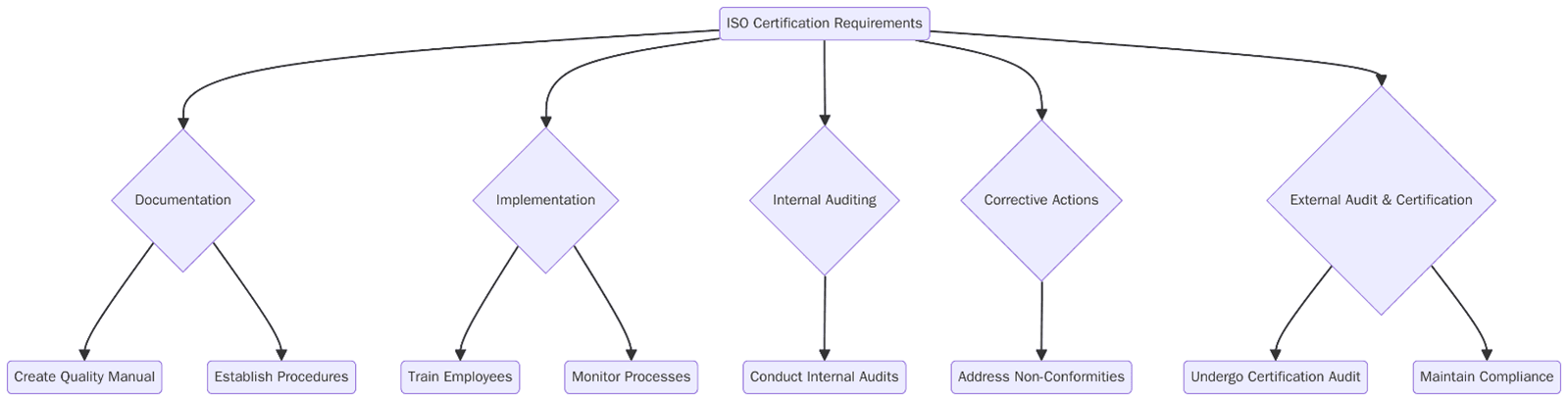
1. **Define** the scope of operations and relevant standards.
2. **Establish** policies and objectives aligned with the chosen ISO standard.
3. **Conduct** risk assessments to identify potential weaknesses.
4. **Document** operational procedures, performance metrics and training records.
5. **Ensure** employee competence and engagement in the management system.
6. **Perform** internal audits to identify nonconformities.
7. **Take** corrective actions and record improvements.
8. **Undergo** management reviews to evaluate system performance.
9. **Engage** an accredited certification body for external audits.
**Tip:** _Before certification, conduct a gap analysis to understand how existing processes align with ISO requirements. This will help avoid delays and additional costs during Stage-1 and Stage-2 audits._
Understand the ISO Process - Contact us
## **What are the benefits of ISO certifications?**
ISO certification brings credibility, discipline and measurable improvement across all operations. Organizations that invest in certification see tangible results in productivity, compliance and market growth. Below are the key benefits:
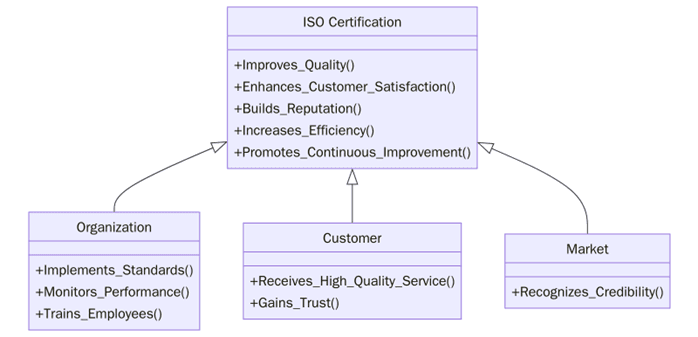
- **Improved** process reliability through documented procedures and controlled workflows.
- **Higher** customer satisfaction by ensuring consistent product and service quality.
- **Enhanced** environmental responsibility, reducing waste and energy consumption.
- **Stronger** data protection under frameworks like ISO/IEC 27001, minimizing cyber risks.
- **Better** workplace safety with ISO 45001, reducing accidents and absenteeism.
- **Increased** competitiveness in global markets through recognized standards.
- **Stronger** supplier confidence and easier entry into regulated sectors.
- **Reduced** costs through better efficiency, fewer incidents and less waste.
- **Faster** tender qualification, as most public and international bids now require ISO certification.
- **Sustainable** reputation, building trust among customers, regulators and investors.
Schedule a certification readiness call with [Pacific Certifications](https://pacificcert.com/) and find which ISO standards best fit your organization’s goals.
## Recent Trends
In recent years, ISO certifications are increasingly used to meet environmental, social and governance (ESG) expectations. Industries are integrating multiple standards under a single management framework, known as integrated management systems (IMS). **ISO 27001** certifications have surged across healthcare and fintech sectors due to global data protection mandates, while **ISO 50001** adoption has expanded in energy-intensive industries focused on carbon reduction and sustainability reporting.
Recent data shows that organizations adopting ISO standards achieve a **20–30%** reduction in process-related costs, a 40% improvement in customer satisfaction scores and up to 50% lower incident rates in workplace safety. These numbers demonstrate that ISO certification drives measurable financial and operational results. **By 2030**, ISO certifications will play a central role in global supply chain management and ESG transparency. Standards like **ISO 14001** and **ISO 50001** will be critical to achieving sustainability targets, while **ISO/IEC 27001** and **ISO 42001** will shape digital governance and AI ethics frameworks. Organizations with certified management systems will have stronger resilience, credibility and competitive positioning in international markets.
Get ISO Certification Details
## **How Pacific Certifications can help?**
Pacific Certifications provides accredited ISO certification services for organizations across sectors. Our audits help companies strengthen governance, improve system reliability and achieve global recognition through impartial and transparent certification processes.
Request your ISO audit plan and fee estimate. We will help you map Stage-1/Stage-2 timelines and evidence requirements for your organization. Contact us at [**support@pacificcert.com**](mailto:support@pacificcert.com) or visit [**www.pacificcert.com**](https://pacificcert.com/).
## **Training and courses**
Pacific Certifications provides accredited training programs for key ISO standards such as ISO 9001, ISO 14001, ISO 45001, and ISO/IEC 27001, designed to help professionals and organizations strengthen their management system knowledge and audit capabilities:
**·** [**Lead Auditor Training**](https://pacificcert.com/lead-auditor-training/) **:** Ideal for professionals responsible for conducting internal or external audits of quality, environmental, occupational health and safety, or information security management systems.
**·** [**Lead Implementer Training**](https://pacificcert.com/lead-implementer/): Intended for individuals tasked with developing, implementing, or improving ISO management systems.
Apply for Training
### **Contact Us**
[**Contact Pacific Certifications**](https://pacificcert.com/contact-us/) to begin your certification journey today!
**Author: Alina Ansari**
Read more: [Pacific Blogs](https://blog.pacificcert.com/)
## FAQs
Q: Which ISO standard should an organization start with?
A: Most organizations begin with ISO 9001, as it builds the foundation for quality and process control.
Q: How long does ISO certification take?
A:
It takes 6 to 12 months depending on the organization’s size and readiness.
Q: Are ISO certifications valid globally?
A:
Yes, ISO certifications are recognized worldwide and accepted across international markets.
Q: What is the difference between ISO 9001 and ISO 14001?
A:
ISO 9001 focuses on quality management, while ISO 14001 deals with environmental performance.
Q: Can small businesses get ISO certified?
A:
Yes, ISO standards are scalable and can be implemented by small and medium enterprises.
Q: What is the validity of ISO certification?
A:
Certifications are valid for three years, with annual surveillance audits to maintain compliance.
Q: How often are audits conducted?
A:
Surveillance audits take place annually; recertification audits occur every three years.
Q: Does ISO certification improve profitability?
A: Yes, by reducing waste, preventing rework and increasing process efficiency, profitability improves over time.
Q: Is employee involvement necessary for ISO certification?
A:
Absolutely, employee participation is key to maintaining system effectiveness.
Q: What are integrated management systems (IMS)?
A:
IMS combines multiple ISO standards - such as ISO 9001, ISO 14001 and ISO 45001, into one unified framework.
---
This blog is powered by Superblog. Visit https://superblog.ai to know more.
---