Introduction
In 2026, businesses face stronger expectations from customers, supply chain partners, and other stakeholders. Organizations are increasingly expected to provide clear evidence of quality control, information protection, reliable service delivery, workplace safety, and responsible environmental practices.
These expectations can become more challenging when operations involve multiple locations, suppliers, digital systems, or remote teams. A structured management system helps organizations define responsibilities, control risks, maintain records, and review whether processes are working as intended.
ISO standards provide internationally recognized frameworks for managing many of these areas. Where certification is applicable, an independent certification audit can provide assurance that the management system has been assessed against the requirements of the relevant standard.
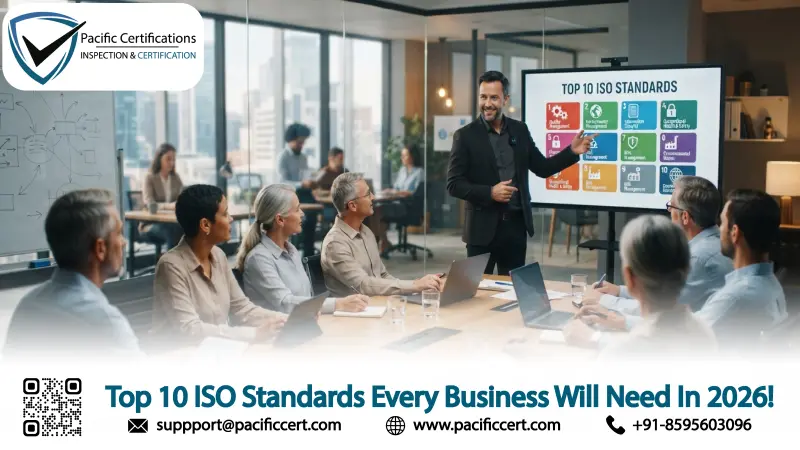
This guide covers ten widely applicable ISO standards that organizations may consider in 2026. The right standards depend on factors such as business activities, customer requirements, information handled, supply chain complexity, legal obligations, and overall risk exposure.
Most organizations do not need to implement every standard at once. A practical approach is to identify the standards that address current business needs first and, where appropriate, gradually integrate them into an integrated management system.
Quick summary
In 2026, businesses face growing pressure around quality, cybersecurity, continuity, sustainability, workplace safety, privacy and AI governance. The article highlights ten relevant standards, including ISO 9001, ISO/IEC 27001, ISO 22301, ISO 14001, ISO 45001, ISO/IEC 27701, ISO/IEC 42001, ISO 50001, ISO 37001 and ISO 28000. Rather than pursuing every standard, organizations should select those that match their risks, customer expectations and operations. An integrated approach can reduce duplication, strengthen controls and improve readiness for audits, tenders and supply-chain requirements.
Why these ISO standards matter in 2026?
Many organizations now operate through cloud platforms third-party logistics outsourced IT and hybrid teams. This makes consistency harder to maintain and increases risk when responsibilities are unclear. ISO standards give organizations a common structure for defining scope assigning roles managing risks running internal audits and reviewing performance at leadership level.
In tenders and supplier onboarding processes buyers still use ISO certificates as a first filter. Having the right certifications can shorten vendor approval cycles and reduce repeated questionnaires. For internal teams the same standards also improve clarity around processes evidence ownership and escalation rules.
Top 10 ISO standards businesses will need
ISO 9001 Quality Management System
ISO 9001 provides a structured approach to quality management. It helps organizations control processes, address customer requirements, monitor performance, and improve the consistency of products and services. It is widely applicable across manufacturing, professional services, construction, technology, healthcare, and other sectors.
Read more: ISO 9001
ISO/IEC 27001 Information Security Management System
Cyberattacks, unauthorized access, and third-party data risks can affect organizations of every size. ISO/IEC 27001 provides requirements for establishing an Information Security Management System (ISMS) based on identified risks. The standard supports controls around information access, security responsibilities, incident management, supplier relationships, and ongoing risk assessment.
Read more: ISO/IEC 27001
ISO 22301 Business Continuity Management System
Technology failures, supplier disruptions, natural events, and other incidents can interrupt critical operations. ISO 22301 helps organizations develop a structured approach to business continuity. It focuses on understanding critical activities, planning appropriate responses, testing continuity arrangements, and improving the organization's ability to recover from disruption.
Read more: ISO 22301
ISO 14001 Environmental Management System
Organizations are facing greater expectations to understand and manage their environmental impacts. ISO 14001 provides a framework for controlling environmental risks and meeting applicable compliance obligations. Businesses can use it to manage areas such as waste, emissions, resource consumption, pollution prevention, and environmental objectives.
Read more: ISO 14001
ISO 45001 Occupational Health and Safety Management System
Workplace injuries and occupational hazards remain important concerns, particularly in construction, manufacturing, logistics, healthcare, and other higher-risk activities. ISO 45001 helps organizations identify health and safety hazards, assess risks, establish controls, investigate incidents, and continually improve workplace safety performance.
Read more: ISO 45001
ISO/IEC 27701 Privacy Information Management System
Organizations that process personal information need clear responsibilities and controls for privacy management. ISO/IEC 27701 provides a framework for managing privacy risks and responsibilities associated with personally identifiable information (PII). It addresses areas such as privacy roles, processing activities, records, controls, and responsibilities for organizations acting as PII controllers or processors.
Read more: ISO/IEC 27701
ISO/IEC 42001 AI Management System
The growing use of artificial intelligence creates new governance, accountability, and risk-management requirements. ISO/IEC 42001 provides a management system framework for organizations that develop, provide, or use AI systems. It helps organizations establish AI policies, define responsibilities, assess risks and impacts, monitor AI systems, and maintain appropriate governance throughout their lifecycle.
Read more: ISO/IEC 42001
ISO 50001 Energy Management System
Rising energy costs and efficiency goals are encouraging organizations to manage energy use more systematically. ISO 50001 provides a framework for improving energy performance through measurement, planning, monitoring, and continual improvement. Organizations can use the standard to identify significant energy uses, establish performance indicators, set objectives, and evaluate the results of energy improvement initiatives.
Read more: ISO 50001
ISO 37001 Anti-Bribery Management System
Organizations working with complex procurement networks, intermediaries, contractors, or international partners may face increased bribery risks. ISO 37001 helps establish anti-bribery policies, responsibilities, due diligence procedures, financial and non-financial controls, reporting mechanisms, and processes for investigating concerns.
Read more: ISO 37001
ISO 28000 Security and Resilience Management System
Supply chains can be affected by theft, unauthorized access, cargo disruption, security incidents, and other operational threats. ISO 28000 provides a structured approach to supply chain security and resilience. It helps organizations identify security risks and establish controls across activities such as sourcing, warehousing, transportation, and logistics. This can support more secure, traceable, and resilient supply chain operations.
Read more: ISO 28000
What are the requirements for these standards?
Most of these standards follow a similar management system logic. They require clear scope leadership involvement defined responsibilities risk-based planning documented processes performance monitoring internal audits corrective actions and management review. Below are some of the key requirements:
Define the scope for each standard including sites remote teams outsourced processes and critical suppliers.
Establish policies and measurable objectives linked to the chosen standards.
Assign roles responsibilities and authorities for each part of the management system.
Identify risks and opportunities relevant to quality security continuity safety environment privacy AI energy or integrity.
Maintain documented processes and records that reflect real operations.
How to prepare for ISO certification in 2026?
Preparation in 2026 should focus on aligning ISO systems with digital workflows supplier realities and hybrid work models. The most successful organizations start with a clear scope and a realistic plan then build evidence through internal audits before the external cycle begins.
Below are some of the key preparation steps:
Identify which standards match your market expectations and risk profile.
Map current processes and compare them with the chosen standard clauses.
Define scope for locations products services data flows and third-party dependencies.
Assign owners for each standard area and confirm leadership oversight.
Train teams based on their roles and daily responsibilities.
Run internal audits to test readiness and close gaps early.
Plan certification in phases if multiple standards are needed within the year.
Certification audit
Stage 1 audit: Review of scope documented system structure policies objectives risk methods and readiness for Stage 2 across the selected standards.
Stage 2 audit: Verification of implementation across operations sites suppliers and digital systems including samples of records interviews and performance evidence.
Nonconformities: Must be corrected with documented root causes updated controls improved records and evidence that changes are in use.
Final certification: Issued once the management system meets the applicable ISO requirements for the defined scope and all nonconformities are closed.
Surveillance audits: Conducted annually to confirm that controls remain active and aligned with business changes across the cycle.
Recertification audits: Required every three years to review the full system expanded scope new risks and major operational changes.
What are the benefits of choosing the right mix?
Choosing the right combination of ISO standards in 2026 helps organizations focus effort where it matters most. It also reduces duplicated controls by allowing shared processes across multiple standards. A well-planned approach supports credibility in the market and steadier delivery under modern operational pressure. Below are some of the key benefits:
Stronger success in tenders and vendor approvals due to clearer trust signals.
More consistent product and service delivery across teams and locations.
Better control over cyber risk privacy risk and AI use where applicable.
Stronger supply chain oversight with clearer expectations for critical vendors.
Improved readiness for disruptions through structured continuity planning.
Market Trends
In 2026 more organizations will move toward integrated management systems where one structure supports quality, environment, safety, security, privacy and AI governance. Audits will rely more on digital evidence such as system logs dashboards workflow approvals and supplier performance data. Businesses that keep documentation aligned with real operations and that build shared internal audit programs will find it easier to expand certification scope without rebuilding the system each time.
Training and courses
Pacific Certifications provides accredited training programs that support multi-standard readiness:
Lead auditor training: For professionals who assess integrated management systems across quality security safety environment privacy and AI governance.
Lead implementer training: For teams building structured systems that can support several ISO standards under one aligned framework.
For training aligned with your 2026 certification plan contact support@pacificcert.com.
How Pacific Certifications can help?
Pacific Certifications provides accredited audit and certification services for a wide range of ISO management system standards. We help organizations define clear scope plan realistic audit schedules and complete impartial assessments across single or integrated certification programs. We issue Certificates of Conformity following objective audits and do not provide consultancy or system design services.
Contact Us
To request an audit plan for 2026 certification priorities contact support@pacificcert.com or visit www.pacificcert.com.
Also read: ISO Certifications for Exhibition & Conference Centres, Requirements and Benefits