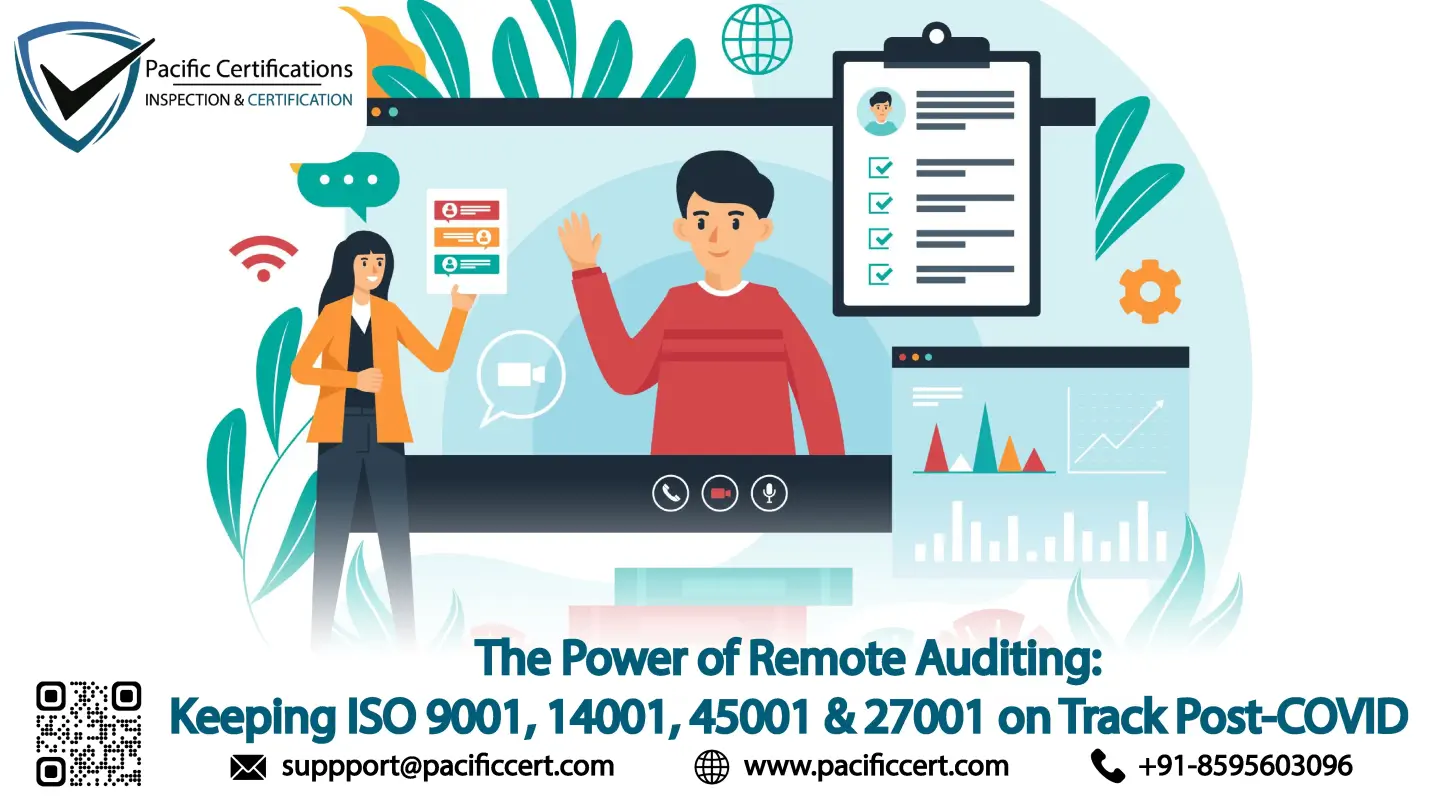
Remote Auditing: Keeping ISO 9001, 14001, 45001 & 27001 on Track
Introduction
The COVID-19 pandemic reshaped the way organizations approach audits and certification. With global restrictions on travel and on-site assessments, remote auditing emerged as a practical solution to keep ISO certifications active while ensuring safety and business continuity. Far from being a temporary fix,ISO remote auditing has become a powerful tool in the post-COVID world, offering flexibility, cost savings and greater accessibility for organizations across industries.
For standards like ISO 9001 (quality management), ISO 14001 (environmental management), ISO 45001 (occupational health & safety) and ISO/IEC 27001 (information security), remote audits ensure organizations can demonstrate compliance without disruption. This approach not only saves time and money but also encourages wider participation from global teams and stakeholders.
Quick summary
Remote auditing allows certification audits to be conducted virtually using secure digital platforms. Organizations can share evidence electronically, hold video interviews and review documentation in real-time. This approach helps maintain compliance with ISO standards while reducing travel costs, improving accessibility and increasing audit efficiency.
Explore how remote auditing could work for your management systems: Consider which sites, processes, and standards in your scope are most suitable for virtual audit techniques.
Why remote auditing matters for ISO certifications?
Post-COVID, organizations needed agile ways to continue certification while adapting to digital workflows. ISO Remote auditing delivers on this by minimizing disruption, maintaining audit schedules and cutting expenses tied to travel and logistics. According to a 2024 BSI survey, 72% of organizations reported remote audits were as effective as on-site audits and over 60% said they preferred a hybrid audit model going forward.
By embracing remote auditing, organizations demonstrate resilience, adaptability and commitment to maintaining global standards even under challenging circumstances. It also enables auditors to involve diverse teams across geographies, providing broader insights and a richer assessment of systems.
Remote auditing is no longer a temporary solution; it’s a strategic approach that adds efficiency, inclusivity and global reach to ISO certification.
Relevant ISO standards and remote auditing applications
What are the requirements for remote ISO auditing?
Organizations preparing for remote ISO audits must ensure they can provide clear, accessible and verifiable evidence through digital means. This involves setting up the right technology, training staff and securing documentation to ensure confidentiality. Below are some of the key requirements:

Reliable digital tools for video conferencing, file sharing and screen sharing.
Digitized documentation, including policies, records and logs.
Secure access for auditors to review sensitive files.
Defined audit scope and timelines shared in advance.
Staff availability for interviews and walkthroughs.
Evidence of risk assessments and corrective actions in digital format.
Data security measures for protecting shared information.
Tip: Test all digital tools at least one week before the audit to avoid technical issues that could disrupt the assessment.
How to prepare for a remote audit?
Preparation requires aligning systems with digital workflows and ensuring transparency in evidence-sharing.
1. Conduct a pre-audit readiness check with internal teams.
2. Organize all records in accessible digital folders.
3. Assign roles for staff to assist during video sessions.
4. Share login credentials securely for auditors when needed.
5. Simulate an internal remote audit to identify technical or process gaps.
6. Track KPIs like complaint resolution times, SLA adherence and environmental performance to present as evidence.
Certification audit
Stage 1 audit: Reviews documentation and evidence via digital platforms.
Stage 2 audit: Evaluates implementation across processes, staff interviews and system demonstrations remotely.
Nonconformities: Must be corrected and verified with digital evidence.
Management review: Confirms leadership commitment during virtual meetings.
Final certification: Awarded once compliance is confirmed.
Surveillance audits: Conducted annually through remote or hybrid methods.
Recertification audits: Every three years, increasingly done through blended models.
What are the benefits of remote ISO auditing?
Remote ISO auditing offers organizations a way to keep certification active while driving efficiency, sustainability and accessibility. It not only reduces the logistical burden of traditional audits but also opens the door to smarter, technology enabled compliance. Below are the key benefits of remote auditing:

Lower certification costs because travel, accommodation and logistical expenses are eliminated.
Reduced environmental impact, as fewer flights and site visits mean significantly lower carbon emissions.
Greater flexibility in scheduling, making it easier for auditors and staff across time zones to participate.
Broader inclusion of global teams, allowing institutions with multiple sites to be assessed more comprehensively.
Faster evidence reviews and reporting through real-time document sharing and digital collaboration platforms.
Market Trends
In recent years, remote and hybrid auditing models have become the new normal. Certification bodies are integrating advanced digital tools such as AI-driven analytics for document review, blockchain for tamper-proof evidence sharing and immersive AR/VR audits for site inspections. Regulators are increasingly recognizing remote audits as equivalent to on-site visits, making them a long-term fixture in certification frameworks. This shift signals that remote auditing is not just an alternative but a forward-looking model that will define the future of compliance.
Looking ahead, the advantages of remote auditing are expected to grow. A PwC report predicts that by 2030, organizations using remote or hybrid audits could see up to 35% cost reductions compared to traditional on-site audits. Similarly, the International Energy Agency (IEA) projects that digitized audit practices could help reduce audit-related carbon emissions by 50% globally by 2030. These forecasts highlight that remote auditing is not just a pandemic-era adaptation but a forward-looking model that delivers long-term financial and environmental benefits.
How Pacific Certifications can help?
Pacific Certifications offers accredited remote auditing services across ISO 9001, ISO 14001, ISO 45001 and ISO/IEC 27001. Our remote audits maintain rigor while reducing costs and improving flexibility, helping organizations stay compliant without compromising safety.
Contact us
Request your remote ISO audit plan and fee estimate, we will help you map timelines, technology requirements and evidence expectations for your institution. Contact us at support@pacificcert.com or visit www.pacificcert.com.
Author: Alina Ansari
Read more: Pacific Blogs