# Maintaining Your ISO Certification: Surveillance Audits, NCRs, and Continuous Improvement
Author: Pacific Certifications
Author URL: https://blog.pacificcert.com/author/pacific-certifications/
Published: 2025-08-14
Meta Title: ISO Surveillance Audit & Continuous Improvement 2026 Guide
Meta Description: Master 2026 ISO surveillance audits, NCR resolution, and continuous improvement. Expert guide to digital evidence, Climate Action Amendments, and 2026 ISO revisions.
Tags: ISO NCR, Maintaining ISO Certification, Continuous Improvement, Need for ISO Certifications, ISO Surveillance audit
Tag URLs: ISO NCR (https://blog.pacificcert.com/tag/iso-ncr/), Maintaining ISO Certification (https://blog.pacificcert.com/tag/maintaining-iso-certification/), Continuous Improvement (https://blog.pacificcert.com/tag/continuous-improvement/), Need for ISO Certifications (https://blog.pacificcert.com/tag/need-for-iso-certifications/), ISO Surveillance audit (https://blog.pacificcert.com/tag/iso-surveillance-audit/)
URL: https://blog.pacificcert.com/maintaining-iso-certification-surveillance-audits-ncrs/
## **Introduction**
ISO certification can **deliver** many benefits; from improving operational efficiency, to increasing customer satisfaction and elevating credibility from peers in the market. But compliance and improvement are necessary for getting the ISO certification and maintaining compliance, and this is where surveillance audits, NCRs and continuous improvement come into play. ISO Surveillance audits can be conducted once a year or in some cases aged if nothing has changed. NCRs will identify whether you are not meeting status with ISO, and **continuous** improving gaps opportunity helps businesses remain compliant with ISO and allow for opportunities to improve changes over time.
For an organization, reaching ISO certification is anything but trivial and shows that your organization is following international standards in key areas such as quality management, information security and environmental duty of care. That said, achieving [ISO certification](http://www.iso.org) is merely the first step on your pathway to success. To ensure that your organization remains certified and keeps improving, it is important to understand the surveillance audit process that comes next as well as how to manage Non-Conformance Reports (NCRs) and how you can create a culture of continuous improvement.
In this blog, we will illustrate how all three will not only help you maintain ISO certification but also help you to keep your organization aligned to ISO standards.
For assistance, contact us at [**support@pacificcert.com**](mailto:support@pacificcert.com).
## **Surveillance Audits: Ensuring Ongoing Compliance**
Audits or surveillance assessments are **periodic** assessments conducted by certification bodies, to determine if your organization still complies with ISO standards/schemes. These audits are normally conducted on a yearly or bi-yearly basis. They are less **overreaching** compared to the first certification audit, but they are important in sustaining ISO certification and ensuring your organization stays compliant.
The main reasons for a surveillance audit are to ensure your organization follows the processes and practices under audit at your first certification audit, assess compliance with the ISO standard and regulatory requirements and ensure **opportunities exist** to identify weaknesses or areas in which the organization can improve processes.
Surveillance audits typically focus on the critical elements of the ISO standard that align with your business’s performance. Some elements may include:
- Document control
- Internal audits
- Corrective actions
- Risk management practices
- Legal and regulatory compliance
## **What are the Non-Conformance Reports (NCRs)?: Identifying Gaps and Taking Corrective Actions**
Auditors are likely to create **Non-Conformance Reports** (NCRs) during surveillance audits if there are areas where your organization doesn't fully meet ISO. NCRs are formal documents which summarize where your organization's processes or practices are non-compliant with ISO.
Despite NCRs **sounding** like bad news, they are really good news - they are useful in identifying which areas require action for improvement. In addressing NCRs, you must identify what caused the non-conformance, review your processes, systems or employee training, take action to rectify the issue and install a plan to ensure the issue does not occur again. Actions to rectify an NCR could entail process adjustments, retraining employees or altering policies and procedures. **Ensuring** that you modify the issues and keep accurate documentation of the actions taken to rectify the non-conformance will show to the auditor that you have addressed the issues and are monitoring the issue for happen again.
For assistance, contact us at [**support@pacificcert.com**](mailto:support@pacificcert.com).
## **Continuous Improvement: The core principle of ISO**
Continuous improvement is a core concept of ISO standards. ISO standards, particularly ISO 9001 (Quality Management) and ISO 14001 (Environmental Management), require organizations to assess and investigate their systems, processes, and performance continuously. Continuous improvement is a process of change that helps organizations respond to changes, address risks, and create opportunities for improvement.
The continuous improvement process in ISO standards is often referred to as the **Plan-Do-Check-Act (PDCA) cycle**:
1. **Plan:** Identify opportunities for improvement and develop a plan to address them
2. **Do:** Carry out the plan and implement changes to processes or systems as needed
3. **Check:** Measure and monitor effectiveness of the changes
4. **Act:** If the changes are effective, incorporate them into business as usual for your organization
This cycle helps your business improve and adapt naturally, so that you are not only ISO compliant but also continuously working towards operational excellence.
## **What are the Benefits of maintaining ISO certification through surveillance audits and continuous improvement?**
Maintaining ISO certification through **surveillance audits**, addressing **NCRs**, and focusing on **continuous improvement** brings several key benefits for businesses:
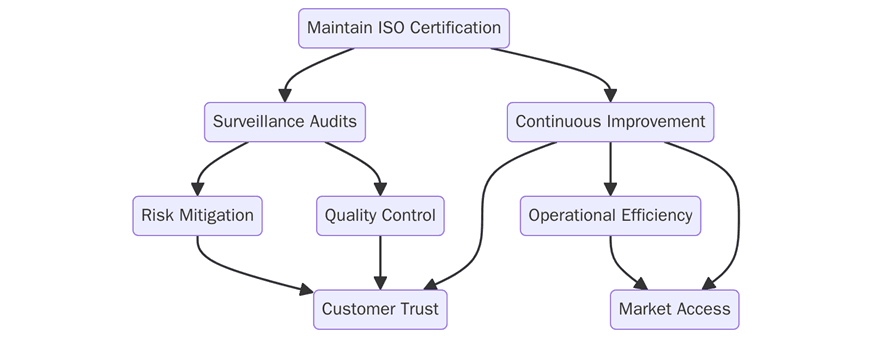
- **Surveillance audits** show your organization is still implementing necessary standards and regulation to avoid potential penalties or legal events.
- By **closing** NCRs and putting in place systems of continuous improvement, businesses can identify inefficiencies to improve process which can result in savings and resources.
- **Regular use** of surveillance audits and corrective actions to maintain ISO standards sends a powerful message to customers and stakeholders that your business is committed to quality, security and continual improvement.
- **Businesses maintaining** ISO certification are committed to standard operating procedure, and a commitment to “best practices” that supports positive reputation and competitive advantage.
- **Continuous improvement** promotes collaboration and accountability amongst employees as well as giving all employees the ability to bring innovation and philosophy of making things better to the organization.
## **How can** Pacific Certifications help?
Pacific Certifications is here to help your organization find the ISO certification process and maintain compliance through ongoing surveillance audits and continuous improvement efforts. Our team of experts can guide you every step of the way, ensuring that your business remains aligned with ISO standards.
### Contact Us
For assistance, contact us at [support@pacificcert.com](mailto:support@pacificcert.com).
Visit our website at [www.pacificcert.com](https://pacificcert.com/).
Read more: [Pacific Blogs](https://blog.pacificcert.com/)
Maintaining Your ISO Certification
## FAQs
Q: What are surveillance audits, and why are they important?
A:
Surveillance audits are scheduled assessments by certification bodies to ensure organizations are still meeting ISO requirements. They are important because they are repeated measures and give the organization a chance to show continuing certification requirements are met and they could identify opportunities for improvement.
Q: How often are surveillance audits conducted?
A:
Surveillance audits are conducted annually or biannually depending on the certification body and what a particular standard prescribes.
Q: What is the role of internal audits in maintaining ISO certification?
A:
Internal audits are important for identifying non-conformities, assessing compliance, and ensuring that your organization is consistently following the processes required by the ISO standard.
Q: How do I prepare for a surveillance audit?
A:
To prepare for a surveillance audit, you can conduct internal audits, review documentation, and make sure that the organization's processes and procedures are in place and operational.
Q: What do I do if I receive an NCR?
A:
If you receive a Non-Conformance Report (NCR), complete a root cause analysis to determine the factor that caused the non-conformance. Then you should take corrective actions to eliminate the non-conformance.
Q: What is the Plan-Do-Check-Act (PDCA) cycle and how does it relate to continuous improvement?
A:
The PDCA cycle is a framework for driving continuous improvement. The four steps of the PDCA cycle are: Plan improvements, Do improvements, Check to see if the improvement worked, and Act to implement the changes made if the check part of the cycle is successful.
Q: What is the difference between surveillance audits and recertification audits?
A:
Surveillance audits are periodic checks to ensure ongoing compliance, while recertification audits are more overreaching audits conducted at the end of the certification cycle to assess whether your organization should continue to be certified.
Q: Can ISO certification be revoked?
A:
Yes, ISO certification can be revoked if an organization fails to maintain compliance with the ISO standard or does not address issues identified during surveillance audits or recertification audits.
Q: How can continuous improvement impact my business?
A:
Continuous improvement leads to greater operational efficiency, cost savings, and improved product or service quality. It fosters innovation and keeps your business competitive.
Q: How can my business benefit from ISO certification?
A:
ISO certification improves operational efficiency, increases customer trust, ensures regulatory compliance, and improves your business’s reputation in the market.
---
This blog is powered by Superblog. Visit https://superblog.ai to know more.
---