# ISO for Startups and Tech Companies: Building Trust from Day One
Author: Pacific Certifications
Author URL: https://blog.pacificcert.com/author/pacific-certifications/
Published: 2025-08-11
Meta Title: ISO Certification for Startups 2026 | Build Trust & Scale Fast
Meta Description: Get ISO 27001, 9001 & 42001 for your tech startup. Master 2026 security updates, AI governance, and compliance for rapid enterprise scaling.
Tags: ISO for startups, ISO 27001 for Tech Company, ISO for Tech Companies, ISO 9001 for Tech Company, ISO 9001 for Startup
Tag URLs: ISO for startups (https://blog.pacificcert.com/tag/iso-for-startups/), ISO 27001 for Tech Company (https://blog.pacificcert.com/tag/iso-27001-for-tech-company/), ISO for Tech Companies (https://blog.pacificcert.com/tag/iso-for-tech-companies/), ISO 9001 for Tech Company (https://blog.pacificcert.com/tag/iso-9001-for-tech-company/), ISO 9001 for Startup (https://blog.pacificcert.com/tag/iso-9001-for-startup/)
URL: https://blog.pacificcert.com/iso-standards-for-digital-transformation/

## **Introduction**
For technology startups and small businesses, building **customer trust** can often be the most challenging part of the process. ISO certification allows your startup to have a tailored approach to start addressing these challenges, gain a competitive edge, and ensure that your organization's products and services assure that your customer expectations are met at a global standard.
Moving fast in the **world of tech** is all the rage! You have to make sure your business can move at speed while understanding that you must also be using processes that can be scalable, secure, and compliant with industry standards. ISO certification and standards help you and your business put a framework around these expectations. you may wish to consider the value it brings in terms of reputation, customer relationship building and improved performance through continuous improvement processes.
## Quick Summary
ISO standards help startups and tech firms build credibility by demonstrating adherence to global best practices. They facilitate compliance in regulated sectors like healthcare and tech, streamline processes to reduce waste, and boost productivity from day one. Achieving ISO certification signals a commitment to quality and reliability—deepening customer trust and fostering loyalty.
[Review how your current IT and security practices align with ISO frameworks](https://pacificcert.com/contact-us/): Reflect on existing controls, service processes, and recovery capabilities against standards like ISO/IEC 27001, ISO 20000, and ISO 22301
## **Why ISO Certification Matters for Startups?**
ISO certification is a powerful tool for startups looking to build trust with clients, investors, and regulatory bodies. It proves your commitment to quality, consistency, and ongoing improvement. Here’s why ISO certification is particularly important for startups and tech companies:
1. **Attaining** ISO certification shows that your organization meets widely accepted international standards. In turn, your credibility with potential clients, investment prospects, and other stakeholders increases.
2. In industries such as technology and health care, it is **critical** to meet industry required regulations. ISO standards ultimately help organizations manage risk by providing compliance frameworks.
3. ISO standards help organizations establish procedures that **reduce** waste, develop business processes, and improve productivity to support all organizations, but especially new startups, from the first day they open.
4. An ISO-certified business **communicates** to customers that they are committed to providing quality products and/or services which will in turn build trust and customer loyalty.
For assistance, contact us at [support@pacificcert.com](mailto:support@pacificcert.com).
## **Key ISO Standards for Startups and Tech Companies**
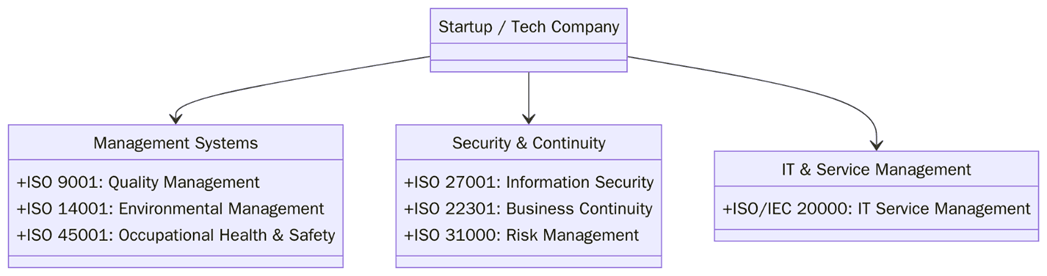
Startups, particularly in the tech industry, can benefit from a range of ISO standards that focus on quality, information security, and operational excellence. Here are some of the most relevant ISO standards for tech companies and startups:
### [ISO 9001:2015 Quality Management System (QMS)](https://pacificcert.com/iso-9001-2015-quality-management-system-certification/)
ISO 9001 is the most common quality management system (QMS). It provides businesses with an outline to improve processes, elevate customer satisfaction, and meet regulatory and customer requirements for products and services.
### [ISO/IEC 27001: The Information Security Management System (ISMS)](https://pacificcert.com/iso-iec-27001-2022-information-security-management-systems/)
For technology companies, data security is paramount. ISO/IEC 27001 is the undisputed authority for information security management, enhancing the ability of a business to protect sensitive data and comply with the requirements prescribed in security standards.
### [ISO 14001:2015 The Environmental Management System (EMS)](https://pacificcert.com/iso-14001-2015-environmental-management-systems/)
With the expectation that companies take ownership of their effects on the environment, ISO 14001 provides new ventures and technology companies the ability to adopt sustainable business practices. ISO 14001 structures an approach for managing environmental responsibilities, waste and resource efficiency, as evidenced by growing corporate social responsibility.
[Click here to find out more applicable standards to your industry](https://pacificcert.com/system-certifications/)
## **How to Get ISO Certified: Step-by-Step Process**
For startups and tech companies, the ISO certification process can be broken down into a few key steps:
1. **Choose** the correct ISO standard to match your business purposes (e.g., [ISO 9001:2015](https://pacificcert.com/iso-9001-2015-quality-management-system-certification/) for quality management, [ISO 27001](https://blog.pacificcert.com/iso-27001-2022-a-beginners-guide-to-certification/) /ISO/IEC 27001 for information security).
2. **Evaluate** your systems and processes to identify the gaps between your current state and the ISO standard.
3. **Amend** your processes, documents and systems until you can meet the ISO standard.
4. **Regularly** conduct internal audits of your systems to satisfy your documented ISO system standard.
5. **Choose** an accredited certification body to conduct the formal audit.
6. The certification body will **conduct** an audit to check your compliance with the ISO standard.
7. **Maintain** your ISO status by conducting regular audits and amending your systems when required.
## How ISO Certification Helps Build Trust from Day One?
Trust is vital for startup success, and ISO certification provides multiple ways to show your startup's commitment to quality, security, and operational excellence.
ISO is globally recognized, which means your startup can **leverage** ISO certification to more easily engage larger international customers and partners. ISO certification also provides third-party verification of your processes so your clients and investors can be assured your business is committed to the silver standard for conduct. Investors will also be more apt to invest in your startup if it is using internationally recognized standards like ISO, as it **signifies** the business' integrity and trustworthiness, and provides evidence the business is well managed, safe and scalable.
Today is a very exciting time to start a business, as well as a frightening time to start a business. For some startups, especially in technology, it may be useful to garner trust on day one. Once a business is at a certain size, it is a requirement to be able to show that your organization is smooth, safe and consistently **delivering** high-quality products or services. ISO (International Organization for Standardization), has globally accepted standards that can help a startup or tech company show a focus on quality, safety and compliance right from the start of the business. In this blog we will explore how ISO certification can help startups, and tech businesses build trust, improve processes and create the first steps for success for many years to come.
For assistance, contact us at [support@pacificcert.com](mailto:support@pacificcert.com).
## **How can** Pacific Certifications help?
Pacific Certifications is here to guide your organization through the ISO certification process. Whether you're looking to improve product quality, ensure information security, or improve customer satisfaction, our team of experts is here to assist you every step of the way.
### Contact Us
For assistance, contact us at [support@pacificcert.com](mailto:support@pacificcert.com).
Visit our website at [www.pacificcert.com](https://pacificcert.com/).
Read more: [Pacific Blogs](https://blog.pacificcert.com/)
ISO for Startups and Tech Companies
## FAQs
Q: What does it cost startups to get ISO certification?
A:
ISO certification costs differ based on the standard and whether the company is small, medium, or large. Typical costs, however, range from the low thousands to tens of thousands of dollars.
Q: How long does ISO certification take?
A:
The certification process can take anywhere from 3 months to 12 months, depending on the standard and the nature of the business.
Q: Do startups need to hire a consultant to implement ISO standards?
A:
Startups can engage ISO standards without using consultants if their people have the competence. While consultants can help foster a more streamlined process and ensure conformance.
Q: What are the key benefits of ISO certification for startups?
A:
ISO certification allows startups to improve quality, build trust, improve efficiency and achieve compliance with regulations.
Q: Which ISO standard is most relevant for tech startups?
A:
The key standards for tech startups are ISO/IEC 27001 (Information Security Management) and ISO 9001 (Quality Management). ISO/IEC 27001 facilitates data security, and ISO/IEC 9001 offers organizations quality processes to meet requirements and customer satisfaction.
Q: Can ISO certification help with global expansion?
A:
Yes, ISO certification is recognized worldwide, making it easier for startups to expand into international markets and attract global clients and partners.
Q: Is ISO certification mandatory for startups?
A:
No, ISO certification is not mandatory. However, it offers numerous benefits, including improved operational performance, increased credibility, and better market positioning.
Q: How do I choose the right ISO standard for my startup?
A:
The right ISO standard depends on your business needs. For quality management, ISO 9001 is ideal, while ISO/IEC 27001 is important for information security. Consider your goals and industry requirements when choosing the appropriate standard.
Q: What is the difference between ISO certification and accreditation?
A:
ISO certification refers to the process of obtaining a certification from an accredited body, while ISO accreditation refers to the recognition of the certification body itself. Certification bodies must be accredited to ensure they meet certain standards of competence.
Q: How often do I need to renew my ISO certification?
A:
ISO certification typically lasts for three years. After that, organizations must undergo surveillance audits and recertification to maintain their status.
---
This blog is powered by Superblog. Visit https://superblog.ai to know more.
---