# How ISO/IEC 42006 Helps Companies Manage AI Model Risks?
Author: Pacific Certifications
Author URL: https://blog.pacificcert.com/author/pacific-certifications/
Published: 2025-12-10
Meta Title: ISO/IEC 42006 & AI Model Risk | 2026 Certification Guide
Meta Description: Learn how ISO/IEC 42006 ensures rigorous audits for AI model risks. Guide to audit consistency, technical competence, and ISO 42001 certification reliability.
Tags: ISO/IEC 42006, Artificial intelligence ISO, ISO 42001 AI management, ISO for Ethical AI, AI Model ISO
Tag URLs: ISO/IEC 42006 (https://blog.pacificcert.com/tag/isoiec-42006/), Artificial intelligence ISO (https://blog.pacificcert.com/tag/artificial-intelligence-iso/), ISO 42001 AI management (https://blog.pacificcert.com/tag/iso-42001-ai-management/), ISO for Ethical AI (https://blog.pacificcert.com/tag/iso-for-ethical-ai/), AI Model ISO (https://blog.pacificcert.com/tag/ai-model-iso/)
URL: https://blog.pacificcert.com/iso-iec-42006-ai-model-risk-management/
## **Introduction**
AI is moving into decisions that **affect** customers, patients, money and safety. Many companies now run multiple models across business units using shared data platforms, third-party tools and fast release cycles. This growth creates real risk. Model drift, hidden bias, weak validation, unclear accountability and poor **monitoring** can damage trust and invite regulatory attention.
**ISO/IEC 42006** sits in the ecosystem that supports ISO/IEC 42001. While [ISO/IEC 42001](https://pacificcert.com/iso-iec-42001-implementation-roadmap-ai-governance-innovation/) focuses on how organizations build and run an AI management system, ISO/IEC 42006 is aimed at how certification bodies and auditors should be competent and consistent when assessing that system. This **matters** because strong, consistent audits push organizations to treat AI model risk as a controlled operational discipline, not a policy statement.
If your organization wants to verify AI governance readiness or plan for ISO/IEC 42001 certification with a clear view of audit expectations, you can request an audit plan from [Pacific Certifications](https://pacificcert.com/) to review scope, timelines and evidence requirements.
## **Quick summary**
ISO/IEC 42006 supports trustworthy AI certification by setting expectations for the competence and consistency of bodies that audit and certify AI management systems. For companies, this helps reduce uncertainty around what “good” AI governance looks like in practice. It indirectly strengthens AI model risk control by encouraging clearer audit criteria for model lifecycle management, data governance, monitoring, incident handling and continuous improvement _._
For more information on how we can assist your ISO/IEC 42006 Implementation with ISO certifications, please contact us at [**support@pacificcert.com**](mailto:support@pacificcert.com).
## **Why ISO/IEC 42006 matters for AI model risk?**
Many AI teams can **build** models quickly but struggle to prove ongoing control once systems scale. Different departments may use different validation methods, different monitoring thresholds and different documentation standards. This leads to uneven risk control and weak organizational oversight.
ISO/IEC 42006 helps **address** this gap by raising the maturity of AI audits. When certification bodies follow a consistent competence and assessment framework, companies receive clearer expectations and more reliable findings. This drives better internal alignment across data science, product, security, privacy, risk and legal. In simple terms, ISO/IEC 42006 helps make AI certification meaningful. It supports audits that test real-world model controls and decision governance rather than checking only high-level documents.
## **What are the requirements for ISO/IEC 42006?**
ISO/IEC 42006 is not a company-facing implementation standard in the same way as ISO/IEC 42001. It is **built to guide** certification bodies. Still, companies benefit by understanding the areas auditors are likely to scrutinize more consistently because of it. We can expect emphasis on:
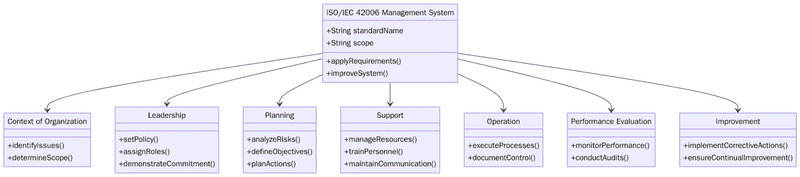
1. **Clear** definition of AIMS scope and boundaries during certification.
2. **Auditor** competence in AI concepts, model lifecycle, data risk and AI-specific impacts.
3. **Consistent** audit methods for evaluating AI governance and technical evidence.
4. **Strong** understanding of AI risk and impact assessment approaches.
5. **Review** of transparency and traceability evidence tied to AI decisions.
6. **Consistent** grading of nonconformities in AI governance contexts.
7. **Clear** expectations for management review and improvement within an AI management system.
**Tip:** _Treat these themes as a preview of how serious AIMS audits will look. This helps you prepare internal evidence in a structured way._
## **How to prepare for ISO/IEC 42006-aligned expectations?**
Even though ISO/IEC 42006 targets certification bodies, companies can prepare for its downstream impact by strengthening how they present and control AI model risk inside ISO/IEC 42001. Refer to the points below:
1. **Build** a complete AI inventory that includes purpose, owners, data sources, model versions and risk level.
2. **Define** model lifecycle rules that cover development, validation, approval, deployment, monitoring and retirement.
3. **Standardize** risk and impact assessments across teams so high-impact models get deeper controls.
4. **Create** consistent documentation templates for training data, testing results, limitations and intended use.
5. **Run** internal reviews that simulate what external auditors will sample.
6. **Ensure** leadership receives periodic reports on AI risks, performance and improvement progress.
## **Certification audit**
**Stage 1 audit:** Review of AIMS scope, AI inventory, AI policy and objectives, risk and impact assessment approach, data and model governance structure, internal audit and management review readiness.
**Stage 2 audit:** Verification of implementation across selected AI use cases, including model lifecycle controls, validation evidence, monitoring records, change management, incident handling and cross-functional accountability.
**Nonconformities:** Must be corrected with documented root causes, updated controls, improved records and evidence that changes are applied and sustained.
**Surveillance audits:** Conducted annually to confirm that AI governance, model monitoring and improvement activities remain active as AI use expands.
**Recertification audits:** Required every three years to review the full AIMS, new AI systems, major model changes and evolving risk context.
## **What are the benefits of ISO/IEC 42006 for companies?**
ISO/IEC 42006 strengthens the value of AI certification by improving audit consistency and competence. Below are key benefits:
1. **Clearer** audit expectations for AI model risk control across business units.
2. **More** consistent evaluation of model lifecycle evidence.
3. **Better** alignment between technical teams and governance teams due to shared audit language.
4. **Stronger** confidence for customers and partners in AI certificates and scope statements.
5. **Reduced** risk of superficial AI audits that miss real operational gaps.
6. **Higher** quality nonconformity findings that support meaningful corrective actions.
7. **Better** long-term improvement of AI governance over the three-year certification cycle.
## Market Trends
**AI governance** is transitioning from principles to measurable control frameworks. As more companies adopt **ISO/IEC 42001**, the market will demand consistent certification practices. This makes supporting standards like **ISO/IEC 42006** more important because they shape how auditors interpret evidence across industries.
In the coming years, **AI audits** are likely to place more weight on model monitoring, lifecycle traceability, data governance and accountability for high-impact use cases. Companies that prepare early will find it easier to demonstrate control without slowing innovation.
## **Training and courses**
Pacific Certifications provide accredited training programs aligned with AI governance and audit expectations:
- [**Lead Auditor Training**](https://pacificcert.com/lead-auditor-training/): For professionals evaluating AI governance, risk and impact assessment, model controls and monitoring evidence.
- [**Lead Implementer Training**](https://pacificcert.com/lead-implementer/) **:** For teams establishing or strengthening an Artificial Intelligence Management System across business units.
For ISO/IEC 42001 and AI governance training aligned with your AI use cases, contact [support@pacificcert.com](mailto:support@pacificcert.com).
## **How Pacific Certifications can help?**
Pacific Certifications provides accredited audit and certification services for AI management systems. We assess AIMS scope, AI inventories, risk and impact assessments, data governance, model lifecycle controls, monitoring, incident handling, internal audits and management reviews.
### Contact Us
To request an ISO/IEC 42001 audit plan and understand how ISO/IEC 42006-driven audit expectations may shape evidence and scope, contact [support@pacificcert.com](mailto:support@pacificcert.com) or visit [www.pacificcert.com](https://pacificcert.com/).
**Author: Alina Ansari**
Read more: [Pacific Blogs](https://blog.pacificcert.com/)
ISO/IEC 42006 and AI Model Risk Management Guide
## FAQs
Q: Will it affect AI audit depth?
A: Yes, it encourages more structured assessment of AI governance and model controls.
Q: Does it cover AI model lifecycle topics?
A: Indirectly yes, through expectations on how auditors assess lifecycle evidence.
Q: Should companies prepare for it now?
A: Yes, by strengthening ISO/IEC 42001-aligned model risk controls and evidence.
Q: Which teams should be involved?
A: Data science, product, risk, security, privacy, compliance and leadership.
Q: Does it apply to third-party AI use?
A: Audit expectations will still examine how you govern supplier and outsourced AI.
Q: What evidence will matter most?
A: AI inventory, risk assessments, validation records, monitoring results and incident logs.
Q: Can it improve trust in AI certificates?
A:
Yes, stronger auditor competence supports more credible certification outcomes.
Q: What is ISO/IEC 42006 mainly about?
A:
It sets expectations for competence and consistency of bodies that audit and certify AI management systems.
Q: How does it help companies directly?
A: It improves the quality and consistency of AI audits that companies receive.
Q: Is ISO/IEC 42006 the same as ISO/IEC 42001?
A:
No, 42001 is for organizations. 42006 supports how certification is carried out.
---
This blog is powered by Superblog. Visit https://superblog.ai to know more.
---