# ISO/IEC 42001: The Future of Responsible AI Governance
Author: Pacific Certifications
Author URL: https://blog.pacificcert.com/author/pacific-certifications/
Published: 2025-09-17
Meta Title: ISO 42001 Certification 2026 | Responsible AI Governance Guide
Meta Description: Master ISO/IEC 42001:2023 for 2026. Expert guide to AIMS requirements, AI risk management, bias mitigation, and EU AI Act alignment for tech & enterprise.
Tags: ISO/IEC 42001, Ethical AI, Artificial intelligence ISO, Responsible AI certification, ISO 42001 for AI
Tag URLs: ISO/IEC 42001 (https://blog.pacificcert.com/tag/isoiec-42001/), Ethical AI (https://blog.pacificcert.com/tag/ethical-ai/), Artificial intelligence ISO (https://blog.pacificcert.com/tag/artificial-intelligence-iso/), Responsible AI certification (https://blog.pacificcert.com/tag/responsible-ai-certification/), ISO 42001 for AI (https://blog.pacificcert.com/tag/iso-42001-for-ai/)
URL: https://blog.pacificcert.com/iso-iec-42001-responsible-ai-governance/
## **Introduction**
Unclear AI rules create **repeat work**, stalled launches and avoidable incidents. ISO/IEC 42001 fixes this by standardizing how you scope AI use, assess risk, test models and monitor outcomes with human oversight.
Adopting 42001 lifts AI from ad hoc practices to a documented system where roles are clear, data lineage is known and decisions are explainable. That builds confidence with customers and regulators and shortens security reviews in sales cycles.
AI now powers search, fraud prevention and life-critical decisions in healthcare and finance. Trust in these systems depends on clear rules for data use, testing and oversight. **ISO/IEC 42001** gives institutions a practical way to run AI like a managed system instead of a collection of experiments, so leaders can reduce risk, win enterprise deals and meet rising legal expectations without slowing product delivery.
## **Quick summary**
[ISO/IEC 42001](https://pacificcert.com/iso-iec-42001-2023-artificial-intelligence-management-system/) sets out an AI management system that connects policy, risk assessment, model lifecycle controls and monitoring. It pairs well with [ISO/IEC 27001](https://pacificcert.com/iso-iec-27001-2022-information-security-management-systems/) for information security and [ISO 9001](https://pacificcert.com/iso-9001-2015-quality-management-system-certification/) for quality management. Institutions use 42001 to align with buyer due diligence, improve audit readiness and track results with KPIs like bias findings closed, model review cadence, incident response time and SLA uptime for AI services.
[Assess your readiness to align with ISO/IEC 42001 requirements](https://pacificcert.com/contact-us/): Look at leadership roles, policies, risk assessment methods, and accountability structures that support responsible AI use.
## **Why ISO/IEC 42001 is rising now?**
The adoption of ISO/IEC 42001 is **accelerating** because the risks and expectations surrounding AI have moved from theory into daily business reality. Institutions no longer use AI only for research or small pilots; AI now drives decisions in finance, healthcare, hiring, security and national infrastructure. Buyers, regulators and end users all want assurance that these systems are safe, transparent and accountable.
Enterprise clients, in particular, **now expect** vendors to show structured AI governance before signing contracts. They want proof that AI models have been tested for bias, validated for accuracy, and are monitored for drift or misuse. Without that assurance, sales cycles are delayed, contracts are lost and reputational risks grow. ISO/IEC 42001 provides a single, globally recognized framework to satisfy these demands and to streamline due diligence.
## **What are the requirements for ISO/IEC 42001?**
To achieve certification, institutions must implement structured systems that ensure AI development and deployment are transparent, accountable and aligned with global expectations. These requirements cover everything from governance policies to technical controls and ongoing monitoring. Below are the key requirements:
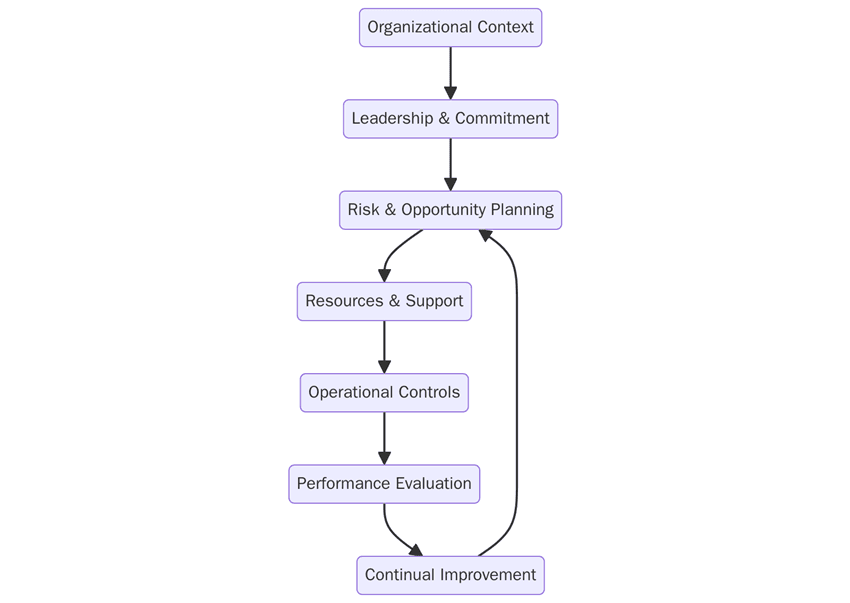
01. **Define** scope for AI uses, products and locations with clear boundaries
02. **Publish** AI policies on transparency, safety, accountability and human oversight
03. **Conduct** risk assessments for bias, misuse, safety impact and data issues
04. **Document** processes for data sourcing, labelling, consent and retention
05. **Establish** model controls for training, validation, versioning and approvals
06. **Provide** evidence records such as data lineage logs, model cards and audit trails
07. **Set** monitoring for drift, performance, bias and incident handling
08. **Train** staff on roles across product, data, ML and compliance
09. **Run** internal audits on the AI management system and close findings
10. **Leadership** reviews of objectives, risks and performance indicators
11. **Correct** nonconformities and keep improving as laws and models evolve
## **How to prepare for ISO/IEC 42001?**
Preparation for ISO/IEC 42001 involves aligning existing practices with certification requirements and building evidence to show auditors that governance is operational, not just documented. The process should engage leadership, technical teams and compliance staff. Key preparation steps include:
1. **Run** a gap analysis against 42001 and map overlaps with 27001 and 9001
2. **Align** policies for AI ethics, transparency and security across teams
3. **Define** scope starting with high-risk or flagship AI products
4. **Build** documentation for data flows, model cards, testing results and approvals
5. **Implement** controls for bias testing, explainability, rollback and incident response
6. **Pilot** internal audits and fix issues before the external assessment
7. **Set** KPIs and SLAs for bias closure time, model review cadence, uptime and MTTR
## **Certification audit**
The certification audit is a structured process conducted in two stages, followed by ongoing surveillance and recertification. It ensures that AI governance policies are both documented and operational across systems. The audit flow is as follows:
**Stage 1 audit:** Reviews documented scope, policies, risk assessments and evidence of AI lifecycle controls.
**Stage 2 audit:** Evaluates implementation across products, data pipelines and operations with interviews and samples.
**Nonconformities:** Must be corrected with documented proof before approval.
**Management review:** Confirms leadership oversight and resources for ongoing governance.
**Final certification:** Awarded after all gaps are resolved.
**Surveillance audits:** Conducted annually to verify controls remain in place and effective.
**Recertification audits:** Required every three years to maintain market validity.
## **What are the benefits of ISO/IEC 42001?**
Certification turns AI governance into a repeatable system buyers can trust. It reduces go-to-market friction, supports legal compliance and improves incident readiness. Institutions track progress with KPIs like bias incident rate, drift alerts handled, audit closure time and SLA uptime for AI services. The main benefits include:

- **Buyer** confidence through audited AI controls
- **Faster** sales cycles with standard evidence for due diligence
- **Lower** risk of bias, misuse and safety failures
- **Clear** accountability across data, ML and product teams
- **Better** documentation for privacy and security reviews
- **Scalable** governance as AI use grows across the portfolio
Institutions are pairing ISO/IEC 42001 with ISO/IEC 27001 and ISO 22301 to create one integrated system for security, AI governance and continuity. Vendor management is in scope now, with SLAs that cover data access, model update cadence, explainability reports and security posture. Teams publish dashboards for bias testing frequency, incident response time, model rollback rate and audit closure periods so customers see real outcomes, not just a certificate.
## **How can Pacific Certifications help?**
Pacific Certifications, accredited by [**ABIS,**](https://abisonline.org/) certifies ISO/IEC 42001 for AI-driven institutions in every sector. We help you define scope, close gaps and prepare evidence that satisfies enterprise buyers and regulators.
Request your ISO audit plan and fee estimate, we will help you map Stage-1/Stage-2 timelines and evidence requirements for your institution.
### Contact Us
Contact us at [support@pacificcert.com](mailto:support@pacificcert.com) or visit [www.pacificcert.com](https://pacificcert.com/).
**Author: Alina Ansari**
Read more: [Pacific Blogs](https://blog.pacificcert.com/)
ISO/IEC 42001 Certification for Responsible AI Governance
## FAQs
Q: What is ISO/IEC 42001 in simple terms?
A:
A management system for AI that covers policy, risk, testing, approval and monitoring with human oversight.
Q: Who should pursue 42001 first?
A:
Institutions shipping AI to enterprises or operating in regulated sectors such as healthcare or finance.
Q: How long does certification take?
A: Many programs complete in 6 to 12 months depending on scope and readiness.
Q: Do we need ISO/IEC 27001 first?
A:
Not required, but 27001 aligns well for data security and shortens evidence work.
Q: What evidence do auditors ask for?
A:
Risk registers, data lineage, model cards, test results, approvals, monitoring and incident logs.
Q: How do KPIs help?
A: They show real results such as bias issues closed, drift alerts handled and mean time to respond.
Q: What SLAs apply to AI?
A: Uptime for AI services, model review cadence, response time for incidents and explanation requests.
Q: Does 42001 cover privacy laws by itself?
A: It supports alignment, but you must still meet each law’s specific rules.
Q: What are common gaps in audits?
A:
Vague scope boundaries, missing lineage, weak bias testing and informal approvals.
Q: Can startups get certified?
A: Yes. Start with a narrow scope, build evidence on one product, then expand.
---
This blog is powered by Superblog. Visit https://superblog.ai to know more.
---