Post by Alina Ansari | July, 2026
What Is ISO/IEC 27042?
ISO/IEC 27042:2015 is the international standard that provides guidelines for the analysis and interpretation of digital evidence in a manner that addresses issues of continuity, validity, reproducibility and repeatability. Published by ISO and IEC under ISO/IEC JTC 1/SC 27, it encapsulates best practice for the selection, design and implementation of analytical processes and for recording sufficient information to allow those processes to be subjected to independent scrutiny when required.
The standard occupies a specific and critical position within the ISO digital forensics family. Where ISO/IEC 27037 governs the identification, collection, acquisition and preservation of digital evidence - the activities that produce the evidence for analysis - ISO/IEC 27042 governs what happens next: the analytical and interpretational processes by which that evidence is examined, understood and evaluated to support investigation conclusions.
It is the technical counterpart to ISO/IEC 27043, which provides the overarching incident investigation framework - ISO/IEC 27043 defines the process groups and lifecycle of an investigation, while ISO/IEC 27042 provides the detailed methodology for the analysis and interpretation activities within the implementation process group.
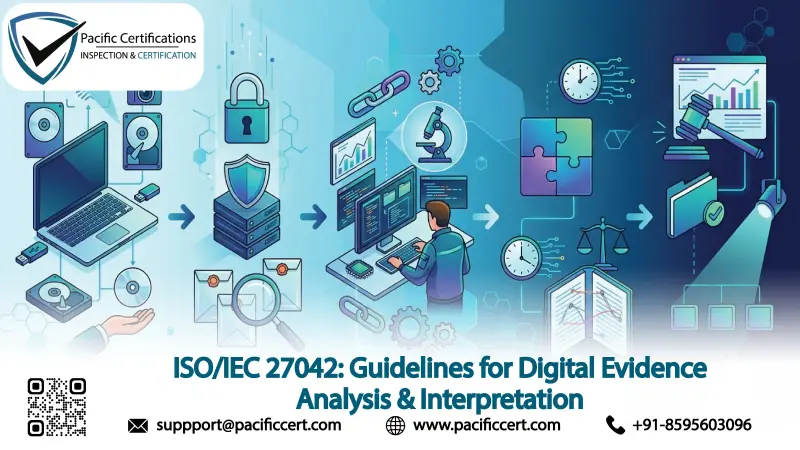
ISO/IEC 27042 helps organizations analyze and interpret digital evidence in a structured, repeatable and defensible way - Pacific Certifications
Evidence Analysis Methodology
Continuity
Continuity in the context of ISO/IEC 27042 refers to the unbroken chain of custody and handling that links the original digital evidence to the analytical outputs derived from it. Every analytical step - from the initial examination of an acquired forensic image through to the final interpretation of findings - must be documented in sufficient detail to demonstrate that the evidence handled at each stage is the same evidence collected from the original source.
Repeatability and Reproducibility
ISO/IEC 27042 requires that analytical processes are designed and documented to be repeatable - the same analyst applying the same method to the same evidence produces the same result - and reproducible - a different qualified analyst applying an equivalent method produces consistent results.
Structured Approach
Analysis must follow a structured approach - beginning with a clear definition of the analytical objectives, proceeding through systematic examination of the evidence using appropriate methods and culminating in documented findings that address those objectives.
Uncertainty
ISO/IEC 27042 explicitly addresses the concept of uncertainty in digital evidence analysis - recognizing that analytical conclusions are not always deterministic and that the degree of confidence in a finding must be communicated clearly.
Practical Tip: A strong evidence analysis methodology should define the forensic questions, approved tools, analysis steps, validation checks and reporting logic before conclusions are drawn.
ISO/IEC 27042 Analytical Models
Static Analysis
Static analysis involves examining digital evidence that has been acquired - typically as a forensic image of a storage device - without executing or running the system or data being analyzed. The analyst examines the acquired copy of the data in a controlled, isolated environment - reviewing file system structures, file contents, metadata, deleted data and other stored artefacts - without any risk of modifying the original evidence or altering the state of the system being investigated.
Live Analysis
Live analysis involves analyzing a running system - examining volatile data such as system memory, active network connections, running processes and real-time system state that cannot be captured in a static forensic image. ISO/IEC 27042 distinguishes between two live analysis scenarios:
Live analysis of non-imageable or non-copyable systems: Where the system cannot be shut down without destroying evidence - such as a running server in a production environment, live analysis must be conducted on the running system. This carries the inherent risk that the analytical activity itself may alter system state, which must be documented.
Live analysis of imageable or copyable systems: Where a live system can be imaged or copied while running - using memory acquisition tools or live imaging techniques - the live image is acquired first and then subjected to static analysis, combining the benefits of capturing volatile state with the repeatability advantages of static analysis.
Tip: Use analytical models to organize evidence logically, link digital artifacts to events and explain how each finding supports the investigation conclusion.
Interpretation of Digital Evidence
Accreditation of Fact
ISO/IEC 27042 introduces the concept of accreditation of fact - the process of establishing that an analytical finding is sufficiently reliable to be treated as a fact for the purposes of the investigation. Accreditation of fact requires that the finding was produced by a validated method, that the analyst is competent to apply that method.
Not all analytical outputs achieve the level of accreditation of fact - some remain as indicators, hypotheses, or potential explanations that require further corroboration.
Factors Affecting Interpretation
ISO/IEC 27042 identifies several factors that affect the interpretation of digital evidence and must be explicitly considered and documented:
Tool behavior: Different analysis tools may produce different outputs from the same evidence - the analyst must understand how the tools used affect the results produced and document any tool-specific limitations
Evidence completeness: Incomplete evidence - partial file recovery, fragmented data, or evidence that has been deliberately or inadvertently deleted - affects the confidence with which conclusions can be drawn
Anti-forensic techniques: Evidence that has been subject to deliberate anti-forensic measures - encryption, data wiping, timestamp manipulation, or steganography - requires specific analytical approaches and affects the interpretation of both the presence and absence of evidence
Context dependency: The meaning of a digital artefact depends on the context in which it is found - the same file, timestamp, or network connection may have entirely different significance in different investigation contexts
Writer’s view: Digital evidence interpretation should clearly separate verified findings, reasonable inferences and uncertainty so conclusions remain defensible.
Analyst Competence
Competence
Competence refers to the analyst's knowledge and skills in the technical domains relevant to the analysis being performed - including knowledge of file systems, operating systems, application data structures, network protocols, cryptographic systems and the specific forensic tools being used.
ISO/IEC 27042 requires that analysts can demonstrate competence appropriate to the analytical tasks they perform - and that the investigation organization has procedures for assessing, recording and maintaining analyst competence.
Proficiency
Proficiency goes beyond individual competence to encompass the demonstrated ability to consistently produce correct results in practice - measured through participation in proficiency testing schemes, blind testing exercises, or peer review programs.
ISO/IEC 27042 identifies several mechanisms for demonstrating proficiency including participation in recognized proficiency testing programs, peer review of casework and structured competence assessments using known reference data sets. Proficiency records must be maintained as part of the analyst's qualification record.
Recording Competence
The organization must maintain documented records of analyst competence and proficiency - covering qualifications, training, experience, tool certifications and proficiency testing results.
These records form part of the investigation record and may be produced in legal proceedings to support the admissibility and weight of analytical findings produced by the analyst.
Practical Tip: Digital evidence analysts should be trained, technically competent and able to explain their methods, findings and limitations clearly during review or legal scrutiny.
ISO/IEC 27042 Documentation and Reporting
Record Keeping During Analysis
ISO/IEC 27042 requires that a contemporaneous record is maintained throughout the analysis - documenting every analytical step, every tool used, every result obtained and every decision made. The analysis record must be detailed enough to allow an independent analyst to understand exactly what was done, replicate the analysis and verify the results.
Report Preparation
The investigation report is the primary communication product of the analysis phase - translating the technical findings and interpretations of the analysis into a document accessible to its intended audience. ISO/IEC 27042 provides guidance on report preparation covering:
Defining the scope and objectives of the report before drafting begins
Distinguishing clearly between findings - what was observed - and interpretations - what those observations mean in the context of the investigation
Identifying and disclosing significant limitations, uncertainties and assumptions that affect the conclusions presented
Structuring the report for its intended audience - which may range from a technical peer reviewer to a court, a regulator, or a non-technical management team
Suggested Report Content
ISO/IEC 27042 defines suggested content for investigation reports, covering:
Identity of the analyst and the organization conducting the analysis
Description of the evidence examined - identification, hash values and acquisition details
Limitations - identified factors that limit the completeness or confidence of the findings
Conclusions - the analyst's overall assessment of the evidence as it relates to the investigation questions
Practical Tip: Keep every analysis step, tool setting, finding and interpretation clearly documented so the final report can be independently reviewed and defended.
Relation to ISO 27041 and ISO 27043
Final Remark: Use ISO/IEC 27042 for digital evidence analysis and interpretation, ISO/IEC 27041 for investigation method assurance and ISO/IEC 27043 for the full incident investigation framework.
ISO/IEC 27042 Use Cases
Corporate Cybersecurity Incident Investigation
A financial services organization experiencing a data breach conducts a digital forensic investigation to determine the root cause, scope and timeline of the compromise.
The analysis team applies ISO/IEC 27042-aligned methods - conducting static analysis of compromised server images to recover attacker tools and artifacts and live analysis of network monitoring data to reconstruct attacker lateral movement.
Criminal Law Enforcement Digital Forensics
A law enforcement agency investigating cybercrime applies ISO/IEC 27042 to ensure that digital evidence analysis conducted by its forensic unit meets the admissibility and reliability standards required by the courts.
Analyst competence records, tool validation documentation and contemporaneous analysis records are maintained in accordance with ISO/IEC 27042 requirements.
Employment Dispute and HR Investigation
An organization investigating allegations of employee misconduct - unauthorized data access or exfiltration, policy violations, or inappropriate use of company systems - applies ISO/IEC 27042 to govern the analysis of digital evidence from company devices.
Regulatory ComplianceInvestigation
A pharmaceutical company subject to regulatory inspection concerning potential data integrity violations in its quality management systems applies ISO/IEC 27042 to govern the analysis of electronic records - audit trails, electronic signatures and laboratory data systems - to determine whether data manipulation occurred and if so, when and by whom.
Practical Tip: Use ISO/IEC 27042 wherever digital evidence must be analyzed, interpreted and reported with technical accuracy, legal defensibility and clear audit trails.
ISO/IEC 27042 Certification Cost
Organizations operating dedicated digital forensics or incident response functions - whether as internal capabilities or as external service providers - typically have focused ISMS scopes that are manageable in audit effort terms, though the depth of evidence required to demonstrate competence management, tool validation and chain of custody controls is proportionally greater than for a standard enterprise ISMS.
Cost planning should consider investigation scope, forensic tool maturity, IT complexity, trained personnel, evidence volume and related ISO/IEC 27001 audit needs.
ISO/IEC 27042 Certification Timeline
This includes 2 to 4 weeks for gap analysis against ISO/IEC 27042 requirements, 4 to 8 weeks for analytical procedure documentation, tool validation record completion and competence assessment program establishment and 2 to 4 weeks for analyst training on documented procedures and a supervised case exercise to validate the program before formal activation.
Where ISO/IEC 27701 is added to address personal data handling in investigations, the timeline extends to 5 to 7 months for an integrated program. Assigning a dedicated investigation program owner, maintaining contemporaneous analysis records from the outset of every investigation and conducting a structured internal audit of the analysis program before the Stage 2 certification assessment are the most effective ways to keep the combined program on track.
A Practical Tip from Pacific Certifications: Organizations can avoid delays by preparing forensic procedures, validated tools, analyst training records and sample reporting evidence early.
How Pacific Certifications Can Help?
Accredited by ABIS, Pacific Certifications conducts impartial, evidence-based audits against applicable ISO standards in full conformance with ISO/IEC 17021. Our services for organizations implementing digital evidence analysis programs include:
Independent certification audits for ISO/IEC 27001, ISO/IEC 27701, ISO 22301 and ISO 9001
Integrated management system audits covering multiple standards in coordinated, efficient audit visits
Stage 1 and Stage 2 audit execution across investigation, forensics and incident response organizations
Clear, transparent audit reports with conformity findings and certification decisions
Issuance of internationally recognized ISO certificates upon successful audit completion
Annual surveillance and triennial recertification audits to maintain certificate validity
Pacific Certifications does not provide consultancy - our role is strictly that of an independent auditor, ensuring your certificate carries full credibility with clients, regulators, courts and law enforcement bodies in every jurisdiction you operate in.
Contact Us
To get started with your digital forensics certification program or initiate your audit, contact us at support@pacificcert.com or +91-8595603096.
For training programs, contact us at trainings@pacificcert.com.
Also read: ISO 27043: Incident Investigation Principles & Digital Evidence