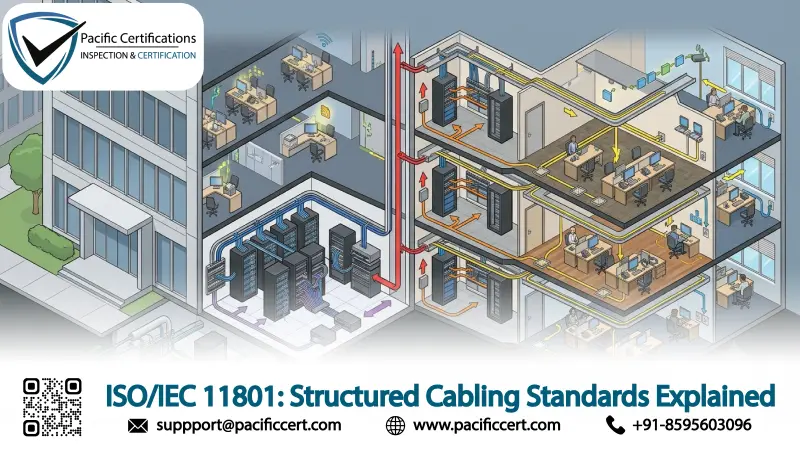
What Is ISO/IEC 11801?
Published jointly by the International Organization for Standardization (ISO) and the International Electrotechnical Commission (IEC), it defines the cabling infrastructure that supports a wide range of services - voice, data, video, building management and industrial control - through a single, structured cabling system designed to last the lifetime of the building it serves.
The standard establishes performance requirements for cabling components, subsystems and complete installed systems - covering everything from cable categories and connector performance to link and channel test limits. It applies to the planning, installation, testing and documentation of structured cabling systems in new and existing buildings and is the primary reference standard for cabling installers, network designers and facilities managers globally.
The current edition is ISO/IEC 11801-1:2017, which restructured the standard into a multi-part series covering different building types and environments. This edition introduced significant updates to support higher-speed applications including 25GBASE-T and 40GBASE-T over copper cabling and aligned more closely with the TIA-568 series used predominantly in North America.
ISO/IEC 11801 helps organizations design structured cabling systems that support reliable, scalable and standards-based network infrastructure - Pacific Certifications
Structured Cabling Classes and Categories
Component Categories define the minimum performance requirements for individual cabling components - cables, connectors, patch panels and outlets - tested under controlled laboratory conditions.
Link and Channel Classes define the end-to-end performance of an installed cabling system, including all components, connections and the cable runs between them.
The current classes and categories defined in ISO/IEC 11801 are:
Class EA / Category 6A is currently the most widely deployed specification for new commercial building installations, as it supports 10 Gigabit Ethernet at the full 100-metre horizontal channel length required for most enterprise environments.
Choose cabling classes and categories based on bandwidth, application requirements, cable length, installation environment and future network growth.
Backbone vs Horizontal Cabling
Horizontal Cabling connects the floor distributor (FD) - the telecommunications room or intermediate distribution frame on each floor - to the telecommunications outlet (TO) at the work area. ISO/IEC 11801 specifies a maximum horizontal channel length of 100 metres for copper cabling, comprising 90 metres of permanent link cable and up to 10 metres of patch and equipment cords.
Horizontal cabling uses balanced twisted-pair copper cable (Category 5e through Category 8) or optical fibre, depending on the performance class specified.
Backbone Cabling connects building distributors (BD) to floor distributors (FD) within a building and campus distributors (CD) to building distributors across a campus.
Backbone cabling carries aggregated traffic from multiple horizontal segments and is subject to distance limits that vary by cable type - up to 2000 metres for single-mode optical fibre on campus backbones. Backbone runs predominantly use optical fibre for new installations, though copper backbone cabling is permitted within defined distance limits.
Work Area components - equipment cords, adaptors and outlet connections at the user end - are not subject to the permanent link test parameters but are included in channel performance calculations and must use components meeting the specified category for the installed class.
Writer’s view: Reliable structured cabling depends on clearly separating backbone infrastructure from horizontal cabling so performance, routing and testing remain controlled.
Editions and Revisions
ISO/IEC 11801:1995 (First Edition): Established the foundational structured cabling framework with Classes A through D (up to Category 5), providing the baseline for enterprise copper cabling supporting 100 Mbps Ethernet.
ISO/IEC 11801:2000 (Second Edition): Added Category 5e performance requirements and introduced preliminary guidance for Class E (Category 6) cabling to support emerging Gigabit Ethernet applications.
ISO/IEC 11801:2002 (Amendment 1): Formalized Class E/Category 6 and introduced Class F/Category 7 specifications with shielded pair requirements.
ISO/IEC 11801:2010 (Second Edition with Amendments): Added Class EA/Category 6A for 10GBASE-T support, introduced optical fibre channel classes OM3 and OM4 and expanded the scope to include data centers.
ISO/IEC 11801-1:2017 (Third Edition - Multi-Part Series): Restructured the standard into a series of parts covering different building and environment types, introduced Class I/Category 8.1 and Class II/Category 8.2 for 25G and 40G applications and strengthened alignment with IEEE 802.3 Ethernet standards. The multi-part structure includes:
ISO/IEC 11801-1: General requirements applicable to all building types
ISO/IEC 11801-2: Office premises
ISO/IEC 11801-3: Industrial premises
ISO/IEC 11801-4: Homes
ISO/IEC 11801-5: Data centers
ISO/IEC 11801-6: Distributed building services
Always check the applicable ISO/IEC 11801 edition because newer revisions address higher-speed applications, data centers and broader building environments.
ISO 11801 vs TIA-568
Final Remark: ISO/IEC 11801 provides the international structured cabling framework, while TIA-568 is mainly used for North American cabling design and testing.
Testing Requirements
Copper Cabling Test Parameters
For balanced twisted-pair copper cabling, the following parameters must be measured and recorded for each installed link and channel:
Wire map: Verifies correct pin-to-pin continuity and absence of opens, shorts, reversed pairs, split pairs and transpositions
Length: Confirms the installed length is within the maximum permitted for the specified class
Insertion loss (attenuation): Measures signal loss along the cabling channel at frequencies up to the class limit
NEXT (Near-End Crosstalk): Measures interference between pairs at the near end of the link
FEXT and ELFEXT: Measures far-end crosstalk and its ratio to insertion loss
Return loss: Measures signal reflection caused by impedance discontinuities
Propagation delay and delay skew: Measures signal travel time and difference between fastest and slowest pairs
PS NEXT and PS ACRF: Power sum measurements covering combined crosstalk from all pairs simultaneously
Optical Fibre Test Parameters
For optical fibre cabling, installed channels must be tested for insertion loss and return loss in accordance with ISO/IEC 61280-4-1 (multimode) and ISO/IEC 61280-4-2 (single-mode). For data center and high-density applications, optical time-domain reflectometer (OTDR) testing is required to verify splice and connector performance along the full fibre path.
Test Documentation
All field test results must be saved in the test instrument's memory and exported as a permanent project record. ISO/IEC 11801 requires that test documentation accompany the as-built cabling drawings and be provided to the building owner or client as part of the project handover package.
Practical Tip: Every installed link should be tested with calibrated equipment and supported by field test records, as-built drawings and handover documentation.
Compliance for Installers
Component compliance: All cabling components - cables, connectors, patch panels and outlets - must be sourced from manufacturers whose products are independently tested and certified to meet the required category performance by an accredited laboratory. Installers should retain component test reports and manufacturer certification documentation as project records.
Installation practice: ISO/IEC 11801 performance limits assume correct installation practice. Exceeding minimum bend radii, maintaining pair twist to within specified distances of termination points, avoiding cable crushing and correctly dressing patch cords are all installation quality requirements that directly affect installed performance.
Field testing: Every installed permanent link and channel must be field-tested using a calibrated test instrument of the appropriate accuracy level - Level IIIe for Class EA and below, Level IV for Class FA and above. Test instruments must be within their manufacturer's calibration validity period.
As-built documentation: Installers must provide complete as-built documentation covering outlet labeling, patch panel schedules, cable routing plans and field test reports for every link and channel in the installation.
Installer certification: Many enterprise clients and facilities managers require cabling installation teams to hold a manufacturer-approved installer certification or an independent cabling installer qualification as a condition of project award - demonstrating that the team has been trained to install the specific cabling system to the manufacturer's installation standards.
Writer’s view: Installer compliance is proven through certified components, correct installation practices, calibrated testing and complete project documentation.
ISO/IEC 11801 Certification Cost
For a small commercial office installation with a few dozen outlets, field testing is a contained effort. For a large enterprise campus, data center, or industrial facility with thousands of installed links requiring Class FA or Class I/II testing, the field testing, documentation and project handover effort is substantially greater. Component certification costs, verifying that cables, connectors and panels meet the specified category are borne by manufacturers and are reflected in the component purchase price rather than as a separate project cost.
For cabling installation organizations also pursuing management system certification alongside their structured cabling operations — ISO 9001, ISO 45001, or ISO 14001, integrated audits across multiple standards reduce total audit days and provide better value than pursuing each standard independently. Pacific Certifications provides transparent, fixed-fee proposals so your organization has full cost visibility before the process begins.
Cost planning should consider site size, number of links, cabling class, testing effort, documentation needs and any integrated ISO 9001, 14001 or 45001 audit scope.
ISO/IEC 11801 Certification Timeline
For a standard commercial office floor covering 50 to 100 outlets to Class EA specification, installation, testing and documentation can be completed within 2 to 4 weeks by a competent installation team using calibrated Level IIIe test equipment.
For a full building or campus project covering multiple floors, backbone infrastructure and data center cabling to Class FA or Class I/II specification, the installation and testing program typically runs 2 to 6 months, with the testing and documentation phase alone accounting for 20 to 30 percent of the total project timeline.
For cabling installation organizations pursuing ISO 9001 management system certification in parallel w,hich governs the quality management processes behind installation delivery, testing and project documentation, the certification process runs approximately 4 to 6 months from initial gap analysis through certificate issuance. Organizations adding ISO 45001 for health and safety management or ISO 14001 for environmental management extend this to 6 to 9 months for integrated certification.
Assigning a dedicated management system owner, starting documentation development alongside active project delivery and completing a full internal audit before the Stage 2 assessment are the most effective ways to stay within the planned timeframe.
A Practical Tip from Pacific Certifications: Organizations can avoid delays by preparing cabling drawings, link test reports, installation records and internal audit evidence early.
How Pacific Certifications Can Help?
Accredited by ABIS, Pacific Certifications conducts impartial, evidence-based audits against applicable ISO standards in full conformance with ISO/IEC 17021.
Our services for telecommunications infrastructure organizations include:
Independent certification audits for ISO 9001, ISO 45001, ISO 14001, ISO/IEC 27001 and ISO/IEC 20000-1
Stage 1 and Stage 2 audit execution across single and multi-site operations
Clear, transparent audit reports with conformity findings and certification decisions
Issuance of internationally recognized ISO certificates upon successful audit completion
Annual surveillance and triennial recertification audits to maintain certificate validity
Pacific Certifications does not provide consultancy, our role is strictly that of an independent auditor, ensuring your certificate carries full credibility with enterprise clients, facilities managers and project procurement authorities in every market you operate in.
Contact Us
To get started with your structured cabling certification program or initiate your audit, contact us at support@pacificcert.com or +91-8595603096.
For training programs, contact us at trainings@pacificcert.com.
Also read: ISO Certifications for Fibre Optic Cable Installation Businesses