Introduction
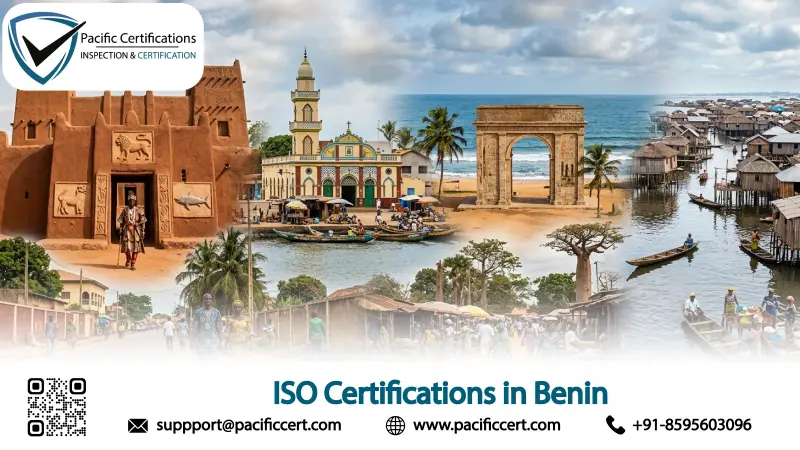
ISO certifications are becoming increasingly important for businesses in Benin as the country moves from a commodity-led economy toward a more diversified and industrial model. Benin’s GDP reached about USD 21.48 billion in 2024, and real GDP growth accelerated to 7.5% in 2024, supported by agro-industry, construction, textiles, and stronger activity through the port of Cotonou. At the same time, the World Bank expects growth to remain strong, helped by investment and the expansion of the Glo-Djigbé Industrial Zone (GDIZ).
This shift matters because Beninese companies are no longer competing only on price. They are increasingly expected to show consistency, traceability, safety, environmental control, and information security. That is especially true for businesses connected to cotton, cashew, agri-food processing, logistics, manufacturing, export trade, and services. The World Bank’s additional financing for Benin’s Agricultural Competitiveness and Export Diversification Project also shows how strongly market access, food security, and value-chain resilience now shape business priorities.
Benin is also strengthening its quality infrastructure. The Agence Nationale de Normalisation, de Métrologie et du Contrôle Qualité (ANM), under the Ministry of Industry, has a mandate covering standardization, certification policy, promotion of standards, and national conformity systems. That makes ISO certification highly relevant for organizations that want stronger internal systems and better credibility with buyers, institutions, and international partners.
Quick Summary
ISO certifications are becoming more valuable in Benin as the economy industrializes and export-oriented sectors expand. The most practical standards for Beninese organizations include ISO 9001 for quality management, ISO 14001 for environmental management, ISO 45001 for occupational health and safety, ISO 22000 for food safety, ISO/IEC 27001 for information security, ISO 50001 for energy management, and ISO 13485 where medical or technical manufacturing is involved. These standards help companies improve operational control, strengthen export readiness, reduce risk, and build confidence with customers and institutional buyers.
Economic Context and Industry Overview
Benin’s economy is currently in a phase of strong expansion. World Bank data shows GDP at USD 21.48 billion in 2024, with GDP per capita at about USD 1,485. The same data shows agriculture still accounting for 24.2% of GDP, which confirms how important farming and agro-processing remain in the national economy. Meanwhile, IMF reporting indicates that 2024 growth was driven by agro-industry, construction, textiles, and increased port activity, showing that value addition and industrial processing are becoming more central.
This is exactly where ISO certifications begin to matter more. As Benin develops textile capacity in GDIZ, expands cashew processing, strengthens agri-food value chains, and aims for better export performance, buyers and partners are likely to expect more formal management systems. GDIZ has already exported “Made in Benin” garments to Europe, which is a strong signal that quality assurance, process control, traceability, and compliance will become even more important for firms operating in or supplying industrial zones.
Why ISO Certifications Matter in Benin?
In Benin, ISO certification matters because the economy is moving toward higher-value production, more formalized supply chains, and stronger links with international markets. When a country is growing through agro-industry, construction, port logistics, and textiles, organizations need systems that make output reliable and scalable. ISO standards help businesses move from informal operational habits to repeatable, measurable, and auditable processes.
For exporters and manufacturers, certification can also support buyer confidence. Benin’s development strategy around agri-food competitiveness, export diversification, and industrial growth means companies increasingly need to show that their goods are produced under controlled conditions. In food, that means hygiene, traceability, and hazard control. In industrial activity, it means process discipline, safety, and consistent output. In service sectors, it means customer focus and dependable delivery.
Economic Context and Industry Overview
Benin’s economy is gradually shifting toward industrial growth and value addition. Services contribute 47.72% of GDP, agriculture 25.4%, and industry 17.3%, with overall growth reaching 7.5% in 2024. The economy still relies heavily on exports like cotton (48%), cashew nuts (10.7%), and soya beans (8.7%), highlighting both strength and vulnerability to price changes. Industrial initiatives such as the Glo-Djigbé Industrial Zone are supporting this transition, aiming to create around 50,000 jobs by 2030. Manufacturing is also expanding, particularly in agro-processing and textiles.
New sectors are driving demand for ISO standards. The textile industry is focusing on local processing, while the digital economy, contributing XOF 960 billion, is increasing demand for information security standards. Agro-processing, especially cashew and shea, is also growing, where food safety certification is critical for exports. Overall, as industries evolve, structured standards are becoming necessary to meet global quality expectations.
Important Standards Often Requested by Buyers in Benin
Popular ISO Standards in Benin
ISO 9001:2015 – Quality Management Systems in Benin
ISO 9001 is usually the most widely applicable standard for organizations in Benin. It helps businesses define processes, control service or product quality, handle customer requirements more systematically, and build a culture of corrective action and continual improvement. For Beninese firms involved in trade, logistics, agro-processing, textiles, or general services, ISO 9001 often becomes the foundation standard because it improves operational discipline without being limited to one industry. In a market where industrial output and export activity are expanding, this standard can help firms become more dependable partners.
Read more about ISO 9001
ISO 14001:2026 – Environmental Management Systems in Benin
As Benin strengthens industrial zones and agri-food value chains, environmental control becomes more important. ISO 14001 helps organizations identify environmental aspects, manage waste and emissions, improve compliance, and reduce negative impacts from operations. This is especially relevant in agro-processing, textiles, construction, and industrial manufacturing, where growth must be balanced with resource efficiency and environmental responsibility. The World Bank’s emphasis on climate resilience in Benin makes environmental management more than a branding issue; it is becoming a long-term business issue.
Read more about ISO 14001
ISO 45001:2018 – Occupational Health and Safety Management Systems in Benin
Benin’s recent growth in construction, textiles, industrial activity, and logistics increases the importance of workplace safety. ISO 45001 helps organizations identify hazards, reduce incidents, clarify roles, strengthen emergency preparedness, and build safer working conditions. For factories, warehouses, port-related activity, and project-based operations, the standard supports better operational stability as well as worker well-being. As companies scale, informal safety practices often become inadequate, and ISO 45001 provides a more structured approach.
Read more about ISO 45001
ISO 22000:2018 – Food Safety Management Systems in Benin
ISO 22000 is particularly relevant for Benin because agriculture and food value chains remain central to the economy. With national and international efforts focused on agri-food competitiveness, food businesses need reliable systems for hygiene, hazard control, traceability, and supplier management. This standard is especially suitable for processors, packers, exporters, storage operators, and food service businesses that need to prove they can manage food safety risks consistently. It supports market confidence and can reduce the chance of costly quality failures.
ISO/IEC 27001:2022 – Information Security Management Systems in Benin
As internet use grows and more business processes become digital, information security becomes more important. World Bank data shows that 34% of the population used the internet in 2024, and digitalization is likely to continue across administration, finance, commerce, and service businesses. ISO/IEC 27001 helps organizations protect data, manage access, reduce cyber risk, and respond more systematically to threats. For firms handling customer records, contracts, financial data, or operational systems, it strengthens trust and governance.
Read more about ISO 27001
ISO 50001:2018 – Energy Management Systems in Benin
Industrial growth often brings higher energy pressure. ISO 50001 helps organizations monitor energy use, identify inefficiencies, and improve performance over time. In manufacturing, textiles, processing plants, and large facilities, the standard can support cost control and operational efficiency. For a country investing in industrial expansion, energy management can become a practical advantage, especially for businesses that want more predictable operating costs and stronger sustainability performance.
Read more about ISO 50001
ISO 13485:2016 – Medical Devices Quality Management in Benin
ISO 13485 is not a universal need, but it is important where organizations are involved in medical-related manufacturing, technical assembly, specialized components, or supply to regulated healthcare markets. It focuses on quality management in environments where safety, traceability, documented controls, and regulatory conformity are essential. As Benin continues diversifying its industrial base, standards like ISO 13485 can become relevant for more specialized operations. This is a growth-oriented standard rather than a mass-market one, but it can be strategically important.
Read more about ISO 13485
What Are the Requirements of ISO Certifications in Benin?
Achieving ISO certification in Benin requires organizations to establish and maintain a management system that is controlled, documented, and actively used. The exact requirements depend on the chosen standard, but the main expectations usually include the following:
Leadership involvement ensures accountability, direction, and alignment with organizational objectives and policies
System documentation ensures processes are defined clearly and consistently followed across all operational areas
Risk management helps identify potential issues and implement controls to minimize operational disruptions
Process control ensures activities are performed consistently with defined procedures and expected outcomes
Performance monitoring enables tracking of objectives and continuous evaluation of system effectiveness
Competent workforce ensures employees are trained and capable of performing assigned responsibilities effectively
Internal audits help identify gaps and ensure compliance with the established management system requirements
Corrective actions address nonconformities and prevent recurrence through structured problem-solving approaches
Information control ensures documents and records are properly maintained, updated, and accessible when required
Management review ensures periodic evaluation of system performance and supports continuous improvement decisions
Benefits of ISO Certifications in Benin
ISO certifications offer practical business benefits for organizations in Benin, especially those aiming to grow, export, or become more structured. Below are the key benefits:
Better operational control: Helps organizations reduce inconsistency, clarify processes, and improve day-to-day management.
Stronger customer confidence: Shows clients and partners that the business works in a disciplined and reliable way.
Improved export readiness: Supports market confidence for agri-food, textiles, processed goods, and other traded products.
Higher internal accountability: Makes responsibilities clearer across teams and management levels.
Reduced risk exposure: Helps businesses manage quality, safety, environmental, and information risks more systematically.
Improved workplace safety: Particularly useful in construction, factories, warehousing, and logistics environments.
Better food and product assurance: Important for businesses supplying regulated or quality-sensitive markets.
Support for growth: Gives fast-growing organizations a structure that can scale more effectively.
Better management decisions: Encourages measurement, review, corrective action, and continual improvement.
Stronger business reputation: Certification can improve credibility with institutional buyers, supply-chain partners, and international customers.
The direction of the Benin economy suggests that ISO certification demand is likely to grow. IMF reporting shows that 2024 growth was powered by agro-industry, construction, textiles, and port activity, while the World Bank points to continued momentum from investment and the expansion of GDIZ. On top of that, the World Bank is directly supporting stronger agri-food value chains and resilience in northern Benin. All of this favors standards that support quality, safety, environmental control, traceability, and operational maturity.
Industrialization is especially important. GDIZ’s early exports of garments to Europe show that Benin is moving beyond raw commodity dependence toward higher-value manufacturing. When a country begins producing and exporting finished goods at scale, ISO standards become more attractive because they help align operations with international buyer expectations. This is likely to increase interest in ISO 9001, ISO 14001, ISO 45001, ISO 22000, and ISO 50001 over the coming years.
There is also a structural quality trend behind this. Benin’s ANM has a mandate covering certification policy, standardization, and conformity systems, which indicates that the country’s institutional framework for standards is active and relevant. As firms become more export-facing and more integrated into formal value chains, the practical demand for certification is likely to widen from large organizations to more SMEs and mid-sized suppliers.
Challenges Faced in Benin
Businesses in Benin can still face several practical barriers when pursuing ISO certification. Many SMEs operate with limited administrative capacity, so documentation, evidence gathering, and system maintenance can feel burdensome. Some growing firms also rely heavily on founder-led decision-making, which makes process standardization harder. In addition, organizations outside larger commercial centers may have less access to internal expertise for system development and upkeep. These are common issues in economies where formalization is still advancing.
Sector-specific conditions can add pressure. Agro-based businesses deal with seasonal variation, supply uncertainty, and climate-related disruptions. Industrial businesses may face rapid scaling pressure. Service businesses may struggle to document processes that were previously handled informally. None of these issues make certification impossible, but they do mean the system must be designed around how the organization actually works. The stronger Benin’s growth becomes, the more important that practical fit will be.
Cost of ISO Certifications in Benin
The cost of ISO certification in Benin depends on several factors, including the size of the organization, number of employees, number of sites, complexity of operations, and the specific standard chosen. A small service company seeking ISO 9001 will not require the same effort as a multi-site agro-processing operation pursuing ISO 22000 or a manufacturing business implementing multiple standards together.
Because Beninese businesses vary widely, from SMEs to industrial operators linked to export value chains, certification cost is best assessed case by case. The real value usually comes from better control, stronger buyer confidence, and lower operational risk rather than the certificate alone. For a tailored quotation, Pacific Certifications can review your scope and requirements directly.
Timeline for ISO Certification in Benin
The timeline for ISO certification in Benin usually depends on how prepared the organization already is. Small organizations can often complete the process in around 1 to 2 months when documentation and implementation move quickly. Medium-sized organizations may need 2 to 4 months, while larger or more complex operations may require 3 to 6 months or more.
In practice, timelines in Benin may also be influenced by harvest cycles, production schedules, construction activity, staffing availability, and how quickly management can make decisions. Organizations that already operate with documented controls generally move faster than businesses starting from a mostly informal system.
How Pacific Certifications Can Help?
Pacific Certifications accredited by ABIS, operates as an independent certification body providing third-party certification services for organizations seeking ISO compliance. We work with businesses across sectors including manufacturing, construction, food processing, logistics, and services, helping them achieve certification through a structured and transparent evaluation process. Our approach follows the same certification stages outlined above, ensuring that organizations are assessed against international standards in a consistent and reliable manner.
Pacific Certifications provides services including certification for ISO 9001, ISO 14001, ISO 45001, ISO/IEC 27001, ISO 22000, ISO 50001, ISO 13485, multi-site certification, annual surveillance activities, recertification cycles, and industry-specific assessments conducted by experienced auditors.
Accredited Training Programs
Pacific Certifications also offers accredited training programs designed to build internal capability within organizations and support effective implementation of ISO standards. These programs help professionals understand system requirements, improve internal management practices, and maintain certification over time.
Training programs include:
Lead auditor training Programs for ISO 9001, ISO 14001, ISO 45001, ISO/IEC 27001, ISO 22000, ISO 50001, ISO 13485 and ISO 22301.
Lead implementer training Courses focused on practical system development and execution
Training is available through online sessions, on-site programs, and customized formats based on organizational needs. These programs help develop skilled personnel who can manage ISO systems effectively within the organization.
For training details, contact trainings@pacificcert.com.
Contact us
Contact Pacific Certifications at support@pacificcert.com to discuss your certification requirements.
Read more: Pacific Blogs