ISO Certifications in Bavaria: Popular Standards, Requirements and Benefits
Introduction
Bavaria's economy is anchored in precision manufacturing, automotive, pharmaceuticals, chemicals, and mechanical engineering—sectors that depend on ISO certifications to compete globally and maintain supply chain excellence. As EU and international buyers demand certified quality, safety, environmental compliance, and information security, ISO certifications in Bavaria give manufacturers, pharmaceutical firms, chemical producers, and engineering companies structured proof of controlled, repeatable, world-class operations.
Share your scope with Pacific Certifications and we provide accreditation coverage, tailored audit days, and Stage 1/Stage 2 timelines aligned with your production cycles, compliance deadlines, and team readiness. We help get ISO certified in Bavaria for single facilities or multi-site operations across regions.
Economic Context and Industry Overview
Bavaria's industrial landscape is shaped by globally competitive automotive, pharmaceutical, chemical, and precision-engineering sectors that drive employment, exports, and technological innovation. Automotive suppliers form a critical supply chain hub, feeding major OEMs across Europe and worldwide. The pharmaceutical and life sciences sector is a major employer and exporter of active ingredients, finished products, and specialized equipment. Chemical manufacturing—including specialty chemicals, coatings, plastics, and industrial polymers—supports multiple downstream industries and represents a key pillar of the Bavarian economy. Precision engineering and toolmaking deliver high-tolerance components to global markets. Digital and IT services are emerging rapidly, driven by Industry 4.0 adoption, IoT integration, and cyber-security demands across manufacturing.
Across these sectors, ISO 9001, ISO 14001, ISO 13485, ISO 45001, and ISO 27001 certification Bavaria are essential for:
Supply chain eligibility and RFP approvals from OEMs and large buyers
Export market access and regulatory compliance across EU and global markets
Banking and financing requirements for business growth and innovation
Insurance and risk management verification by underwriters
Customer and investor confidence in organizational capability
Environmental and social responsibility mandates (ESG reporting, sustainability initiatives)
Why ISO Certifications Matter in Bavaria?
International buyers, regulators, banks, and investors seek evidence of management systems with traceable records and consistent performance. ISO certification Bavaria accelerates contract awards, enables market entry into regulated industries, and stabilizes operations during market volatility or supply chain disruptions.
ISO 9001 certification Bavaria controls design, production, complaints, and continual improvement for automotive, engineering, and manufacturing firms—reducing defect rates and improving customer satisfaction. ISO 14001 certification Bavaria manages emissions, waste, water use, and environmental risks—critical for chemical and manufacturing operations facing strict EU environmental regulations. ISO 45001certification Bavaria supports safe working conditions in factories, chemical plants, and precision workshops—reducing accident rates and improving employee engagement and workplace culture.
ISO 13485 certification Bavaria ensures pharmaceutical and medical device quality, traceability, and regulatory compliance for EU and global distribution—essential for maintaining market authorization and customer trust. ISO 27001 certification Bavaria secures digital assets, customer data, and intellectual property for IT services, fintech, automotive software, and tech-driven organizations—critical for GDPR compliance. ISO certifications for small business Bavaria help SMEs and startups enter supply chains and compete globally.
Popular ISO Standards in Bavaria
Automotive and pharmaceuticals drive ISO 9001 certification Bavaria and ISO 13485 certification Bavaria for export compliance and supply chain entrenchment.
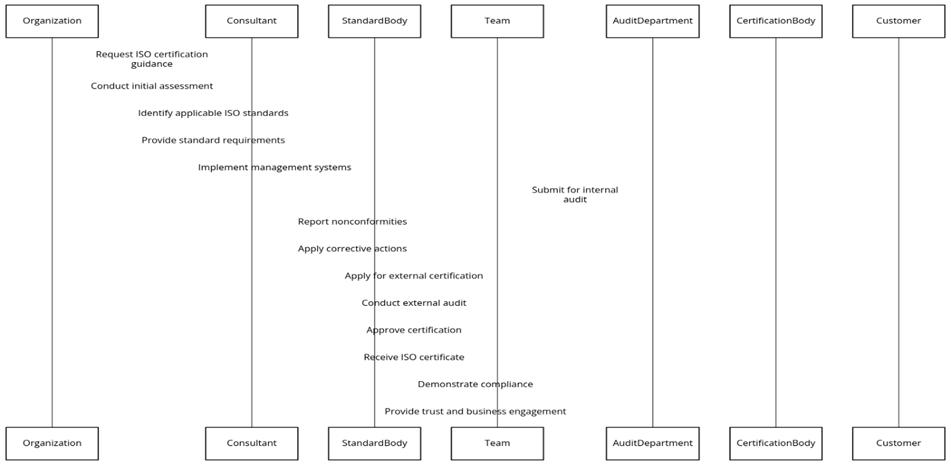
ISO Certification Process in Bavaria
Start from your current operations in manufacturing plants, pharmaceutical facilities, chemical plants, engineering workshops, or digital service centers. Here's how to get ISO certified in Bavaria:
Management Decision & Scope Definition – Top management commits to ISO certification, defines which activities, locations, products, or services will be covered, and sets strategic objectives aligned with business goals.
Gap Analysis / Readiness Assessment – Existing practices are reviewed against ISO standard requirements to identify gaps, risks, and areas needing correction before formal audits.
System Development & Implementation – Required policies, documented procedures, work instructions, controls, and record-keeping systems are developed and rolled out across teams and facilities.
Training & Awareness – Employees are trained to understand ISO requirements, their roles, responsibilities, and how daily operations support certification objectives.
Internal Audit – A trained internal auditor conducts an internal audit to verify system conformity, identify nonconformities, and pinpoint areas for improvement.
Management Review – Top management formally reviews audit results, performance data, risks, opportunities, and approves corrective actions and improvement plans.
Selection of Certification Body – An accredited ISO certification body is selected to conduct independent third-party audits. Pacific Certifications is an accredited partner offering Stage 1 and Stage 2 audits across Bavaria's industries.
Stage 1 Audit (Documentation & Readiness Review) – The certification body reviews your documented system, confirms readiness, and identifies any documentation gaps or process risks before full certification audit.
Stage 2 Audit (Certification Audit) – On-site audit verifies effective implementation, compliance with ISO requirements, and confirms that systems work as documented in real operations.
Corrective Actions & Certification Decision – Any nonconformities found are analyzed, corrected, and documented. Certification body approves corrections and issues decision.
Certificate Issuance – ISO certificate is issued, valid for three years, and clearly specifies the organization, standard(s), and certification scope.
Surveillance Audits – Annual surveillance audits (typically 1–2 days per year) ensure continued compliance and system effectiveness.
Recertification Audit – At year three, a full reassessment audit is conducted to renew certification for another three-year cycle.
Need guidance through this process? Contact Pacific Certifications at [email protected] for a personalized certification roadmap.
What Are the Requirements for ISO Certifications in Bavaria?
ISO certifications in Bavaria require organizations to establish, implement, and maintain a structured management system that meets internationally accepted ISO standard requirements. The following baseline requirements apply across certification audits in Bavaria:
The organization must clearly define the scope—which activities, locations, products, services, or functions are covered by certification.
Top management must demonstrate active leadership, clear accountability, and sustained support for the management system.
Relevant ISO policies, measurable objectives, and alignment with organizational strategy and values are required and documented.
Risks and opportunities that could affect system performance must be identified, evaluated, and managed through appropriate controls.
Responsibilities, authorities, and reporting lines must be assigned, documented, and communicated to all relevant personnel.
Documented processes and operational controls must be implemented to meet ISO standard clauses and maintain system effectiveness.
Applicable laws, regulations, and statutory obligations in Germany and the EU must be identified and integrated into operations.
Personnel must be competent based on education, training, experience, or demonstrated skill; competency records must be maintained.
Documents, procedures, work instructions, and records must be controlled, updated, protected, and retained according to ISO requirements.
Key business processes must be monitored, measured, and evaluated using defined metrics and performance indicators.
Periodic internal audits (typically annual) must be conducted to verify conformity and system effectiveness.
Top management must formally review system performance, audit results, risks, and approve improvement actions.
Nonconformities, customer complaints, and process failures must be addressed through root-cause analysis and corrective actions.
The management system must be implemented and operating for a sufficient period (typically 2–3 months minimum) before third-party certification audits.
Continuous compliance is required throughout the certification cycle, with prompt response to audit findings and maintenance of all required records.
What Are the Benefits of ISO Certifications in Bavaria?
ISO certifications offer Bavarian organizations a structured, internationally recognized framework to improve management practices and compete effectively in local, EU, and global markets. The following benefits apply across sectors and organization sizes:
Efficiency – Standardized processes reduce errors, rework, duplication, and operational waste across manufacturing and service operations.
Credibility and Trust – ISO certification demonstrates compliance with internationally recognized management standards and builds customer confidence.
Access to International Markets – Certified organizations gain better acceptance in export markets, global supply chains, and RFPs—essential for Bavaria's export-driven economy.
Compliance – ISO frameworks help identify, monitor, and comply with applicable German and EU laws, regulations, and statutory requirements.
Customer Satisfaction and Retention – Consistent service and product quality improve customer loyalty and reduce complaints.
Risk Reduction – Systematic identification and management of operational, environmental, safety, and information risks minimizes losses and disruptions.
Workplace Safety and Culture – Standards promote safer working conditions, reduce accident rates, and strengthen employee engagement and morale in hazardous industries.
Competitive Advantage in Tenders – ISO certification strengthens eligibility for government, corporate, and international contract tenders.
Continuous Improvement – Regular audits and management reviews drive ongoing performance enhancement and organizational learning.
Better Decision-Making – Data-driven monitoring and review processes support informed strategic and operational decisions.
Supplier and Partner Confidence – Certification builds trust with suppliers, investors, financial institutions, and business partners.
Long-Term Sustainability – ISO systems support organizational resilience, consistency, operational stability, and sustainable growth.
Challenges of obtaining ISO Certifications in Bavaria
Organizations in Bavaria pursuing ISO certification often face sector-specific and structural challenges. High-precision manufacturing and pharmaceutical standards demand rigorous documentation and quality controls, which can be resource-intensive during implementation. Smaller organizations and startups may lack in-house ISO expertise, requiring external consultant support, adding to project costs and complexity.
Integration of ISO requirements with existing legacy systems or complex multi-site operations can be time-consuming, particularly when standardizing procedures across different facility locations. Resistance to process changes, especially in long-established firms, can slow system adoption and employee buy-in. Balancing ISO compliance with rapid innovation cycles—common in automotive and tech sectors—requires clear system flexibility and periodic updates.
Additionally, competing compliance demands (e.g., IATF 16949 for automotive, GDP for pharmaceuticals, ATEX for hazardous chemical areas, GDPR for IT services) can create overlapping or conflicting requirements, requiring expert interpretation and careful system design. Many Bavarian organizations benefit from consulting support during implementation to navigate these complexities effectively.
What Is the Cost ofISO Certifications in Bavaria?
ISO certification cost in Bavaria varies significantly based on organization size, number of sites, standard complexity, and the certification body selected. A single-site ISO 9001 for a small manufacturing firm typically requires fewer audit days than a multi-site pharmaceutical operation with ISO 13485 and cleanroom standards.
Cost factors include:
Organization headcount (affects audit days and training scope)
Number of facilities/sites (multi-site audits cost more than single-site)
Standard complexity (ISO 9001 typically lower than ISO 13485 or ISO 14644)
System maturity (mature systems audit faster than immature ones)
Internal vs. external consultant support (impacts implementation timeline and cost)
Certification body audit fees (varies by body and standard)
Travel and on-site audit logistics (affects the remote vs. on-site audit mix)
Think in terms of investment range. Contact Pacific Certifications at [email protected] for a detailed scope-based quote tailored to your organization.
What Is the timeline for ISO Certifications in Bavaria?
The certification timeline in Bavaria generally ranges from 3 to 6 months, depending on organization size, system readiness, and standard complexity.
Small organizations (< 50 employees, single site, single standard) may complete certification within 2–3 months if systems are relatively mature and well-documented.
Medium organizations (50–250 employees, single or dual sites, 1–2 standards) typically require 3–4 months, including gap analysis, implementation, internal audit, and Stage 1/Stage 2.
Large or multi-site operations (250+ employees, multiple sites, multiple standards) typically require 4–6 months or longer, given complexity and coordination across locations.
Timeline can be expedited if:
You allocate dedicated internal resources to implementation and training
You engage experienced external consultants early in the process
You conduct a thorough pre-assessment or readiness audit before formal certification
Your organization has strong management commitment and change readiness
Timeline can be extended if implementation is delayed, team capacity is limited, or findings from Stage 1 require significant corrective actions before Stage 2 audit. Pacific Certifications can work with you to optimize audit scheduling around your production cycles and business needs.
Important Standards Requested by Buyers in Bavaria
How Can Pacific Certifications Help with ISO Certifications in Bavaria?
Pacific Certifications supports organizations in Bavaria by operating as an independent, accredited ISO certification provider, offering impartial audits and internationally accepted certification services aligned with accreditation requirements.
Conducts Stage 1 and Stage 2 certification audits to assess conformity with applicable ISO standards across all major standards (ISO 9001, ISO 13485, ISO 14001, ISO 45001, ISO 27001, and others)
Issues ISO certificates upon successful audit completion and closure of nonconformities—recognized internationally and across EU supply chains
Performs annual surveillance audits to ensure ongoing compliance and system effectiveness throughout your certification cycle
Carries out recertification audits at the end of the three-year certification cycle to renew your certification
Employs competent, qualified auditors with sector experience (automotive, pharma, chemicals, engineering, IT) and deep knowledge of Bavarian industries
Maintains impartiality, confidentiality, and credibility throughout the certification process—we audit independently without involvement in implementation or consulting
Offers flexible audit scheduling with options for on-site, remote, or hybrid approaches aligned with your operations and business needs
This approach enables Bavarian organizations to demonstrate compliance, build buyer confidence, and maintain internationally recognized ISO certification without involvement in consultancy or implementation activities. We remain independent, keeping our certification decisions impartial and aligned with international standards.
Ready to start your certification journey? Contact Pacific Certifications today at [email protected] to discuss your certification scope, timeline, and investment.
Accredited Training Programs
Pacific Certifications provides structured ISO training programs in Bavaria to strengthen organizational competence while maintaining impartial certification practices.
Lead Auditor Training – Develops skills to plan, conduct, report, and follow up on ISO audits in line with ISO/IEC 17021 and ISO 19011 guidelines. Ideal for quality managers, compliance teams, and internal auditors seeking professional certification.
Lead Implementer Training – Focuses on building, implementing, and maintaining ISO management systems in accordance with standard requirements and international best practices. Suitable for project managers, quality officers, and implementation teams seeking hands-on expertise.
Contact Us
If you need support with ISO certifications in Bavaria, contact us at [email protected].
Read More at: Blogs by Pacific Certifications