Introduction
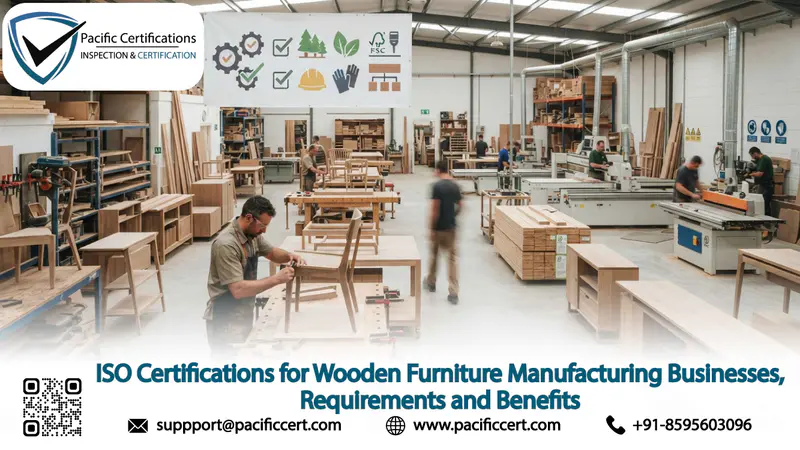
The wooden furniture manufacturing industry includes small workshops, custom furniture makers, and large-scale factories serving residential, commercial, hospitality, and institutional markets. Production methods vary depending on the type of furniture, materials, and customer requirements.
Manufacturing typically involves timber selection, cutting, shaping, joinery, assembly, sanding, and surface finishing. Both manual tools and automated equipment, including CNC machinery, may be used to maintain accuracy and production consistency.
These activities create several workplace and environmental risks. Wood dust, machinery, flammable particles, adhesives, stains, coatings, and other chemicals require appropriate safety controls to protect workers and reduce the risk of fire, injury, and harmful exposure.
Manufacturers also face growing expectations around responsible timber sourcing, waste reduction, product quality, and environmental performance. Effective procedures, trained workers, equipment maintenance, supplier controls, and reliable records help businesses manage these risks consistently throughout production.
For businesses in this sector, ISO certifications for wooden furniture manufacturing provide internationally recognized management frameworks that help convert daily operations into controlled and documented processes. Many hospitality groups, commercial contractors, and global furniture retailers require certified management systems before approving suppliers.
In wooden furniture manufacturing, quality lives in the grain of the process, not just the grain of the wood.
Quick Summary
ISO certifications provide wooden furniture manufacturing with internationally recognized frameworks to manage production quality through ISO 9001, sustainable timber sourcing through ISO 38200, workplace safety through ISO 45001, environmental performance through ISO 14001, energy efficiency through ISO 50001, and information security through ISO/IEC 27001. Organizations that align their production systems with ISO requirements gain a measurable advantage in hospitality sector contracts and international retail supply programs that demand verified sustainability and quality credentials.
Applicable ISO Standards for Wooden Furniture Manufacturing Businesses
Below are the most relevant ISO standards applicable to mass-production wooden furniture manufacturers, custom and bespoke furniture producers, commercial and hospitality furniture suppliers, and flat-pack and modular furniture manufacturers:
ISO 9001: Quality Management Systems
ISO 9001 requires manufacturers to document every critical production process, establish inspection checkpoints from raw timber intake through finished product acceptance, and maintain a corrective action system that investigates quality failures at the root cause level rather than applying surface fixes. Manufacturers certified to ISO 9001 consistently perform better on retail and hospitality buyer quality audits and report fewer warranty claims and production rework events across their product range.
Read more: ISO 9001
ISO 38200:2018 – Chain of Custody of Wood and Wood-Based Products
ISO 38200 provides manufacturers with a chain of custody framework that tracks timber from source through each stage of production to the finished product, enabling credible sustainability claims that satisfy both buyer requirements and environmental certification frameworks. Manufacturers certified to ISO 38200 differentiate themselves clearly in markets where ethical sourcing has become a baseline procurement requirement rather than a premium selling point.
Read more: ISO 38200:2018
ISO 14001: Environmental Management Systems
ISO 14001 gives manufacturers a documented system to identify their significant environmental impacts, set measurable reduction targets, and maintain verifiable compliance evidence for the sustainability audits that retail chains and commercial buyers conduct on their manufacturing partners. As consumer demand for environmentally responsible furniture production intensifies and buyer sustainability requirements tighten across global retail and hospitality supply chains.
Read more: ISO 14001
ISO 45001: Occupational Health and Safety Management Systems
ISO 45001 requires manufacturers to document each hazard through structured risk assessments, assign practical controls, deliver targeted worker training, and verify safety performance through regular internal audit cycles. Businesses that certify to ISO 45001 consistently report fewer lost-time incidents and build a safety culture that improves both worker welfare and production efficiency across the facility.
Read more: ISO 45001
ISO 50001: Energy Management Systems
ISO 50001 provides a structured framework to monitor consumption at the equipment and process level, identify inefficiencies, set reduction targets, and track performance improvement through management reviews. For manufacturers operating large facilities with multiple production lines, certified energy management can generate meaningful cost savings per unit of furniture produced while strengthening the sustainability profile that retail and commercial buyers increasingly include in their supplier evaluation criteria.
Read more: ISO 50001
ISO 28000: Supply Chain Security Management Systems
ISO 28000 enhances supply chain security and ensures the integrity of raw materials, especially in industries like furniture manufacturing, where sustainable wood sourcing is vital.
Read more: ISO 28000
What are the Requirements of ISO Certifications for Wooden Furniture Manufacturing Businesses?
Wooden furniture manufacturing businesses seeking ISO certification must establish and maintain documented policies, procedures, and records aligned with the selected ISO standards. Key requirements include the following:
ISO 9001:2015 – Quality Management Systems Requirements
Define a quality policy with targets for defect rates, complaints, rework levels, and delivery performance across all furniture products.
Control timber intake through checks for species, moisture level, dimensions, surface quality, and supplier documentation.
Use documented work instructions for machining, assembly, adhesive curing, and finishing for each product type.
Maintain corrective action procedures for finish defects, joint failures, size errors, and customer returns.
Review timber suppliers regularly to ensure consistent quality, legal sourcing, and proper documentation.
ISO 38200:2018 – Chain of Custody for Wood Requirements
Maintain a chain of custody system tracking timber species, source, and quantity from receipt to finished furniture.
Accept timber only with valid certification proving legal harvest and sustainable sourcing.
Keep certified and non-certified timber separated during storage and production.
Retain records showing timber source, volume, certification reference, and usage in each product batch.
ISO 45001:2018 – Occupational Health and Safety Requirements
Assess risks in machining, sanding, assembly, spray finishing, adhesive use, storage, and material handling.
Define safe procedures for CNC machines, cutting tools, spray booths, dust extraction, and heavy lifting.
Record and investigate injuries, dust exposure, chemical incidents, and near-misses with corrective actions.
Maintain training records for dust safety, coating chemicals, PPE use, fire prevention, and machine operation.
Evaluate fire risk in timber storage, dust systems, and finishing areas with controls and emergency plans.
ISO 14001:2026 – Environmental Management Systems Requirements
Identify environmental risks from solvents, adhesives, sawdust, timber waste, energy use, and packaging waste.
Control waste through segregation and approved disposal of wood waste, dust, chemicals, and coating residues.
Set targets to reduce solvent use, timber waste, and energy consumption per furniture unit.
Perform internal audits and keep records proving compliance with environmental controls.
Tip:Start ISO implementation with production, timber procurement, safety, environmental, finishing, and quality teams. Review each stage from timber intake, machining, joinery, assembly, finishing, inspection, to dispatch, and identify existing controls, missing procedures, and documentation gaps to build a clear implementation roadmap before certification audit.
What are the Benefits of ISO Certifications for Wooden Furniture Manufacturing Businesses?
ISO certifications provide wooden furniture manufacturing with strong operational and commercial advantages. Listed below are the key benefits for the ISO standards applicable to mass-production wooden furniture manufacturers:
Stronger credibility with retail and hospitality buyers that require ISO certification before approving furniture suppliers.
Better product consistency through ISO 9001 controls that standardize machining, assembly, and finishing, reducing defects and rework.
Verified sustainable sourcing through ISO 38200 chain of custody showing timber comes from legal and certified forests.
Lower environmental risk using ISO 14001 controls for solvent emissions, wood waste, and chemical disposal.
Improved worker safety with ISO 45001 systems that reduce dust exposure, machine injuries, and chemical hazards.
Reduced energy costs through ISO 50001 by controlling power use in machining, drying, and finishing equipment.
Higher delivery reliability with ISO 22301 continuity planning to protect production from supply or equipment disruptions.
Easier buyer audits since ISO certification provides verified proof of controlled processes and compliance.
Market Trends
The global wooden furniture market is currently valued at approximately USD 461.84 billion and is projected to reach approximately USD 719.61 billion within the next several years, growing at a compound annual growth rate of 5.7%. The residential segment drives the majority of demand, supported by urbanization trends, rising disposable incomes in emerging economies, and growing consumer preference for sustainable and aesthetically personalized interior solutions. In the coming years, demand will be further shaped by the expansion of the hospitality and commercial construction sectors, growth in the e-commerce furniture channel, and a significant shift in consumer preference toward verified eco-friendly and sustainably sourced products.
In fast-growing furniture manufacturing regions, ISO certification serves as internationally recognized proof that local producers can meet the same quality, safety, and environmental standards followed in established markets. Manufacturers that implement certified systems early are better positioned to secure long-term supply agreements, enter global retail networks, and show that responsible production practices are built into daily operations rather than prepared only for inspections.
How Pacific Certifications Can Help?
Pacific Certifications, accredited by ABIS, acts as an independent certification body for wooden furniture manufacturing businesses by conducting impartial audits against applicable ISO standards. Our role is to objectively assess whether documented management systems and furniture manufacturing-specific practices, including timber intake controls, production quality procedures, chain of custody records, occupational safety programs, environmental waste management systems, and energy management controls, conform to international ISO requirements based strictly on verifiable evidence and operational records.
We support wooden furniture manufacturing providers through:
Independent certification audits conducted in accordance with ISO/IEC 17021 to ensure audit integrity and global recognition of all issued certificates
Practical assessment of real manufacturing operations covering timber intake, machining, assembly, surface finishing, quality inspection, environmental controls, and worker safety systems
Clear audit reporting that reflects conformity status, nonconformity findings, and certification decisions based entirely on documented evidence and observed manufacturing practices
Internationally recognized ISO certification upon successful demonstration of compliance with all applicable standard requirements
Surveillance and recertification audits to maintain ongoing certification validity and verify continual improvement across all certified management systems
Contact us
If you need support with ISO certification for your wooden furniture manufacturing business, contact us at support@pacificcert.com or +91-8595603096.
Author: Alina
Read more: ISO certifications for timber manufacturing businesses