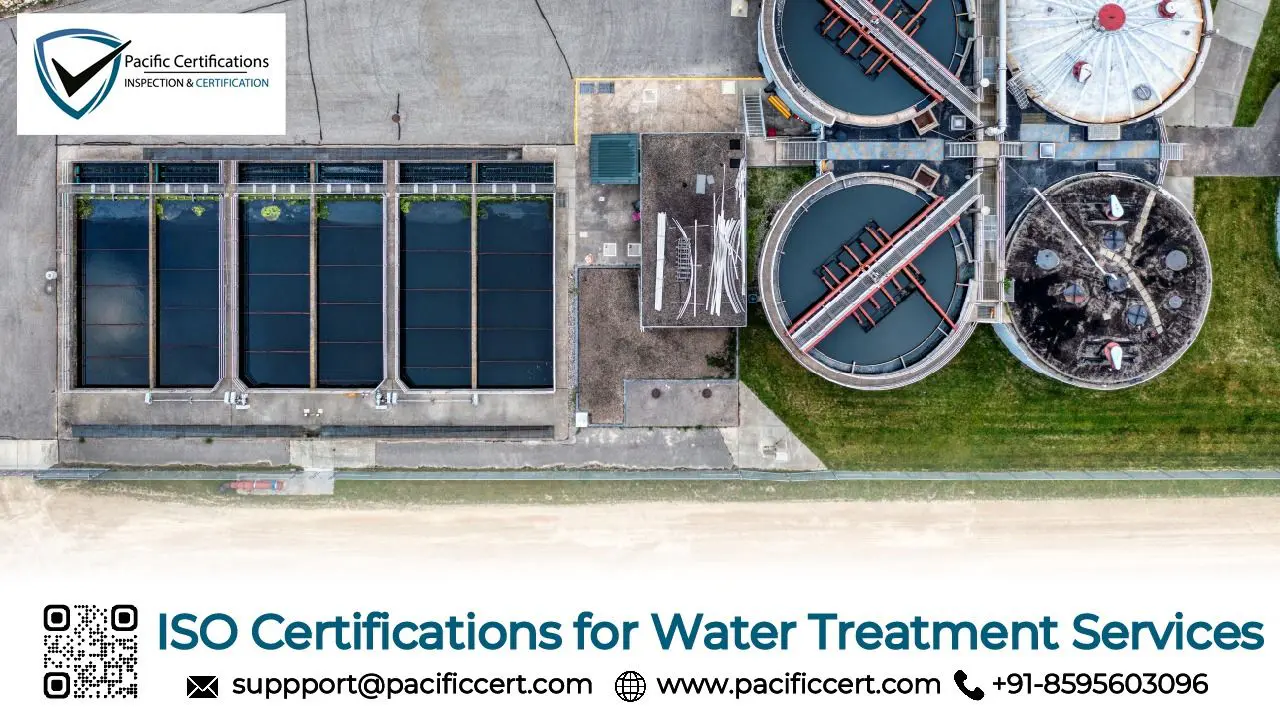
Introduction: ISO Certifications for Water Treatment Services
Water treatment services cover a wide spectrum, from municipal water supply and sewage treatment to industrial water recycling and desalination. With water scarcity affecting over 2 billion people worldwide, the sector is under pressure to deliver safe and efficient water solutions. According to market research, the global water treatment industry is projected to exceed USD 500 billion by 2030, driven by stricter environmental rules and rising demand for clean water in industries such as food, pharmaceuticals, and energy.
This sector faces challenges including contamination risks, chemical management, environmental impact etc. ISO certifications help water treatment providers establish transparent, internationally recognized systems and assure customers and regulators of consistent standards.
Water treatment services are vital to public health and industrial operations—ISO certifications provide structured systems to ensure safety, compliance, and reliability.
Quick Summary
Water treatment providers improve safety, efficiency, and environmental stewardship through ISO certifications. Key standards include ISO 9001 (quality), ISO 14001 (environmental), ISO 45001 (safety), ISO 22000 (drinking water safety), ISO 17025 (testing accuracy), and ISO 50001 (energy efficiency). Certification enhances credibility, regulatory compliance, and operational performance across industrial, municipal, and residential services.
If you are looking for certification support for your water treatment business, contact us at support@pacificcert.com to schedule the audit!
Applicable ISO Standards for Water Treatment Services
Water treatment services must implement various ISO standards to ensure compliance with quality, environmental, and safety regulations. Here are the most relevant ISO certifications for the industry:
ISO 9001:2015 – Quality Management System (QMS)
ISO 9001:2015 is a globally recognized standard for quality management. It helps water treatment companies establish efficient processes, improve customer satisfaction, and ensure consistent service delivery.
ISO 14001:2015 – Environmental Management System (EMS)
Environmental protection is a critical concern in water treatment. ISO 14001:2015 provides a framework for organizations to manage their environmental responsibilities effectively.
ISO 45001:2018 – Occupational Health & Safety Management System (OHSMS)
Water treatment operations often involve hazardous chemicals and equipment. ISO 45001:2018 ensures a safe working environment.
ISO 22000:2018 – Food Safety Management System (FSMS) (Applicable for Drinking Water Treatment)
For companies involved in potable water treatment, ISO 22000:2018 ensures water quality meets health and safety standards.
ISO 17025:2017 – Testing and Calibration Laboratories
Water treatment facilities conducting laboratory testing for water quality need ISO 17025:2017 certification.
ISO 50001:2018 – Energy Management System (EnMS)
Energy consumption is a major factor in water treatment plants. ISO 50001:2018 helps organizations optimize energy usage and reduce costs, improve energy efficiency and sustainability.
Click here to find out more applicable standards to your industry
What are the requirements of ISO Certifications for Water Treatment Services?
Each ISO standard has specific requirements that water treatment service providers must meet. Below is a breakdown of general and specific requirements for each applicable standard:
General requirements:
Define the scope of services (municipal water supply, wastewater treatment, industrial treatment, or desalination).
Establish policies for quality, safety, environmental management, and risk control.
Conduct risk assessments for contamination, chemical handling, equipment failure, and emergencies.
Document procedures for intake, treatment, testing, distribution, and waste disposal.
Train staff in chemical safety, testing protocols, and emergency response.
Maintain records of water quality tests, inspection logs, audits, and corrective actions.
Monitor KPIs such as turbidity, chemical dosing accuracy, compliance rates, and energy use.
Carry out internal audits and management reviews for continual system improvement.
Specific requirements: ISO 9001:2015 – Quality Management System (QMS) Requirements
Establish a documented Quality Management System (QMS)
Define roles, responsibilities, and objectives
Implement risk-based thinking and process improvements
Ensure customer satisfaction through continuous monitoring
Conduct regular internal audits and management reviews
ISO 14001:2015 – Environmental Management System (EMS) Requirements
Identify environmental aspects and impacts of operations
Comply with environmental laws and regulations
Implement pollution prevention and waste management strategies
Set environmental objectives and track performance
Continuously improve environmental performance
ISO 45001:2018 – Occupational Health & Safety (OHSMS) Requirements
Identify and assess workplace hazards
Implement safety procedures and risk control measures
Provide employee training and awareness programs
Ensure compliance with health and safety regulations
Monitor and improve occupational health and safety performance
ISO 22000:2018 – Food Safety Management System (FSMS) (For Drinking Water Treatment) Requirements
Implement a Hazard Analysis and Critical Control Points (HACCP) system
Identify and control food safety hazards
Maintain hygiene and sanitation in water treatment processes
Ensure traceability of water sources and supply chain safety
Establish corrective actions and verification procedures
ISO 17025:2017 – Testing and Calibration Laboratories Requirements
Ensure laboratory competence and technical expertise
Use validated testing and calibration methods
Maintain traceability of measurements and testing results
Implement quality control procedures for accurate reporting
Conduct regular proficiency testing and audits
ISO 50001:2018 – Energy Management System (EnMS) Requirements
Develop an energy policy and improvement objectives
Monitor and optimize energy consumption in operations
Identify and reduce energy wastage
Ensure compliance with energy efficiency regulations
Continuously assess and improve energy performance
Tip: Water utilities should start with ISO 9001 and ISO 14001, while industrial water treatment firms may prioritize ISO 45001 for safety and ISO 50001 for energy efficiency.
Book an ISO audit for your water treatment services by contacting us at support@pacificcert.com.
What are the benefits of ISO Certifications for Water Treatment Services?
Achieving ISO certification offers multiple benefits for water treatment companies:
Safer drinking water with reduced contamination risks.
Improved compliance with national and international water quality standards.
Safer workplaces for operators handling chemicals and equipment.
Reduced operational costs through energy and resource efficiency.
Stronger trust from regulators, municipalities, and industrial clients.
Better resilience against emergencies such as floods, droughts, or power failures.
Documentation that supports inspections and audits with ease.
Opportunities to secure contracts with governments and international organizations.
The water treatment services industry is expanding quickly as governments and utilities invest heavily in clean water infrastructure, wastewater recycling, and sustainable water management. Recent industry research estimates that the global water and wastewater treatment market was valued at approximately USD 320–330 billion in 2023 and is projected to reach nearly USD 550–600 billion by 2030, growing at a compound annual growth rate (CAGR) of around 7–8%. This growth is largely driven by increasing urbanization, industrial water demand, stricter environmental regulations, and rising concerns about water scarcity and pollution.
Infrastructure investments are also accelerating worldwide. Governments across Asia, the Middle East, and Africa are expanding desalination plants, municipal wastewater treatment facilities, and industrial water recycling systems to meet growing population and industrial needs. At the same time, advanced technologies such as membrane filtration, reverse osmosis, UV disinfection, and smart monitoring systems are transforming how water treatment plants operate and manage quality. As utilities and industrial operators face tighter environmental compliance requirements, service providers are increasingly expected to demonstrate structured operational controls, environmental management practices, and documented quality assurance systems, which is encouraging wider adoption of internationally recognized ISO-based management frameworks in the water treatment sector.
How Pacific Certifications can help?
Pacific Certifications is accredited by ABISto provide independent auditing and certification services for ISO standards across the water treatment sector. Whether you are a municipal utility, industrial plant, or private contractor, we help align your systems with global requirements.
With Pacific Certifications, you can:
Get certified for ISO 9001, ISO 14001, ISO 45001, ISO 24512, ISO 24518, and others.
Build credibility with regulators and clients through accredited certification.
Strengthen compliance in water quality, safety, and sustainability.
Adopt structured systems that support long-term reliability
Contact us
If you need support with ISO certification for your Water Treatment Services business, contact us at support@pacificcert.com or +91-8595603096.
Author: Pushpinder K
Read More at: Blogs by Pacific Certifications