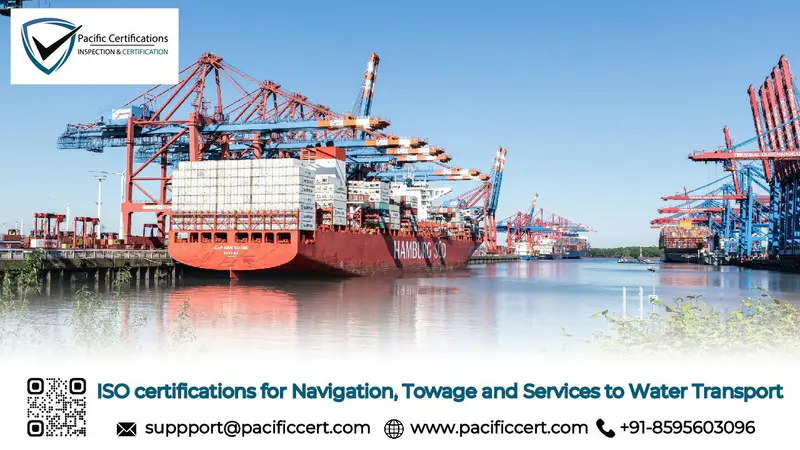
ISO Certifications for Navigation, Towage and Water Transport, Requirements and Benefits
Introduction
Navigation, towage and water transport operations form the lifeline of global commerce and coastal mobility, where vessels, tugs, pilot boats, and ferries navigate complex waterways to move goods and people. Core activities include ship assist services for vessel berthing and unberthing, coastal and harbor towing of disabled or barges, pilotage for safe navigation through challenging channels, and ferry transportation for passengers and vehicles across water barriers. Operators face persistent challenges: ensuring safety amid high-risk maneuvers with large vessels, preventing environmental incidents like oil spills or ballast water discharge, maintaining vessel reliability under harsh marine conditions, adapting to fluctuating trade volumes and regulatory changes, and meeting rising expectations for punctuality and service transparency, all under constant scrutiny from maritime authorities focused on safety of life at sea and pollution prevention.
ISO certifications provide essential frameworks to address these pressures by establishing internationally recognized benchmarks that transcend fragmented national maritime regulations. Rather than reacting to isolated incidents or compliance gaps, these standards create proactive systems for quality management, environmental stewardship, occupational safety, and information security, critical for building trust with shipping companies, port authorities, and coastal communities. They transform operational inconsistencies into standardized processes that directly support reliable service delivery, demonstrable risk reduction, and verifiable compliance with global maritime safety and environmental frameworks, which is indispensable in an industry where reputation for safe, dependable, and ecologically responsible operations directly influences contract eligibility and social license to operate.
In navigation and towage, every maneuver depends on systems that prevent failure—where ISO certification transforms maritime vigilance into verified trust.
Quick Summary
ISO certifications provide navigation, towage and water transport with internationally recognized frameworks to manage service quality through ISO 9001, environmental impact through ISO 14001, occupational health and safety through ISO 45001, and information security through ISO/IEC 27001. Organizations should prioritize aligning safety-critical processes like vessel maintenance protocols, crew training programs, and data protection measures with these standards to ensure resilience and stakeholder confidence.
For more information on how we can assist your navigation, towage and water transport business with ISO certifications, contact us at support@pacificcert.com.
Applicable ISO Standards for Navigation, Towage and Water Transport Businesses
Below are the most relevant ISO standards applicable to tugboat operators, pilotage services, ferry operators, and port logistics providers:
ISO 9001:2015 - Quality Management Systems
This standard is critical for navigation and towage operators to ensure consistent, high-quality service delivery—a core expectation from clients relying on safe vessel movements. It covers maintenance scheduling, pre-operation checks, incident reporting, and customer feedback. Benefits include fewer service discrepancies, enhanced client trust through transparency, and improved operational efficiency, as seen in marine providers achieving standardized procedures post-certification.
ISO 14001:2015 - Environmental Management Systems
This standard is vital for water transport operations due to sector impacts on marine ecosystems via emissions, ballast water, and waste. It addresses fuel monitoring, spill prevention, waste management, and noise reduction. Benefits include reduced environmental liability, MARPOL compliance support, and enhanced eco-stakeholder reputation, aided by water-specific EMS guidelines.
ISO 45001:2018 - Occupational Health and Safety Management Systems
This standard is paramount for maritime operations where crew safety faces risks from vessel motion, machinery, and isolated work. It addresses slip/trip hazards, manual handling, fatigue management, and emergency response. Benefits include reduced lost-time injuries, ILO maritime alignment, and improved crew retention, as seen in shipping firms strengthening safety cultures post-certification.
ISO 27001: Information Security Management Systems (ISMS)
This standard is critical for protecting navigational data, AIS information, and passenger records from cyber threats targeting maritime systems. It addresses access controls, communication encryption, and anomaly monitoring. Benefits include defense against breaches compromising voyage security, data protection compliance, and partner assurance for maritime IT systems, as noted in transport sector certifications.
ISO 28000:2022 – Supply Chain Security Management Systems
This standard is essential for mitigating cargo theft, tampering, and unauthorized access risks in port and coastal operations. It addresses perimeter controls, seal verification, and suspicious activity monitoring. Benefits include ISPS Code compliance support, reduced cargo loss incidents, and enhanced shipper credibility, as recognized in supply chain security certifications.
ISO 31000:2018 - Risk Management
ISO 31000:2018 provides guidelines on managing risk faced by organizations. The maritime industry is inherently risky, with challenges such as adverse weather conditions, equipment failure, and operational risks.
ISO 50001:2018 - Energy Management Systems
ISO 50001:2018 is the international standard for energy management systems. This standard helps organizations improve their energy efficiency, reduce energy consumption, and minimize their carbon footprint.
ISO 22301:2019 - Business Continuity Management Systems
This standard ensures operations can be maintained or restored during disruptions like extreme weather or cyber incidents affecting ports or vessels. It addresses planning for weather closures, system attacks, and vessel collisions. Benefits include minimized emergency downtime, faster post-incident recovery, and proven resilience for stakeholders, as supported in transport sector continuity frameworks.
Click here to find out more applicable standards to your industry
What are the Requirements of ISO Certifications for Navigation, Towage and Water Transport Businesses?
Navigation, towage and water transport businesses seeking ISO certification must establish and maintain documented policies, procedures, and records aligned with the selected ISO standards. Key requirements include the following:
ISO 9001:2015 – Quality Management Systems
Define standardized procedures for tugboat maintenance, pilot boat operations, and ferry scheduling to ensure consistent service delivery across all shifts and weather conditions.
Control calibration of navigation equipment, radar systems, and engine performance monitors to maintain accuracy in vessel handling and transit monitoring during operations.
Implement customer feedback collection mechanisms for service timeliness, safety perception, and communication effectiveness following each transport operation to identify improvement areas and trends.
Monitor key performance indicators such as on-time assist completion rates, incident frequency per voyage, and customer satisfaction scores to assess operational effectiveness.
Hold monthly management reviews assessing service quality, fleet readiness, and client feedback trends to drive continuous improvement initiatives and resource allocation based on review findings.
Maintain records of corrective actions for recurring issues such as navigation delays or equipment malfunctions affecting service reliability and safety concerns of operations.
ISO 14001:2015 – Environmental Management Systems
Establish an environmental policy committing to preventing pollution from vessel emissions, ballast discharge, and waste streams in marine and coastal operations.
Identify environmental aspects including fuel consumption, oil spill risks, garbage disposal, and noise generation from propulsion systems of vessels and machinery.
Set measurable objectives for reducing sulfur emissions, improving ballast water treatment, and decreasing solid waste and grey water discharge per voyage.
Implement operational controls like fuel-efficient voyage planning, spill containment equipment, and waste segregation protocols onboard for crew and cargo areas.
Monitor environmental performance through emissions calculations, spill drill effectiveness, and waste audits at port facilities and regular vessel reception points.
Conduct annual management reviews assessing environmental goal achievement, audit results, and regulatory compliance status with stakeholder expectations.
ISO 45001:2018 – Occupational Health & Safety Management Systems
Establish an occupational health and safety policy committing to zero harm for crew during vessel operations, maintenance, and shore-based activities.
Identify workplace hazards including slip/trip risks on decks, manual handling strains during mooring, and fatigue from irregular watch schedules and environmental exposure.
Define operational controls like enforced life jacket use, standardized lifting procedures, and maximum duty hour limits based on maritime regulations and guidelines.
Monitor safety metrics such as lost-time injury rates per man-hour and near-miss reports during cargo transfers, mooring operations, and anchorage procedures.
Conduct quarterly safety performance reviews analyzing trends and effectiveness of training and intervention programs for crew and shore personnel.
Maintain records of worker safety training completion and equipment inspection certificates for davits, winches, windlasses, and anchor handling gear.
ISO 28000:2022 – Security Management Systems for Supply Chain
Conduct risk assessments targeting cargo areas, vessel access points, and information systems for security vulnerabilities in port and coastal operations.
Implement access controls limiting terminal privileges to authorized personnel based on job function and security clearance levels and training requirements.
Establish seal verification procedures for containers, breakbulk, dry bulk, liquid, and high-value cargo consignments during loading and unloading.
Monitor surveillance systems and access logs for unauthorized entry attempts or anomalous vessel movements near terminals, anchoring zones, and fairway approaches.
Test incident response plans through simulated security breaches (theft, tampering, unauthorized boarding, and cyber intrusion attempts on critical systems) quarterly.
Maintain vendor security agreements for all technology providers handling cargo tracking, terminal operational data, vessel monitoring systems, and port security networks.
Tip:Start by mapping your existing navigation, towage, and water transport workflows, from vessel dispatch and crew assignment to voyage execution, cargo handling, and post-operation reporting—against relevant ISO clause requirements, involving cross-functional teams such as operations, safety, maintenance, IT, and customer service to identify gaps and align current practices with standard expectations before formalizing controlled documentation.
For certification-related inquiries or to understand the audit and certification process for marine and towage operations, you can reach out at support@pacificcert.com.
What are the Benefits of ISO Certifications for Navigation, Towage and Water Transport Businesses?
ISO certifications provide navigation, towage and water transport with strong operational and commercial advantages, including: listed below are the key benefits for the ISO standards applicable to tugboat operators, pilotage services, ferry operators, and port logistics providers:
Improved reduction in navigation incidents through systematic hazard identification, risk assessment, and crew training and maintenance programs for vessel operations.
Stronger protection of vessel and cargo integrity via secured handling systems minimizing damage, loss, and documentation errors and reporting delays.
Better service continuity during disruptions due to predefined continuity protocols and resource readiness for critical functions such as emergency response.
Higher client satisfaction from reliable vessel availability, accurate information provision, and professional service delivery throughout operations and proactive client communication.
Enhanced regulatory compliance demonstrating alignment with international maritime safety, security, and environmental benchmark frameworks such as SOLAS and MARPOL.
Greater access to premium shipping contracts as carriers prefer ISO-certified operators for lower risk profiles and verified performance and safety records.
Reduced operational costs through optimized fuel consumption, predictive maintenance, and efficient shore facility and vessel energy use.
Increased resilience against cyberattacks targeting navigational systems, payment platforms, vessel tracking technology, and onshore and offshore communication networks for fleet management.
Navigation, towage, and inland water transport services are expanding steadily, supported by global maritime trade, port activity, and inland waterway development. With over 80% of global trade by volume transported via sea, demand for tug operations, pilotage, and vessel assistance remains closely linked to port throughput and vessel traffic growth, which continues to rise at 3–5% annually in most regions.
Towage services are becoming more critical as vessel sizes increase, particularly with ultra-large container ships and LNG carriers requiring high-powered, technologically advanced tugboats for safe maneuvering. At the same time, inland water transport is gaining attention as a cost-efficient and lower-emission alternative to road and rail in regions such as Europe, India, and Southeast Asia.
Digitalization is transforming operations through vessel traffic management systems, GPS-based navigation, real-time communication platforms, and predictive scheduling, improving coordination and safety. However, this also introduces higher expectations around cybersecurity and system reliability.
Sustainability is a growing priority, with operators investing in hybrid and electric tugboats, fuel-efficient engines, and emission monitoring systems to comply with stricter environmental regulations. Safety and operational precision remain critical due to the high-risk nature of vessel handling in congested or restricted waterways.
As complexity increases, operators are focusing on structured management systems to ensure consistent service delivery, regulatory compliance, and safe navigation support in a sector where precision and reliability are essential.
How Pacific Certifications Can Help?
Pacific Certifications, accredited by ABIS, acts as an independent certification body for navigation, towage and water transport businesses by conducting impartial audits against applicable ISO standards. Our role is to objectively assess whether documented management systems and navigation, towage and water transport-specific practices conform to international ISO requirements, based strictly on verifiable evidence and operational records.
We support navigation, towage and water transport providers through:
Independent certification audits conducted in accordance with ISO/IEC 17021
Practical assessment of real navigation, towage and water transport operations, vessel safety controls, and cargo handling standards
Clear audit reporting reflecting conformity status and certification decisions
Internationally recognized ISO certification upon successful compliance
Surveillance and recertification audits to maintain certification validity
Contact us
If you need support with ISO certification for your navigation, towage and water transport business, contact us at support@pacificcert.com or +91-8595603096.
Author: Alina
Read More at: Blogs by Pacific Certifications