Introduction
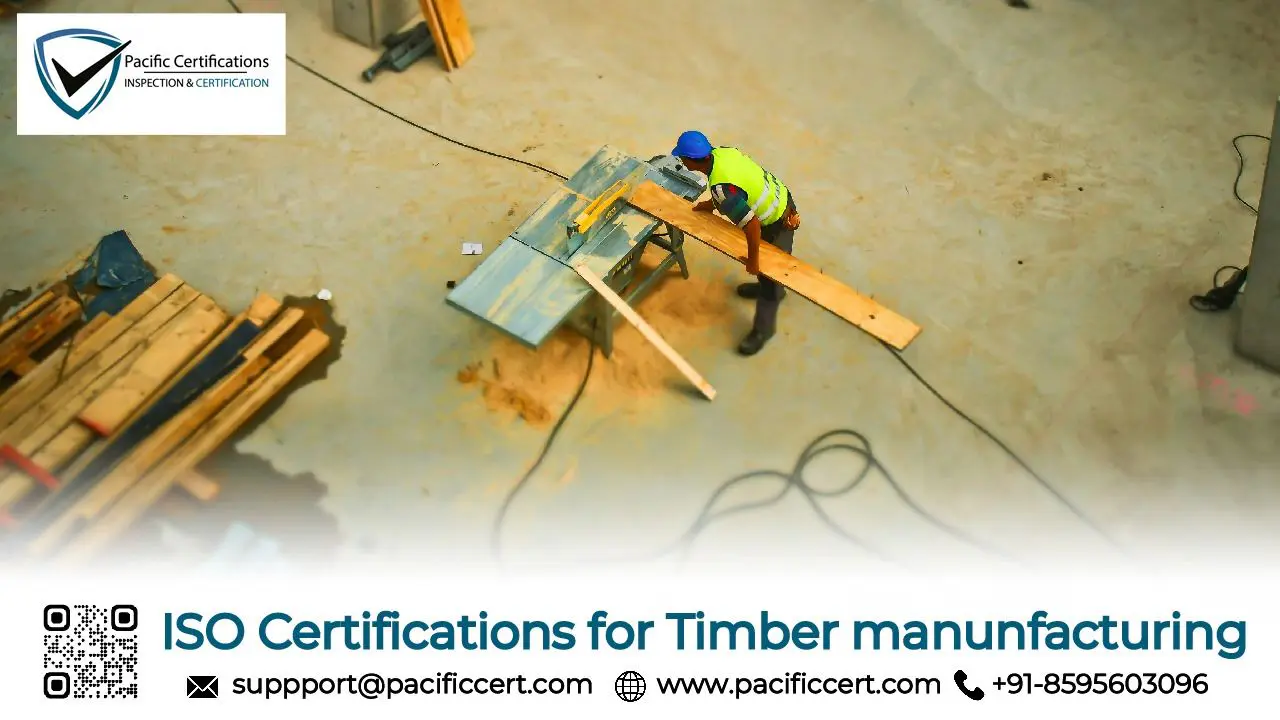
Timber manufacturing transforms raw wood into sawn lumber, engineered panels, flooring, furniture components and a wide range of value‑added products. Core operations include log debarking, sawing, drying, planing, machining, surface treatment and assembly. Facilities manage high‑volume material flows, operate heavy machinery such as band saws and planers, and apply chemical treatments for preservation or finishing. Typical challenges involve ensuring consistent product dimensions, controlling emissions from drying kilns, managing wood dust and noise exposure, and meeting sustainability expectations from global buyers who demand proof of legal sourcing and low environmental impact.
ISO certifications are essential for timber manufacturers because they provide an internationally recognized framework to manage quality, safety, environmental responsibility and information security systematically. Global compliance frameworks increasingly require documented evidence that production processes control hazardous substances, protect worker health and verify legal chain‑of‑custody for wood. By aligning with ISO standards, manufacturers demonstrate transparency in their operations, build trust with downstream users who rely on timber performance for structural safety, and establish a risk‑managed foundation that satisfies both regulatory expectations and customer‑driven quality clauses in supply contracts.
In timber manufacturing, trust is built into every board — and robust systems are how you guarantee that trust holds.
Quick Summary
ISO certifications provide timber manufacturing businesses with internationally recognized frameworks to manage production quality through ISO 9001, environmental performance through ISO 14001, worker health and safety through ISO 45001, information security through ISO/IEC 27001, operational continuity through ISO 22301, risk management through ISO 31000 and legal sourcing through ISO 38200. Organizations in this sector should pay particular attention to product quality consistency and verified chain‑of‑custody, as these directly influence market access and customer confidence in international trade.
For more information on how we can assist your timber manufacturing business with ISO certifications, contact us atsupport@pacificcert.com.
Applicable ISO Standards for Timber Manufacturing Businesses
Below are the most relevant ISO standards applicable to sawmills and planing mills, engineered wood product manufacturers, flooring and panel producers, and furniture component fabricators:
ISO 9001: Quality Management Systems
Consistent timber performance is the cornerstone of customer trust, and ISO 9001:2015 delivers the documented controls needed to achieve it. The standard governs every stage from incoming log verification — including species, moisture content and defect grading — through precise sawing targets, kiln drying schedules, planing tolerances and final inspection against defined strength, straightness and finish criteria. Manufacturers benefit from reduced batch‑to‑batch variation, fewer customer claims about warping or insufficient strength, and stronger credibility when responding to quality audits from construction contractors or furniture OEMs.
ISO 14001: Environmental Management Systems
Timber processing generates emissions from biomass drying, chemical waste from preservative treatments and solid waste from bark, sawdust and offcuts. ISO 14001:2015 gives manufacturers a systematic method to identify these aspects, set measurable reduction targets — such as lowering particulate emissions from kilns or increasing wood waste recycling — and demonstrate continuous improvement across audit cycles. Compliance supports adherence to international forestry regulations, improves the environmental profile of products marketed as “certified sustainable” and meets the sustainability expectations of green‑building and retail customers.
ISO 45001: Occupational Health and Safety
Working with high‑speed saws, planers and dryers exposes employees to wood dust, noise levels above safe limits and risks from moving blades or hot surfaces. ISO 45001:2018 requires comprehensive hazard identification, implementation of engineering controls like local exhaust ventilation for dust, acoustic enclosures for noisy equipment and interlocks on dryer doors, and regular emergency response drills for fire or mechanical entrapment scenarios. Facilities that adopt this standard typically see lower incident rates, improved worker morale and stronger alignment with the safety clauses embedded in multinational supplier contracts.
ISO 27001: Information Security Management Systems (ISMS)
Proprietary product designs, customer‑specific performance requirements and digital production records represent critical intellectual property in the timber sector. ISO/IEC 27001:2022 establishes a framework for classifying this information, applying access controls based on need‑to‑know and monitoring for unauthorized exfiltration attempts. Certification reassures partners that design data, cutting programs and supply‑chain communications are safeguarded against cyberattacks, which is increasingly important as manufacturers adopt cloud‑based ERP and IoT‑enabled process monitoring systems.
ISO 26000: Social Responsibility
ISO 26000 provides guidelines on social responsibility, urging businesses to address social and ethical concerns. In timber manufacturing, this includes fair labor practices, community engagement, and transparency regarding environmental practices. While ISO 26000 is not certifiable, aligning operations with its principles helps companies enhance their corporate reputation.
ISO 38200:2018 – Chain of Custody of Wood and Wood-Based Products
Legal and sustainable sourcing is a growing expectation for timber sold into European, North American and Asian markets. ISO 38200:2018 requires organizations to map the flow of wood from forest harvest through processing, establish documented procedures for verifying supplier certifications, maintain material identification tags and implement one or more control methods, physical separation, percentage or credit, to track certified material. Certification provides independent proof that timber used in products meets legality criteria under regulations such as the EU Deforestation Directive and supports claims for green building credits like LEED or BREEAM.
ISO 50001: Energy Management Systems
Kilns and dryers are among the largest energy consumers in timber plants. ISO 50001:2018 provides a structured approach to establishing energy baselines, identifying major consumers, such as batch dryers, condenser units and compressed air networks, setting improvement targets and implementing operational controls like dryer load scheduling, heat recovery from exhaust air and leak detection in compressed‑air lines. Manufacturers that adopt this standard frequently achieve measurable cost reductions while demonstrating commitment to carbon‑management goals required by international buyers and sustainability frameworks.
Click here to find out more applicable standards to your industry
What are the Requirements of ISO Certifications for Timber Manufacturing Businesses?
Timber manufacturing businesses seeking ISO certification must establish and maintain documented policies, procedures and records aligned with the selected ISO standards. Key requirements include the following:
ISO 9001:2015 – Quality Management Systems Requirements
Define quality objectives linked to moisture content tolerances, dimensional accuracy, surface finish grades and on‑time delivery performance across all product lines
Control production processes through documented work instructions for log debarking, sawing speed, kiln temperature profiles, planing feed rates and moisture‑meter verification
Manage nonconforming batches — including out‑of‑spec dimensions, excessive warp or surface defects — with documented segregation, root cause analysis and corrective action records
Implement a supplier qualification and ongoing monitoring program for log suppliers, chemical providers and packaging vendors to ensure consistent incoming material quality
Maintain calibrated measurement equipment for moisture meters, callipers and tensile testers, with traceable calibration logs at defined intervals
Conduct scheduled internal audits and management reviews evaluating defect trends, customer feedback, supplier performance and corrective action effectiveness against quality goals
ISO 14001:2015 – Environmental Management Systems Requirements
Identify and register all significant environmental aspects including particulate emissions from dryers, volatile organic compound release from finishes, wastewater from treatment tanks, solid waste from bark and offcuts and energy consumption across processing lines
Establish measurable environmental objectives with defined timelines, such as increasing heat recovery from dryer exhaust, reducing chemical wastewater per cubic metre of product or improving wood waste recycling rates
Monitor environmental discharges against applicable international benchmarks, with documented records supporting continual improvement reviews
Implement emergency preparedness and response procedures for chemical spills, uncontrolled vapour releases and effluent overflow events, with drill records and follow‑up actions
Assess and document the environmental performance of logistics providers, waste disposal contractors and energy suppliers within the broader environmental management scope
ISO 45001:2018 – Occupational Health and Safety Management Systems Requirements
Conduct systematic hazard identification across log handling stations, sawing lines, drying kilns, planing machines and packaging areas, noting dust exposure, noise levels, mechanical risks and chemical handling hazards
Define and implement hierarchy‑of‑control measures such as local exhaust ventilation for dust, acoustic enclosures for noisy equipment, guards on moving blades and administrative controls like permit‑to‑work for hot‑work activities
Establish and regularly test emergency response plans for fire scenarios in drying areas, mechanical entrapment on conveyors, chemical exposure incidents and electrical faults in control panels, with documented outcomes and corrective actions
Monitor occupational health indicators including injury frequency, near‑miss reports, dust exposure measurements, noise dosimetry data and vibration exposure for hand‑tool operators, with trend analysis in management reviews
Ensure active worker participation in safety committees, hazard identification walks and control effectiveness audits to build a proactive safety culture
ISO/IEC 27001:2022 – Information Security Management Systems Requirements
Conduct a documented information security risk assessment covering design databases, customer specification files, ERP systems and supplier portals
Implement access controls ensuring that sensitive data — such as cutting programs and pricing matrices — are available only on a least‑privilege, need‑to‑know basis with regular access reviews
Establish incident detection, response and reporting procedures covering unauthorized access to design repositories, ransomware on production servers and data exfiltration attempts
Define and enforce information security requirements for IT service providers, cloud platforms and third‑party analytics vendors through contractual obligations and periodic security assessments
Monitor information security performance through internal audits, security log review and management review of incident trends, verifying that controls remain effective
Tip: Begin ISO implementation by assembling a cross‑functional team that includes production supervisors, quality engineers, environmental specialists, health and safety officers and IT staff to map current process logs, maintenance records and change‑control documents against the applicable ISO clause requirements.
To get started with your certification process, contact us at support@pacificcert.com.
What are the Benefits of ISO Certifications for Timber Manufacturing Businesses?
ISO certifications provide timber manufacturing businesses with strong operational and commercial advantages, including:
Improved product quality consistency through documented process controls, in‑process testing and final validation, reducing field failures and warranty claims in downstream construction or furniture assemblies
Stronger market access as global OEMs, construction contractors and retail chains increasingly require ISO‑certified timber providers as a baseline qualification for inclusion in approved vendor lists
Enhanced environmental credibility with customers who prioritize certified sustainable wood, as ISO 14001 demonstrates systematic management of emissions, waste and energy consumption
Reduced occupational incidents through ISO 45001‑aligned hazard controls covering wood dust, noise, machine guarding and chemical handling, leading to fewer production stoppages and lower insurance premiums
Better energy cost management via ISO 50001‑driven efficiencies in kiln heating, dryer operation and compressed air systems, delivering measurable savings across continuous production lines
Greater information security protection for proprietary designs, customer technical data and supply‑chain communications through ISO/IEC 27001 controls that meet the data protection expectations of industrial partners
Higher operational resilience by preparing for raw material shortages, utility interruptions or critical equipment failures via ISO 22301 continuity planning, thus safeguarding committed delivery schedules
Streamlined compliance demonstration during third‑party audits, regulatory inspections and customer quality surveys, decreasing the administrative effort needed to prove conformity to multiple frameworks
The global timber and wood products market continues to expand, driven by rising demand from construction renovation, prefabricated building systems and sustainable packaging initiatives. Recent analyses estimate the sector’s value at approximately USD 400 billion in 2025, with projections exceeding USD 650 billion by 2033, reflecting a compound annual growth rate near 6 percent. This growth is supported by the increasing adoption of automation in sawmills and drying lines, which improves batch consistency and enables tighter integration with high‑speed assembly lines. Simultaneously, the shift toward legally verified and sustainably sourced timber responds to stricter deforestation regulations and consumer preference for verified eco‑friendly products across construction, furniture and DIY sectors.
Over the next decade, ISO‑certified timber manufacturers are likely to experience measurable operational gains, including 20‑30 percent reductions in off‑spec batches, fewer customer‑initiated corrective action requests and improved outcomes in supplier qualification audits conducted by multinational corporations. Future drivers such as real‑time emissions monitoring for dryers, blockchain‑based traceability for wood origins and heightened cybersecurity expectations will further elevate the relevance of standards like ISO 14001, ISO 38200 and ISO/IEC 27001. Companies that embed quality, environmental, safety and information‑security management into a certified framework will be better positioned to meet the stringent demands of both mature markets in North America and Europe and the rapidly growing manufacturing hubs of Asia‑Pacific, where adherence to international benchmarks often determines supplier eligibility.
How Pacific Certifications Can Help?
Pacific Certifications, accredited by ABIS, acts as an independent certification body for timber manufacturing businesses by conducting impartial audits against applicable ISO standards. Our role is to objectively assess whether documented management systems and timber manufacturing practices, including quality controls, environmental monitoring, safety protocols and information security measures, conform to international ISO requirements, based strictly on verifiable evidence and operational records.
We support timber manufacturing providers through:
Independent certification audits conducted in accordance with ISO/IEC 17021
Practical assessment of real production operations including log debarking, sawing and drying controls, machining and finishing processes, environmental compliance activities and occupational safety programs
Clear audit reporting reflecting conformity status, nonconformance findings and certification decisions
Internationally recognized ISO certification upon successful compliance demonstration
Surveillance and recertification audits to maintain certification validity across your certified standards portfolio
Contact Us
If you need support with ISO certification for your timber manufacturing business, contact us at support@pacificcert.com or +91-8595603096.
Author: Alina
Read More at: Blogs by Pacific Certifications