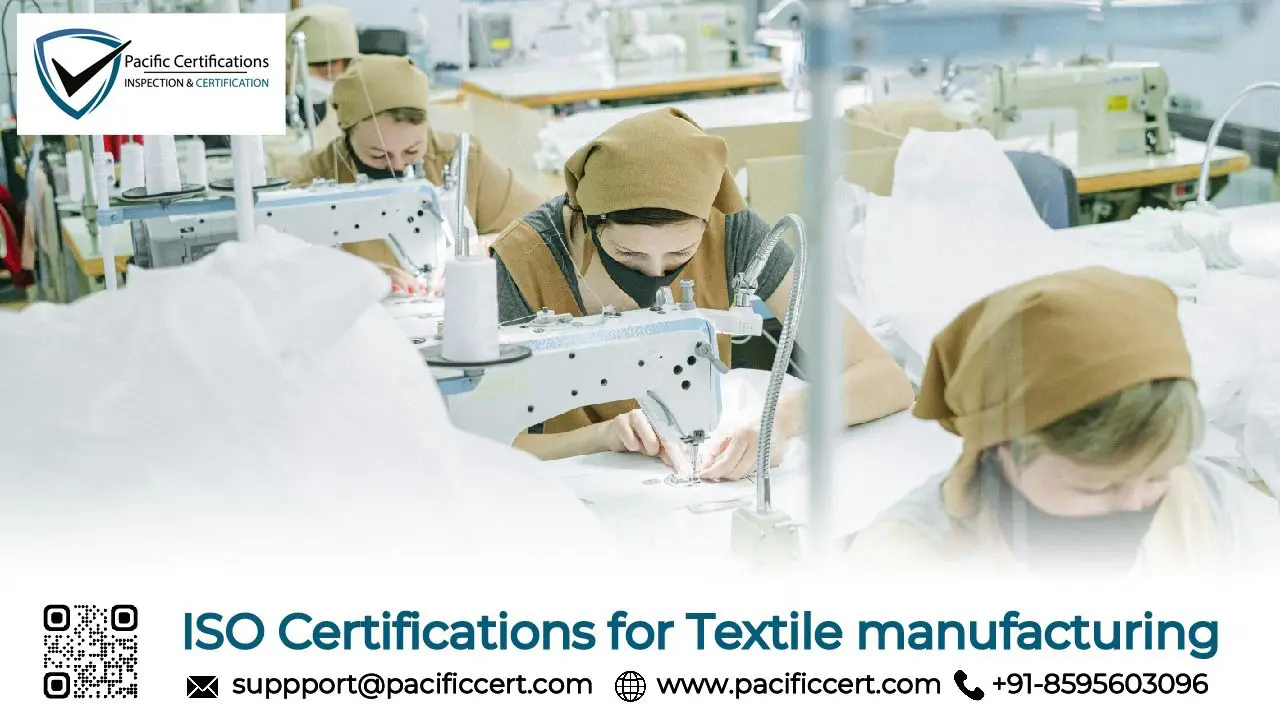
Introduction
Textile manufacturing remains one of the most globally competitive and sustainability-driven industries. Whether operating spinning mills, weaving facilities, dyeing and finishing plants, garment & apparel units, or technical textile facilities, producers today face a convergence of quality expectations, environmental regulations, labor compliance scrutiny, and trade-based sustainability criteria. Global buyers increasingly insist on demonstrable, certifiable systems that guarantee consistent product quality, responsible chemical and water management, fair and safe working conditions, traceable supply chains, and data-secure ERP-enabled operations.
ISO certifications support textile manufacturers in building structured governance systems, reducing production variability, strengthening pollution and effluent controls, ensuring workplace health & safety excellence, and positioning themselves as reliable, ethical, and globally acceptable suppliers in a rapidly evolving marketplace.
In a textile marketplace dominated by quality benchmarks, ethical sourcing, and sustainable production, compliance is not paperwork; it is your passport to global trade.
Quick Summary
ISO certifications provide textile businesses with internationally recognized frameworks to manage production quality through ISO 9001, environmental performance through ISO 14001, worker health and safety through ISO 45001, energy efficiency through ISO 50001, information security through ISO/IEC 27001, operational continuity through ISO 22301, and greenhouse gas management through ISO 14064. These standards address the critical risk dimensions of textile operations, chemical and effluent management, consistent product quality across high-volume runs, worker safety in physically demanding environments, and the sustainability credentials that international buyers now require.
For more information on how we can assist your textile business with ISO certifications, contact us at support@pacificcert.com.
Applicable ISO Standards for Textile Businesses
Below are the most relevant ISO standards applicable to spinning mills and yarn manufacturers, woven and knitted fabric producers, dyeing and finishing facilities, and garment and technical textile manufacturers:
ISO 9001: Quality Management System (QMS)
Consistent product quality is the primary commercial obligation of any textile manufacturer, and ISO 9001:2015 provides the documented management architecture to deliver it reliably across high-volume production. The standard establishes systematic controls over raw material acceptance, covering fibre quality, yarn count consistency, and fabric construction specifications, through every subsequent process stage including dyeing shade matching, dimensional stability after washing, tensile strength, and finished goods inspection before dispatch. It requires manufacturers to capture customer complaints and non-conformance events systematically and to apply root cause analysis that prevents recurrence rather than managing isolated incidents.
ISO 14001: Environmental Management System (EMS)
ISO 14001:2015 gives manufacturers a structured system for identifying the environmental aspects, setting measurable reduction targets, and demonstrating continuous improvement over successive certification cycles. Beyond regulatory alignment, ISO 14001 certification has become a procurement prerequisite for many European and North American fashion brands whose supplier codes of conduct embed environmental management requirements as binding commercial conditions.
ISO 45001: Occupational Health and Safety (OH&S)
Textile manufacturing is physically demanding and chemically intensive across nearly every production stage. Spinning and weaving departments expose workers to high-speed rotating machinery and elevated noise levels. ISO 45001:2018 requires systematic hazard identification across all of these environments, proportionate layered controls, and worker participation structures that build a proactive safety culture. Manufacturers certified under this standard consistently achieve lower lost-time injury rates and stronger compliance outcomes in the ethical audit programs.
ISO 50001: Energy Management System
ISO 50001:2018 provides a structured approach to establishing energy baselines, identifying significant energy uses, setting measurable improvement targets, and implementing operational controls that reduce waste systematically. Manufacturers implementing this standard frequently identify efficiency opportunities in boiler heat recovery, dyeing machine loading optimization, compressed air leak reduction, and spinning hall climate control scheduling. Beyond direct cost savings, ISO 50001 certification supports manufacturers in meeting the energy and carbon performance expectations embedded in the sustainability programs.
ISO 27001: Information Security Management Systems (ISMS)
ISO/IEC 27001:2022 establishes a comprehensive information security management system covering risk assessment, access controls, incident response planning, and supply chain data security requirements. For textile manufacturers handling proprietary fabric constructions, seasonal collection designs, and buyer-specific development samples, the protection of design intellectual property is particularly consequential — and ISO/IEC 27001 certification provides the recognized framework for demonstrating this protection to customers and partners.
ISO 22301:2019 – Business Continuity Management Systems
Textile supply chains operate on seasonally fixed delivery windows where disruptions carry immediate commercial consequences — late shipments miss retail launch windows, and delivery failures trigger order cancellations or penalty deductions that affect manufacturer margins materially. ISO 22301:2019 requires manufacturers to identify their most critical production and supply dependencies, define recovery time objectives aligned with buyer delivery commitments, and build and test continuity plans covering raw material supply disruptions, key equipment failures, utility outages, and logistics disruption scenarios.
ISO 26000: Social Responsibility
ISO 26000 provides guidance on how textile companies can operate in a socially responsible way, balancing profit with environmental stewardship and social welfare.
Click here to find out more applicable standards to your industry
What are the Requirements of ISO Certifications for Textile Businesses?
Textile businesses seeking ISO certification must maintain documented policies, procedures, and records to control quality, environmental impact, worker safety, energy use, and information security. These requirements apply across spinning, weaving, knitting, dyeing, finishing, printing, and garment production operations. Key requirements include the following:
ISO 9001:2015 – Quality Management Systems
Define quality objectives for defect rates, shade matching, dimensional stability, strength, and delivery performance
Control production through procedures for fibre inspection, yarn testing, dyeing recipes, finishing chemicals, and fabric inspection
Manage nonconforming products such as off-shade batches, weaving defects, or stitching failures with identification and corrective action
Approve and monitor suppliers of fibre, yarn, dyes, chemicals, and packaging materials
Maintain calibrated testing methods for shade, strength, shrinkage, and fabric performance
Keep calibration records for all testing and measuring equipment
Perform internal audits at planned intervals
Conduct management reviews on quality results, complaints, and corrective actions
ISO 14001:2015 – Environmental Management Systems
Identify environmental aspects such as dyeing effluent, chemical waste, water use, air emissions, and fabric waste
Maintain environmental aspect register for all production activities
Set targets for water reduction, waste control, and chemical management
Monitor effluent quality, water consumption, emissions, and solid waste
Maintain emergency procedures for chemical spills, effluent overflow, and boiler incidents
Control use of restricted substances in dyes and finishing chemicals
Keep supplier declarations and test records for chemical compliance
Review environmental performance in management meetings
ISO 45001:2018 – Occupational Health and Safety Management Systems
Identify hazards in spinning, weaving, dyeing, finishing, cutting, sewing, chemical storage, and boiler areas
Assess risks from machinery, chemicals, noise, dust, heat, and lifting operations
Apply safety controls such as machine guards, ventilation, dust extraction, and safe work procedures
Maintain chemical handling rules and restricted area controls
Provide required personal protective equipment
Establish emergency plans for fire, chemical exposure, machinery accidents, and boiler incidents
Record incidents, near misses, and safety observations
Monitor exposure to dust, noise, and chemicals
Involve workers in safety meetings and hazard reporting
ISO 50001:2018 – Energy Management Systems
Establish energy baseline for boilers, dyeing machines, dryers, spinning frames, looms, compressors, and HVAC
Identify major energy users in production and finishing processes
Define energy performance indicators and improvement targets
Control energy use through heat recovery, optimized machine loading, and leak detection
Review energy efficiency when purchasing new machines or expanding production
Monitor energy consumption and keep records
Review energy performance in management meetings
Record actions taken to improve efficiency
ISO/IEC 27001:2022 – Information Security Management Systems
Identify information security risks related to design files, buyer specifications, ERP systems, and production data
Control access to sensitive customer and production information
Maintain authorization and password control procedures
Establish incident response procedures for data breach or system failure
Define security requirements for suppliers, agents, and service providers
Monitor system logs and security events
Perform internal audits of information security controls
Review security performance during management reviews
Tip:Before beginning ISO implementation across your textile facility, bring together a cross-functional team including production management, quality control, dyehouse supervision, environmental compliance, health and safety, IT, and HR personnel to map your existing process documentation, production records, and operational controls against the applicable ISO clause requirements.
For more information on how we can assist your textile business with ISO certifications, contact us at support@pacificcert.com.
What are the Benefits of ISO Certifications for Textile Businesses?
ISO certifications give textile companies strong operational and commercial advantages. These standards help control product quality, improve safety, meet environmental requirements, and satisfy the expectations of international buyers. The benefits below apply to spinning mills, fabric manufacturers, dyeing and finishing units, garment factories, and technical textile producers:
Improved product quality consistency through controlled processes for raw material inspection, dyeing recipes, finishing settings, and final fabric checking, helping reduce defects and rework in large production runs
Stronger export market access, as global buyers and brands often require ISO certified suppliers before approving textile factories for long term sourcing
Higher environmental credibility with fashion brands and retail companies that check supplier performance for effluent treatment, chemical control, water use, and waste management, areas covered under ISO 14001
Fewer workplace accidents through ISO 45001 safety management covering machine safety, chemical handling, cotton dust exposure, and ergonomic risks, helping reduce stoppages and improve worker welfare compliance
Lower energy costs through ISO 50001 improvements in boilers, dyeing machines, dryers, compressors, and climate control systems, helping factories save energy and support carbon reduction targets
Better protection of buyer design files, product data, and ERP systems through ISO/IEC 27001 information security controls, which many international buyers expect when sharing confidential designs
Stronger business continuity through ISO 22301 planning, helping textile manufacturers handle raw material shortages, machine breakdowns, or shipping delays without missing delivery schedules
Easier compliance with buyer audits and sustainability programs because ISO systems already maintain required records and procedures
Reduced administrative workload when dealing with multiple customers, export inspections, and regulatory checks, since documentation is kept in a standardized and internationally accepted format
The global textile and apparel industry is one of the largest manufacturing sectors, supported by growing population, rising incomes, and strong demand for fashion, sportswear, and technical textiles. Production is also becoming more digital, with automated inspection, computerized dyeing controls, and supply chain tracking systems now common in modern factories. As operations become more connected, proper control of production data, customer files, and planning systems becomes important, and ISO standards help manage these risks in a structured way.
Sustainability has become a key requirement in textile supply chains. Major fashion brands and retailers now expect suppliers to control environmental impact, chemical use, worker safety, and energy consumption through documented systems. Standards such as ISO 14001, ISO 45001, and ISO 50001 help manufacturers show that these areas are properly managed, which is often required for export approval and long-term sourcing contracts.
Textile companies with ISO certification usually see fewer defects, better audit results, and stronger acceptance by international buyers. Certified factories are also better prepared to meet carbon reduction targets, chemical compliance rules, and safety expectations that are now part of global sourcing programs. Because of this, ISO certification has become an important factor for textile businesses that want to stay competitive in both established export markets and fast-growing manufacturing regions.
How Pacific Certifications Can Help?
Pacific Certifications, accredited by ABIS, works as an independent certification body for textile businesses by performing impartial audits against applicable ISO standards. The audit process checks whether documented management systems and actual textile manufacturing practices follow international ISO requirements. This includes review of production quality controls, dyeing and finishing operations, environmental management, worker safety programs, and energy management activities based only on objective evidence and records.
We support textile manufacturers through:
Independent certification audits carried out in line with ISO/IEC 17021 requirements
Assessment of real production activities including spinning, weaving, dyeing, finishing, inspection, and packaging controls
Evaluation of environmental, occupational safety, and energy management systems against ISO 14001, ISO 45001, and ISO 50001
Review of supplier control, testing records, chemical management, and production documentation
Clear audit reports showing conformity, nonconformities, and certification decisions
Issuance of internationally recognized ISO certification after successful audit completion
Surveillance and recertification audits to maintain validity of certified ISO standards over time
Contact us
If you need support with ISO certification for your textile business, contact us at support@pacificcert.com or +91-8595603096.
Author: Pooja
Read More at: Blogs by Pacific Certifications

