Introduction
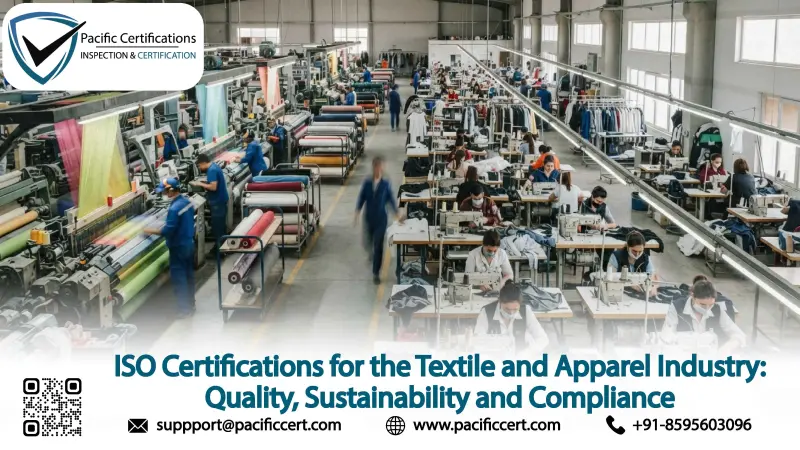
The textile and apparel industry operates through a global supply chain that covers fiber production, spinning, weaving and knitting, dyeing, finishing, garment manufacturing, and distribution. Each stage must maintain consistent quality while meeting customer, regulatory, environmental, and workplace requirements.
Textile manufacturing can be highly resource- and labor-intensive. Activities such as dyeing and finishing require careful control of water use, chemicals, wastewater, and energy, while production facilities must also manage worker safety, equipment risks, product defects, and supply chain disruptions.
Global brands, retailers, and procurement teams increasingly expect suppliers to demonstrate reliable controls for quality management, environmental performance, occupational health and safety, and responsible sourcing. Poor controls can lead to rejected products, production delays, environmental violations, workplace incidents, and loss of buyer confidence.
Relevant ISO certifications provide structured management system frameworks that textile and apparel businesses can use to control these risks and improve consistency. Standards covering quality, environmental management, occupational health and safety, and other business risks can also provide documented evidence of how an organization manages its processes and continually improves them.
For manufacturers, exporters, and suppliers, implementing the right ISO management systems can strengthen internal controls and support customer and regulatory requirements. The value comes from how effectively the system is implemented and maintained, not simply from holding a certificate.
Quick summary
ISO certifications help textile and apparel businesses improve product quality, sustainability, worker safety and operational control across spinning, weaving, dyeing, finishing and garment production. Key standards include ISO 9001, ISO 14001, ISO 45001, ISO 50001 and ISO/IEC 27001, covering quality, environmental performance, workplace safety, energy efficiency and information security. Implementing these standards can reduce defects, waste, environmental impacts and operational risks while improving compliance readiness. For manufacturers supplying international brands and retailers, ISO-certified systems also strengthen buyer confidence, supply-chain credibility and access to global markets.
Applicable ISO Standards for the Textile and Apparel Industry
Below are the most relevant ISO standards applicable to spinning mills, weaving and knitting units, dyeing and finishing factories, garment manufacturers, accessories and trims producers, and fashion brands or sourcing offices:
ISO 9001: Quality Management Systems (QMS)
Quality is the first and most visible standard for textile and apparel businesses. ISO 9001 provides a framework to control spinning, weaving, knitting, dyeing, finishing, and garment‑making processes so that products meet customer specifications consistently. It covers color matching, shrinkage, seam strength, fabric construction, and packaging, as well as internal requirements for training, inspection, and corrective action. For manufacturers supplying global brands, ISO 9001 certification demonstrates that defects are managed systematically rather than left to individual line supervisors.
Read more: ISO 9001
ISO 14001: Environmental Management System (EMS)
Textile and apparel production is one of the most water‑ and chemical‑intensive segments of manufacturing. Dyeing and finishing operations generate significant effluent loaded with chemicals and color, while energy‑intensive processes such as drying, heat‑setting, and steam‑based finishing contribute to greenhouse‑gas emissions. ISO 14001 helps organizations identify these environmental aspects, set measurable targets for water and energy use, manage chemical‑waste streams, and prepare for emergencies such as dye‑pond overflow or chemical‑spill events. For manufacturers aiming to meet buyer ESG and chemical‑restriction requirements, ISO 14001 provides a credible, auditable basis for environmental governance.
Read more: ISO 14001
ISO 45001: Occupational Health and Safety Management Systems
Garment and textile factories often involve high‑risk work environments: large knitting and weaving machines, heavy cutting tables, heat‑intensive pressing and ironing operations, and chemical handling in dyeing and finishing. ISO 45001 helps organizations identify these hazards, implement engineering and administrative controls, train workers, and manage incident reporting and investigation. It also supports compliance with labor‑law and social‑compliance expectations around fire safety, electrical safety, and ergonomics in high‑repetition sewing‑line work. Certified manufacturers demonstrate to buyers and regulators that worker safety is managed as a system, not left to chance.
Read more: ISO 45001
ISO 50001: Energy Management Systems
Energy consumption is a major cost and environmental driver in spinning, weaving, heat‑setting, and finishing operations. ISO 50001 introduces a disciplined energy‑management framework that requires organizations to establish a consumption baseline, identify significant energy‑use areas, set reduction targets, and embed energy‑performance considerations into equipment procurement and process redesign. For textile and apparel businesses, ISO 50001 certification supports both cost savings and a stronger sustainability narrative for buyers and ESG‑reporting frameworks.
Read more: ISO 50001
ISO 27001: Information Security Management Systems (ISMS)
Textile and apparel businesses increasingly rely on digital platforms to manage design, planning, production, and distribution. ISO/IEC 27001 helps protect sensitive design files, bills of material, customer orders, and price‑volume agreements from cyber threats. It is especially relevant for export‑oriented manufacturers and brands that depend on cloud‑based PLM and ERP systems. Strong information security supports both brand‑protection and supply‑chain integrity in a sector where design leaks and data breaches can quickly erode commercial advantage.
Read more: ISO 27001
ISO/IEC 17025:2017 – Testing and Calibration Laboratories
Quality assurance in textiles and apparel depends on reliable laboratory data. ISO/IEC 17025 governs technical competence for testing color fastness, pH, tensile strength, shrinkage, and chemical residues such as formaldehyde or banned dyes. For manufacturers that maintain on‑site testing labs, ISO 17025 accreditation signals that test results are accurate, traceable, and defensible in buyer audits and regulatory inspections. It strengthens the technical credibility of the entire quality‑management system.
Read more: ISO/IEC 17025
What are the Requirements of ISO Certifications for Textile and Apparel Businesses?
Textile and apparel businesses seeking ISO certification must establish and maintain documented policies, procedures, and records aligned with the selected ISO standards. Key requirements include the following:
ISO 9001:2015 – Quality Management Systems Requirements
Define quality objectives for defect rates, customer‑approved lot ratios, rework and rejection levels, and on‑time delivery performance across fabric and garment operations.
Document core processes from yarn intake and fabric construction through dyeing, finishing, cutting, sewing, and final inspection, including quality‑control checkpoints.
Establish controls for raw‑material and intermediate‑input qualification, color matching, and trims and accessories inspection.
Implement a non‑conformance and corrective‑action system to manage defects, customer complaints, and recurring quality issues with documented root‑cause analysis.
Maintain calibration and validation records for measuring instruments, inspection gauges, and laboratory equipment used in quality control.
Conduct internal audits and management reviews to verify that documented procedures align with actual practice and support continuous‑improvement outcomes.
ISO 14001:2026 – Environmental Management Systems Requirements
Identify significant environmental aspects linked to wastewater generation, chemical‑dye and finishing‑chemical use, energy‑intensive operations, and solid‑waste handling.
Establish operational controls for effluent treatment, chemical storage and handling, and hazardous‑waste management.
Set measurable environmental objectives and targets for water consumption, chemical‑load reduction, and energy‑use efficiency.
Implement emergency‑preparedness and response plans for chemical spills, unplanned discharges, and other environmental‑incident scenarios.
Monitor environmental performance indicators at defined intervals, documenting readings and management‑review outcomes.
Conduct internal environmental audits and management reviews to verify that controls remain effective and objectives are being met.
ISO 45001:2018 – Occupational Health and Safety Management Systems Requirements
Assess workplace hazards including machinery, chemical exposure, fire risk, and ergonomics across spinning, weaving, dyeing, and sewing operations.
Implement appropriate engineering and administrative controls, including machine guarding, ventilation, and safe work procedures.
Establish safe‑work practices for high‑risk activities such as chemical‑handling, press‑and‑ironing, and confined‑space work in tanks and dye vats.
Document incident reporting, investigation, and corrective‑action processes for injuries and near misses.
Conduct safety training, inspections, and emergency‑drill programs, with records maintained for management review.
Monitor safety performance indicators such as incident frequency and hazard‑reporting rates.
ISO 50001:2018 – Energy Management Systems Requirements
Establish an energy baseline for major energy‑use areas such as spinning, weaving, dyeing, finishing, and heat‑setting.
Set measurable energy‑reduction targets with assigned responsibilities and timelines.
Implement operational controls and maintenance practices that support energy efficiency.
Monitor energy performance and analyze data to identify opportunities for improvement.
Conduct internal energy audits and management reviews to verify that targets are being met.
Maintain documentation of energy‑management activities and improvement outcomes.
Tip: Begin by mapping your end‑to‑end textile and apparel flow from fiber to finished garment. Use this map to align each process step with the selected ISO standard requirements, involving production, quality, EHS, and IT in a single cross‑functional readiness workshop.
What are the Benefits of ISO Certifications for Textile and Apparel Businesses?
ISO certifications provide textile and apparel businesses with strong operational and commercial advantages, including: listed below are the key benefits for the ISO standards applicable to spinning mills, weaving and knitting units, dyeing and finishing factories, garment manufacturers, accessories and trims producers, and fashion brands or sourcing offices:
Improved product quality and consistency across fabric and garment production, reducing defects and customer complaints.
Better environmental performance with reduced water and chemical use, lower emissions, and stronger waste‑management outcomes.
Higher worker safety through clearer hazard control and stronger safety culture.
Greater energy efficiency and lower operational costs through structured energy‑management practices.
Enhanced supply‑chain security and reliability for export‑oriented manufacturers.
Stronger data protection and design‑security posture for brands and large factories.
Improved compliance readiness for regulatory and buyer audits.
Higher market access for international buyers, retailers, and sustainability‑focused customers.
Better brand reputation and social‑responsibility narrative with stakeholders and ESG‑reporting frameworks.
More efficient internal management through documented processes and measurable performance indicators.
Market Trends
The global textile and apparel market continues to grow, driven by urbanization, rising disposable incomes, and increasing demand for fast fashion and sustainable apparel. At the same time, regulatory and consumer expectations are tightening around environmental impact, chemical use, and labor‑practice transparency. International brands are increasingly requiring ISO‑aligned quality‑, environmental‑, and safety‑management systems from suppliers as part of their ESG and risk‑management frameworks. Digitalization and traceability are also reshaping the sector, with blockchain, digital‑product passports, and sustainability‑data platforms linking manufacturing practices to point‑of‑sale information.
ISO‑certified textile and apparel businesses are better positioned to meet these expectations because certified systems already document quality, environmental controls, and social‑responsibility practices. For manufacturers supplying Europe‑facing brands, ISO 14001 and ISO 45001 certifications support compliance with increasingly strict environmental and social‑compliance requirements. As energy‑intensive wet‑processing operations face higher carbon‑cost pressure, ISO 50001 certification provides a structured way to improve energy efficiency and reduce emissions. Overall, the trend is toward greater transparency and accountability, and ISO‑certified systems help manufacturers turn those trends into competitive advantage.
How Pacific Certifications Can Help?
Pacific Certifications, accredited by ABIS, acts as an independent certification body for textile and apparel businesses by conducting impartial audits against applicable ISO standards. Our role is to objectively assess whether documented management systems and textile and apparel‑specific operational practices conform to international ISO requirements, based strictly on verifiable evidence and operational records.
We support textile and apparel providers through:
Independent certification audits conducted in accordance with ISO/IEC 17021 for quality, environmental, safety, energy, information security, and business‑continuity management systems
Practical assessment of real textile and apparel operations, including spinning, weaving, dyeing, finishing, garment‑making, and laboratory testing practices
Clear audit reporting reflecting conformity status, objective findings, and certification decisions based on documented evidence and operational performance
Internationally recognized ISO certification upon successful compliance demonstration
Surveillance and recertification audits to maintain ongoing certification validity and support continual improvement
Contact us
If you need support with ISO certification for your textile and apparel business, contact us at support@pacificcert.com or +91‑8595603096.
Author: Alina
Also read:ISO Certifications for Clothing Retailing Businesses, Requirements and Benefits