# ISO Certifications for Solar Panel Installation Services, Requirements and Benefits
Author: Pacific Certifications
Author URL: https://blog.pacificcert.com/author/pacific-certifications/
Published: 2026-03-25
Category: System Certification
Category URL: https://blog.pacificcert.com/category/system-certification/
Meta Title: ISO Certification for Solar Installers 2026 | Pacific Cert
Meta Description: Get ISO 9001, 14001 & 45001 for solar services. Expert guide to 2026 revisions, climate risk mandates, and safety for rooftop & utility projects.
Tags: ISO 45001 for solar, ISO 9001 for solar, ISO for Solar Panel, ISO 14001 for solar, ISO 9001:2015
Tag URLs: ISO 45001 for solar (https://blog.pacificcert.com/tag/iso-45001-for-solar/), ISO 9001 for solar (https://blog.pacificcert.com/tag/iso-9001-for-solar/), ISO for Solar Panel (https://blog.pacificcert.com/tag/iso-for-solar-panel/), ISO 14001 for solar (https://blog.pacificcert.com/tag/iso-14001-for-solar/), ISO 9001:2015 (https://blog.pacificcert.com/tag/iso-90012015-2/)
URL: https://blog.pacificcert.com/iso-certifications-for-solar-panel-installation-services/
## Introduction
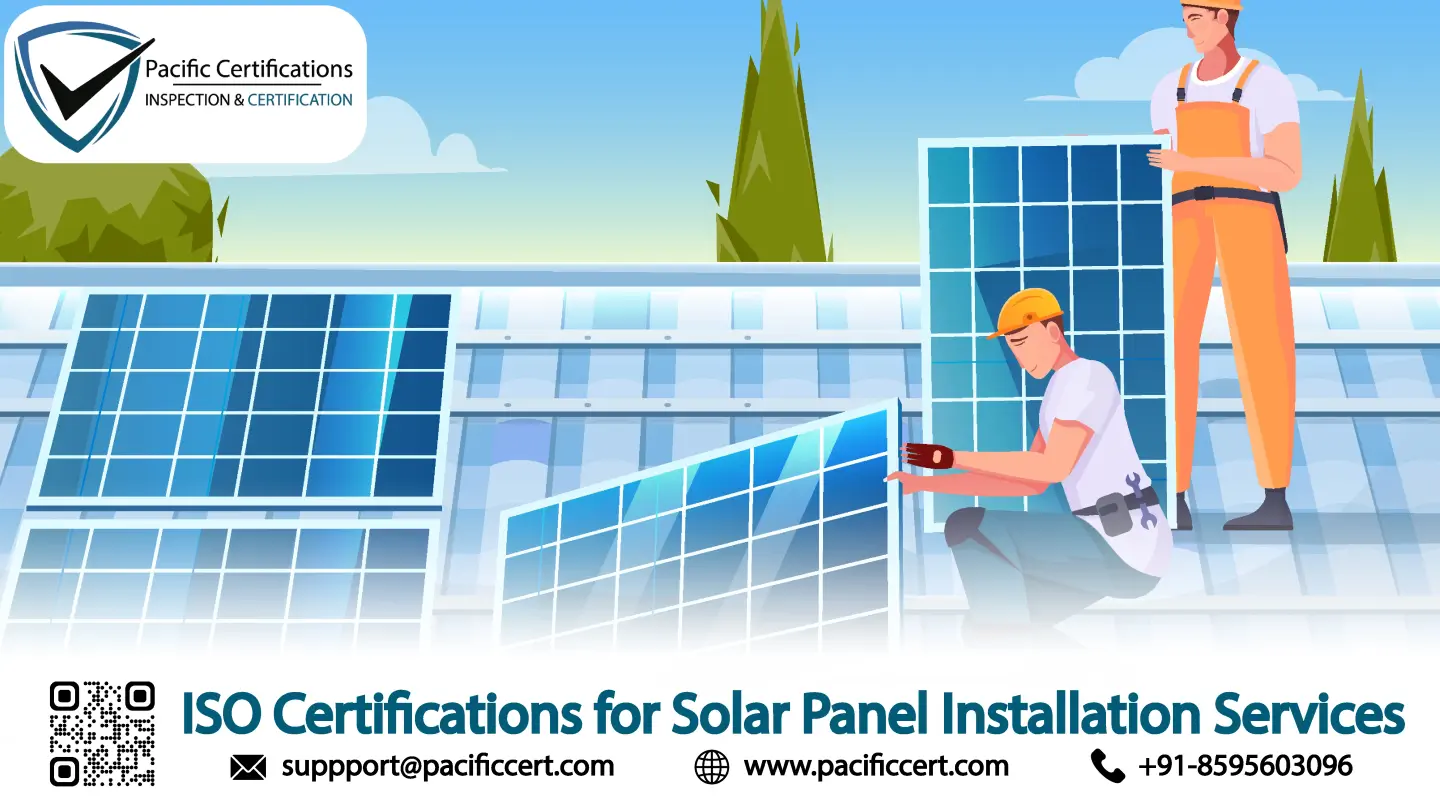
Solar panel installation services involve a **combination** of technical expertise, field execution, and increasing commercial expectations. Activities range from site surveys and system design to rooftop installation, electrical integration, grid connection, and ongoing maintenance. Each stage presents distinct risks, including working at height, handling DC electrical systems, and ensuring the quality and reliability of equipment used.
In addition to **operational challenges**, customers are placing greater emphasis on how installation companies manage their processes. Inadequate safety practices, poor documentation, or the use of substandard components can lead to long-term performance issues and reputational impact.
In this context, ISO certification is not merely a compliance requirement but a structured approach to managing safety, quality, and operational consistency. It also **supports** organizations in meeting tender requirements, improving credibility, and scaling operations in a controlled and reliable manner.
> Sustainable energy projects demand not only technical expertise but also internationally recognized systems that assure quality, safety, and compliance at every stage.
Assess ISO Certifications for Your Solar Installation Services
## **Quick Summary**
ISO certifications provide solar panel installation services with internationally recognized frameworks to manage installation quality and customer satisfaction through ISO 9001, worker health and safety through ISO 45001, environmental impact through ISO 14001, energy management through ISO 50001, information security through ISO/IEC 27001, business continuity through ISO 22301, and risk governance through ISO 31000. Organizations entering utility-scale and government procurement markets should pay particular attention to documented installation procedures, electrical safety controls, subcontractor management, and environmental handling of panel and battery waste - all areas where ISO frameworks deliver the structured, auditable discipline that project owners, asset financiers, and grid operators now expect as standard evidence of professional capability.
For more information on how we can assist your solar panel installation business with ISO certifications, contact us at [**support@pacificcert.com**](mailto:support@pacificcert.com).
## Applicable ISO standards to Solar Panel Installation companies
Below are the applicable ISO standards for Solar Panel Installation services:
Standard
Focus Area
Relevance
**ISO 9001:2015**
Quality Management Systems
Ensures consistent quality in installation, inspection, and maintenance.
**ISO 14001:2026**
Environmental Management Systems
Minimizes environmental impact during panel installation and lifecycle activities.
**ISO 45001:2018**
Occupational Health & Safety
Protects workers from electrical hazards, falls, and site-specific risks.
**ISO 50001:2018**
Energy Management Systems
Improves energy efficiency in operations and promotes renewable adoption.
**ISO/IEC 27001:2022**
Information Security
Relevant for companies handling energy monitoring data, IoT, or smart grid systems.
**ISO 31000:2018**
Risk Management
Provides a framework to identify and mitigate risks across projects.
### [**ISO 9001:2015 - Quality Management System (QMS)**](https://pacificcert.com/iso-9001-2015-quality-management-system-certification/)
Solar customers expect long-term performance, often over 20–25 years. **ISO 9001** provides the framework to ensure consistent quality from initial site survey to final commissioning. It requires documented procedures, supplier control, inspection processes, and structured handling of non-conformities. The result is fewer installation errors, reduced rework, and stronger customer confidence, especially when bidding for commercial or institutional projects.
### [**ISO 14001:2026 - Environmental Management System (EMS):**](https://pacificcert.com/iso-14001-2015-environmental-management-systems/)
Environmental responsibility is central to the solar industry. **ISO 14001** helps organizations manage impacts such as site disturbance, packaging waste, chemical use, and end-of-life disposal of panels and batteries. It requires identification of environmental aspects, measurable improvement targets, and proper waste and incident management. Certification strengthens credibility with clients who prioritize sustainability across their supply chain.
### [**ISO 45001:2018 - Occupational Health and Safety Management System (OHSMS):**](https://pacificcert.com/iso-45001-2018-health-safety/)
Solar panel installation is considered a high-risk activity within construction and electrical services. Daily exposure to fall hazards, live DC systems, heat stress, and manual handling risks requires more than informal safety practices. **ISO 45001** ensures that organizations systematically identify hazards, implement layered controls, enforce safe work procedures, and investigate incidents with proper root-cause analysis. For companies working on large or government-backed projects, this certification is increasingly a baseline requirement to demonstrate that safety is managed through a structured system.
### [**ISO 27001:2022 - Information Security Management System (ISMS):**](https://pacificcert.com/iso-iec-27001-2022-information-security-management-systems/)
Modern solar installations often include smart monitoring systems, IoT-enabled devices, and energy management platforms. This introduces cybersecurity risks related to customer data, system access, and connected infrastructure. **ISO/IEC 27001** provides a structured approach to identifying information assets, assessing risks, and implementing controls to protect sensitive data and systems. For commercial and government clients, this is becoming an expected requirement.
### [**ISO 50001:2018 - Energy Management System (EnMS):**](https://pacificcert.com/iso-50001-energy-management/)
For solar companies, energy performance is at the core of their business. **ISO 50001** requires organizations to monitor their own energy use, set improvement targets, and integrate energy efficiency into operations. Beyond internal benefits, it enhances credibility when advising clients on energy solutions, demonstrating alignment between what the company delivers and how it operates.
### **ISO 19600:2014 - Compliance Management System (CMS)**
Ensuring compliance with legal and regulatory requirements is essential for Solar Panel Installation companies.
### [**ISO 17025:2017 - General requirements for the competence of testing and calibration laboratories:**](https://pacificcert.com/iso-iec-17025-2017/)
For entities involved in testing or calibration of solar panels or related equipment, ISO 17025 ensures the competence and quality of their laboratory services.
[**Click here to find out more applicable standards to your industry**](https://pacificcert.com/system-certifications/)
Identify Applicable ISO Standards for Your Solar Projects
## **What are the requirements of ISO Certifications for Solar Panel Installation Industry?**
**** To achieve ISO certification, solar panel service providers must implement structured systems that address quality, safety, environment, and performance, supported by documented processes and regular evaluations. Below are generic and standard specific requirements:
1. **Establish** policies and objectives for quality, safety, and sustainability, with clear leadership commitment and governance responsibilities across all levels.
2. **Define** the scope of services, including design, procurement, installation, and maintenance, while identifying applicable regulations and customer requirements.
3. **Conduct** risk assessments and hazard identification covering electrical safety, working at heights, fire hazards, and environmental impacts linked to solar projects.
4. **Develop** documented operating procedures for installation, inspection, testing, preventive maintenance, and safe disposal of solar components.
5. **Ensure** training and competence of staff through structured programs on electrical safety, PPE usage, first-aid, and environmental awareness.
6. **Maintain** documented records of compliance, audits, inspections, and corrective actions to provide evidence of operational control and improvement.
7. **Implement** environmental measures to minimize waste, manage chemical substances, and reduce the carbon footprint of installation activities.
8. **Carry** out internal audits and management reviews at planned intervals to confirm system effectiveness and identify opportunities for continual improvement.
## **Specific** Requirements **of key ISO standards:**
### **ISO 9001: Quality Management** System **(QMS) Requirements**
- Establish a quality management system with documented procedures.
- Focus on customer satisfaction and continuous improvement.
- Implement a process-based approach to operations.
- Conduct regular internal audits and management reviews.
- Monitor, measure, and analyze key performance indicators.
### **ISO 14001: Environmental Management System (EMS)** Requirements
- Identify and control environmental impacts from operations.
- Implement sustainable practices and reduce waste.
- Ensure compliance with environmental regulations.
- Set environmental objectives and monitor performance.
- Conduct periodic environmental audits and reviews.
### **ISO 45001: Occupational Health and Safety (OH&S)** Requirements
- Develop and implement a health and safety management system.
- Identify and mitigate workplace hazards and risks.
- Ensure compliance with occupational safety regulations.
- Promote worker participation in health and safety initiatives.
- Regularly review and improve safety measures through audits and incident reporting.
### **ISO 50001: Energy Management System** Requirements
- Establish energy management policies and objectives.
- Monitor and improve energy use efficiency.
- Implement energy-saving practices across operations.
- Ensure compliance with relevant energy regulations.
- Perform energy audits to track progress and identify improvement areas.
**_Tip:_** _Solar companies should start with ISO 9001 and ISO 45001 to strengthen their quality and safety foundations, and then integrate ISO 14001 or ISO 50001 to demonstrate environmental leadership and energy efficiency, especially when targeting large-scale or government-backed projects._
Certification for your company, contact us today at [**support@pacificcert.com**](mailto:support@pacificcert.com) .
## **What are the benefits of ISO Certifications for Solar Panel Installation Businesses?**
ISO certifications offer numerous benefits to Solar Panel businesses, below are the key benefits:
- ISO 9001 certification helps Solar Panel Installation providers to improve the quality of their products and services.
- Solar companies can reduce their environmental footprint, comply with regulations with ISO 14001 certification.
- ISO 45001 certification ensures a safer working environment, reducing the risk of accidents and injuries for employees.
- ISO 27001 certification helps protect sensitive data and ensures the confidentiality.
- ISO 50001 certification assists in optimizing energy use and reducing energy costs.
- ISO certifications demonstrate compliance with international standards, regulatory requirements, and industry best practices.
- Implementing ISO standards often leads to streamlined and standardized processes.
- ISO certifications can open up new markets and customers.
- ISO standards require companies to assess and mitigate risks, helping them proactively manage potential issues and crises.
- ISO certifications can enhance a company's reputation and credibility.
- ISO certifications provide customers with confidence in the company's ability to meet their requirements and expectations consistently.
The global solar energy market is expanding rapidly and reshaping how power is generated and delivered. Installed solar capacity has already crossed **1.6 terawatts by the end of 2024**, and is expected to more than double over the next decade as solar becomes the most cost-effective energy source in many regions. Alongside this, the solar installation services market is growing at an estimated **8–12% annually**, driven by residential demand, commercial rooftop projects, utility-scale developments, and the growing integration of battery storage and EV charging.
The role of installation companies is also evolving. With the rise of smart monitoring systems, AI-based performance tracking, and remote diagnostics, installers are no longer just contractors—they are becoming long-term energy service providers. This shift brings new responsibilities around data security, system reliability, and ongoing asset management, areas where traditional practices often fall short.
Customer expectations are rising just as quickly. Clients now evaluate installers based on certifications, process maturity, and proven track records before making decisions.
In this environment, ISO-certified companies have a clear advantage. Businesses implementing **ISO 9001 and ISO 45001** consistently achieve better quality outcomes, fewer safety incidents, and higher customer satisfaction. For large-scale and government projects, ISO certification also speeds up prequalification, reduces repeated audits, and provides the structured evidence that project owners and investors expect.
Looking ahead, trends like corporate PPAs, community solar, and battery integration will further increase the need for strong governance. Companies that adopt **integrated ISO management systems** across quality, safety, environment, and information security are positioning themselves as reliable, scalable partners in a fast-growing and increasingly competitive market.
Start ISO Certification for Your Solar Installation Business
## How Pacific Certifications Can Help?
Pacific Certifications, accredited by [**ABIS**](https://abisonline.org), operates as an independent certification body for solar panel installation businesses. The role is to carry out impartial assessments against applicable ISO standards, verifying that both documented systems and actual on-site practices meet international requirements based on objective evidence.
Solar installation providers are supported through:
- Independent certification assessments aligned with **ISO/IEC 17021** for quality, occupational health and safety, environmental, energy, information security, and business continuity management systems
- Practical evaluation of real installation activities, including site surveys, system design, installation and commissioning controls, electrical safety practices, subcontractor management, and customer data handling
- Clear and structured reporting that reflects conformity status, audit observations, and certification decisions based on documented records and field verification
- Issuance of **internationally recognized ISO certification**, strengthening credibility with residential customers, commercial clients, government bodies, and project financiers
- Ongoing surveillance and recertification processes to maintain certification validity and support continuous improvement across the full lifecycle
### Contact us
If you need support with ISO certification for your solar panel installation business, contact us at [**support@pacificcert.com**](mailto:support@pacificcert.com) or +91-8595603096.
### Author: Alina
**Read More at:** [**Blogs by Pacific Certifications**](https://blog.pacificcert.com/)
Contact Us
ISO Certifications for Solar Installers
## FAQs
Q: Is ISO certification mandatory for solar installers?
A: No. ISO confirms that certification is generally voluntary; requirements usually come from clients, tenders, or regulators—not ISO itself.
Q: What technical standards should installers know for PV equipment and systems?
A: Product and system performance/safety are mainly covered by IEC standards: IEC 61215 & 61730 for module design and safety, IEC 61724-1 for PV performance monitoring, and IEC 62446 for system documentation, commissioning tests and inspection
Q: Which ISO certifications are best for solar panel installation companies?
A: Most installers start with ISO 9001 (quality), add ISO 14001 (environment), ISO 45001 (worker health & safety), and often ISO/IEC 27001 for protecting customer and monitoring data. These are the most commonly referenced ISO management standards for the sector
Q: What’s the difference between ISO and IEC in solar?
A: ISO publishes management-system and many cross-industry standards; IEC TC 82 publishes standards specific to solar PV modules, components and systems. In short: ISO = how your company runs; IEC = how PV products and systems must perform and be tested.
Q: Why would a solar company adopt ISO/IEC 27001?
A: Connected inverters, portals and fleet/telematics data make security essential. ISO/IEC 27001 gives a formal ISMS used widely in energy/renewables to protect operational and customer data
Q: What is ISO 50001 and how can it help an installer?
A: ISO 50001 is an energy-management system standard. Solar EPCs and O&M firms use it to track and improve energy performance across depots, construction sites and offices, cutting use and cost.
Q: How long does ISO certification usually take?
A: Timelines vary with size and readiness, but many sources cite about 3–12 months from kickoff to certification. You’ll also need evidence that the system has been operating (e.g., ~3 months of records) before the audit
Q: How long is an ISO certificate valid?
A: Typically three years, with annual surveillance audits and a recertification audit at the end of the cycle.
Q: How can I verify a supplier’s ISO certificate?
A: Use IAF CertSearch, the global database of accredited certifications, to check the certificate, the issuing certification body and its accreditation status.
Q: Are there industry certifications for individual PV installers beyond ISO?
A: Yes—many markets recognize installer credentials like NABCEP (U.S.) and state licensing. These complement company-level ISO systems.
---
This blog is powered by Superblog. Visit https://superblog.ai to know more.
---