Introduction
Roofing services operate in a safety-critical, workmanship-intensive, and compliance-driven construction environment where installation accuracy, material performance, working-at-height safety, and weather resistance directly impact building integrity, occupant safety, and long-term asset value. Roofing service providers deliver activities such as flat and pitched roofing, waterproof membranes, metal and tile roofing, roof insulation, green roofs, repairs, maintenance, and refurbishment across residential, commercial, and industrial buildings.
With stricter building regulations, higher expectations for waterproofing and durability, increased fire and wind-load requirements, and stronger scrutiny from developers, insurers, and regulators, roofing contractors are under pressure to demonstrate disciplined operational control. Defective installation, unsafe site practices, water ingress, or poor documentation can result in structural damage, rework, legal disputes, and reputational harm. ISO certifications provide an internationally recognized framework to standardize roofing operations, manage safety and environmental risks, ensure consistent quality, and strengthen credibility with clients and authorities.
In roofing services, trust is built on safety, durability, and consistency.
Quick Summary
ISO certifications provide roofing service providers with internationally recognized frameworks to manage service quality through ISO 9001, ensure occupational health and safety through ISO 45001, manage environmental responsibilities through ISO 14001, protect drawings, specifications, and inspection records through ISO/IEC 27001, ensure continuity of site operations through ISO 22301, and strengthen project and business risk governance through ISO 31000. These standards support compliant roofing works, safer sites, and reliable project delivery.
For guidance on selecting the most relevant ISO standards for your roofing services business, contact support@pacificcert.com.
Applicable ISO Standards for Roofing Services
Below are the key ISO standards for Roofing Services:
ISO 9001:2015 – Quality Management Systems
ISO 9001 helps roofing contractors standardize project planning, material approval, installation methods, inspections, defect rectification, maintenance activities, and handover processes. It improves consistency across projects, reduces leaks and rework, and ensures roofing systems meet design specifications, warranties, and regulatory requirements.
ISO 45001:2018 – Occupational Health & Safety Management Systems
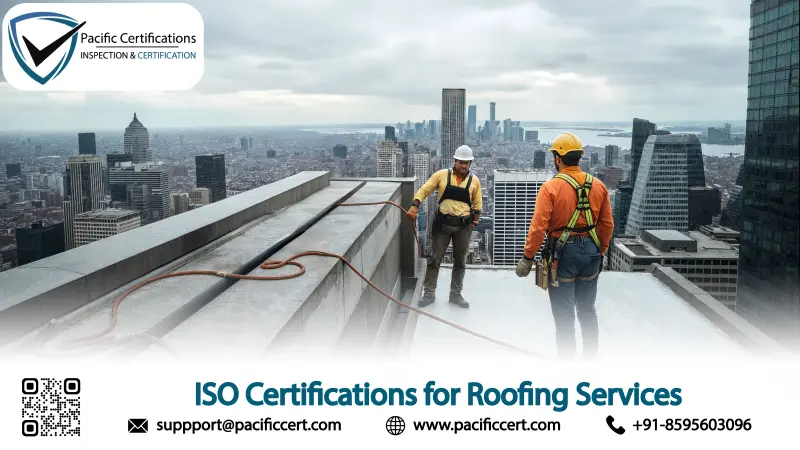
Roofing activities involve high-risk work such as working at heights, edge protection, ladder and scaffold use, manual handling, and exposure to weather conditions. ISO 45001 provides a structured framework to identify hazards, implement fall-prevention controls, ensure legal compliance, and reduce accidents and occupational injuries.
ISO 14001:2015 – Environmental Management Systems
ISO 14001 supports responsible management of environmental aspects such as roofing waste, packaging, bitumen and membrane residues, adhesives, noise, and runoff. It helps roofing companies meet environmental regulations and sustainability expectations increasingly required by developers and green-building projects.
ISO 27001: Information Security Management Systems (ISMS)
Roofing contractors manage sensitive information including design drawings, waterproofing details, fire-rating specifications, contracts, warranties, and inspection records. ISO/IEC 27001 ensures that technical and commercial information is protected against unauthorized access, loss, or misuse, especially when digital platforms are used.
ISO 22301:2019 – Business Continuity Management Systems
Roofing projects are vulnerable to disruptions caused by weather, material shortages, labor constraints, or site shutdowns. ISO 22301 ensures that critical roofing activities can continue or recover quickly, protecting project schedules and contractual commitments.
ISO 31000:2018 – Risk Management
ISO 31000 enables roofing service providers to systematically identify and manage risks related to safety incidents, waterproofing failures, material performance, delays, and contractual liabilities. It strengthens governance and decision-making across multiple projects.
Click here to find out more applicable standards to your industry
What are the Requirements of ISO Certifications for Roofing Services?
Roofing service providers seeking ISO certification must establish documented management systems and demonstrate consistent implementation across site operations and governance functions. Key requirements include the following:
ISO 9001:2015 – Quality Management Systems Requirements
Document roofing installation, inspection, repair, and maintenance procedures
Define quality objectives aligned with durability, watertightness, and client expectations
Control drawings, method statements, inspection checklists, and warranty records
Monitor defects, non-conformities, and rework
Manage subcontractor and supplier performance
Conduct internal audits and management reviews
ISO 45001:2018 – Occupational Health & Safety Requirements
Identify hazards related to working at heights and roof access
Assess OH&S risks and implement fall-protection measures
Ensure compliance with safety legislation and site permit requirements
Provide safety training, PPE, harnesses, and edge protection
Establish incident reporting and emergency response procedures
Monitor safety performance and continual improvement
ISO 14001:2015 – Environmental Management Requirements
Identify environmental aspects of roofing activities
Control waste segregation, recycling, and disposal
Manage use of bitumen, membranes, sealants, and chemicals
Ensure compliance with environmental regulations
Monitor environmental performance and improvement actions
ISO/IEC 27001:2022 – Information Security Requirements
Identify and classify technical and commercial information assets
Conduct information security risk assessments
Implement access controls for drawings and project records
Secure digital platforms and shared documentation
Manage third-party access to sensitive information
Monitor and improve ISMS effectiveness
ISO 22301:2019 – Business Continuity Requirements
Identify critical roofing services and dependencies
Conduct business impact analysis (BIA)
Develop continuity and recovery plans
Plan for weather-related, workforce, and supply disruptions
Test and review continuity arrangements
Tip:Map one complete roofing project lifecycle—from material approval and roof preparation to installation, inspection, testing, and handover—against ISO requirements to identify quality, safety, and continuity gaps early.
For assistance in evaluating your roofing services against ISO requirements, contact support@pacificcert.com.
What are the Benefits of ISO Certifications for Roofing Services?
ISO certifications provide roofing service providers with strong operational and commercial advantages, including:
Consistent roofing quality and reduced leakage risks
Safer worksites and fewer fall-related accidents
Better compliance with building and safety regulations
Stronger control over drawings, warranties, and inspection records
Reduced rework, delays, and cost overruns
Increased trust from developers, consultants, and insurers
Improved eligibility for commercial and public projects
Better environmental performance and waste management
Reduced contractual and liability risks
Long-term business credibility and resilience
Global demand for roofing services continues to grow due to urban development, climate-resilient construction, energy-efficient buildings, and refurbishment of aging structures. The global roofing market is projected to exceed USD 150 billion within this decade, driven by commercial construction, residential housing growth, and sustainability initiatives such as cool roofs and green roofing systems.
At the same time, regulators and project owners are placing stronger emphasis on workmanship quality, fall-prevention safety, waterproofing performance, and documented management systems. Roofing contractors demonstrating ISO-aligned governance are better positioned to secure higher-value projects and meet insurance and compliance expectations.
ISO certifications such as ISO 9001, ISO 45001, and ISO 14001 are increasingly being regarded as minimum qualification requirements for professional roofing service providers in regulated construction markets.
How Pacific Certifications Can Help?
Pacific Certifications, accredited by ABIS, acts as an independent certification body for roofing service providers by conducting impartial audits against applicable ISO standards. Our role is to objectively assess whether documented management systems and roofing operations conform to international ISO requirements, based strictly on verifiable evidence and records.
We support roofing service providers through:
Independent certification audits conducted in accordance with ISO/IEC 17021
Objective assessment of quality, safety, environmental, and risk controls
Clear audit reporting reflecting conformity status and certification decisions
Internationally recognized ISO certification upon successful compliance
Surveillance and recertification audits to maintain certification validity
Contact Us
For ISO certification for roofing services, contact support@pacificcert.comor call +91-8595603096.
Author: Ashish
Read more: Pacific Blogs