Introduction
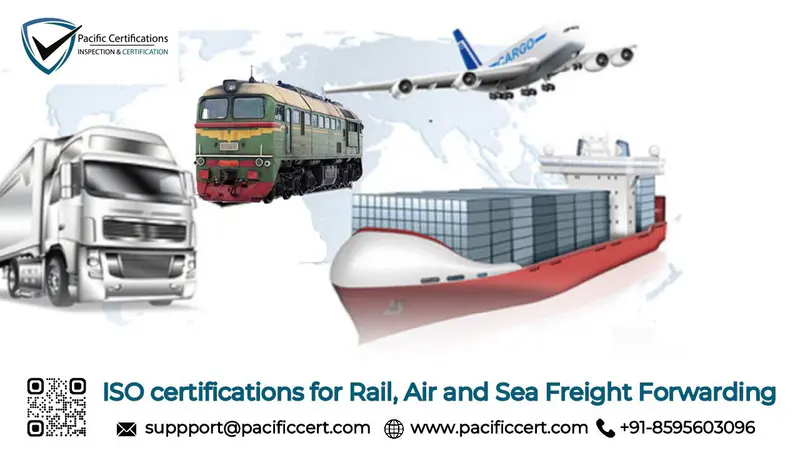
Rail, air, and sea freight forwarding keeps global supply chains moving by coordinating shipments across different transport modes. This involves planning routes, handling customs and documentation, managing cargo consolidation, tracking shipments in real time, and offering services like warehousing, packaging, and handling sensitive or hazardous goods. It’s a demanding environment, operators have to protect cargo at every stage, keep data secure, deal with changing regulations and fuel costs, manage risks across transport modes, and meet growing expectations for fast, transparent delivery.
ISO certifications bring structure to this complexity. They provide globally recognized systems for quality, safety, security, and environmental management. Instead of reacting to issues, they help companies prevent them through clear processes. This improves reliability, reduces risks, and builds trust with customers, partners, and regulators—essential in an industry where consistency and credibility directly impact business success.
In global freight forwarding, every shipment's journey depends on interconnected systems—where ISO certification transforms logistics coordination into verified trust.
Quick Summary
ISO certifications provide rail, air and sea freight forwarders with internationally recognized frameworks to manage service quality through ISO 9001, environmental impact through ISO 14001, occupational health and safety through ISO 45001, supply chain security through ISO 28000, information security through ISO/IEC 27001, and energy efficiency through ISO 50001. Organizations should prioritize aligning cargo handling, documentation security, and multimodal transit processes with these standards to ensure resilience and shipper confidence.
For more information on how we can assist your freight forwarding business with ISO certifications, contact us at support@pacificcert.com.
Applicable ISO Standards for Rail, Air and Sea Freight Forwarding Businesses
Below are the most relevant ISO standards applicable to multimodal transport providers, customs brokerage firms, warehousing and distribution operators, project cargo specialists, and temperature-controlled logistics specialists:
ISO 9001: Quality Management Systems (QMS)
As the foundational management system standard, ISO 9001 ensures freight forwarding services consistently meet shipper requirements for accurate, timely, and documented delivery—directly impacting contract retention and competitive positioning in logistics markets. It applies to critical processes including order entry and dispatch accuracy, multimodal route optimization, documentation accuracy for bills of lading and customs forms, shipment tracking and exception management, and customer communication regarding shipment status and delivery confirmation.
ISO 28000:2022 – Supply Chain Security Management Systems
This standard is paramount for rail, air and sea freight forwarders as it provides a systematic framework to prevent cargo theft, tampering, and unauthorized access, a core expectation from shippers, insurers, and regulatory bodies. It addresses processes like risk assessment for supply chain vulnerabilities, implementation of controlled access protocols, seal verification procedures for containers and trailers, surveillance system monitoring, and incident response planning for security breaches.
ISO 14001: Environmental Management Systems (EMS)
Freight forwarding operations significantly contribute to transportation-sector emissions through aircraft, vessels, and rail locomotives; this standard helps operators manage environmental aspects systematically through measurable objectives and operational controls. It covers aspects like fuel consumption tracking and optimization strategies, emission reduction technologies for exhaust systems, proper disposal and recycling of maintenance waste streams, noise abatement practices for facility operations, and integration of energy-efficient equipment and alternative fuels into operational programs.
ISO 45001: Occupational Health and Safety Management Systems (OHSMS)
The safety of workers navigating warehouses, loading docks, and intermodal transfer points represents a daily operational priority; this standard provides a proactive system to prevent work-related injuries and illnesses unique to freight forwarding professions. It addresses hazard identification for manual handling risks, equipment operation hazards (forklifts, conveyor belts), fatigue management through scheduling controls, personal security concerns for workers in high-theft areas or isolated facilities, and ergonomic considerations for desk-based operations involving long hours of documentation work.
ISO 27001: Information Security Management Systems (ISMS)
ISO 27001 provides a framework for managing information security, ensuring that data related to shipments, customers, and operations are protected from cyber threats and breaches.
Click here to find out more applicable standards to your industry
What are the Requirements of ISO Certifications for Rail, Air and Sea Freight Forwarding Businesses?
Rail, air and sea freight forwarders seeking ISO certification must establish and maintain documented policies, procedures, and records aligned with the selected ISO standards. Key requirements include the following:
ISO 28000:2022– Security Management Systems for Supply Chain Requirements
Conduct risk assessments targeting cargo facilities, transit routes, and information systems for security vulnerabilities.
Implement access controls limiting facility privileges to authorized personnel based on job function and security clearance.
Establish seal verification and tamper-evident systems for containers, trailers, and air cargo unit load devices.
Monitor surveillance systems and access logs for unauthorized entry attempts or anomalous cargo movements.
Test incident response plans through simulated security breaches (theft, tampering, unauthorized access) quarterly.
Maintain vendor security agreements for all technology providers handling cargo tracking or facility access data.
ISO 9001:2015 – Quality Management Systems Requirements
Document standard operating procedures for shipment booking, documentation preparation, and delivery confirmation.
Control calibration of weighing scales, measuring devices, and tracking equipment for shipment accuracy.
Implement shipment visibility systems providing real-time updates to shippers and consignees.
Monitor key performance indicators such as on-time delivery percentage, documentation accuracy, and claim frequency.
Hold monthly management reviews assessing service quality, operational readiness, and shipper satisfaction trends.
Maintain records of corrective actions for recurring issues such as customs delays or tracking discrepancies.
ISO 14001:2015 – Environmental Management Systems Requirements
Establish an environmental policy committing to preventing pollution and minimizing ecological footprint.
Identify environmental aspects including fuel consumption, emissions, waste streams, and noise generation.
Set measurable objectives and targets for reducing emissions, noise levels, and waste generation.
Implement operational controls like idle reduction programs, eco-driving training, and waste segregation protocols.
Monitor environmental performance through fuel consumption tracking, emissions calculations, and waste audits.
Conduct annual management reviews assessing environmental performance, audit results, and objective achievement.
ISO/IEC 27001:2022 – Information Security Management Systems Requirements
Conduct risk assessments targeting shipment data systems, customs platforms, and payment processing networks.
Apply strict access controls limiting system privileges to authorized personnel based on role requirements.
Encrypt sensitive data including shipment details, payment information, and personally identifiable data.
Monitor network and application logs for unauthorized access attempts or anomalous data transfers.
Test incident response plans through simulated cyberattacks on freight IT systems quarterly.
Maintain vendor security agreements for all technology providers handling shipment or operational data.
ISO 45001:2018 – Occupational Health & Safety Management Systems Requirements
Identify logistics-specific hazards including manual handling risks, equipment operation dangers, and slip/trip/fall hazards.
Establish worker safety procedures for equipment breakdowns, cargo securement failures, and adverse weather operations.
Implement fatigue management through maximum duty hours and mandatory rest period controls based on regulations.
Monitor health and safety metrics such as injury rates and lost-time incidents due to work-related causes.
Conduct bi-annual safety training covering safe lifting techniques, equipment operation, and personal security protocols.
Document warehouse safety procedures and material handling equipment inspection records.
Tip: Begin by mapping your current freight forwarding workflows—from order receipt and carrier selection to documentation preparation, transit monitoring, delivery completion, and payment settlement—against ISO clause requirements; engage operations, security, IT, compliance, and customer service leads in workshops to identify gaps where existing practices align with or diverge from standard expectations, using process flowcharts to visualize integration points before drafting new controlled documents.
For more information on how we can assist your freight forwarding business with ISO certifications, contact us at support@pacificcert.com.
What are the Benefits of ISO Certifications for Rail, Air and Sea Freight Forwarding Businesses?
ISO certifications provide rail, air and sea freight forwarders with strong operational and commercial advantages, including: listed below are the key benefits for the ISO standards applicable to multimodal transport providers, customs brokerage firms, warehousing and distribution operators, and project cargo specialists.
Improved reduction in cargo loss and damage incidents through systematic security controls, handling procedures, and employee training programs.
Stronger protection of shipment integrity via secured tracking systems minimizing theft, tampering, and documentation errors across multimodal chains.
Better service continuity during disruptions due to predefined continuity protocols and resource readiness for critical operations.
Higher shipper satisfaction from reliable transit times, accurate documentation, and proactive exception management throughout the supply chain.
Enhanced regulatory compliance demonstrating alignment with international security, quality, environmental, and safety benchmarks.
Greater access to premium shipping contracts as shippers prefer ISO-certified forwarders for lower risk profiles and verified performance.
Reduced operational costs through optimized routing, predictive maintenance, and efficient facility energy use.
Streamlined shipment management with clear quality, security, and environmental expectations for service providers and partners.
Increased resilience against cyberattacks targeting tracking platforms, payment systems, and shipment data visibility.
Better environmental stewardship quantifying and mitigating multimodal emissions, noise pollution, and resource consumption.
Freight forwarding across rail, air, and sea is expanding alongside global trade, with the overall logistics market exceeding USD 9–10 trillion in 2024 and freight forwarding growing at around 4–6% annually. Air freight continues to dominate high-value and time-sensitive shipments, while sea freight accounts for nearly 80–90% of global trade by volume, and rail is gaining traction as a cost-effective and lower-emission alternative on key intercontinental routes.
The industry is shifting toward integrated multimodal logistics, where forwarders manage end-to-end supply chains rather than isolated transport segments. Digitalization is accelerating, with adoption of real-time shipment tracking, digital documentation, AI-based route optimization, and freight management platforms, improving visibility and coordination across modes.
At the same time, sustainability pressures are increasing, with a focus on carbon reporting, fuel efficiency, and alternative transport solutions such as rail corridors and low-emission shipping fuels. Regulatory requirements around data security, customs compliance, and cross-border documentation are also becoming stricter.
As complexity grows, freight forwarders are focusing on standardized and structured management systems to ensure operational consistency, regulatory compliance, and reliable service delivery across global logistics networks.
How Pacific Certifications Can Help?
Pacific Certifications, accredited by ABIS, acts as an independent certification body for rail, air and sea freight forwarding businesses by conducting impartial audits against applicable ISO standards. Our role is to objectively assess whether documented management systems and rail, air and sea freight forwarding-specific practices conform to international ISO requirements, based strictly on verifiable evidence and operational records.
We support rail, air and sea freight forwarding providers through:
Independent certification audits conducted in accordance with ISO/IEC 17021
Practical assessment of real freight forwarding operations, shipment security controls, and documentation accuracy
Clear audit reporting reflecting conformity status and certification decisions
Internationally recognized ISO certification upon successful compliance
Surveillance and recertification audits to maintain certification validity
Contact Us
If you need support with ISO certification for your rail, air and sea freight forwarding business, contact us at support@pacificcert.com or +91-8595603096.
Author: Ashish
Read More at: Blogs by Pacific Certifications

