Introduction
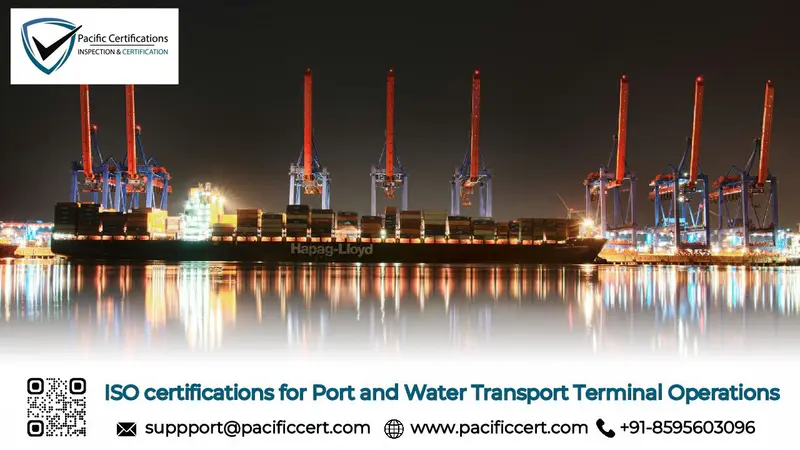
ISO Port and water transport terminal operations function within a dynamic global logistics ecosystem where vessel handling, cargo operations, storage facilities, and intermodal connectivity must align efficiently across coastal and inland waterways. Core activities include berthing and unberthing vessels, loading and unloading containers, breakbulk, and bulk cargo, operating heavy equipment such as cranes and reach stackers, managing customs documentation, and coordinating with shipping lines, freight forwarders, and inland transport providers. Operators face ongoing challenges such as maintaining worker safety in high-risk environments, preventing cargo damage during handling, ensuring equipment reliability under continuous use, adapting to fluctuating trade volumes and vessel schedules, and complying with strict international security and environmental requirements, all while operating in open and weather-exposed terminal environments under regulatory oversight.
ISO certifications provide structured frameworks that help terminal operators manage these complexities through internationally recognized management system standards. Rather than addressing incidents reactively, these standards promote proactive systems for occupational health and safety, quality assurance, environmental management, and supply chain security. By standardizing operations, ISO frameworks improve service consistency, strengthen risk control measures, and support verifiable compliance with global maritime and trade requirements. In a sector where operational efficiency, safety performance, and cargo integrity directly influence competitiveness and long-term partnerships, ISO certification reinforces operational discipline and builds trust with shipping lines, cargo owners, and regulatory authorities.
Ports and water terminals are the backbone of global trade. ISO certifications give these facilities the structure to operate safely, efficiently, and sustainably.
Quick Summary
ISO certifications help ports and water transport terminals manage safety, quality, and sustainability in a complex industry. The key standards are ISO 9001 (quality), ISO 14001 (environment), ISO 45001 (safety), ISO 28000 (supply chain security), and ISO 22301 (business continuity). Certification builds confidence with shipping companies, regulators, and customers while supporting sustainable and secure port operations.
For more information on how we can assist your port and water transport terminal business with ISO certifications, contact us at support@pacificcert.com.
Applicable ISO Standards for Port and Water Transport Terminal Operations Businesses
Below are the most relevant ISO standards applicable to container terminals, breakbulk handlers, dry bulk terminals, passenger ferry terminals, and specialized cargo facilities:
ISO 9001:2015 - Quality Management Systems
As the foundational management system standard, ISO 9001 ensures terminal services consistently meet shipping line requirements for accurate, damage-free, and timely cargo handling, directly impacting terminal competitiveness and contract retention in the global port market. It applies to critical processes including cargo intake verification, stowage planning accuracy, equipment operation and maintenance schedules, damage inspection and reporting procedures, and documentation accuracy for cargo manifests and customs declarations.
ISO 14001:2015 - Environmental Management Systems
Port terminals significantly contribute to air and water pollution; this standard helps operators manage environmental aspects systematically through measurable objectives and operational controls. It covers aspects like fuel consumption tracking for diesel-powered cranes and vehicles, emission reduction technologies for exhaust systems, proper disposal and recycling of maintenance waste streams (oils, batteries, tires), noise abatement practices for yard operations and equipment maintenance, and integration of electric or hybrid cargo handling equipment into fleet renewal programs.
ISO 45001:2018 - Occupational Health and Safety Management Systems
ISO 45001 standard is paramount for port and water transport terminal operators as it provides a systematic framework to prevent work-related injuries and illnesses, a core expectation from regulators, insurers, and the global maritime community. It addresses processes like crane operation safety protocols, suspended load management, heavy equipment traffic control, dockside slip/trip/fall prevention, and worker training for hazardous cargo handling (e.g., chemicals, refrigerated units)
ISO 28000 - Security Management Systems for the Supply Chain
With the proliferation of electronic data interchange (EDI) systems, automated container tracking platforms, and digital customs documentation, securing cargo and supply chain information is non-negotiable for modern terminal operations. This standard governs controls for preventing unauthorized access to cargo areas, verifying seal integrity, monitoring high-value or hazardous shipments, and protecting operational technology systems against cyber threats targeting port logistics.
ISO 27001: Information Security Management Systems (ISMS)
Terminal operations increasingly rely on digital systems for vessel scheduling, cargo tracking, documentation processing, and gate operations, making information security critical for protecting sensitive data. This standard establishes controls for securing personnel data, financial transaction records, operational logistics information, and communication networks against cyber threats targeting terminal infrastructure.
ISO 50001:2018 - Energy Management Systems
ISO 50001:2018 focuses on improving energy performance, including energy efficiency, use, and consumption. Given the energy-intensive nature of port operations, ISO 50001 helps operators manage their energy consumption more efficiently, reduce costs, and minimize environmental impact.
Click here to find out more applicable standards to your industry
What are the Requirements of ISO Certifications for Port and Water Transport Terminal Businesses?
Port and water transport terminal operators seeking ISO certification must establish and maintain documented policies, procedures, and records aligned with the selected ISO standards. Key requirements include the following:
ISO 9001:2015– Quality Management Systems
Document standard operating procedures for vessel berthing, cargo handling, equipment operation, and cargo release.
Control calibration of container spreaders, twistlock indicators, and cargo weighing systems.
Implement cargo condition reporting systems for pre- and post-handling damage assessment.
Monitor key performance indicators such as crane moves per hour, vessel berth productivity, and damage claim frequency.
Hold monthly management reviews assessing operational efficiency, equipment readiness, and shipping line satisfaction trends.
Maintain records of corrective actions for recurring issues such as container misdirection or equipment malfunction patterns.
ISO 45001:2018 – Occupational Health & Safety Management Systems
Establish an occupational health and safety policy committing to reducing fatalities, injuries, and illnesses linked to terminal operations.
Implement worker assessment procedures covering competency validation for equipment operation, medical fitness checks, and substance use screening.
Define operational controls including equipment inspection protocols, load securement verification, and exclusion zone enforcement during lifts.
Monitor safety metrics such as lost-time injury rates per million man-hours and near-miss incident reports.
Conduct quarterly safety performance reviews analyzing trends and effectiveness of crane safety and pedestrian segregation programs.
Maintain records of worker safety training completion and equipment maintenance certificates.
ISO 14001:2015 – Environmental Management Systems
Establish an environmental policy committing to preventing pollution and minimizing ecological footprint in port operations.
Identify environmental aspects including equipment emissions, noise generation, waste streams, and resource consumption (fuel, electricity, water).
Set measurable objectives and targets for reducing emissions, noise levels, and waste generation.
Implement operational controls like engine idle reduction programs, eco-driving training for vehicle operators, and waste segregation protocols.
Monitor environmental performance through fuel consumption tracking, noise measurements at property boundaries, and waste audits.
Conduct annual management reviews assessing environmental performance, audit results, and objective achievement.
ISO 28000:2022 – Security Management Systems for Supply Chain
Conduct risk assessments targeting cargo areas, perimeter security, access control points, and critical operational technology systems.
Apply strict access controls limiting terminal privileges to authorized personnel based on job function and security clearance.
Implement seal verification procedures and tamper-evident systems for high-value or sensitive cargo consignments.
Monitor surveillance systems and access logs for unauthorized entry attempts or anomalous cargo movements.
Test incident response plans through simulated security breaches (theft, tampering, or unauthorized access) quarterly.
Maintain vendor security agreements for all technology providers handling cargo tracking or terminal operational data.
Tip: Start by mapping your existing terminal workflows, from vessel berthing and cargo receipt to equipment operation, cargo transfer, storage staging, and inland dispatch, against relevant ISO clause requirements, involving cross-functional teams such as operations, safety, maintenance, IT, and customer service to identify gaps and align current practices with standard expectations before formalizing controlled documentation.
Take the first step towards ISO certification for your Port and Water Transport Terminal Operations. Contact Pacific Certifications at support@pacificcert.com.
What are the Benefits of ISO Certifications for Port and Water Transport Terminal Businesses?
ISO certifications provide port and water transport terminal operators with strong operational and commercial advantages, including: listed below are the key benefits for the ISO standards applicable to container terminals, breakbulk handlers, dry bulk specialists, and passenger facilities:
Improved reduction in workplace incidents through systematic equipment training, load securement protocols, and pedestrian segregation programs.
Stronger protection of cargo integrity via secured handling systems minimizing damage, misplacement, and documentation errors.
Better operational continuity during disruptions due to predefined continuity protocols and resource readiness for critical functions.
Higher shipping line satisfaction from accurate cargo handling, timely vessel turnaround, and proactive exception management.
Enhanced regulatory compliance demonstrating alignment with international safety, quality, environmental, and security benchmarks.
Greater access to premium shipping contracts as carriers prefer ISO-certified terminals for lower risk profiles.
Reduced operational costs through optimized fuel consumption, predictive maintenance, and efficient terminal energy use.
Streamlined equipment management with clear quality, safety, and environmental expectations for service providers.
Increased resilience against cyberattacks targeting tracking systems, documentation platforms, and access control technology.
Better environmental stewardship quantifying and mitigating terminal emissions, noise pollution, and resource consumption.
Port and terminal operations are growing steadily, with the global market estimated at USD 90–100 billion in 2024 and expected to expand at 4–6% annually through 2030. This growth is driven by rising global trade volumes, which reached around 12.3 billion tonnes of seaborne cargo in 2023, along with increasing container traffic exceeding 880 million TEUs per year.
Ports are rapidly evolving into integrated logistics hubs, combining cargo handling with warehousing, intermodal transport, and digital tracking. Automation and digitalization—such as AI-based planning, smart terminals, and real-time cargo visibility—are improving efficiency but also increasing cybersecurity risks.
Sustainability is becoming central, with ports investing in shore power, electrified equipment, and low-emission fuels to meet stricter environmental regulations. As operational complexity grows, terminal operators are focusing on structured management systems to maintain safety, efficiency, and compliance in a highly competitive and regulated global trade environment.
How Pacific Certifications Can Help?
Pacific Certifications, accredited by ABIS, acts as an independent certification body for port and water transport terminal businesses by conducting impartial audits against applicable ISO standards. Our role is to objectively assess whether documented management systems and port and water transport terminal-specific practices conform to international ISO requirements, based strictly on verifiable evidence and operational records.
We support port and water transport terminal providers through:
Independent certification audits conducted in accordance with ISO/IEC 17021
Practical assessment of real port and water transport terminal operations, equipment safety controls, and cargo handling standards
Clear audit reporting reflecting conformity status and certification decisions
Internationally recognized ISO certification upon successful compliance
Surveillance and recertification audits to maintain certification validity
Contact us
If you need support with ISO certification for your port and water transport terminal business, contact us at support@pacificcert.com or +91-8595603096.
Author: Sony
Read more: Pacific Blogs

