Introduction
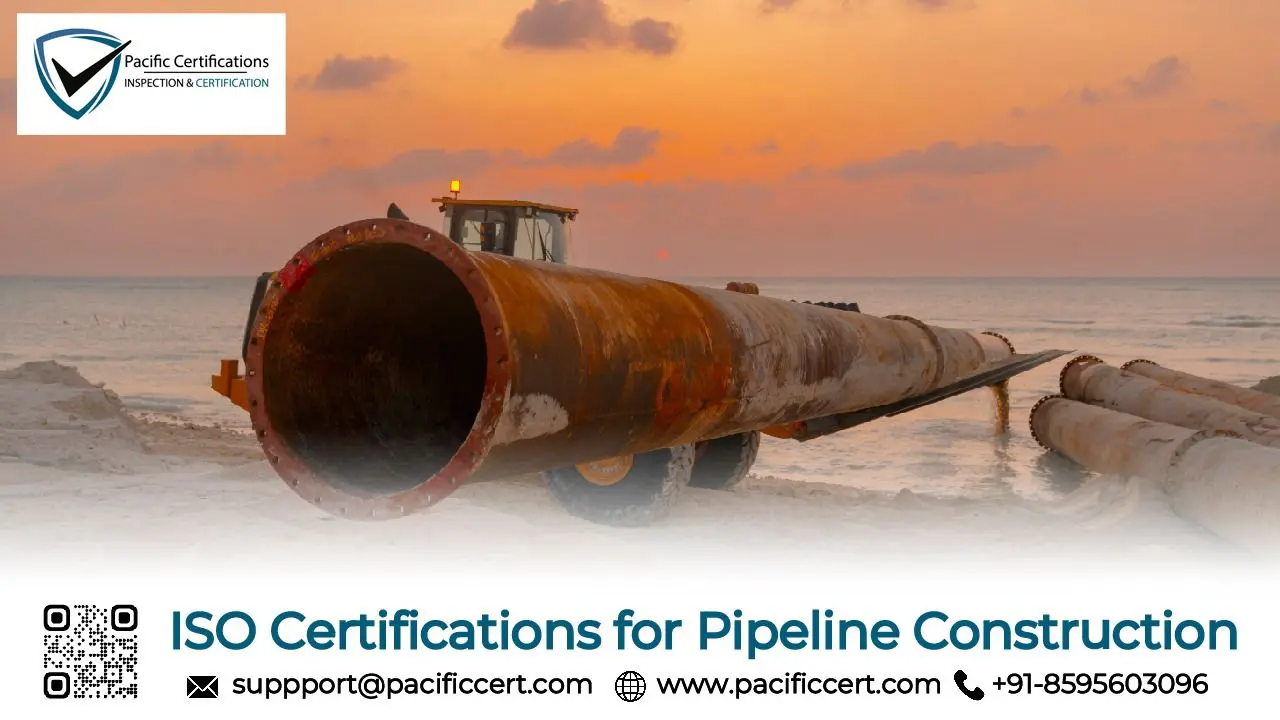
Pipeline construction businesses operate in a highly regulated, safety-critical, and capital-intensive environment where construction quality, welding integrity, environmental protection, worker safety, and regulatory compliance directly influence project approvals and long-term asset reliability. These businesses construct pipelines for oil, gas, water, chemicals, hydrogen, and other utilities across onshore, offshore, urban, and remote environments.
With increasing global investment in energy infrastructure, cross-border pipeline projects, and heightened scrutiny on safety and environmental impacts, pipeline contractors are under pressure to demonstrate disciplined project governance and internationally recognized management systems. ISO certifications have therefore become an essential framework for pipeline construction businesses to control risks, ensure construction quality, meet regulatory expectations, and build trust with operators, governments, and financiers.
In pipeline construction, what lies underground must be built on uncompromising standards.
Quick Summary
ISO certifications provide pipeline construction businesses with internationally recognized frameworks to manage construction quality through ISO 9001, occupational health and safety through ISO 45001, environmental responsibility through ISO 14001, asset lifecycle control through ISO 55001, information security through ISO/IEC 27001, business continuity through ISO 22301, and risk governance through ISO 31000. These certifications help pipeline contractors deliver safe, compliant, and durable infrastructure projects.
Ensure your pipeline construction business meets international standards by partnering with Pacific Certifications today! Contact us at support@pacificcert.com.
Applicable ISO Standards for Pipeline Construction Businesses
Below are the most relevant ISO standards applicable to oil, gas, water, and utility pipeline construction contractors:
ISO 9001:2015 – Quality Management System (QMS)
ISO 9001 is the foundation standard for pipeline construction. It ensures controlled processes for route surveys, welding procedures, NDT inspection, coating, lowering-in, backfilling, testing, documentation, and handover, reducing defects and rework.
ISO 14001:2015 – Environmental Management System (EMS)
Pipeline projects impact land use, water bodies, soil stability, vegetation, and emissions. ISO 14001 helps manage environmental aspects, ensure permit compliance, and reduce ecological damage during construction.
ISO 45001:2018 – Occupational Health and Safety Management System (OHSMS)
Pipeline construction involves excavation, heavy machinery, welding, pressurization, confined spaces, and remote worksites. ISO 45001 provides structured hazard identification, safety controls, training, and emergency preparedness to reduce accidents and fatalities.
ISO 29001:2020 – Quality Management for Oil and Gas Industry
Developed specifically for the petroleum, petrochemical, and natural gas industries, ISO 29001 extends the principles of ISO 9001 with additional requirements for risk management, supply chain control, and defect prevention in pipeline construction.
ISO 17020:2012 – Inspection Bodies Accreditation
This standard applies to organizations involved in pipeline inspections. It ensures that inspection bodies operate competently, impartially, and consistently, which is crucial for verifying pipeline integrity and compliance with safety regulations.
ISO 27001: Information Security Management Systems (ISMS)
With the increasing use of digital technologies in pipeline monitoring and operation, cybersecurity threats are a major concern. ISO 27001 helps companies protect sensitive data, mitigate cyber risks, and ensure the security of pipeline control systems.
ISO 3834:2005 – Quality Requirements for Welding
Welding is a fundamental process in pipeline construction. ISO 3834 establishes quality requirements for welding operations, ensuring structural integrity and compliance with international standards.
ISO 55001:2014 – Asset Management Systems
Pipelines are long-life assets requiring reliable construction records and lifecycle planning. ISO 55001 supports integrity management, asset documentation, and value optimization from construction to operation.
Click here to find out more applicable standards to your industry
What are the Requirements of ISO Certifications for Pipeline Construction Businesses?
Pipeline construction contractors seeking ISO certification must establish and maintain documented policies, procedures, and records aligned with the selected ISO standards. Key requirements include the following:
ISO 9001:2015 – Quality Management Systems
Define standardized processes for route survey, trenching, welding, coating, testing, commissioning, and handover
Control technical drawings, welding procedures (WPS), inspection and test plans (ITPs), and design changes
Manage subcontractors, suppliers, and material traceability, including pipes, fittings, and consumables
Implement inspection, testing, and acceptance controls such as NDT, pressure testing, and coating inspection
Monitor quality performance, non-conformities, client requirements, and corrective actions
ISO 45001:2018 – Occupational Health and Safety Management Systems
Identify hazards related to excavation, confined spaces, hot work, lifting operations, and pressurized systems
Conduct task-based risk assessments and implement controls for high-risk pipeline activities
Provide safety induction, job safety analysis (JSA), PPE usage, and permit-to-work systems
Establish emergency preparedness for gas leaks, fires, explosions, and medical incidents
Monitor incidents, near misses, contractor safety performance, and OH&S improvement actions
ISO 14001:2015 – Environmental Management Systems
Identify environmental aspects such as soil disturbance, vegetation clearance, waste, emissions, and water crossings
Assess environmental impacts along pipeline routes and sensitive areas
Implement mitigation, erosion control, waste management, and site restoration measures
Ensure compliance with environmental permits, land-use conditions, and regulatory approvals
Monitor environmental performance and implement continual improvement programs
ISO 55001:2014 – Asset Management Systems
Establish asset management policies aligned with pipeline integrity and lifecycle requirements
Maintain accurate construction records, weld maps, material certificates, and as-built documentation
Define asset ownership, responsibilities, and handover processes to operators
Support integrity management through data accuracy and traceability
Monitor asset performance information relevant to long-term operation
ISO 22301:2019 – Business Continuity Management Systems
Identify critical construction activities, equipment, skilled labor, and supply chain dependencies
Conduct business impact analysis for disruptions such as weather, material delays, or labor shortages
Develop contingency plans for alternative suppliers, rerouting, or schedule recovery
Establish recovery procedures to resume construction and meet contractual milestones
Test continuity arrangements and train project teams on response actions
Tip:Start by mapping one complete pipeline construction cycle—from route survey and permitting to welding, testing, commissioning, and handover—against ISO requirements to identify safety, quality, and environmental gaps early.
For further information on how we can assist your pipeline construction business with ISO certifications, contact us at support@pacificcert.com.
What are the Benefits of ISO Certifications for Pipeline Construction Businesses?
ISO certifications are suitable for oil and gas pipeline contractors, water pipeline builders, and utility infrastructure companies. Key benefits include:
Improved welding quality and construction consistency, reducing defects, rework, and integrity failures.
Safer working conditions for crews and subcontractors, lowering incident rates and unplanned stoppages.
Stronger environmental compliance and stakeholder confidence, supporting permits and community acceptance.
Higher credibility with pipeline operators, utilities, and regulators, improving tender success and contract awards.
Better control of subcontractors, materials, and field activities, improving execution across long routes.
Improved asset documentation, traceability, and handover quality, supporting long-term pipeline integrity.
Greater resilience to weather, logistics, and supply-chain disruptions, protecting project schedules.
Improved readiness for audits, inspections, and regulatory reviews, minimizing project disruption and penalties.
The pipeline construction industry is expanding as countries increase investments in energy transportation infrastructure, water distribution networks, and industrial pipeline systems. Market research indicates that the global pipeline construction market was valued at approximately 38–40 billion USD in 2023 and is expected to reach around 65–70 billion USD by 2030, growing at a compound annual growth rate of roughly 7–8%. Growth is being driven by rising demand for oil and gas transportation, expansion of natural gas networks, and the development of new energy infrastructure across emerging economies.
Large-scale energy projects are also accelerating global pipeline investments. The global oil and gas pipeline network is projected to expand by more than 250,000 kilometers of new pipelines by 2035, particularly across Asia, the Middle East, and North America. In addition, governments are increasingly investing in hydrogen transport pipelines, carbon capture infrastructure, and water transmission systems to support energy transition and urban development. As pipeline construction projects involve complex engineering activities, environmental risks, and high safety requirements, contractors are increasingly expected to demonstrate structured management practices covering quality, environmental protection, occupational health and safety, and project risk management, leading many pipeline construction businesses to adopt internationally recognized ISO-based management systems to remain competitive in global infrastructure projects.
How Pacific Certifications Can Help?
Pacific Certifications, accredited by ABIS, acts as an independent certification body for pipeline construction businesses by conducting impartial audits against applicable ISO standards. Our role is to objectively assess whether documented management systems and construction practices conform to international ISO requirements, based strictly on verifiable evidence and operational records.
We support pipeline construction companies through:
Independent certification audits conducted in accordance with ISO/IEC 17021
Practical assessment of real construction, welding, and safety controls
Clear audit reporting reflecting conformity status and certification decisions
Internationally recognized ISO certification upon successful compliance
Surveillance and recertification audits to maintain certification validity
Contact us
If you need support with ISO certification for your pipeline construction business, contact us at support@pacificcert.com or +91-8595603096.
Author: Ashish
Read more: Pacific Blogs