Introduction
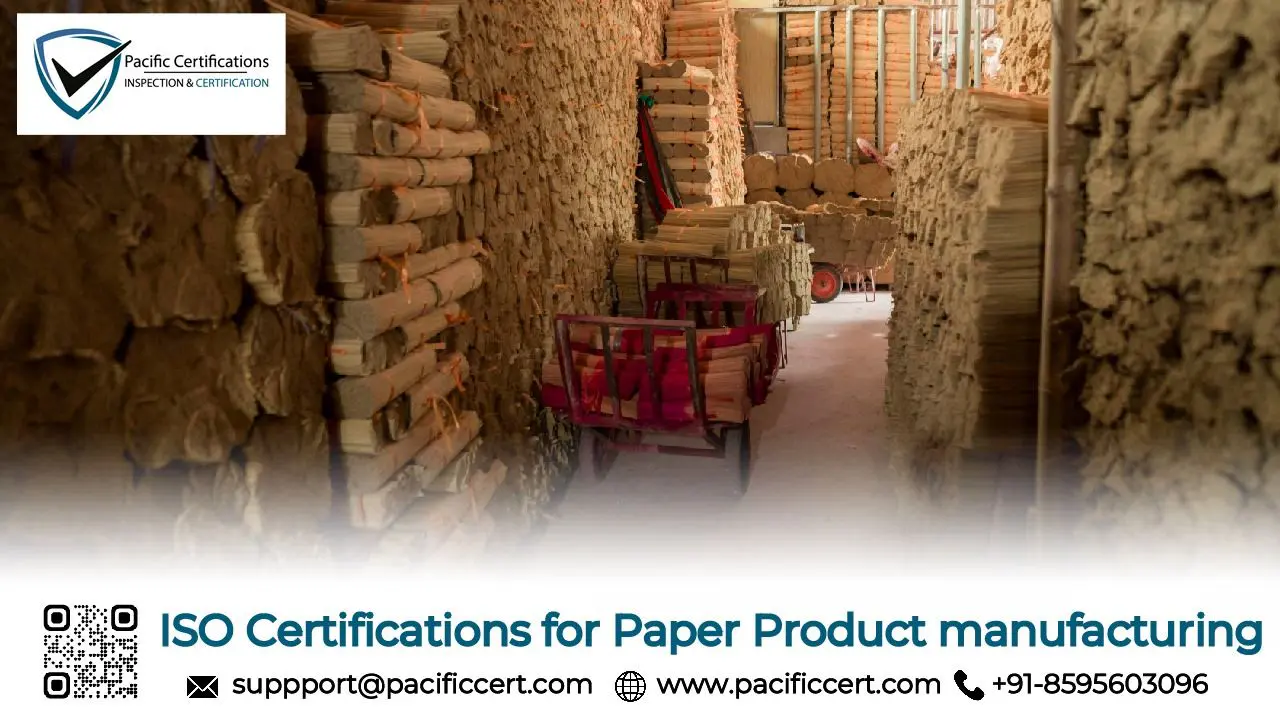
Paper product manufacturing transforms raw materials like wood pulp, recycled fibers, and specialty additives into essential goods ranging from office paper and packaging materials to tissue products and specialty papers. Core operations include pulping processes that break down raw materials, paper machine operations where fibers are formed into sheets, drying and calendaring stages that determine final properties, and converting operations that cut, fold, and package products for distribution. These processes occur in highly automated facilities facing challenges such as maintaining consistent fiber quality, managing water and chemical usage, controlling airborne dust particles, ensuring machine safety at high speeds, and meeting fluctuating demand for different paper grades.
ISO certifications provide critical frameworks to address these challenges by embedding internationally recognized best practices into core operations. They respond to implicit pressures from global compliance frameworks focusing on resource efficiency, workplace safety, and product responsibility without naming specific regulatory bodies. Certification demonstrates commitment to transparent processes that build trust with suppliers, customers, and communities while systematically managing risks from fiber sourcing variability to end-of-life product considerations.
In paper manufacturing, consistent quality begins with reliable fiber preparation and ends with products that perform exactly as promised.
Quick summary
ISO certifications provide paper product manufacturing with internationally recognized frameworks to manage operational quality, environmental stewardship, workplace safety, and information security. Key standards include ISO 9001 for consistent quality in pulping and paper machine operations, ISO 14001 for minimizing ecological footprint across water and energy usage, ISO 45001 for protecting workers in high-speed manufacturing environments, and ISO/IEC 27001 for safeguarding process control systems and business data.
For more information on how we can assist your paper product manufacturing business with ISO certifications, contact us at support@pacificcert.com.
Applicable ISO Standards for Paper Product Manufacturing Businesses
Below are the most relevant ISO standards applicable to pulp and paper mills, tissue producers, packaging paper manufacturers, and specialty paper converters:
ISO 9001:2015 – Quality Management System
This standard is critical due to the industry's sensitivity to fiber variability and process conditions where quality deviations can lead to costly off-spec production or converting issues. It covers fiber furnish control, chemical additive dosing, and real-time monitoring of paper machine variables like moisture profile and calender nip load. Practical benefits include fewer customer claims about paper performance, reduced waste from grade changes, and improved runnability on customers' printing and converting equipment.
ISO 14001:2015 – Environmental Management System
Environmental management is paramount as pulp and paper operations consume significant water volumes, use chemicals like chlorine dioxide in bleaching, and generate biosolids requiring responsible handling. The standard requires monitoring of key effluent parameters, implementation of closed-loop water systems where feasible, and establishment of objectives for reducing fossil fuel consumption in steam generation. Benefits include avoiding regulatory penalties, improving community relations through transparent sustainability reporting, and identifying fiber recovery projects that lower raw material costs.
ISO 45001:2018 – Occupational Health and Safety Management
Worker safety remains a top concern given the presence of combustible paper dust, high-temperature steam systems, and moving machinery with in-running nips. It requires hazard analyses for stock preparation areas, permitting systems for boiler maintenance and reel changes, and specific controls for managing chemicals like sulfur dioxide in pulping. Outcomes include lower incident rates reducing downtime and insurance costs, improved employee confidence in operating complex machinery, and demonstrable compliance with corporate safety expectations from major retail and publishing clients.
ISO 50001:2018 – Energy Management System
Energy management directly impacts profitability through reduced natural gas consumption in steam generation and optimized electricity use in motor-driven systems like refiners and vacuum pumps. Core processes covered include steam trap maintenance programs, variable frequency drive applications on pumps and fans, and heat recovery systems for dryer sections. Benefits encompass lower operating costs per ton of paper, reduced carbon footprint supporting sustainability claims, and improved competitiveness in energy-intensive markets.
ISO 27001:2022 – Information Security Management System
Cybersecurity is increasingly critical as modern paper mills rely on interconnected automation systems where a breach could disrupt quality control systems or safety interlocks on winders and rewinders. It requires segmentation of corporate and process control networks, regular vulnerability assessments of programmable logic controllers (PLCs), and incident response plans addressing scenarios like ransomware targeting production scheduling data. Implementation prevents production losses from cyber-induced trips, meets growing IT requirements from e-commerce packaging clients, and protects valuable formulations for specialty coatings or additives.
ISO 22301:2019 – Business Continuity Management Systems
Supply chain continuity is vital given the sector's reliance on consistent fiber quality and chemical supplies where disruptions can halt production lines. It mandates dual-sourcing strategies for key chemicals like sodium hydroxide, geographically dispersed fiber suppliers, and predefined protocols for switching to alternate energy sources during grid outages. Implementation reduces downtime during disruptions by 20-30%, strengthens force majeure clauses in supplier contracts, and provides verifiable resilience metrics for customers requiring assured supply.
Click here to find out more applicable standards to your industry
What are the Requirements of ISO Certifications for Paper Product Manufacturing Businesses?
Paper product manufacturing businesses seeking ISO certification must establish and maintain documented policies, procedures, and records aligned with the selected ISO standards. Key requirements include the following:
ISO 9001:2015 – Quality Management Systems Requirements
Define quality objectives tied to specific metrics like customer complaint rate and first-pass yield
Control document versions for work instructions covering stock preparation, wet end, and dry end operations
Manage supplier performance through scorecards evaluating fiber consistency and chemical purity
Implement calibration programs for critical sensors like moisture gauges and basis weight scanners
Monitor key process indicators such as machine direction/CD ratio and porosity uniformity
Establish corrective action procedures for deviations like wet-end streaks or calender marks
ISO 14001:2015 – Environmental Management Systems Requirements
Establish an environmental policy covering water discharge standards and waste minimization commitments
Conduct aspect identification focusing on effluent chemical oxygen demand, air particulate emissions, and solid waste generation
Set legal and other requirements matrix tracking regulations like EPA effluent guidelines for pulp mills
Implement operational controls including improved black liquor evaporation and tertiary wastewater treatment
Maintain monitoring records for discharge points and stack emissions from power boilers
Conduct semi-annual management reviews evaluating environmental performance trends
ISO 45001:2018 – Occupational Health & Safety Management Systems Requirements
Establish OH&S policy committing to hazard elimination and worker participation in safety committees
Conduct hazard identification covering dust control, chemical handling, and mechanical power transmission
Determine legal and other requirements matrix including combustible dust standards and lockout/tagout procedures
Implement controls like explosion venting on silos and local exhaust ventilation for chemical handling areas
Maintain records of incident investigations and safety suggestion programs for continuous improvement
Establish emergency response procedures covering scenarios like chlorine dioxide release or boiler overpressure
ISO/IEC 27001:2022 – Information Security Management Systems Requirements
Establish information security policy covering classification of process data and customer specifications
Conduct risk assessments focused on threats to distributed control systems and design data repositories
Apply access controls limiting permissions based on role and need-to-know principle for engineering teams
Implement network segmentation separating office networks from process control and safety systems
Maintain logs of all access attempts to historian databases containing quality and production data
Conduct biannual penetration testing targeting firewalls between IT and operational technology networks
Tip: Begin mapping current processes to ISO requirements by assembling a cross-functional team from process engineering, environmental services, safety, and IT/OT departments to walk through a single product grade journey, from fiber furnish preparation to final product testing and shipment, and document each step against relevant standard clauses to identify gaps and overlaps efficiently.
For more information on how we can assist your paper product manufacturing business with ISO certifications, contact us at support@pacificcert.com.
What are the Benefits of ISO Certifications for Paper Product Manufacturing Businesses?
ISO certifications provide paper product manufacturing with strong operational and commercial advantages, including: listed below are the key benefits for the ISO standards applicable to pulp and paper mills, tissue producers, and packaging paper manufacturers:
Improved product consistency through standardized testing procedures reducing grade transitions and reclaim by 3-8%
Stronger environmental performance via transparent reporting supporting customer sustainability requirements
Better process safety through structured hazard analysis lowering likelihood of dust explosions or chemical releases
Higher regulatory compliance minimizing fines and enforcement actions under frameworks like Clean Water Act
Enhanced cybersecurity resilience protecting critical automation systems from disruptive digital attacks
Greater supply assurance maintaining production during regional disruptions through continuity planning
Reduced environmental incidents lowering remediation costs and community impact expenses
Streamlined reporting using standardized data formats improving accuracy for corporate sustainability disclosures
Improved access to financing demonstrating robust risk management to lenders investing in capital projects
Enhanced brand reputation showcasing commitment to quality, safety, and environmental stewardship
The global paper and paperboard market is projected to exceed USD 450 billion by 2030, driven by sustained demand for corrugated packaging in e-commerce growth, increasing consumption of tissue products in developing economies, and persistent need for specialty papers in labeling and technical applications. Digital transformation accelerates as mills implement advanced process control using artificial intelligence for moisture profile optimization, deploy wireless sensor networks for real-time bearing and gearbox monitoring, and adopt blockchain-based traceability for certified fiber sources like FSC or PEFC. Regulatory evolution intensifies regarding single-use plastics substitution and forest stewardship requirements, pushing facilities toward proactive investments in recycled fiber utilization and closed-loop water systems rather than end-of-pipe treatments alone.
Organizations with certified management systems typically experience 15-25% fewer production-related incidents and demonstrate 20-30% faster recovery times during unplanned shutdowns compared to non-certified peers, based on forest products industry benchmarks. Future success hinges on managing emerging risks like cyber threats to safety systems and adapting to stricter lifecycle assessment requirements for packaging papers. ISO-certified entities hold advantages in markets where major brand owners mandate supplier qualification through schemes like Sedex, while in developing regions they gain faster access to international partnerships for joint ventures by demonstrating adherence to global environmental and social governance benchmarks that reduce perceived operational risk.
How Pacific Certifications Can Help?
Pacific Certifications, accredited by ABIS, acts as an independent certification body for paper product manufacturing businesses by conducting impartial audits against applicable ISO standards. Our role is to objectively assess whether documented management systems and industry-specific practices conform to international ISO requirements, based strictly on verifiable evidence and operational records.
We support paper product manufacturing providers through:
Independent certification audits conducted in accordance with ISO/IEC 17021
Practical assessment of real mill operations, laboratory controls, and safety systems
Clear audit reporting reflecting conformity status and certification decisions
Internationally recognized ISO certification upon successful compliance
Surveillance and recertification audits to maintain certification validity
Contact Us
If you need support with ISO certification for your paper product manufacturing business, contact us at support@pacificcert.com or +91-8595603096.
Author: Ashish
Read More at: Blogs by Pacific Certifications
Read more: Pacific Blogs