Introduction
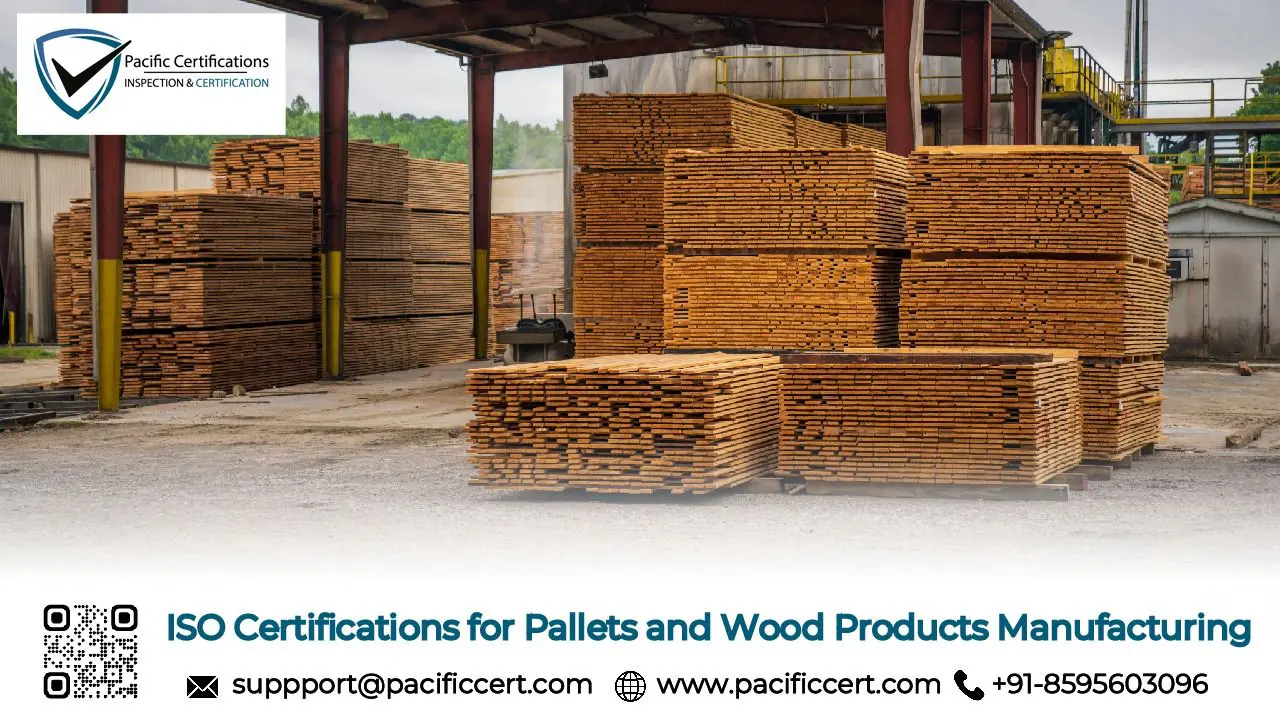
Pallets and wood products manufacturing operates in a production environment where raw material variability, high-volume output, and strict logistics deadlines must be controlled at the same time. Facilities process timber through cutting, milling, grading, heat treatment, and automated assembly to produce pallets, crates, and other wood products used in construction, warehousing, food distribution, and industrial supply chains. Maintaining correct moisture levels, dimensional accuracy, and structural strength is essential, especially when products must meet export requirements such as phytosanitary heat treatment standards. Because production runs continuously and often at high speed, small errors in material selection, machine setup, or treatment conditions can quickly lead to rejected shipments or customer claims.
As these products move into global trade, buyers increasingly expect documented proof that suppliers operate under recognized quality, safety, and environmental management systems. Many procurement programs require traceable timber sourcing, verified worker safety controls, and evidence of responsible environmental practices before approving pallet and wood product manufacturers. ISO certifications provide structured frameworks that help companies manage production consistency, control workplace hazards, maintain compliance with export and sustainability rules, and keep reliable records for audits. With certified systems in place, manufacturers can demonstrate credibility to international customers, reduce operational risk, and compete more effectively in supply chains where verified compliance is required rather than assumed.
In wood products manufacturing, the quality of what you ship reflects the integrity of every process that preceded it
Quick Summary
ISO certifications provide pallets and wood products manufacturers with internationally recognized frameworks to manage consistent production quality through ISO 9001:2015, workplace safety through ISO 45001:2018, environmental impact through ISO 14001:2015, sustainable timber sourcing through ISO 38200:2021, risk governance through ISO 31000:2018, and energy efficiency through ISO 50001:2018.
For more information on how we can assist your pallets and wood products manufacturing business with ISO certifications, contact us at support@pacificcert.com.
Applicable ISO Standards for Pallets and Wood Products Manufacturing Businesses
Below are the most relevant ISO standards applicable to pallet manufacturers, timber processing mills, wooden crate and packaging producers, and engineered wood product manufacturers:
ISO 9001: Quality Management Systems (QMS)
ISO 9001 requires organizations to define production process parameters, control measuring equipment, manage nonconforming outputs, and maintain documented evidence of conformance for every product batch. It creates the operational infrastructure that allows manufacturers to respond confidently to customer audits, specification changes, and traceability queries. For manufacturers supplying food, pharmaceutical, or automotive sectors, ISO 9001 is typically a minimum qualification requirement.
ISO 14001: Environmental Management Systems (EMS)
ISO 14001 provides a structured framework for measuring the impacts, setting reduction targets, and demonstrating ongoing improvement to regulators, buyers, and insurers. It integrates naturally with sustainability reporting obligations that major retail and automotive supply chains impose on their supplier base. Manufacturers that certify to ISO 14001 gain credibility in markets where environmental performance is a sourcing criterion.
ISO 45001: Occupational Health and Safety
Woodworking and pallet manufacturing environments carry significant injury risk — circular saws, vertical spindle moulders, pneumatic nailers, and forklift operations combine to make these facilities statistically hazardous workplaces. ISO 45001 requires manufacturers to systematically identify these hazards, assess residual risk, and implement engineering controls, safe work procedures, and competence training. Wood dust accumulation, a known fire and explosion risk, demands dedicated extraction and monitoring systems that ISO 45001 incorporates as documented controls.
ISO 38200: Chain of Custody of Wood and Wood-Based Products
ISO 38200 requires organizations to document the flow of timber, engineered wood, and recycled content through every stage of production, verifying legality and sustainability credentials at each transfer point. It directly satisfies the sourcing due-diligence requirements that major buyers in retail, food distribution, and construction increasingly embed in supplier contracts. Manufacturers holding ISO 38200 certification gain recognized proof of responsible sourcing that accelerates access to premium markets.
ISO 50001: Energy Management
ISO 50001 requires manufacturers to establish energy baselines, analyze significant energy uses, set improvement targets, and monitor performance against them with calibrated measurement. Organizations implementing ISO 50001 alongside ISO 14001 achieve both cost savings and credible carbon reduction narratives, a combination that resonates strongly with buyers committed to Scope 3 emissions reduction. Certified manufacturers typically report 10–15% reductions in energy intensity within the first certification cycle.
Click here to find out more applicable standards to your industry
What are the Requirements of ISO Certifications for Pallets and Wood Products Manufacturing Businesses?
Pallets and wood products manufacturers seeking ISO certification must establish and maintain documented policies, procedures, and records aligned with the selected ISO standards. Key requirements include the following:
ISO 9001:2015 – Quality Management Systems
Define process parameters for sawing, grading, assembly, and finishing with limits for thickness, nail spacing, and moisture content.
Control measuring tools such as moisture meters, gauges, and load testers through calibration and verification schedules.
Apply nonconforming product procedures to identify, segregate, and dispose of rejected components before dispatch.
Monitor customer satisfaction using feedback records, complaint tracking, and delivery performance reviews.
Perform internal audits across production, storage, and dispatch to confirm compliance with procedures.
ISO 45001:2018 – Occupational Health and Safety Management Systems
Identify hazards from saws, nailers, forklifts, dust systems, and manual handling using formal risk assessments.
Define safe work procedures for cutting, nailing, kiln loading, and chemical treatment with operator training checks.
Monitor wood dust exposure levels and keep records showing compliance with safety limits.
Record and investigate incidents and near-misses with root cause analysis and corrective actions.
Maintain emergency plans for dust fires, chemical spills, and machine entrapment, with regular drills.
ISO 38200:2021 – Chain of Custody of Wood and Wood-Based Products
Track all incoming timber with supplier certificates, species data, and legality verification records.
Keep certified and non-certified timber separated during storage, cutting, and assembly.
Maintain a register of approved suppliers including certification status and audit results.
Verify subcontracted treatment or heat processing meets chain-of-custody requirements.
Ensure invoices and delivery notes correctly show certified material content for full traceability.
ISO 14001:2015 – Environmental Management Systems
Identify environmental impacts such as sawdust waste, kiln emissions, preservatives, and wastewater.
Set targets to reduce waste, chemical use, and energy consumption in drying and treatment processes.
Record waste, water, and energy usage and review against environmental objectives.
Implement spill response procedures for preservative chemicals to prevent soil or water contamination.
Tip: Start mapping your current processes to ISO requirements by forming a cross-functional working group that includes production supervisors, the safety officer, the procurement team, and the operations manager.
For more information on how we can assist your pallets and wood products manufacturing business with ISO certifications, contact us at support@pacificcert.com.
What are the Benefits of ISO Certifications for Pallets and Wood Products Manufacturing Businesses?
ISO certifications provide pallets and wood products manufacturers with strong operational and commercial advantages across quality, safety, and sustainability dimensions; listed below are the key benefits for the ISO standards applicable to pallet manufacturers:
Stronger supplier approval status with major buyers in food, retail, automotive, and logistics sectors where ISO 9001 certification is often required before suppliers can enter approved vendor lists.
Improved product consistency through documented production controls that reduce dimensional variation, nail pattern errors, and moisture content deviations across high-volume pallet and wood component runs.
Better workplace safety performance with fewer lost-time injuries after ISO 45001 implementation, especially in operations involving saws, nailers, forklifts, kilns, and manual material handling.
Enhanced environmental credibility through ISO 14001 systems that support waste wood recycling, chemical preservative control, dust management, and energy efficiency reporting to sustainability-focused customers.
Greater export market access through ISO 38200 chain-of-custody certification, proving legal and sustainable timber sourcing from supplier receipt through production and dispatch.
Reduced operational risk using ISO 31000-based risk assessment methods that help anticipate timber shortages, machinery breakdowns, regulatory changes, and delivery disruptions before they affect contracts.
Higher energy efficiency in drying kilns, milling lines, and treatment plants through ISO 50001 controls, lowering production costs and helping customers meet carbon reporting and ESG requirements.
Streamlined compliance management by integrating quality, safety, environmental, and chain-of-custody standards into one management system, reducing duplicate audits and administrative workload.
Stronger positioning in public tenders and large infrastructure supply contracts where certified quality, environmental, and sourcing controls are specified as mandatory prequalification conditions.
The global wood pallets market was valued at approximately USD 5.7 billion in 2025 and is projected to reach USD 9.4 billion by 2032, growing at a CAGR of 7.4% — driven by expanding international trade volumes, e-commerce fulfillment infrastructure investment, and rising demand for standardized logistics platforms across emerging economies. The European Pallet Association recorded 15% growth in certified pallet volumes in 2023 alone, reflecting how fast certification-based procurement standards are reshaping buyer expectations worldwide. Digitalization of supply chains is accelerating this trend further, with traceability requirements for timber inputs tightening under international deforestation due-diligence regulations that now affect exports to major developed markets. Manufacturers without verifiable chain-of-custody documentation increasingly find themselves excluded from major contract opportunities, regardless of product price competitiveness.
ISO-certified manufacturers in this sector report 20–30% reductions in scrap and rework rates following ISO 9001 implementation, alongside significant improvements in supplier audit pass rates and customer complaint resolution times. Over the next decade, sustainability will transition from a differentiator to a baseline requirement, with buyers embedding carbon footprint data and certified timber origin into procurement specifications as standard practice. Rising raw material costs and skilled labor shortages will push manufacturers toward energy management and process optimization, where ISO 50001 and ISO 9001 provide measurable financial returns.
How Pacific Certifications Can Help?
Pacific Certifications, accredited by ABIS, acts as an independent certification body for pallets and wood products manufacturing businesses by conducting impartial audits against applicable ISO standards. Our role is to objectively assess whether documented management systems and wood product manufacturing practices conform to international ISO requirements, based strictly on verifiable evidence and operational records.
We support pallets and wood products manufacturers through:
Independent certification audits conducted in accordance with ISO/IEC 17021 and applicable sector guidance
Practical assessment of real production floor operations, timber receiving controls, heat treatment processes, and safety management systems
Clear audit reporting reflecting conformity status, identified nonconformities, and certification decisions with actionable closure timelines
Internationally recognized ISO certification upon successful compliance, valid for three years
Surveillance and recertification audits to maintain certification validity and track continual improvement across production operations
Support for integrated management system audits covering ISO 9001, ISO 14001, ISO 45001, and ISO 38200 simultaneously, reducing audit burden and cost
Contact us
If you need support with ISO certification for your pallets and wood products manufacturing business, contact us atsupport@pacificcert.comor +91-8595603096.
Author: Alina
Read more: Pacific Blogs

