Introduction
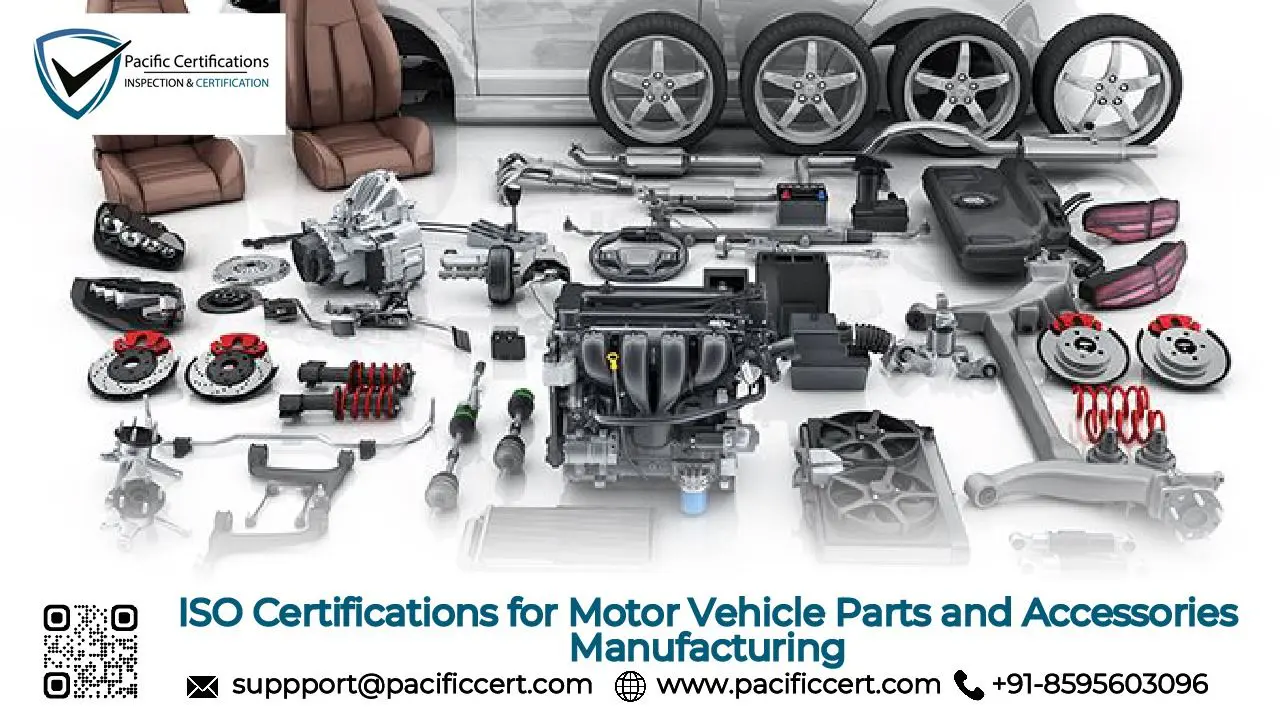
Motor vehicle parts and accessories manufacturing is one of the most demanding sectors in modern industry, requiring strict control over quality, traceability, and production reliability. Manufacturers produce components such as engine parts, transmission housings, brake systems, electronic modules, interior assemblies, and aftermarket accessories, often for multiple OEM customers at the same time. Production processes include precision machining, molding, coating, assembly, and functional testing, all performed to detailed engineering specifications defined by automotive customers. Even small dimensional errors or material defects can lead to safety risks, recalls, or supplier disqualification, while global supply chain requirements demand full traceability of materials, processes, and test results for every batch produced.
Because of these pressures, ISO certifications for motor vehicle parts and accessories manufacturing provide structured management systems that help manufacturers demonstrate consistent control over production, safety, and compliance. Automotive OEMs and tier-one suppliers usually require certified quality, environmental, and safety systems before approving a vendor, and many programs also expect formal risk management and information security controls.
ISO standards create documented and auditable processes for design control, supplier management, inspection, corrective action, and data protection, allowing procurement and quality teams to verify capability objectively. Manufacturers with certified systems are better positioned to qualify for OEM supply contracts, meet export requirements, and adapt to changes such as electric vehicle platforms, new materials, and stricter regulatory expectations across global automotive markets.
In motor vehicle parts manufacturing, every component you produce is a safety commitment verified by the system that made it.
Quick Summary
ISO certifications provide motor vehicle parts and accessories manufacturing businesses with internationally recognized frameworks to manage automotive quality through IATF 16949, product quality through ISO 9001, environmental performance through ISO 14001, worker safety through ISO 45001, energy efficiency through ISO 50001, and information security through ISO/IEC 27001. These standards apply directly to OEM tier-one and tier-two suppliers, aftermarket parts producers, and electronic automotive accessory manufacturers.
For more information on how we can assist your motor vehicle parts and accessories manufacturing business with ISO certifications, contact us at support@pacificcert.com.
Applicable ISO Standards for Motor Vehicle Parts and Accessories Manufacturing Businesses
Below are the most relevant ISO standards applicable to OEM tier-one and tier-two component suppliers, aftermarket parts manufacturers, automotive electronic accessory producers, and vehicle interior and exterior trim converters:
ISO 9001: Quality Management Systems
ISO 9001 provides the foundational quality management framework that ensures product consistency, supplier control, and systematic improvement across all production activities. The standard requires documented process controls, measurable quality objectives, customer complaint management, and calibrated measurement equipment across all relevant operations. It also serves as the structural base that IATF 16949 supplements with automotive-specific requirements, meaning that ISO 9001 alignment is a prerequisite for any organization considering the automotive standard in the future.
IATF 16949: Automotive Quality Management
IATF 16949 is the primary quality management standard for the automotive supply chain, covering 16 key areas that extend significantly beyond ISO 9001 to address the specific demands of vehicle parts production. It requires manufacturers to implement process failure mode and effects analysis, production part approval processes, control plans, and statistical process control methods across all production lines. OEMs globally mandate IATF 16949 certification as a minimum qualification criterion, effectively excluding non-certified suppliers from direct supply programs regardless of technical capability.
ISO 14001: Environmental Management Systems
ISO 14001 structures how facilities identify significant environmental aspects, set measurable reduction objectives, and monitor performance through management reviews that engage senior leadership in environmental decision-making. Multinational OEMs are increasingly embedding supplier environmental certification requirements into their procurement programs as part of corporate sustainability commitments and ESG reporting obligations.
ISO 45001: Occupational Health and Safety Management
ISO 45001 requires formal hazard identification, documented engineering controls, lockout and tagout procedures for maintenance activities, and systematic incident investigation that identifies root causes and verifies corrective actions. Production facilities with ISO 45001 certification report measurably lower incident rates, reduced lost-time injury costs, and improved workforce retention in high-demand manufacturing environments.
ISO 27001: Information Security Management Systems (ISMS)
ISO/IEC 27001 requires organizations to identify information security risks, implement access controls, manage vendor data sharing security, and maintain incident response procedures for cybersecurity events. As automotive production systems become more interconnected through digital supply chain platforms and Industry 4.0 manufacturing technologies, information security breaches carry both operational and contractual consequences.
ISO 26262: Functional Safety for Automotive Systems
This standard focuses on the functional safety of electrical and electronic systems in vehicles. It is critical for manufacturers producing advanced driver-assistance systems (ADAS), sensors, and other high-tech automotive components.
ISO 50001: Energy Management Systems
Energy efficiency is vital for reducing costs and improving sustainability. ISO 50001 helps organizations optimize energy usage across operations, reducing carbon footprints and operational expenses.
Click here to find out more applicable standards to your industry
What are the Requirements of ISO Certifications for Motor Vehicle Parts and Accessories Manufacturing Businesses?
Motor vehicle parts and accessories manufacturing businesses seeking ISO certification must establish and maintain documented policies, procedures, and records aligned with the selected ISO standards. Key requirements include the following:
IATF 16949:2016 – Automotive Quality Management Systems Requirements
Prepare process flow diagrams, PFMEA, and control plans for every automotive production process.
Use PPAP approval for new or changed parts with dimensional, material, and functional validation.
Apply statistical process control on critical characteristics to detect variation before defects occur.
Maintain customer-specific requirement registers for each OEM and review them regularly.
Perform layered process audits to verify operators and supervisors follow control plans.
ISO 14001:2015 – Environmental Management Systems Requirements
Identify environmental impacts from coolant disposal, paint emissions, surface treatment waste, and packaging.
Monitor discharge, emissions, and waste levels against compliance limits and record results.
Control hazardous waste handling including storage, labeling, transport, and disposal documentation.
Conduct environmental reviews to evaluate performance and approve corrective actions.
ISO 45001:2018 – Occupational Health and Safety Management Systems Requirements
Assess crush, pinch, and welding hazards in machining, stamping, and robotic stations.
Implement chemical safety controls for fluids, solvents, and treatment chemicals.
Evaluate ergonomic risks in assembly operations and apply rotation or tooling improvements.
Investigate incidents and near-misses with root cause analysis and tracked corrective actions.
ISO 50001:2018 – Energy Management Systems Requirements
Establish energy baseline for machining, furnaces, molding presses, and compressed air systems.
Define energy indicators and review consumption against reduction targets monthly.
Evaluate energy impact before installing new equipment or changing production cycles.
Maintain action plans for energy savings based on cost and performance benefits.
ISO/IEC 27001:2022 – Information Security Management Systems Requirements
Maintain a security risk register for CAD data, production systems, and customer portals.
Apply role-based access control for design files, ERP systems, and production data.
Control supplier and contractor access through security agreements and periodic reviews.
Perform security audits and vulnerability testing on connected production systems.
Tip: Begin your ISO and IATF certification preparation by forming a cross-functional working team that includes your quality engineer, production supervisor, environmental coordinator, health and safety officer, and IT security lead. Walk this team through each major process from raw material intake through machining, treatment, assembly, and final inspection and map every activity against the specific requirements of each target standard.
For more information on how we can assist your motor vehicle parts and accessories manufacturing business with ISO certifications, contact us at support@pacificcert.com.
What are the Benefits of ISO Certifications for Motor Vehicle Parts and Accessories Manufacturing Businesses?
ISO certifications deliver motor vehicle parts and accessories manufacturing businesses measurable operational improvements and stronger positioning across highly competitive global automotive OEM and aftermarket supply chains. Listed below are the key benefits for OEM tier-one and tier-two component suppliers:
Stronger environmental credibility through ISO 14001, supporting supply programs where OEMs require verified ESG performance.
Easier OEM supplier approval with IATF 16949, meeting mandatory automotive quality system requirements for tier-one and OEM contracts.
Improved worker safety using ISO 45001, reducing injuries in machining, welding, and assembly operations.
Lower energy costs with ISO 50001 by controlling consumption in machining centers, heat treatment, and plant utilities.
Better data protection through ISO/IEC 27001, safeguarding OEM drawings, production data, and customer portals.
Higher delivery reliability with ISO 22301 continuity planning for supply shortages or equipment failure.
Better audit results since OEM quality teams use ISO and IATF certification as key supplier evaluation criteria.
Faster compliance checks because documented systems provide organized records for audits and inspections.
Stronger functional safety credibility with ISO 26262 alignment for electronic and safety-critical automotive parts.
The global automotive parts and accessories market is projected to reach USD 1,120 billion by 2033, growing at a CAGR of 4.2% from 2026 to 2033. Asia Pacific currently accounts for approximately 40% of global market share and is forecast to sustain the highest regional growth rate as vehicle production expands in emerging economies. The rapid transition to electric vehicle platforms is reshaping component demand, creating significant new supply opportunities for battery management system components, power electronics, and thermal management parts while reducing demand for traditional combustion engine components. Consumer behavior is simultaneously shifting toward connected and personalized vehicles, increasing demand for advanced electronic accessories and software-defined vehicle components that carry new functional safety and cybersecurity certification requirements. In the coming years, OEM supplier qualification programs will integrate ESG, cybersecurity, and functional safety requirements more deeply into standard certification frameworks, raising the entry barrier for non-certified manufacturers.
Manufacturers with certified systems are better positioned to keep existing OEM business, secure nominations for new vehicle platforms including electric vehicle programs, and qualify for global supply contracts where verified management systems are required. Over time, certified organizations typically experience smoother audits, stronger customer confidence, and greater stability when operating across both established automotive markets and fast-growing emerging production regions.
How Pacific Certifications Can Help?
Pacific Certifications, accredited by ABIS, acts as an independent certification body for motor vehicle parts and accessories manufacturing businesses by conducting impartial audits against applicable ISO standards. Our role is to objectively assess whether documented management systems and automotive parts production practices conform to international ISO requirements, based strictly on verifiable evidence and operational records.
We support motor vehicle parts and accessories manufacturing providers through:
Independent certification audits conducted in accordance with ISO/IEC 17021 across quality, environmental, safety, energy, and information security management systems.
Practical assessment of real machining, assembly, surface treatment, and testing operations alongside chemical handling controls, OEM documentation systems, and energy management records.
Clear audit reporting that reflects conformity status and certification decisions without ambiguity.
Internationally recognized ISO certification upon successful demonstration of compliance.
Surveillance and recertification audits to maintain certification validity across the full three-year certification cycle.
Contact Us
If you need support with ISO certification for your motor vehicle parts and accessories manufacturing business, contact us at support@pacificcert.com or +91-8595603096.
Author: Ashish
Read more: Pacific Blogs