Introduction
Motor vehicle body and interior repair operations involve collision damage assessment, structural frame straightening, dent removal, panel replacement, paint refinishing, interior upholstery restoration, and trim component installation across passenger vehicles, commercial trucks, and specialty automobiles. Body shops face operational challenges including hazardous chemical exposures from paint and solvents, volatile organic compound (VOC) emissions, hazardous waste generation from coatings and cleaners, workplace injuries from equipment operation, and quality consistency in complex multi-step repair processes. These businesses provide collision repair services, paint refinishing and color matching, structural alignment and frame correction, parts replacement and installation, interior restoration services, and insurance claim coordination for retail customers and fleet operators.
ISO certifications enable auto body shops, collision repair centers, paint refinishing facilities, and interior restoration specialists to establish internationally recognized frameworks addressing service quality, environmental compliance, workplace safety, and customer data protection. Repair facilities face mounting regulatory pressure from environmental protection agencies enforcing VOC concentration limits, hazardous air pollutant standards under EPA NESHAP 6H regulations, occupational safety authorities requiring worker protection protocols, and industry associations mandating OEM repair procedure compliance.
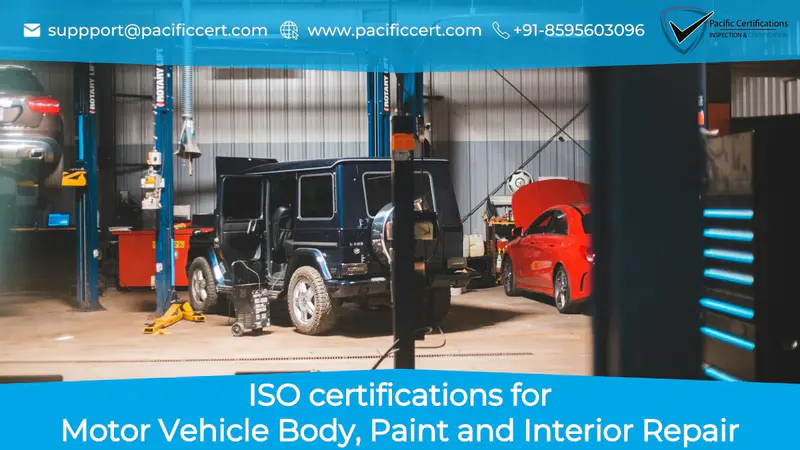
Quality craftsmanship and environmental responsibility define professional collision repair excellence.
Quick Summary
ISO certifications provide motor vehicle body and interior repair services with internationally recognized frameworks to manage service quality through ISO 9001, occupational health and safety through ISO 45001, environmental impacts through ISO 14001, information security through ISO/IEC 27001, energy efficiency through ISO 50001, risk management through ISO 31000, business continuity through ISO 22301, and automotive quality through IATF 16949.
For more information on how we can assist your motor vehicle body and interior repair business with ISO certifications, contact us at support@pacificcert.com.
Applicable ISO Standards for Motor Vehicle Body & Interior Repair Services
Below are the most relevant ISO standards applicable to collision repair shops, auto body refinishing facilities, paint and body centers, and interior restoration specialists:
ISO 9001: Quality Management Systems (QMS)
ISO 9001 is critical for auto body repair operations establishing systematic quality controls for damage assessment, repair planning, structural corrections, paint refinishing processes, final inspection procedures, and customer satisfaction measurement ensuring consistent repair quality and reduced comebacks. Implementation enables collision centers to standardize repair workflows, document OEM procedure compliance, manage supplier parts quality, improve first-time completion rates, and enhance customer confidence through measurable quality performance.
ISO 14001:2015 (Environmental Management Systems)
ISO 14001 addresses environmental impacts from collision repair including VOC emissions from paint and solvents, hazardous waste oils and thinners, spent filters and contaminated materials, air pollutant releases from spray operations, and wastewater discharge from cleaning processes. This standard ensures compliance with EPA NESHAP 6H regulations, VOC concentration limits, hazardous waste disposal requirements, and emission controls protecting facilities from fines, violations, and operational shutdowns.
ISO 45001:2018 (Occupational Health and Safety Management Systems)
ISO 45001 systematically manages workplace hazards unique to body shops including chemical exposures to isocyanates and solvents, respiratory risks from paint overspray, fire hazards from flammable coatings, equipment operation dangers, ergonomic strain from manual sanding and lifting, and electrical shock risks. Implementation protects body technicians, painters, frame technicians, and detailers through hazard identification, exposure controls, personal protective equipment requirements, ventilation system management, and continuous safety monitoring.
ISO 27001:2022 (Information Security Management Systems)
ISO/IEC 27001 protects sensitive information in collision repair operations including customer financial and insurance data, vehicle identification numbers, repair estimates, diagnostic scan results, parts ordering systems, and photo documentation of repairs. This standard establishes security controls for estimating software, cloud-based management systems, payment processing, digital imaging, and customer databases protecting against cyber threats, data breaches, and privacy violations.
ISO 50001:2018 (Energy Management Systems)
ISO 50001 helps energy-intensive collision repair facilities reduce consumption in paint booth heating and ventilation, downdraft exhaust systems, compressed air equipment, welding operations, and facility lighting through systematic energy performance improvement. Implementation enables body shops to measure energy usage, identify efficiency opportunities in curing ovens and spray booths, set reduction targets, and lower operational costs through optimized equipment operation and maintenance.
IATF 16949:2016 – Automotive Quality Management Systems
IATF 16949 is essential for body shops manufacturing or refurbishing automotive parts, panels, or components for OEM supply chains, establishing automotive-specific quality requirements for defect prevention, process controls, and customer satisfaction beyond ISO 9001 baseline. This standard enables collision facilities participating in parts remanufacturing, component refurbishing, or supplying repaired assemblies to meet automotive manufacturer quality expectations and supply chain integration requirements.
Click here to find out more applicable standards to your industry
What are the Requirements of ISO Certifications for Motor Vehicle Body & Interior Repair Services?
Motor vehicle body and interior repair providers seeking ISO certification must establish and maintain documented policies, procedures, and records aligned with the selected ISO standards. Key requirements include the following:
ISO 9001:2015 – Quality Management Systems Requirements
Develop quality policy and objectives for repair consistency, customer satisfaction, OEM procedure compliance, and continuous service improvement
Define processes for damage assessment, repair planning, structural corrections, panel replacement, paint refinishing, and final quality inspection
Control supplier quality for replacement parts, paint materials, refinishing supplies, specialty tools, and subcontracted services
Implement customer communication procedures for repair authorization, progress updates, warranty explanations, and satisfaction surveys
Monitor quality metrics including first-time completion rates, comeback percentages, cycle times, customer complaints, and warranty claims
Conduct pre-repair and post-repair vehicle scans following OEM requirements, document all repair procedures, and maintain quality control records
ISO 14001:2015 – Environmental Management Systems Requirements
Establish environmental policy addressing VOC emission reduction, hazardous waste management, air pollutant controls, and regulatory compliance
Identify environmental aspects including paint and solvent VOC releases, hazardous waste oils and thinners, air emissions from spray booths, and wastewater discharge
Ensure compliance with EPA NESHAP 6H regulations, VOC concentration limits for automotive refinishing products, hazardous waste disposal rules, and air quality permits
Implement controls for paint booth filtration, spray gun transfer efficiency, solvent recovery systems, waste segregation, and proper chemical storage
Set environmental objectives for low-VOC coating adoption, waste reduction, recycling programs, and energy-efficient equipment upgrades
Monitor environmental performance through VOC emission tracking, hazardous waste manifests, air quality measurements, and regulatory audit results
ISO 45001:2018 – Occupational Health and Safety Management Systems Requirements
Develop occupational health and safety policy addressing chemical exposures, respiratory protection, fire prevention, equipment safety, and ergonomic hazards
Identify workplace hazards through risk assessments of paint spray operations, solvent handling, welding fumes, compressed air equipment, and manual material handling
Implement safety controls including supplied-air respirators for painters, personal protective equipment, ventilation system maintenance, fire suppression equipment, and chemical safety training
Ensure worker participation through safety committees, hazard reporting systems, pre-task briefings, and consultation on process changes affecting safety
Monitor occupational health metrics including chemical exposure levels, respiratory fit testing, injury rates, near-miss incidents, and training compliance
ISO/IEC 27001:2022 – Information Security Management Systems Requirements
Establish information security policy protecting customer financial data, insurance information, vehicle records, repair estimates, and photo documentation
Identify information assets including estimating software systems, customer databases, payment processing terminals, photo management platforms, and parts ordering systems
Assess information security risks from cyber attacks, payment fraud, unauthorized access, data breaches, and ransomware threats
Implement security controls for network protection, user access management, data encryption, regular backups, and incident response procedures
ISO 50001:2018 – Energy Management Systems Requirements
Develop energy policy targeting efficiency improvements in paint booth operations, compressed air systems, facility lighting, and heating/cooling
Identify significant energy uses in spray booth ventilation, paint curing ovens, compressed air generation, welding equipment, and facility infrastructure
Establish energy performance indicators and improvement targets for booth runtime optimization, equipment maintenance, and facility upgrades
Implement energy-efficient practices including LED lighting conversion, variable frequency drives on booth fans, and compressed air leak detection programs
Tip: Begin your ISO certification journey by documenting existing repair procedures, safety protocols, and environmental practices currently followed in your facility. Engage experienced body technicians, painters, estimators, and frame specialists in developing practical procedures that reflect actual repair workflows, paint application techniques, and quality inspection processes rather than creating documentation disconnected from daily shop operations.
For more information on how we can assist your motor vehicle body and interior repair business with ISO certifications, contact us at support@pacificcert.com.
What are the Benefits of ISO Certifications for Motor Vehicle Body & Interior Repair Services?
ISO certifications deliver measurable operational and competitive advantages for collision repair providers, establishing systematic frameworks that enhance repair quality, workplace safety, environmental compliance, and customer confidence while positioning body shops for sustainable growth in increasingly competitive and regulated automotive service markets, listed below are the key benefits for the ISO standards applicable to collision repair shops, auto body refinishing facilities, paint and body centers, and interior restoration specialists:
Improved repair quality through standardized procedures, OEM compliance, consistent paint finishes, and reduced comeback rates enhancing customer satisfaction
Stronger environmental compliance reducing risk of EPA violations, fines, and operational shutdowns from VOC emissions or hazardous waste violations
Enhanced workplace safety protecting technicians from chemical exposures, paint overspray, equipment hazards, and ergonomic injuries
Better customer confidence from documented quality systems, warranty assurance, transparent processes, and measurable service performance
Greater competitive advantage in securing insurance company direct repair programs, OEM certified repair network participation, and fleet maintenance contracts
Reduced operational costs through process efficiency, waste minimization, rework reduction, and improved first-time completion rates
Higher employee satisfaction from safer working conditions, clear procedures, effective training programs, and professional development opportunities
Lower insurance premiums from demonstrated safety management, reduced incident rates, and systematic risk mitigation protocols
Improved supplier relationships through quality requirements, materials specifications, and performance monitoring ensuring consistent parts and materials quality
Strengthened market reputation demonstrating professional commitment to quality craftsmanship, environmental responsibility, safety excellence, and customer data protection
The global automotive collision repair market reached USD 247.5 billion and is projected to exceed USD 330 billion in the coming years, driven by increasing vehicle complexity with advanced driver assistance systems, longer vehicle ownership cycles requiring more repairs, rising accident rates, and growing demand for certified OEM repair procedures. Regulatory authorities are tightening requirements for VOC emission controls, EPA NESHAP 6H compliance, hazardous waste management, technician certification standards through I-CAR Gold Class programs, and mandatory pre/post-repair scanning following OEM specifications.
ISO implementation in collision repair operations delivers 20-30% improvements in first-time completion rates, measurable reductions in customer comebacks, enhanced workplace safety performance, and stronger environmental compliance reducing regulatory violations. ISO certification is becoming baseline requirement for insurance company direct repair programs, OEM certified collision networks, fleet maintenance authorizations, and consumer confidence as vehicle technology complexity, environmental regulations, and quality expectations drive demand for certified management systems demonstrating systematic quality and compliance controls.
How Pacific Certifications Can Help?
Pacific Certifications, accredited by ABIS, acts as an independent certification body for motor vehicle body and interior repair businesses by conducting impartial audits against applicable ISO standards. Our role is to objectively assess whether documented management systems and collision repair operational practices conform to international ISO requirements, based strictly on verifiable evidence and operational records.
We support motor vehicle body and interior repair providers through:
Independent certification audits conducted in accordance with ISO/IEC 17021
Practical assessment of real collision repair operations, paint refinishing procedures, safety controls, environmental compliance, and quality systems
Clear audit reporting reflecting conformity status and certification decisions
Internationally recognized ISO certification upon successful compliance
Surveillance and recertification audits to maintain certification validity
Objective evaluation of management systems across multiple repair facilities and collision center locations
Contact Us
If you need more support with ISO certifications for your motor vehicle body and interior repair business, contact us at support@pacificcert.com or +91-8595603096.
Author: Ashish
Read More at: Blogs by Pacific Certifications