# ISO Certification for the Manufacturing Sector: Benefits, Challenges, Costs & Common Standards
Author: Pacific Certifications
Author URL: https://blog.pacificcert.com/author/pacific-certifications/
Published: 2025-09-09
Meta Title: ISO Certification for Manufacturing 2026 | Quality, ESG & Costs
Meta Description: Master ISO 9001:2026 & 14001:2026 for manufacturing. Expert guide to 2026 revisions, "Quality Culture" requirements, implementation costs, and ESG benefits.
Tags: ISO 14001 for Manufacturing, Manufacturing industry ISO, iso for manufacturing, ISO 45001 for Manufacturing, ISO 9001 for Manufacturing
Tag URLs: ISO 14001 for Manufacturing (https://blog.pacificcert.com/tag/iso-14001-for-manufacturing/), Manufacturing industry ISO (https://blog.pacificcert.com/tag/manufacturing-industry-iso/), iso for manufacturing (https://blog.pacificcert.com/tag/iso-for-manufacturing/), ISO 45001 for Manufacturing (https://blog.pacificcert.com/tag/iso-45001-for-manufacturing/), ISO 9001 for Manufacturing (https://blog.pacificcert.com/tag/iso-9001-for-manufacturing/)
URL: https://blog.pacificcert.com/iso-certifications-for-manufacturing-sector/
## **Introduction**
The manufacturing sector **remains** one of the preeminent pillars of global economic growth. In the recent years, the sector is under pressure due to global markets and increased competition; adding to this pressure are compliance frameworks, regulatory measures, customer expectations and sustainability considerations. For all manufacturers and the manufacturing sector, consistently delivering product quality, providing a safe workplace and operating in an environmentally responsible manner is not just a priority, but rather, they are critical to growth and viability.
ISO Standards for Manufacturing **offer** an internationally recognized response to this dilemma. Manufacturers can develop credibility, show accountability and ramp up entry into international markets simply by adopting a structured approach to frameworks. Certification shows that a manufacturer’s operations align with the quality, safety and sustainability criteria increasingly demanded by regulators, customers and global supply chains.
## **Quick summary**
ISO Standards for Manufacturing companies in quality control, workplace safety and sustainability. The most relevant standards include [ISO 9001:2015 for quality management](https://pacificcert.com/iso-9001-2015-quality-management-system-certification/), [ISO 14001:2015 for environmental responsibility](https://pacificcert.com/iso-14001-2015-environmental-management-systems/), [ISO 45001:2018 for occupational health and safety](https://pacificcert.com/iso-45001-2018-health-safety/) and [ISO/IEC 27001:2022 for data security in digitalized manufacturing systems](https://pacificcert.com/iso-iec-27001-2022-information-security-management-systems/). This guide outlines requirements, preparation steps, costs and benefits, plus recent trends such as Industry 4.0, sustainability, and integrated management systems for manufacturers.
[Review how your existing shop‑floor and support processes map to ISO requirements](https://pacificcert.com/contact-us/): Reflect on planning, production, maintenance, logistics, and supplier control practices already in place.
## **Why ISO certification matters in manufacturing?**
ISO standards for manufacturing companies is **critical** because it assures customers, regulators and partners that they can expect the same processes and product every time as a manufacturer. Many industries, such as automotive, aerospace, electronics, pharmaceuticals and machinery have strict supply chain requirements that require suppliers to be ISO certified. Certification gives **manufacturers** access to global markets, allowing manufacturers to effectively compete on a global scale.
While providing trust to customers, ISO certification also helps manufacturers create safer working environments, reduce waste, and manage environmental requirements. It also provides an internal benefit as it dovetails teams towards structured goals, improves efficiencies and mitigates costly error. For organizations trying to **set themselves apart** in crowded markets, ISO standards for manufacturing companies often becomes a determining factor for winning contracts.
## **What are the requirements of ISO standards for manufacturing companies?**
Manufacturers must establish systems that ensure consistency, quality, and safety across all production stages. The requirements are designed to reduce risks, protect workers and improve accountability. Below are the main requirements:
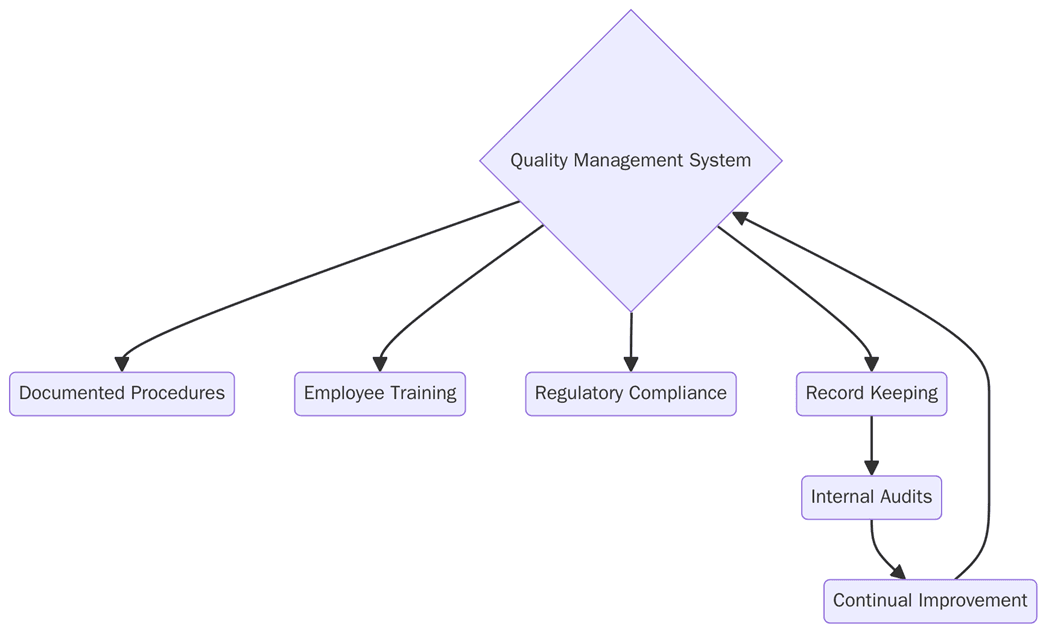
1. **Identify** the management system boundaries for production process, supply chain or product quality.
2. **Establish** quality, safety, or environmental performance policies depending on the certification.
3. **Conduct** risk assessments and risk controls for all hazards including defective products, machine safety and emissions.
4. **Train** staff on regulatory compliance, machine operation and occupational health and safety practices.
5. **Establish** operational controls including inspections, testing and preventative maintenance.
6. **Complete** internal audits on compliance and evaluate the effectiveness of the system.
7. **Ensure** upper management conducts reviews to evaluate objectives, performance and corrective action.
8. **Address** any nonconformities in a timely fashion to avoid recurrence.
9. **Support** continual improvement by upgrading processes, equipment and safety.
## **How to prepare for ISO standards for manufacturing companies?**
Preparation involves aligning production processes with ISO standards for manufacturing companies and ensuring employees are ready for audits. Below are the steps:
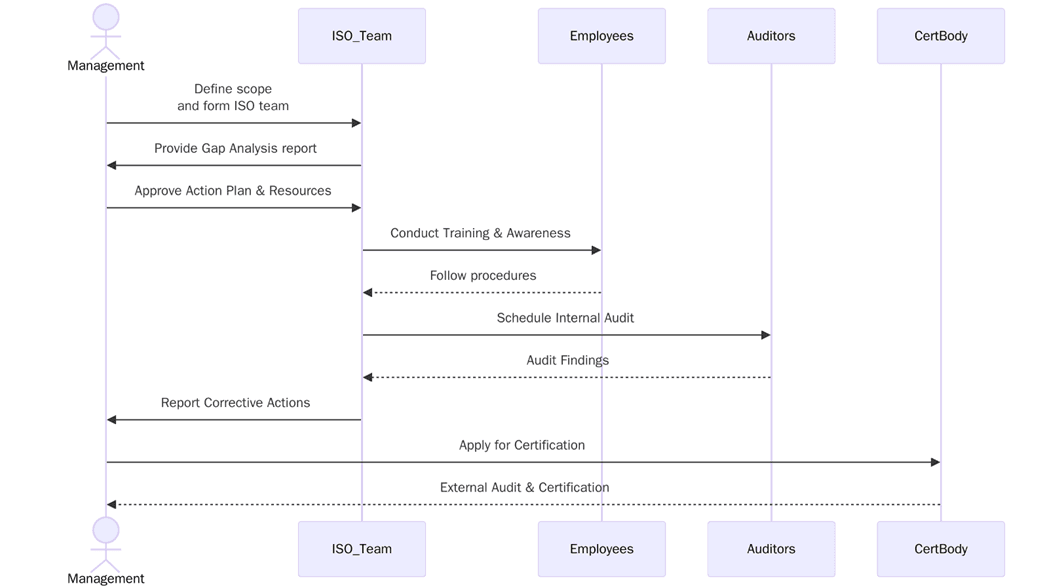
1. **Conduct** a gap analysis to compare existing processes with ISO requirements.
2. **Develop** policies reflecting the organisation’s quality, safety, or sustainability goals.
3. **Train** employees across production and management teams on compliance roles.
4. **Maintain** documented procedures for product testing, machine operation, and supplier management.
5. **Implement** risk management strategies to address workplace hazards and product failures.
6. **Conduct** internal audits and trial reviews before the external certification audit.
7. **Involve** management in reviewing performance indicators and allocating resources.
## **Certification audit**
The certification audit ensures manufacturers meet ISO requirements. It involves the following steps:
**Stage 1 audit** assesses corporate policies and documentation related to production and compliance records.
**Stage 2 audit** verifies organizational implementation in production lines, warehouses and safety.
**Nonconformities** are highlighted and must be dealt with in order to be awarded a certificate.
**Management** reviews ensure that management is demonstrating their commitment in maintaining these systems.
**Certification** will be awarded once the gaps have been closed.
**Institution** will have to undergo an annual surveillance audit to maintain certification status.
**Recertification audits** must occur every three years.
## **What are the benefits of ISO standards for manufacturing companies?**
ISO standards for manufacturing companies bring measurable benefits by improving credibility and strengthening internal systems. In an industry where competition is high and customer demands are rising, the ability to provide consistent quality and reliable operations is essential. Below are the key benefits:

- **Better** product quality, reducing errors and improving customer satisfaction
- **Improved** access to global markets by meeting international buyer requirements
- **Stronger** credibility in supply chain partnerships and contracts
- **Reduced** workplace accidents through occupational safety systems
- **Lower** environmental impact through waste reduction and energy efficiency
- **Cost** savings from fewer defects, recalls and resource inefficiencies
- **Increased** employee accountability and training, creating a culture of compliance
- **Competitive** advantage in tenders and industry recognition
In the recent years, many manufacturers are adopting **integrated management systems** that combine ISO 9001, ISO 14001, and ISO 45001 to reduce duplication and streamline audits. Sustainability is becoming a major focus, with more companies pursuing **ISO 50001** to manage energy use and support environmental goals.
The rise of Industry 4.0 and smart factories has also made ISO/IEC 27001 highly relevant, as manufacturers protect sensitive data from cyber threats. Organisations are increasingly measuring the impact of certification using KPIs such as audit closure times, supplier defect rates, energy consumption per unit produced and customer complaint resolution times. Many are also including SLAs in supplier contracts to ensure timely delivery, product conformity, and quality consistency across the supply chain. Globally, supply chain resilience and ESG expectations are influencing buyers, making ISO standards for manufacturing companies a key differentiator for securing contracts and maintaining long-term competitiveness.
## **How can Pacific Certifications help?**
Pacific Certifications, accredited by [**ABIS,**](https://abisonline.org/) provides accredited ISO certification services tailored to the manufacturing sector. We work with organizations to assess systems against international standards and certify their quality, safety and sustainability practices. Our role is to provide impartial audits that give manufacturers credibility in competitive markets.
Request your ISO audit plan and fee estimate, we will help you map Stage-1/Stage-2 timelines and evidence requirements for your organization.
### Contact Us
Contact us at [support@pacificcert.com](mailto:support@pacificcert.com) or visit [www.pacificcert.com](https://pacificcert.com/).
Read more: [Pacific Blogs](https://blog.pacificcert.com/)
### Author: Alina Ansari
ISO Standards for Manufacturing
## FAQs
Q: Why do manufacturers need ISO certification?
A: It helps them improve product quality, meet buyer requirements and gaincredibility in global markets.
Q: Which ISO standard is most important for manufacturing?
A: ISO 9001 is the foundation, but ISO 14001, ISO 45001 and sector-specific standards like IATF 16949 are also critical.
Q: How long does it take to get ISO certified in manufacturing?
A: The process takes 6 to 9 months, depending on company size, readiness, and documentation.
Q: Do buyers prefer ISO-certified manufacturers?
A:
Yes, many contracts and supply chain requirements specifically demand ISO-certified suppliers.
Q: What are the long-term benefits of ISO for manufacturers?
A: They include fewer defects, safer workplaces, sustainable operations and improved global competitiveness.
Q: What are the costs of ISO certification for manufacturers?
A: Costs depend on the scope of certification, workforce size, and number of facilities. They include training, audits and certification fees.
Q: Can small manufacturers get ISO certified?
A: Yes, ISO standards are scalable and can be applied to businesses of all sizes.
Q: How often are manufacturers audited after certification?
A: Surveillance audits are annual, while recertification occurs every three years.
Q: What challenges do manufacturers face in ISO certification?
A:
Challenges include costs, employee resistance, and the time required to document and implement systems.
Q: Can ISO certifications be combined in manufacturing?
A: Yes, many companies integrate ISO 9001, ISO 14001, and ISO 45001 into a single system for efficiency.
---
This blog is powered by Superblog. Visit https://superblog.ai to know more.
---