ISO Certifications for Machine Tool and Parts Manufacturing Businesses, Requirements and Benefits
Introduction
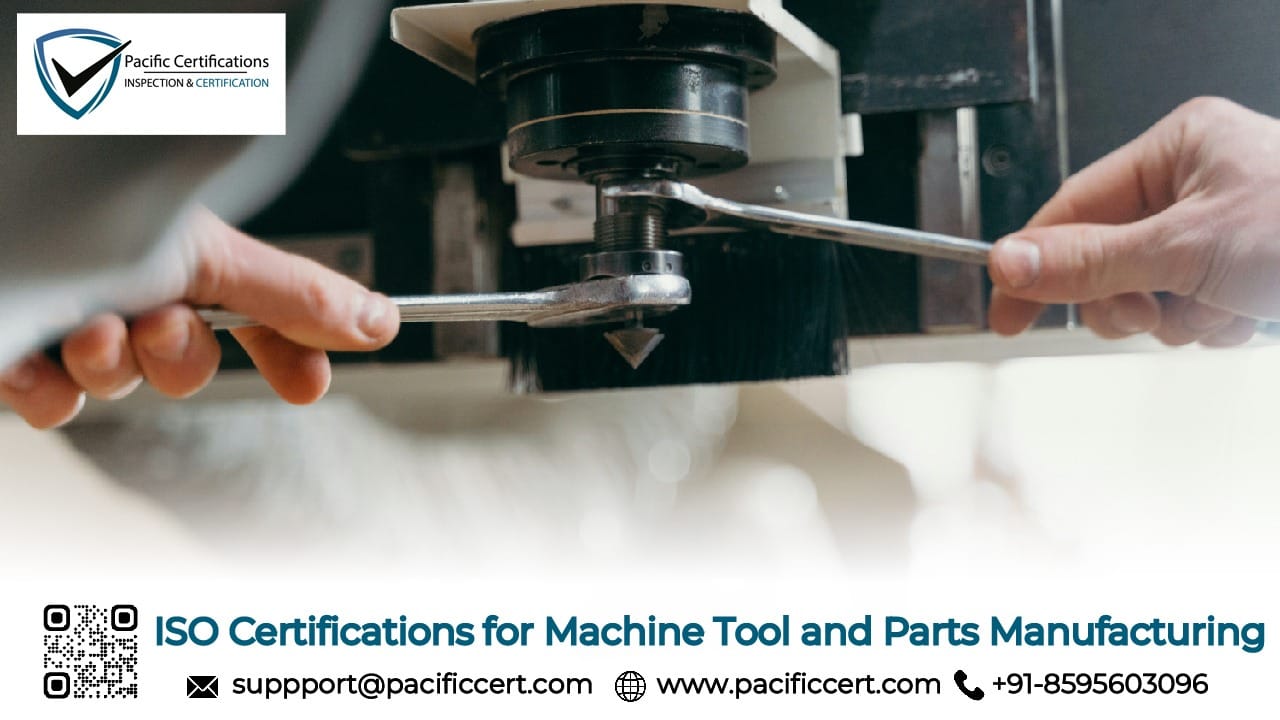
Machine tool and parts manufacturing sits at the high-precision end of industrial production. Companies in this field produce CNC machining centers, lathes, milling and grinding machines, gear cutting equipment, and close-tolerance components used in automotive, aerospace, defense, medical, and energy applications. Daily operations involve strict material checks, multi-axis machining, heat and surface treatment, detailed measurement, and careful assembly where even micron-level variation can matter. The work is demanding because manufacturers must keep accuracy consistent across large production runs, control tool wear that can affect quality, protect sensitive machining programs, and keep workers safe around fast-moving spindles and automated equipment. On top of that, customers in these industries usually require suppliers to meet strict qualification rules before any order is approved.
Because of these pressures, ISO certifications have become almost essential in this sector. Many automotive, aerospace, and defense buyers now include certified management systems as a basic supplier requirement, not an added advantage. ISO standards give manufacturers a clear structure for managing quality, safety, environmental impact, and information security in a controlled and documented way. Instead of handling compliance separately in different areas, companies can run their operations under one verified system that auditors can check and customers can trust. This helps reduce production variation, improves traceability, and shows that the manufacturer can maintain stable performance over long production cycles — something precision industries expect before awarding contracts.
In machine tool and parts manufacturing, precision in your product starts with precision in your processes
Quick Summary
ISO certifications provide machine tool and parts manufacturing businesses with internationally recognized frameworks to manage production quality through ISO 9001, occupational safety through ISO 45001, environmental performance through ISO 14001, information security through ISO/IEC 27001, laboratory testing competence through ISO/IEC 17025, and energy efficiency through ISO 50001. These standards address the sector's most significant operational risks: dimensional non-conformance, worker injury near automated machinery, intellectual property exposure, and environmental impacts from cutting fluids and metal waste.
For more information on how we can assist your machine tool and parts manufacturing business with ISO certifications, contact us at support@pacificcert.com.
Applicable ISO Standards for Machine Tool and Parts Manufacturing Businesses
Below are the most relevant ISO standards applicable to CNC machine tool manufacturers, precision parts producers, tooling and fixture suppliers, and contract machining service providers:
ISO 9001: Quality Management Systems (QMS)
ISO 9001 provides the control framework for managing quality across the entire production sequence: incoming raw material certification, process parameter documentation for each operation, in-process inspection at defined checkpoints, final dimensional verification, and structured corrective action for deviations. It establishes change control disciplines for machining parameters, cutting tool substitutions, and fixture modifications, all of which can silently introduce dimensional variation if managed informally.
ISO 14001: Environmental Management Systems (EMS)
Machining operations generate environmental impacts that are easy to underestimate at an individual process level but substantial at facility scale. Cutting fluid disposal, coolant contamination of wastewater, metal swarf generation, energy-intensive compressed air systems, and chemical surface treatment processes all contribute to a significant environmental footprint. ISO 14001 requires organizations to document these aspects, set reduction targets, and implement verifiable operational controls.
ISO 45001: Occupational Health and Safety (OHS)
Machine tool environments present a specific and well-documented set of occupational hazards. High-speed rotating spindles, automated part loading systems, pressurized cutting fluid delivery, chip and swarf ejection, airborne metal dust in grinding operations, and ergonomic strain from repetitive component handling all require systematic controls. ISO 45001 mandates hazard identification and risk assessment across all these activities, with documented controls proportional to assessed risk. It requires organizations to engage workers directly in safety planning, which in practice generates a much higher volume of reported near-miss events and allows proactive hazard elimination before incidents occur.
ISO 50001: Energy Management Systems
CNC machining centers, grinding machines, hydraulic clamping systems, and centralized coolant delivery infrastructure consume substantial energy across extended production shifts. Compressed air generation alone can represent 20 to 30% of a machining facility's total energy consumption. ISO 50001 requires organizations to establish consumption baselines by process area, identify significant energy users, implement measurement infrastructure, and set documented reduction targets with assigned accountability. The financial returns from ISO 50001 implementation are measurable within the first certification cycle, making this standard commercially attractive in addition to its compliance and reputational value.
ISO 27001: Information Security Management Systems (ISMS)
ISO/IEC 27001 establishes a risk-based framework for identifying information assets, assessing threats and vulnerabilities, implementing technical and organizational controls, and responding to incidents with structured containment procedures. For contract manufacturers serving defense and aerospace customers, information security governance is increasingly a formal qualification requirement.
Click here to find out more applicable standards to your industry
What are the Requirements of ISO Certifications for Machine Tool and Parts Manufacturing Businesses?
Machine tool and parts manufacturing businesses seeking ISO certification must establish and maintain documented policies, procedures, and records aligned with the selected ISO standards. Key requirements include the following:
ISO 9001:2015 – Quality Management Systems Requirements
Define the QMS scope covering all machining, inspection, assembly, and dispatch activities from order receipt to final delivery.
Document process controls for each machining operation, including tooling parameters, fixtures, and inspection checkpoints.
Maintain full traceability linking finished parts to raw material certificates, heat treatment, and in-process inspections.
Control non-conforming parts through segregation, root cause analysis, and corrective action before release.
Calibrate all measuring instruments such as CMMs, gauges, micrometers, and hardness testers at defined intervals.
Conduct internal audits across production and quality functions and ensure corrective actions are closed.
ISO 45001:2018 – Occupational Health and Safety Management Systems Requirements
Identify and assess risks related to high-speed machining, automation, cutting fluids, and manual handling.
Maintain safe operating procedures for setup, maintenance, lockout/tagout, and emergency stop systems.
Record near-miss events, unsafe conditions, and operator feedback in the safety review process.
Monitor safety performance indicators such as injuries, incidents, and equipment damage.
Apply safety requirements to contractors, service engineers, and external personnel working on site.
ISO/IEC 17025:2017 – Testing and Calibration Laboratory Competence Requirements
Define laboratory scope covering dimensional inspection, surface finish checks, and hardness testing.
Maintain calibration programs with traceability to national or international measurement standards.
Keep competency records for inspectors, including training and proficiency verification.
Ensure impartiality and confidentiality of inspection results and customer data.
Document measurement uncertainty for critical dimensions and include it in reports when required.
ISO/IEC 27001:2022 – Information Security Management Systems Requirements
Define the security scope covering drawings, CNC programs, ERP systems, and quality records.
Assess risks to customer data, machining programs, and connected production systems.
Control user access based on job role, with periodic review and authorization records.
Maintain incident response procedures for data loss, cyber threats, or system failures.
Train employees on secure handling of technical data, removable media, and digital communication.
Tip: Machine tool and parts manufacturing businesses should initiate ISO implementation by forming a cross-functional working group that includes production engineers, quality technicians, metrology specialists, HSE officers, IT administrators, and customer account managers.
For more information on how we can assist your machine tool and parts manufacturing business with ISO certifications, contact us at support@pacificcert.com.
What are the Benefits of ISO Certifications for Machine Tool and Parts Manufacturing Businesses?
ISO certifications give CNC machine tool manufacturers, precision parts producers, tooling suppliers, and contract machining companies clear operational and commercial advantages. These standards help improve process control, strengthen customer confidence, and make it easier to meet strict supplier qualification rules used in automotive, aerospace, defense, and other high-precision industries. Key benefits include:
Easier supplier approval with automotive, aerospace, and defense customers that require ISO 9001 and ISO/IEC 17025 as minimum qualification conditions.
Better dimensional accuracy through ISO 9001 controls that reduce machining variation, tool wear errors, and first-article rejection rates.
Fewer workplace incidents as ISO 45001 safety controls address spindle hazards, cutting fluid exposure, and heavy part handling risks.
Higher inspection credibility with ISO/IEC 17025 systems that validate CMM results and reduce disputes over measurement reports.
Stronger protection of customer drawings, CNC programs, and tooling data through ISO/IEC 27001 information security controls.
Lower energy costs with ISO 50001 programs targeting compressed air use, idle machine power, and inefficient hydraulic systems.
Improved environmental compliance using ISO 14001 controls for coolant disposal, metal recycling, and waste management.
Faster customer audits because certified systems provide clear, organized, and verifiable documentation.
Better supply reliability for JIT customers through ISO 22301 continuity planning covering breakdowns and material shortages.
The global machine tools market is currently valued at roughly USD 95–110 billion and is expected to grow to around USD 185–190 billion over the next decade, with steady annual growth driven by demand for high-precision components. Growth is coming from electric vehicle production, aerospace structures, semiconductor equipment, and medical devices, all of which require tight tolerances and highly reliable machining. At the same time, manufacturing is becoming more digital, with multi-axis CNC systems, automated inspection, digital twins, and predictive tooling software generating large amounts of production data that must be properly controlled. Alongside this, automotive and aerospace buyers are tightening supplier rules, often requiring certified management systems as part of supply agreements. Customers also expect full traceability and consistent quality, which is pushing measurement and testing standards deeper into the supply chain.
Companies that implement ISO management systems in this sector usually see measurable improvements in performance. Manufacturers using ISO 9001 together with ISO/IEC 17025 often report fewer first-article rejections and lower customer complaint rates within the first certification cycles, while ISO 45001 programs commonly lead to noticeable reductions in lost-time injuries in machining environments. As CNC machines become more connected, cybersecurity risks are increasing, which is driving more manufacturers to adopt ISO/IEC 27001 to protect programs, drawings, and production data. Environmental and energy pressures from major customers are also increasing the use of ISO 14001 and ISO 50001, while ISO 22301 is gaining importance for companies supplying just-in-time production lines that cannot afford disruptions. In practice, certified machine tool and precision parts manufacturers are usually in a stronger position to keep approved supplier status, win long-term contracts, and compete in higher-value global markets.
How Pacific Certifications Can Help?
Pacific Certifications, accredited by ABIS, acts as an independent certification body for machine tool and parts manufacturing businesses by conducting impartial audits against applicable ISO standards. Our role is to objectively assess whether documented management systems and manufacturing-specific practices, including CNC process controls, metrology system governance, safety management programs, and information security protocols, conform to international ISO requirements, based strictly on verifiable evidence and operational records.
We support machine tool and parts manufacturing providers through:
Independent certification audits conducted in accordance with ISO/IEC 17021
Practical assessment of real machining operations, dimensional inspection systems, safety controls, and information security management
Clear audit reporting reflecting conformity status and certification decisions
Internationally recognized ISO certification upon successful compliance
Surveillance and recertification audits to maintain certification validity
Contact Us
If you need support with ISO certification for your machine tool and parts manufacturing business, contact us at support@pacificcert.com or +91-8595603096.
Author: Alina
Read More at: Blogs by Pacific Certifications