Introduction
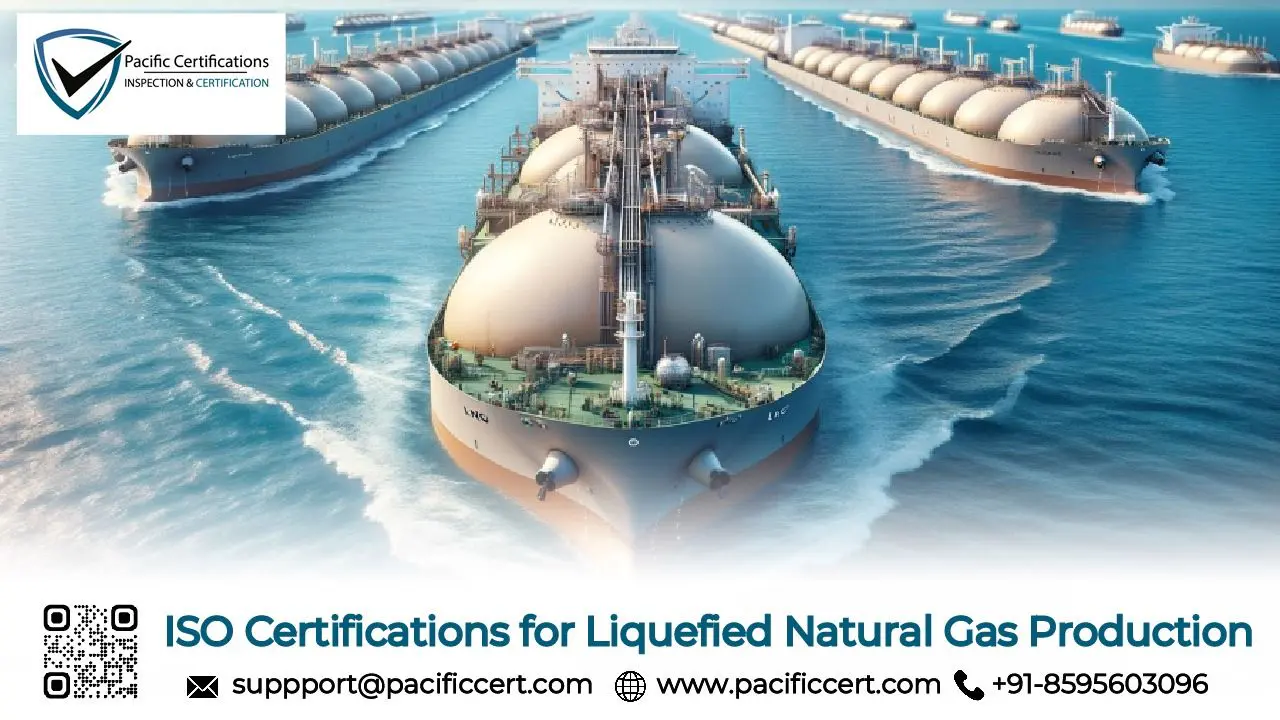
The liquefied natural gas (LNG) production chain transforms raw natural gas into a cryogenic liquid through pretreatment, liquefaction, storage, and loading operations that operate at temperatures near ‑162 °C and pressures exceeding 50 bar. Core activities include acid‑gas removal, dehydration, mercury elimination, mixed‑refrigerant or cascade cooling cycles, and cryogenic tank management, all supported by extensive piping, compressors, and heat‑exchange networks. These processes face persistent challenges: managing cryogenic hazards, preventing rapid phase‑transition explosions, ensuring hydrocarbon purity, controlling emissions from flaring and fugitive leaks, and maintaining public trust in an industry where safety incidents can have severe environmental and reputational consequences.
ISO certifications offer a globally recognized framework to address these challenges while strengthening operational resilience and stakeholder confidence. International standards provide systematic approaches to quality, environmental stewardship, occupational safety, energy efficiency, asset integrity, information security, business continuity, and risk management that transcend regional regulatory variations. By implementing ISO‑based management systems, LNG producers demonstrate a commitment to transparent processes, robust data protection, and continual improvement, essential elements for sustaining social license and securing long‑term supply contracts.
In LNG production, safety and reliability are not targets—they are conditions for operation.
Quick Summary
ISO certifications provide LNG production businesses with internationally recognized frameworks to manage quality through ISO 9001, environmental responsibility through ISO 14001, occupational health and safety through ISO 45001, energy performance through ISO 50001, asset integrity through ISO 55001, information security through ISO/IEC 27001, business continuity through ISO 22301, and risk governance through ISO 31000. These certifications support safe LNG operations, regulatory compliance, and long-term operational resilience.
For more information on how we can assist your LNG production business with ISO certifications, please contact us at support@pacificcert.com.
Applicable ISO Standards for Liquefied Natural Gas (LNG) Production Businesses
Below are the most relevant ISO standards applicable to LNG plants, liquefaction terminals, and associated processing facilities:
ISO 45001:2018 – Occupational Health and Safety Management Systems
Given the inherent risks of cryogenic temperatures, flammable hydrocarbons, and rotating equipment, ISO 45001 provides a systematic method for hazard identification, risk assessment, and control implementation across LNG facilities. It applies to activities such as maintenance of compressors, operation of cryogenic pumps, confined‑space entry for tank inspections, and emergency response planning for potential RPT events.
ISO 29001:2020 – Quality Management Systems for Oil & Gas Sector
This sector‑specific standard is critical for LNG producers because it embeds oil‑and‑gas‑risk management, supplier controls, and product reliability requirements into a QMS framework, directly addressing the hazards of cryogenic liquefaction and high‑pressure processing. It covers processes such as feedstock pretreatment, refrigerant cycle management, LNG storage integrity, and vessel loading operations, ensuring that quality objectives are aligned with safety and environmental goals.
ISO 14001:2015 – Environmental Management Systems
LNG production involves atmospheric emissions from flaring, wastewater from pretreatment, and potential marine impacts at loading terminals; ISO 14001 helps operators identify these aspects, set measurable objectives, and implement controls to minimize environmental footprint. The standard guides management of acid‑gas treatment units, solvent recovery systems, storm‑water runoff, and noise abatement, ensuring alignment with global sustainability frameworks.
ISO 50001:2018 – Energy Management Systems
Liquefaction is among the most energy‑intensive industrial processes, often consuming 10‑15 % of the feedgas’s energy content; ISO 50001 enables LNG plants to establish energy baselines, monitor key performance indicators (such as specific energy consumption per tonne of LNG), and implement efficiency measures like waste‑heat recovery and optimized refrigerant loop operation. It covers the operation of gas turbines driving compressors, auxiliary power units, and control systems that affect overall plant energy balance.
ISO 55001:2014 – Asset Management Systems
LNG facilities rely on high‑value, long‑life assets such as centrifugal compressors, aluminum‑cryogenic heat exchangers, metallic storage tanks, and marine loading arms that must maintain integrity over decades of thermal cycling. ISO 55001 provides a framework for strategic asset planning, condition‑based maintenance, and risk‑based investment decisions, directly supporting the reliability of liquefaction cycles and storage integrity. It applies to activities like vibration monitoring of compressors, thickness monitoring of cryogenic tanks, and integrity testing of loading‑arm joints.
ISO 9001:2015 – Quality Management Systems
ISO 9001 supports controlled operations, process consistency, documentation, contractor management, and continual improvement across LNG production and support activities.
ISO 27001: Information Security Management Systems (ISMS)
Operational technology (OT) systems controlling refrigerant flows, pressure safety valves, and tank level measurement are increasingly networked and vulnerable to cyber intrusion; ISO/IEC 27001 mandates risk assessments, access controls, encryption, and incident‑response planning for these critical OT and IT environments. It covers protection of SCADA historians, business‑critical contracts, and customer nomination data that, if compromised, could disrupt liquefaction or enable fraudulent nominations.
Click here to find out more applicable standards to your industry
What are the Requirements of ISO Certifications for LNG Production Businesses?
LNG producers seeking ISO certification must establish and maintain documented policies, procedures, and records aligned with the selected ISO standards. Key requirements include the following:
ISO 29001:2020 – Petroleum, Petrochemical and Natural Gas Quality Management Systems
Define quality objectives for product purity, liquefaction yield, and vessel loading accuracy across all operational shifts
Control document versions for operating procedures, maintenance work‑instructions, and contractor qualification records
Manage internal audit programs to verify compliance with pretreatment specifications and refrigerant charge limits
Implement corrective action processes for deviations in cryogenic temperature control, pressure excursions, or product off‑spec events
Monitor key performance indicators including boil‑off gas rates, compressor vibration trends, and LNG storage tank integrity metrics
Establish management review meetings evaluating QMS effectiveness, resource adequacy, and alignment with corporate safety targets
ISO 45001:2018 – Occupational Health and Safety Management Systems
Establish occupational health and safety policies addressing cryogenic burn prevention, toxic gas exposure, and confined‑space entry controls
Conduct hazard identification and risk assessments for compressor maintenance, valve actuation, and LNG spill scenarios
Implement operational controls such as pressure relief device testing, gas detection system calibration, and hot‑work permit systems
Provide competency‑based training for emergency shutdown procedures, personal protective equipment use, and first‑aid response
Monitor leading indicators including near‑miss reports, safety‑intervention trends, and permit‑to‑work compliance rates
Maintain records of incident investigations, emergency drill outcomes, and regulatory correspondence related to worker safety
ISO 14001:2015 – Environmental Management Systems
Identify environmental aspects such as CO₂ equivalent emissions, wastewater hydrocarbon content, and noise levels at terminal boundaries
Set environmental targets for flare reduction, effluent discharge limits, and energy‑intensity improvements per tonne of LNG
Implement operational controls including acid‑gas unit performance monitoring, solvent recovery efficiency checks, and storm‑water treatment
Measure compliance through continuous emissions monitoring, effluent sampling, and ambient noise surveys
Maintain documentation of environmental audit findings, corrective actions for spill events, and stakeholder engagement logs
Conduct periodic management reviews of environmental performance, objective status, and needed updates to legal registers
ISO 50001:2018 – Energy Management Systems
Develop an energy policy reflecting commitments to reduce specific energy consumption and increase waste‑heat utilization
Establish energy baselines for liquefaction trains, auxiliary systems, and offshore power generation where applicable
Define energy objectives and targets such as decreasing kWh/tonne LNG and improving refrigerant cycle coefficients of performance
Implement energy‑action plans including heat‑exchanger fouling controls, compressor staging optimization, and leak‑detection programs
Monitor energy performance indicators via submetering of compressors, pumps, and control‑system loads
Conduct internal audits of the EnMS and management reviews to ensure continued suitability and effectiveness
Tip:Start by mapping your LNG value chain—from gas reception and treatment to liquefaction, storage, and loading—against ISO requirements to identify safety, energy, and environmental control gaps early.
For further information on how we can assist your LNG production business with ISO certifications, contact us at support@pacificcert.com.
What are the Benefits of ISO Certifications for LNG Production Businesses?
ISO certifications are suitable for LNG liquefaction plants, export terminals, and integrated gas processing facilities. Key benefits include:
Stronger process safety and risk control, reducing major incident exposure.
Improved environmental compliance and emissions management, supporting licensing.
Better energy efficiency and cost control, improving plant economics.
Enhanced asset reliability and uptime, ensuring supply commitments.
Greater confidence from regulators, investors, and buyers, supporting projects.
Improved readiness for inspections and audits, reducing operational disruption.
The global LNG market continues to expand, driven by increasing demand for cleaner‑burning fuels in power generation, marine transport, and heavy‑duty sectors, with projected capacity growth exceeding 15 % per year over the next decade as new liquefaction projects come online in North America, Africa, and the Arctic. Digitalization advances through predictive analytics for compressor performance, wireless sensor networks for cryogenic tank monitoring, and cloud‑based SCADA platforms that enable remote operational oversight. Regulatory evolution focuses on methane‑slip reduction, carbon‑intensity reporting, and stricter safety distances for floating units, while end‑users increasingly verify supplier sustainability credentials before entering long‑term contracts.
ISO‑aligned governance delivers tangible results, with benchmarking showing facilities that have implemented structured safety, energy, and asset management systems experiencing 20‑30 % reductions in unplanned shutdowns, safety‑related incidents, and energy inefficiencies. Future market competitiveness will be shaped by the integration of renewable‑derived hydrogen into LNG streams, stricter fugitive‑emission limits, and growing liquefied biomethane trade, all of which demand robust data integrity and change‑management capabilities. Organizations holding current ISO certifications are better positioned to navigate these shifts because their verified management systems provide evidence of operational discipline, facilitate quicker adaptation to new technical standards, and strengthen credibility with financiers and insurers in both established and emerging LNG markets.
How Pacific Certifications Can Help?
Pacific Certifications, accredited by ABIS, acts as an independent certification body for LNG production businesses by conducting impartial audits against applicable ISO standards. Our role is to objectively assess whether documented management systems and LNG operations conform to international ISO requirements, based strictly on verifiable evidence and operational records.
We support LNG producers through:
Independent certification audits conducted in accordance with ISO/IEC 17021
Practical assessment of real process safety, environmental, and asset controls
Clear audit reporting reflecting conformity status and certification decisions
Internationally recognized ISO certification upon successful compliance
Surveillance and recertification audits to maintain certification validity
Contact us
If you need support with ISO certification for your LNG production business, contact us at support@pacificcert.com or +91-8595603096.
Author: Pushpinder K
Read More at: Blogs by Pacific Certifications