ISO Certifications for Industrial Machinery Manufacturing Businesses, Requirements and Benefits
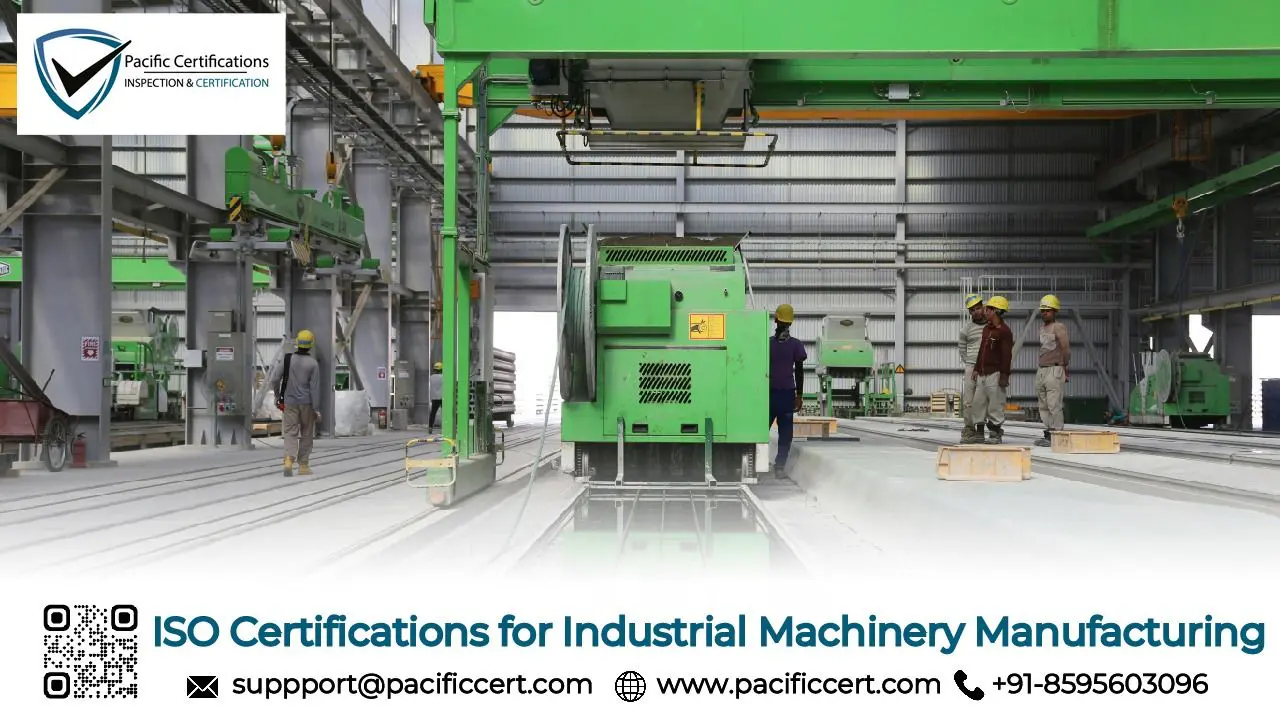
Introduction
Industrial machinery manufacturing is a demanding field where precision, reliability, and safety all have to work together. Companies in this sector build equipment such as CNC machines, presses, turbines, conveyors, and automated production systems, often for customers in industries where failure is not acceptable. Production involves heavy fabrication, precision machining, welding, electrical integration, and performance testing, usually with components sourced from different countries. A small dimensional error, a weak weld, or a control system fault can lead to expensive breakdowns, project delays, or warranty claims, so consistent process control is critical.
Because of these risks, customers no longer rely only on technical capability. Buyers in automotive, aerospace, energy, and manufacturing sectors expect suppliers to show documented systems for quality, safety, and environmental management. They want proof that equipment is built under controlled procedures, that workers are protected on the shop floor, and that design data and customer specifications are handled securely. ISO certifications provide the structure for doing this in a consistent and auditable way. With certified systems in place, machinery manufacturers can reduce production errors, manage workplace hazards more effectively, and present clear evidence of compliance during customer audits. In competitive global supply chains, having these certifications often makes the difference between being considered for a project and being left out of the supplier list.
In industrial machinery manufacturing, quality is not what you claim — it is what your systems consistently prove
Quick Summary
ISO certifications provide industrial machinery manufacturing businesses with internationally recognized frameworks to manage product quality through ISO 9001, occupational safety through ISO 45001, environmental performance through ISO 14001, information security through ISO/IEC 27001, energy efficiency through ISO 50001, and machinery safety through ISO 12100. These frameworks directly address the most critical operational risks in this sector: product non-conformance, workplace injuries, environmental violations, and data breaches.
For more information on how we can assist your industrial machinery manufacturing business with ISO certifications, contact us at support@pacificcert.com.
Applicable ISO Standards for Industrial Machinery Manufacturing Businesses
Below are the most relevant ISO standards applicable to heavy equipment manufacturers, precision machinery producers, automated systems integrators, and industrial tooling fabricators:
ISO 9001: Quality Management System (QMS)
ISO 9001 establishes rigorous controls across every stage of the product lifecycle: design input validation, engineering change control, material traceability, machining tolerances, assembly verification, functional testing, and final inspection. It ensures that deviations are captured, investigated, and corrected systematically rather than informally. For manufacturers supplying OEMs, tier-1 buyers, and government procurement agencies, ISO 9001 certification is frequently a baseline tender prerequisite.
ISO 12100: Safety of Machinery
Machinery manufacturers carry direct liability for the safe performance of equipment throughout its operational life. ISO 12100 provides the foundational framework for embedding risk assessment into the design process itself, guiding engineers to identify foreseeable hazards, evaluate severity and probability, and implement protective measures before a machine leaves the factory floor. It covers mechanical, electrical, thermal, ergonomic, and noise-related hazards across all machinery types.
ISO 14001: Environmental Management System (EMS)
ISO 14001 requires organizations to identify all significant environmental aspects, establish measurable reduction targets, and implement operational controls that prevent non-compliant releases. As international environmental compliance frameworks tighten across major trading regions, certified environmental management has become a key differentiator in export markets and a growing prerequisite in public infrastructure procurement.
ISO 27001: Information Security Management Systems (ISMS)
ISO/IEC 27001 provides a systematic framework for identifying information security risks, implementing technical and organizational controls, managing access privileges, and responding to incidents with structured containment procedures. As connected manufacturing and remote diagnostics expand, the attack surface widens, making information security management not optional but fundamental.
ISO 45001: Occupational Health and Safety (OHS)
Industrial machinery manufacturing consistently ranks among the highest-risk manufacturing environments globally. Workers operate in proximity to rotating equipment, high-temperature welding arcs, heavy overhead loads, pressurized hydraulic systems, and hazardous chemical agents used in surface treatment and lubrication. ISO 45001 mandates systematic hazard identification, risk rating, and preventive control implementation across all of these activities.
ISO 50001: Energy Management Systems (EnMS)
ISO 50001 helps manufacturers establish energy baselines, identify inefficiencies, set reduction targets, and systematically improve energy performance over time. For operations competing on cost efficiency, energy savings achieved through ISO 50001 implementation directly improve margin. Increasingly, major industrial buyers and procurement platforms also request evidence of energy management commitments as part of sustainability-aligned supply chain programs.
Click here to find out more applicable standards to your industry
What are the Requirements of ISO Certifications for Industrial Machinery Manufacturing Businesses?
Industrial machinery manufacturers seeking ISO certification must establish and maintain documented policies, procedures, and records aligned with the selected ISO standards. Key requirements include the following:
ISO 9001:2015 – Quality Management Systems Requirements
Define and document the scope of quality management, including product lines, production sites, and applicable design and manufacturing processes.
Establish engineering change control procedures that require documented approval, traceability, and verification before implementation in production.
Implement material and component traceability systems that link finished assemblies to raw material certificates, inspection records, and supplier qualifications.
Manage supplier qualification and ongoing performance evaluation, including documented criteria for approval, monitoring, and re-assessment of critical component vendors.
Conduct structured internal audits across all production and quality functions, ensuring findings are formally recorded and corrective actions are tracked to closure.
Maintain calibration records for all measurement and testing equipment used in dimensional inspection, torque verification, and functional performance testing.
ISO 45001:2018 – Occupational Health and Safety Management Systems Requirements
Conduct systematic hazard identification and risk assessments covering machining, welding, fabrication, assembly, material handling, and chemical storage activities.
Document safe operating procedures for high-risk tasks including confined space entry, hot work permitting, overhead crane operation, and lockout/tagout protocols.
Establish a worker participation mechanism that formally channels hazard reports, near-miss notifications, and safety improvement suggestions into documented management review.
Define emergency response procedures for fire, chemical spill, machinery entrapment, and electrical fault scenarios, including regular drill schedules and post-drill evaluations.
Monitor and analyze occupational injury data, lost-time incident rates, and near-miss frequency to assess the effectiveness of implemented safety controls.
ISO 14001:2015 – Environmental Management Systems Requirements
Identify and evaluate all significant environmental aspects including waste generation, water discharge, air emissions, and soil contamination risks across all operational areas.
Establish measurable environmental objectives with associated action plans, resource allocations, timelines, and responsibility assignments for each reduction target.
Implement operational controls for the handling, storage, and disposal of cutting fluids, hydraulic oils, solvents, and metal waste in compliance with applicable environmental frameworks.
Monitor environmental performance against established targets through scheduled measurements, audits, and documented management review discussions.
ISO/IEC 27001:2022 – Information Security Management Systems Requirements
Define the information security scope encompassing CAD systems, product lifecycle management platforms, ERP systems, customer portals, and connected production equipment.
Conduct formal information security risk assessments identifying threats to confidentiality, integrity, and availability of technical data and operational systems.
Implement access control policies that restrict system privileges based on job function, with documented provisioning, review, and revocation procedures for all users.
Establish an incident management process with defined detection, reporting, escalation, containment, and post-incident review procedures applied consistently across operations.
Train all personnel with access to sensitive systems on information security policies, phishing awareness, clean desk practices, and acceptable use requirements.
Tip: Industrial machinery manufacturers should begin ISO implementation by mapping their existing design review and production control workflows against the requirements of their chosen standards.
For more information on how we can assist your industrial machinery manufacturing business with ISO certifications, contact us at support@pacificcert.com.
What are the Benefits of ISO Certifications for Industrial Machinery Manufacturing Businesses?
ISO certifications provide industrial machinery manufacturers, heavy equipment producers, precision component fabricators, and automated systems integrators with strong operational and commercial advantages. Listed below are the key benefits:
Stronger protection against product liability through documented design reviews, risk assessments, and traceability records that show proper control if equipment failures occur in the field.
Improved tender eligibility for infrastructure, industrial, and government projects where ISO 9001 certification is required before suppliers are considered.
Reduced workplace incident rates with ISO 45001 safety controls, helping lower compensation costs, avoid production stoppages, and reduce the risk of regulatory penalties.
Easier access to export markets where buyers expect certified management systems, allowing faster supplier approval and fewer qualification audits.
Better environmental compliance with ISO 14001, helping control emissions, waste, and resource use while meeting sustainability requirements from international customers.
Improved protection of engineering data and customer specifications through ISO/IEC 27001, securing CAD files, control software, and confidential project information.
Lower energy costs using ISO 50001, especially in machining, welding, heat treatment, and testing operations that consume large amounts of power.
More reliable supply chains through ISO 9001 supplier control procedures, reducing the risk of defective materials affecting production schedules.
Higher customer satisfaction from consistent product quality and on-time delivery supported by structured quality management processes.
Stronger business continuity with ISO 22301 planning, helping maintain production during supplier delays, equipment breakdowns, or unexpected facility disruptions.
The global industrial machinery manufacturing market is experiencing robust and sustained expansion. Valued at approximately USD 844 billion currently, the market is projected to surpass USD 1.8 trillion within the next decade, advancing at a compound annual growth rate exceeding 8%. This growth trajectory is powered by accelerating Industry 4.0 adoption, the proliferation of smart factory investments, and the widespread integration of IoT sensors, digital twins, and automated production cells into traditional manufacturing environments. Simultaneously, international regulatory standards are evolving to reflect these technological realities, with compliance frameworks increasingly addressing cyber-physical system security, functional safety in connected machines, and the environmental footprint of large-scale production. Consumer demand for higher precision, faster delivery cycles, and product customization is compounding operational pressure, making structured quality and safety management systems a fundamental requirement rather than a competitive differentiator for manufacturers competing across developed and emerging markets.
Looking ahead, new pressures are pushing more manufacturers toward certification. Connected CNC machines, remote diagnostics, and cloud-based monitoring have increased cybersecurity risks, which is why more equipment makers are adopting ISO/IEC 27001 to protect design data and production systems. At the same time, customers in energy, automotive, and infrastructure projects are tightening sustainability and efficiency requirements, making ISO 14001 and ISO 50001 more important for supplier approval. Manufacturers with certified systems often move through customer audits faster, face fewer regulatory delays, and negotiate contracts from a stronger position because they can show proven control over quality, safety, environment, and data security.
How Pacific Certifications Can Help?
Pacific Certifications, accredited by ABIS, acts as an independent certification body for industrial machinery manufacturing businesses by conducting impartial audits against applicable ISO standards. Our role is to objectively assess whether documented management systems and manufacturing-specific practices — including design controls, production quality systems, shop floor safety programs, and information security protocols — conform to international ISO requirements, based strictly on verifiable evidence and operational records.
We support industrial machinery manufacturers through:
Independent certification audits conducted in accordance with ISO/IEC 17021
Practical assessment of real production operations, safety controls, and engineering quality management systems
Clear audit reporting reflecting conformity status and certification decisions
Internationally recognized ISO certification upon successful compliance
Surveillance and recertification audits to maintain certification validity
Contact Us
If you need support with ISO certification for your industrial machinery manufacturing business, contact us at support@pacificcert.com or +91-8595603096.
Author: Ashish
Read More at: Blogs by Pacific Certifications

