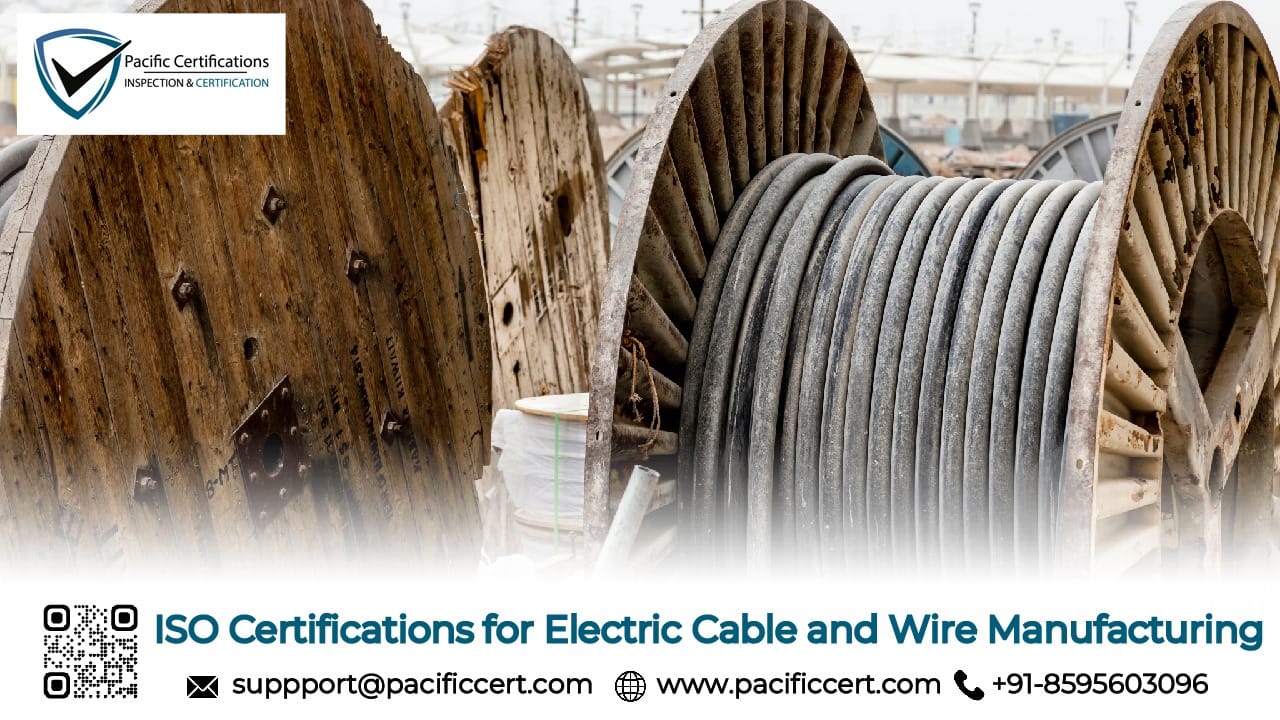
ISO Certifications for Electric Cable and Wire Manufacturing Businesses, Requirements and Benefits
Introduction
Electric cable and wiremanufacturing requires tight control over metal processing, insulation, and testing to supply power, telecom, automotive, and industrial sectors. Plants produce building wires, power cables, armored control cables, and fiber-optic assemblies using copper drawing, extrusion, high-voltage testing, and controlled winding processes. Manufacturers must deal with copper price changes, insulation defects, strength consistency over long runs, and strict safety and flame-resistance requirements across different voltage levels and applications. Even small variations in materials or extrusion settings can affect performance, so production needs strong process control and reliable testing.
ISO certifications help cable manufacturers prove that their operations are stable, safe, and consistently controlled. Certified systems ensure proper handling of raw materials, defined production parameters, documented testing, and full traceability of finished cables. Utility companies, EPC contractors, and automotive customers often require ISO certification before approving suppliers, especially for large or long-term projects. With certified management systems in place, manufacturers can show that quality, safety, and environmental requirements are managed in a structured way, giving buyers more confidence when awarding supply contracts.
In cable manufacturing, every micron matters—certified systems ensure consistent performance kilometer after kilometer.
Quick Summary
ISO certifications provide electric cable and wire manufacturing businesses with internationally recognized frameworks to manage quality through ISO 9001, occupational health and safety through ISO 45001, environmental performance through ISO 14001, energy efficiency through ISO 50001, and testing competence through ISO/IEC 17025. Producers should prioritize extrusion concentricity controls and spark test protocols, as utilities and automotive OEMs scrutinize these metrics during pre-qualification alongside flame propagation verification for building wire applications.
For more information on how we can assist your electric cable and wire manufacturing business with ISO certifications, contact us at support@pacificcert.com.
Applicable ISO Standards for Electric Cable and Wire Manufacturing Businesses
Below are the most relevant ISO standards applicable to building wire producers, power cable extruders, automotive harness assemblers, and fiber optic cable manufacturers:
ISO 9001 - Quality Management
Power cables failing dielectric withstand tests compromise grid reliability while building wires exhibiting poor insulation adhesion generate field failures. ISO 9001 mandates control plans verifying copper elongation above 25%, insulation wall concentricity within 8%, and spark test sensitivity detecting 0.02mm pinholes. Manufacturers reduce scrap through root cause analysis linking eccentricity patterns to die swell inconsistencies or haul-off tension variations. Utility procurement teams reference certification during qualification, prioritizing ISO 9001 extruders for transmission network upgrades.
ISO 14001 - Environmental Management
PVC compounding emits HCl vapors while XLPE cross-linking generates volatile byproducts exceeding 100ppm thresholds. ISO 14001 requires aspect inventories covering scrubber media saturation monitoring, copper scrap segregation efficiency, and cooling water blowdown TSS levels. Management integrates environmental KPIs with line speeds during reviews, authorizing regenerative thermal oxidizers or closed-loop cross-linking fluid systems. Certified manufacturers satisfy EPC sustainability scorecards while minimizing effluent violations halting production.
ISO 45001 - Occupational Health and Safety
Drawing mills expose operators to 1,000m/min wire snap-back while extruders present 250°C molten polymer splash risks. ISO 45001 demands hazard identification for bull blocks, capstans, and payoff stands, documenting pinch point guarding and emergency stop response verification. Facilities achieve incident reductions through near-miss analysis identifying systemic gaps like inadequate dancer arm overload protection. Certification reassures automotive OEMs of verified manufacturing safety supporting just-in-time harness deliveries.
ISO 27001: Information Security Management Systems (ISMS)
In an increasingly digital world, ISO 27001 helps companies protect sensitive information. This is crucial in the manufacturing industry, where safeguarding intellectual property and operational data is vital.
ISO 50001 - Energy Management
Induction furnaces melting 20t copper hourly alongside 500kW haul-off drives consume substantial energy. ISO 50001 establishes sub-metered baselines for billet preheat efficiency, extruder screw power factor, and cooling trough chiller COP. Energy teams review variances monthly prioritizing variable frequency drive retrofits and waste heat recovery yielding 12-18% consumption reductions. Certification aligns with green procurement mandates while improving competitiveness against imported building wire.
Click here to find out more applicable standards to your industry
What are the Requirements of ISO Certifications for Electric Cable and Wire Manufacturing Businesses?
Electric cable and wire manufacturing businesses seeking ISO certification must establish and maintain documented policies, procedures, and records aligned with the selected ISO standards. Key requirements include the following:
ISO 9001:2015 – Quality Management Systems Requirements
Document rod breakdown parameters specifying die progression sequences, lubrication SF2 ratings, and elongation verification maintaining 99.5% conductivity minimum.
Implement triple-layer extrusion control protocols synchronizing conductor preheater temperature, XLPE melt pressure, and sheath haul-off tension within 2% variance.
Establish insulation adhesion testing confirming peel strength above 15N/cm post-spark testing using calibrated peel testers quarterly.
Conduct armor application verification measuring interlock bite depth and circumferential coverage exceeding 95% specification.
ISO 14001:2015 – Environmental Management Systems Requirements
Monitor HCl scrubber performance maintaining liquor pH 1.2-1.8 and pressure drop below 800Pa through continuous conductivity measurement.
Document copper scrap classification procedures segregating bright annealed from oxidized material achieving 98% recycling purity.
Implement cross-linking fluid recovery systems capturing 90% silicone oil volume from LDPE/XLPE degassing towers.
Track cooling water blowdown TSS levels maintaining below 50mg/L through multimedia filtration performance verification.
ISO 45001:2018 – Occupational Health & Safety Management Systems Requirements
Map pinch hazards across 30t payoff reels, bull block capstans, and dual take-up spoolers documenting two-hand control and light curtain positioning.
Establish lockout-tagout procedures for 6.6kV rod heating furnaces, 415V extruder drive motors, and pneumatic dancer arm isolation.
Implement fume extraction verification for PVC compounding maintaining face velocity above 0.5m/s across hood face area.
Conduct noise mapping across drawing lines establishing engineering controls where exposures exceed 85dB(A) 8-hour TWA.
ISO 50001:2018 – Energy Management Systems Requirements
Baseline induction furnace energy consumption targeting specific melt energy below 600kWh/t through power factor correction verification.
Monitor extruder specific energy consumption maintaining below 0.35kWh/kg PVC through barrel temperature profiling optimization.
Track haul-off drive efficiency measuring VFD output kW versus line speed maintaining above 92% across speed range.
Review cooling trough chiller performance targeting COP above 4.0 through evaporator approach temperature monitoring.
Tip: Assemble drawing foremen, extrusion supervisors, EHS coordinators, and quality engineers to walk production from copper rod payoff through armored cable take-up, mapping existing controls against certification requirements collaboratively while building cross-departmental commitment essential for sustained compliance.
For more information on how we can assist your electric cable and wire manufacturing business with ISO certifications, contact us at support@pacificcert.com.
What are the Benefits of ISO Certifications for Electric Cable and Wire Manufacturing Businesses?
ISO certifications equip electric cable and wire manufacturing businesses with verified production consistency and compliance governance, listed below are the key benefits for the ISO standards applicable to building wire extruders, power cable producers, automotive harness assemblers, and fiber optic manufacturers:
Improved extrusion concentricity through ISO 9001 reduces scrap losses while qualifying for utility master supply agreements.
Stronger worker protection via ISO 45001 minimizes drawing injuries maintaining continuous kilometer-scale production runs.
Enhanced environmental performance under ISO 14001 documents emission capture satisfying green procurement mandates.
Greater energy efficiency through ISO 50001 achieves 12-18% furnace reductions strengthening import competitiveness.
Reduced field failures via systematic spark testing lowers warranty costs in building applications.
Higher pre-qualification success as EPC contractors reference certifications streamlining project approvals.
Global cable demand accelerates with grid modernization requiring high-voltage underground transmission alongside EV charging infrastructure expansion. Renewable integration drives demand for solar DC cables tolerant 120°C operation while data center hyperscalers specify LSZH compounds for plenum-rated backbone cabling. Automotive electrification favors aluminum conductor harnesses reducing vehicle weight 15kg alongside 800V architectures demanding partial discharge-free insulation. Over the next decade, circular economy pressures mandate 95% copper recycling rates while halogen-free formulations capture 60% low-voltage market share.
Certified extruders document superior metrics including 20-25% scrap reductions through ISO 9001 alongside measurable safety improvements under ISO 45001. Utilities embed supplier certification in RFPs favoring ISO 14001/50001 operators over traditional producers. Tightening circularity legislation, aluminum conductor adoption, 5G backhaul expansion, and EV supply chain localization position certified manufacturers advantageously. In transmission networks demanding verified dielectric performance alongside building wire volume production, ISO systems underpin both infrastructure projects and sustainable electrification transitions.
How Pacific Certifications Can Help?
Pacific Certifications, accredited by ABIS, acts as an independent certification body for electric cable and wire manufacturing businesses by conducting impartial audits against applicable ISO standards. Our role is to objectively assess whether documented management systems and production practices conform to international ISO requirements, based strictly on verifiable evidence and operational records.
We support electric cable and wire manufacturing providers through:
Independent certification audits conducted in accordance with ISO/IEC 17021 across quality, safety, environmental, energy, and testing management systems
Practical assessment of real rod breakdown mills, triple extrusion lines, spark test cages, and armor application stations during production shifts
Clear audit reporting reflecting conformity status and certification decisions without ambiguity
Internationally recognized ISO certification upon successful demonstration of compliance
Surveillance and recertification audits to maintain certification validity across the full three-year certification cycle
Contact Us
If you need support with ISO certification for your electric cable and wire manufacturing business, contact us at support@pacificcert.com or +91-8595603096.
Author: Poonam
Read More at: Blogs by Pacific Certifications