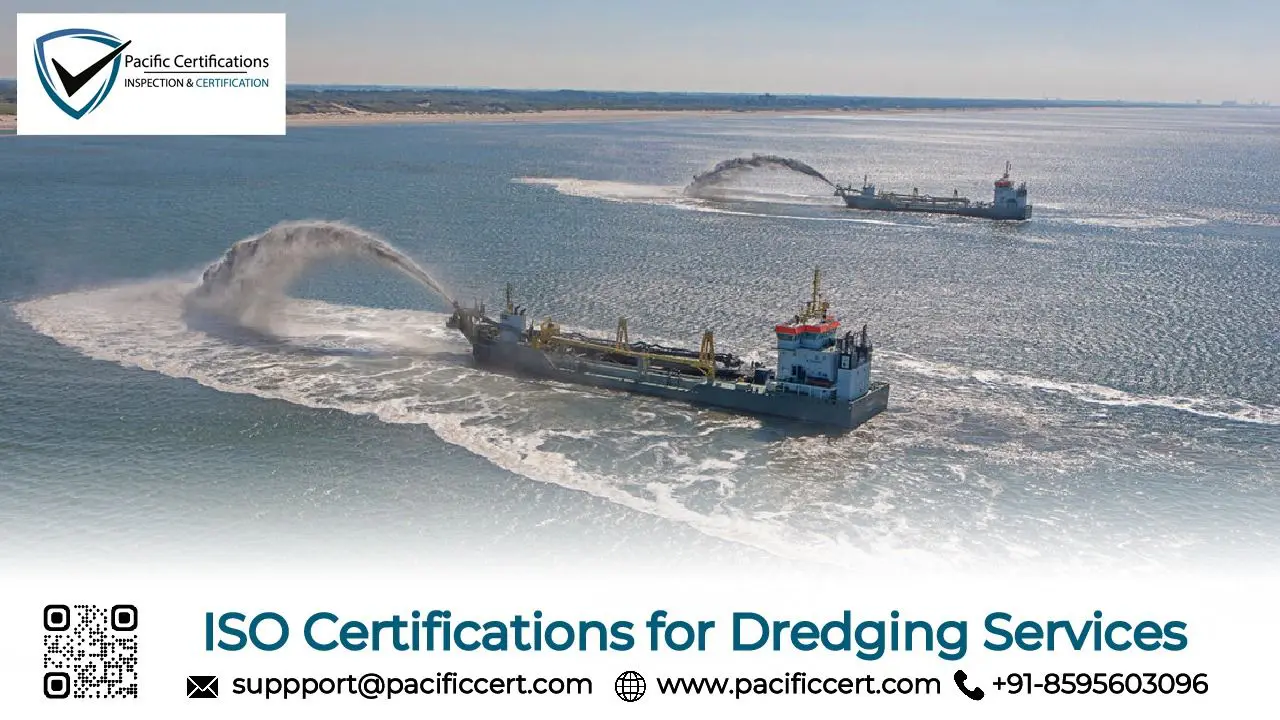
ISO Certifications for Dredging Services, Requirements and Benefits
Introduction
Dredging services play a vital role in maintaining navigable waterways, developing port infrastructure, and protecting coastal environments through the removal and relocation of sediments. Core activities include hydraulic or mechanical excavation, transport of dredged material via pipelines or barges, surveying of seabed conditions, and environmental monitoring of discharge zones. These operations face persistent challenges such as minimizing ecological disturbance to marine habitats, managing safety risks from heavy machinery and high‑pressure systems, complying with evolving international maritime regulations, and ensuring equipment reliability amid abrasive wear and variable sea conditions.
ISO certifications provide essential frameworks for dredging companies to systematically address these challenges while building operational resilience and stakeholder confidence. International standards establish consistent methodologies for quality control, environmental stewardship, occupational safety, and risk management that transcend regional regulatory variations. By implementing ISO‑based management systems, dredging firms demonstrate a commitment to transparent processes, verified competence, and continual improvement—factors critical for securing long‑term contracts with port authorities, government agencies, and private developers.
In dredging, precision below the surface determines trust above it.
Quick Summary
ISO certifications provide dredging service providers with internationally recognized frameworks to manage service quality through ISO 9001, environmental protection through ISO 14001, occupational health and safety through ISO 45001, asset management through ISO 55001, energy efficiency through ISO 50001, information security through ISO/IEC 27001, business continuity through ISO 22301, and risk governance through ISO 31000. These certifications support compliant dredging operations, environmental stewardship, and reliable project delivery.
For more information on how we can assist your dredging service business with ISO certifications, please contact us at support@pacificcert.com.
Applicable ISO Standards for Dredging Services
Below are the most relevant ISO standards applicable to dredging contractors, marine works companies, and sediment management service providers:
ISO 9001: Quality Management Systems (QMS)
This standard is important for dredging companies seeking to deliver consistent, accurate volumetric results that meet contractual specifications. It establishes requirements for documenting dredging plans, calibrating flow‑meters, verifying sediment‑density measurements, and maintaining traceable records of material disposal locations. Practical benefits include fewer disputes over delivered volumes, improved compliance with port‑authority permits, and enhanced reputation for reliability that supports repeat business.
ISO 14001:2015 Environmental Management System (EMS)
Given the potential for sediment resuspension, contaminant release, and habitat disruption, ISO 14001 provides a systematic method for identifying environmental aspects, setting measurable objectives, and implementing controls such as silt curtains, turbidity monitoring, and environmentally‑sound disposal options.
ISO 45001:2018 Occupational Health and Safety Management Systems
Dredging crews face hazards from rotating propellers, high‑pressure hydraulic lines, confined spaces in pump rooms, and exposure to harsh marine weather; ISO 45001 mandates hazard identification, risk assessment, and control implementation across all vessel and shore‑based activities.
ISO 55001:2024 – Asset Management Systems
Dredgers represent high‑value assets whose hulls, pumps, and pipeline systems suffer from abrasion, corrosion, and fatigue over long service lives; ISO 55001 provides a framework for strategic asset planning, condition‑based maintenance, and risk‑based investment decisions, directly supporting vessel availability and operational safety. Benefits include extended service intervals, fewer unexpected breakdowns, and improved ability to meet firm‑time charter commitments.
ISO 50001:2018 – Energy Management Systems
Propulsion engines, generator sets, and auxiliary hydraulic systems consume significant fuel during dredging campaigns; ISO 50001 enables operators to establish energy baselines, track specific fuel consumption per cubic meter moved, and introduce efficiency measures such as speed‑optimization routines and waste‑heat recovery. Adoption yields measurable reductions in fuel expenditure, lower carbon intensity per project, and enhanced competitiveness in tenders that evaluate environmental performance.
Click here to find out more applicable standards to your industry
What are the Requirements of ISO Certifications for Dredging Services?
Dredging service providers seeking ISO certification must establish and maintain documented policies, procedures, and records aligned with the selected ISO standards. Key requirements include the following:
ISO 9001:2015 – Quality Management Systems
Define quality objectives such as volumetric accuracy tolerance, delivery‑schedule adherence, and client‑satisfaction score targets
Control document versions for dredging plans, calibration certificates, and disposal‑site approvals
Manage internal audit programs to verify compliance with depth‑keeping procedures and sediment‑density measurement protocols
Implement corrective‑action processes for volume discrepancies, equipment mis‑readings, or repeated client complaints
Monitor key performance indicators including cubic metres per hour, fuel efficiency, and re‑work rates due to survey errors
Establish management‑review meetings evaluating QMS effectiveness, resource adequacy, and trends in non‑conformities
ISO 14001:2015 – Environmental Management Systems
Establish an environmental policy committing to pollution prevention, habitat protection, and regulatory compliance
Identify environmental aspects such as turbidity plumes, contaminant release, and underwater noise emissions
Set targets for reducing sediment‑borne contaminant discharge, increasing beneficial‑use of dredged material, and minimizing marine‑mammal disturbance
Implement operational controls including silt‑curtain deployment, real‑time turbidity monitoring, and eco‑friendly disposal routes
Measure compliance through turbidity sensors, effluent sampling, and marine‑observer logs
Maintain records of environmental audits, spill‑incident reports, and stakeholder‑consultation minutes
ISO 45001:2018 – Occupational Health and Safety Management Systems
Establish an OH&S policy addressing machinery safety, confined‑space entry, and personal‑protective‑equipment requirements
Conduct hazard identification and risk assessments for propeller entanglement, high‑pressure hose failure, and slip‑trip hazards on decks
Implement operational controls such as lockout/tagout systems, pressure‑relief valve testing, and guarded access to moving parts
Provide training on safe handling of hazardous‑material spills, proper PPE use for chemical exposure, and emergency‑evacuation drills
Monitor leading indicators including near‑miss reports from deck work, safety‑equipment inspection compliance, and drill‑participation rates
Maintain records of incident investigations, medical‑treatment logs, and safety‑equipment certification
ISO 50001:2018 – Energy Management Systems
Develop an energy policy reflecting commitments to reduce specific fuel consumption and recover waste heat
Establish energy baselines for main propulsion engines, generator sets, and hydraulic power units
Define energy objectives such as decreasing litres per cubic metre dredged and improving engine load factor
Implement energy‑action plans including hull‑cleaning schedules, propeller‑polishing programs, and idle‑time reduction
Monitor energy performance indicators via fuel flow meters, exhaust‑gas temperature sensors, and engine‑hour loggers
Conduct internal audits of the EnMS and management reviews to ensure continued suitability and effectiveness
Tip:Start by mapping a full dredging project lifecycle—from hydrographic surveys and mobilization to dredging execution, disposal, demobilization, and reporting—against ISO requirements to identify safety, environmental, and operational gaps early.
For further information on how we can assist your dredging service business with ISO certifications, contact us at support@pacificcert.com.
What are the Benefits of ISO Certifications for Dredging Services?
ISO certifications are suitable for port dredging contractors, coastal engineering firms, inland waterway dredgers, and offshore service providers. Key benefits include:
Improved volumetric accuracy reducing disputes over delivered quantities and associated claim costs
Stronger protection of crew from machinery strikes, high‑pressure fluid leaks, and slip‑hazards through structured controls
Better managed sediment‑plume turbidity and contaminant release supporting compliance with marine‑protection regulations
Higher fuel efficiency from optimized propulsion routes and reduced auxiliary‑power consumption lowering operating expenses
Enhanced asset reliability leading to fewer unplanned breakdowns and higher vessel availability during peak demand windows
Greater confidence from port authorities, government agencies, and private developers demonstrating adherence to international norms
Improved readiness for announced or surprise audits minimizing disruption to active dredging campaigns
Streamlined warranty claim processing through documented service records and verifiable calibration data
Reduced liability exposure via controlled work processes, maintained safety‑equipment registers, and verified environmental‑monitoring results
Improved ability to scale operations during market upturns while maintaining quality, safety, and environmental standards
The global dredging market continues to expand, driven by increasing demand for port‑capacity expansion, coastal‑protection projects, and land‑reclamation initiatives in Asia, the Middle East, and Africa. Digital transformation advances through real‑time GPS‑guided dredging, autonomous surface vessels for surveying, and cloud‑based data platforms that enable instant sharing of sediment‑quality reports with regulators and clients. Regulatory evolution focuses on stricter limits for suspended‑solid discharges, enhanced requirements for beneficial‑use of dredged material, and growing scrutiny of underwater noise impacts on marine mammals over the coming decade.
ISO‑aligned governance delivers measurable results, with industry benchmarks showing dredging firms that have implemented structured quality, safety, and environmental management systems experiencing 20‑30 % reduction in re‑work due to survey errors, 15‑25 % decline in workplace incidents, and 10‑20 % improvement in fuel‑efficiency metrics. Future competitiveness will be shaped by the ability to service electric‑propulsion dredgers, to provide verifiable carbon‑footprint data for dredging campaigns, and to integrate blockchain‑based sediment‑traceability that confirms material origin and disposal legitimacy. Organizations holding current ISO certifications are better positioned to navigate these shifts because their validated management systems supply evidence of operational discipline, enable quicker adaptation to new technical standards from classification societies, and strengthen credibility with financiers, insurers, and public‑sector clients in both established and emerging dredging markets.
How Pacific Certifications Can Help?
Pacific Certifications, accredited by ABIS, acts as an independent certification body for dredging service providers by conducting impartial audits against applicable ISO standards. Our role is to objectively assess whether documented management systems and dredging operations conform to international ISO requirements, based strictly on verifiable evidence and operational records.
We support dredging companies through:
Independent certification audits conducted in accordance with ISO/IEC 17021
Practical assessment of real dredging, environmental, and safety controls
Clear audit reporting reflecting conformity status and certification decisions
Internationally recognized ISO certification upon successful compliance
Surveillance and recertification audits to maintain certification validity
Contact us
If you need support with ISO certification for your dredging services business, contact us at support@pacificcert.com or +91-8595603096.
Author: Ashish
Read More at: Blogs by Pacific Certifications