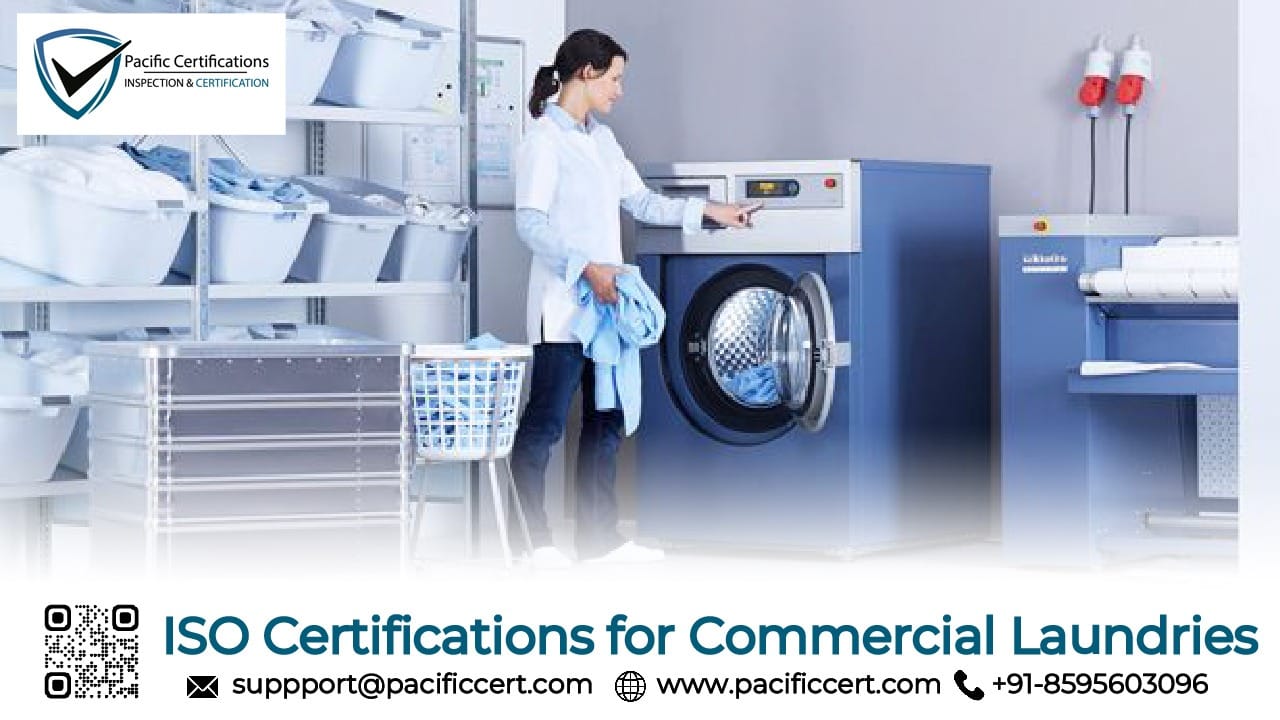
ISO Certifications for Commercial Laundries, Requirements and Benefits
Introduction
Commercial laundry businesses operate in a hygiene-critical and compliance-driven environment where fabric safety, infection control, chemical handling, water management, service consistency, and occupational safety directly affect client trust and contractual continuity. These businesses serve hospitals, hotels, airlines, food processors, factories, care homes, and industrial facilities, handling large volumes of linen, uniforms, workwear, and specialized textiles.
With increasing regulatory oversight on hygiene standards, wastewater discharge, chemical usage, and worker safety, commercial laundries are under pressure to demonstrate structured operational control and traceability. ISO certifications have therefore become an essential framework for commercial laundry businesses to standardize processes, reduce contamination risks, improve efficiency, and strengthen credibility with institutional and regulated clients.
In commercial laundering, cleanliness is expected—but control is what proves it.
Quick Summary
ISO certifications provide commercial laundry businesses with internationally recognized frameworks to manage service quality through ISO 9001, hygiene and contamination control through ISO 22000 (where applicable), environmental responsibility through ISO 14001, occupational health and safety through ISO 45001, energy and water efficiency through ISO 50001, information security through ISO/IEC 27001, and business continuity through ISO 22301. These certifications help laundries deliver consistent, compliant, and scalable services across demanding sectors.
For more information on how we can assist your commercial laundry business with ISO certifications, contact us at [email protected].
Applicable ISO Standards for Commercial Laundries Businesses
Below are the most relevant ISO standards applicable to institutional, healthcare, hospitality, and industrial laundry operations:
ISO 9001: Quality Management System (QMS)
ISO 9001 provides structured control over sorting, washing, drying, finishing, packing, delivery, customer handling, complaint management, and continuous improvement, ensuring reliable service quality across clients and shifts.
ISO 14001: Environmental Management System (EMS)
Commercial laundries consume large volumes of water, energy, detergents, and generate wastewater. ISO 14001 helps manage environmental impacts, comply with discharge norms, and improve sustainability performance.
ISO 45001: Occupational Health and Safety Management Systems
Laundry operations involve heat, chemicals, machinery, lifting, and repetitive tasks. ISO 45001 reduces workplace injuries and improves staff safety culture.
ISO 50001:2018 – Energy Management Systems
Washing, drying, ironing, and steam generation are energy-intensive. ISO 50001 supports systematic reduction of energy and water consumption, improving margins.
ISO 22000:2018 – Food Safety Management Systems
For laundries handling food-industry uniforms, hospital linen, or hygiene-critical textiles, ISO 22000 helps control cross-contamination risks and hygiene hazards.
Click here to find out more applicable standards to your industry
What are the Requirements of ISO Certifications for Commercial Laundries Businesses?
Commercial laundry operators seeking ISO certification must establish and maintain documented policies, procedures, and records aligned with the selected ISO standards. Key requirements include the following:
ISO 9001:2015 – Quality Management Systems Requirements
Define a quality policy and measurable service objectives addressing wash quality standards, on-time delivery performance, client specification compliance rates, and customer complaint resolution timeframes for all laundry service categories.
Control core processing procedures — including textile sorting and inspection, wash cycle parameters, chemical dosing protocols, drying and finishing standards, and packaged garment quality inspection — through documented work instructions with defined acceptance criteria.
Manage supplier qualification for detergents, disinfectants, packaging materials, and maintenance service providers through formal approval criteria and ongoing performance monitoring linked to service quality and environmental outcomes.
Implement a structured nonconformity and corrective action process for processing errors, client complaints, and delivery failures, with documented root cause analysis and verification that implemented corrective actions prevent recurrence.
Conduct planned internal quality audits and management reviews at defined intervals, evaluating performance against quality objectives, client satisfaction data, and nonconformity trends to drive systematic service improvements.
ISO 14001:2015 – Environmental Management Systems Requirements
Identify significant environmental aspects across all laundry operations — including water consumption per wash cycle, detergent and chemical volumes, wastewater quality parameters, steam and electricity consumption, packaging waste, and textile waste disposal volumes.
Establish a documented environmental objectives program with measurable targets covering water use reduction per kilogram of processed textiles, chemical waste minimization, wastewater treatment performance, and energy consumption per production unit.
Implement operational controls for high-impact environmental aspects — including water recirculation systems, automated chemical dosing to minimize over-application, wastewater pre-treatment before discharge, and equipment shutdown protocols during non-production periods.
Monitor environmental performance data at defined intervals, tracking water consumption, chemical usage, wastewater quality, and energy consumption per processing cycle, with results presented at management reviews to update environmental targets.
Conduct periodic legal compliance evaluations against applicable international environmental framework obligations covering wastewater discharge standards, chemical classification, and hazardous waste handling requirements relevant to laundry operations.
ISO 45001:2018 – Occupational Health and Safety Requirements
Assess occupational hazards across all work areas — including chemical handling in detergent dosing stations, thermal exposure from hot laundry equipment and steam systems, mechanical entanglement risks near automated sorting and folding machinery, and ergonomic hazards in manual textile handling.
Establish a documented hierarchy-of-controls approach for each significant hazard, prioritizing engineering controls — such as enclosed chemical dispensing, machine guarding, ventilation systems, and ergonomic lifting aids — over reliance on personal protective equipment.
Implement documented emergency response procedures covering chemical spill events, thermal burn incidents, machinery entrapment, fire events, and worker medical emergencies, with trained response personnel and emergency equipment maintained in operational readiness.
Monitor OHS performance through scheduled facility safety inspections, near-miss reporting programs, and periodic management review of incident frequency data, with all findings generating documented corrective actions reviewed at management level.
Conduct structured safety induction and task-specific refresher training for all production staff, delivery personnel, and maintenance engineers, with training records maintained and competence verified for all safety-critical operational roles.
ISO 50001:2018 – Energy Management Systems Requirements
Define energy performance indicators for significant energy users across the facility — washing machines, tumble dryers, ironing and pressing systems, steam boilers, and compressed air systems — establishing baseline consumption data by equipment category.
Conduct a structured energy review identifying the highest-consuming systems within the facility, analyzing operational variables that drive consumption variability, and prioritizing improvement opportunities by impact and implementation feasibility.
Implement operational controls for significant energy users — including load scheduling to optimize machine utilization rates, heat recovery systems on dryer exhaust streams, variable frequency drive installations on pump and motor systems, and preventive maintenance to maintain equipment efficiency.
Monitor energy consumption against established baselines at regular intervals, investigating significant deviations from expected performance and documenting corrective actions that restore or improve energy efficiency across affected processing systems.
Tip:Start by mapping your full laundry cycle—from linen receipt and segregation to washing, finishing, packing, delivery, and return—against ISO requirements to identify hygiene, safety, and efficiency gaps early.
For further information on how we can assist your commercial laundry business with ISO certifications, contact us at [email protected].
What are the Benefits of ISO Certifications for Commercial Laundries Businesses?
ISO certifications are suitable for hospital laundries, hotel laundries, industrial workwear services, airline linen providers, and contract laundry operators. Key benefits include:
Improved hygiene and contamination control, reducing infection risks.
Consistent service quality and turnaround times, strengthening client trust.
Better control of water, energy, and chemical use, lowering operating costs.
Safer working environments for staff, reducing injuries and downtime.
Enhanced credibility with institutional and regulated clients, supporting contracts.
Improved readiness for audits and inspections, reducing compliance risk.
The global commercial laundry services market is valued at over USD 100 billion and projected to grow at compound annual rates of 4–6% over the next decade, driven by expanding healthcare infrastructure, sustained growth in hospitality and tourism, increasing outsourcing of linen services by food manufacturing and pharmaceutical facilities, and rising demand for specialist cleanroom and contamination-control laundry programs. Sustainability pressures are accelerating the adoption of water-efficient equipment, biodegradable chemical programs, and heat recovery technologies, while digitalization is transforming route optimization, quality tracking, and client portal management simultaneously. International environmental and hygiene compliance frameworks are tightening steadily, raising the documented governance expectations on laundry operators servicing regulated sectors.
Organizations implementing structured ISO management systems report reductions of 20–30% in energy consumption, workplace incidents, and environmental nonconformities following their first certification cycle — outcomes that directly improve both margin and market position. Future competitive drivers include verified sustainability performance for decarbonizing supply chains, robust hygiene validation systems for healthcare and food sector clients, cybersecurity governance for digitally integrated service platforms, and energy management credentials for clients with scope 3 emission reporting obligations.
ISO-certified commercial laundry operators are substantially better positioned to win major institutional contracts, retain premium client accounts, and navigate the intensifying governance landscape that will define the sector over the coming decade.
How Pacific Certifications Can Help?
Pacific Certifications, accredited by ABIS, acts as an independent certification body for commercial laundry businesses by conducting impartial audits against applicable ISO standards. Our role is to objectively assess whether documented management systems and operational practices conform to international ISO requirements, based strictly on verifiable evidence and records.
We support commercial laundry businesses through:
Independent certification audits conducted in accordance with ISO/IEC 17021
Practical assessment of real hygiene, safety, and environmental controls
Clear audit reporting reflecting conformity status and certification decisions
Internationally recognized ISO certification upon successful compliance
Surveillance and recertification audits to maintain certification validity
Contact us
If you need support with ISO certification for your commercial laundry business, contact us at [email protected] or +91-8595603096.
Author: Ashish
Read more: Pacific Blogs