Introduction
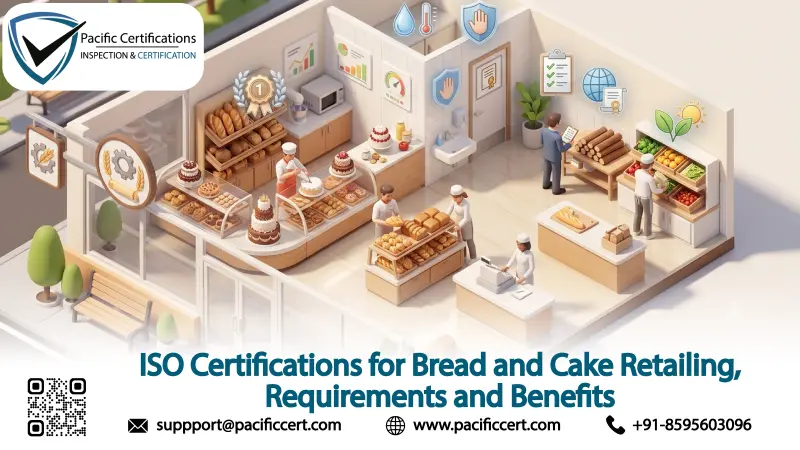
Bread and cake retailing combines food safety, customer service, inventory control, and shelf-life management. Businesses may operate through independent bakeries, supermarket counters, online ordering platforms, and delivery services while handling fresh bread, sliced loaves, celebration cakes, pastries, and packaged bakery products.
These operations involve important risks related to temperature control, ingredient traceability, allergen management, display hygiene, stock rotation, and product handling. Retailers must also manage short selling periods, rapid inventory turnover, fluctuating demand, and the need to maintain consistent product quality and presentation during peak hours, holidays, and seasonal events.
For that reason, bread and cake retailing ISO certifications are more than a formality. They help retailers show that food safety, quality control, and business continuity are managed through documented systems rather than ad hoc routines. Buyers and channel partners increasingly expect evidence of hygienic handling, complaint resolution, and traceability across the retail chain. ISO standards provide a practical framework for reducing contamination risk, improving store discipline, and supporting the level of confidence that modern food consumers expect from a trusted bakery brand.
Quality in every slice and safety in every bite — ISO certification ensures your bakery earns both trust and taste — Pacific Certifications
Quick Summary
The article explains how ISO certifications help bread and cake retailers strengthen food safety, quality and operational consistency. It highlights standards such as ISO 22000 for food safety, ISO 9001 for quality management, ISO 14001 for environmental responsibility and ISO 45001 for workplace safety. These frameworks improve hygiene, allergen control, traceability, stock management and customer confidence while supporting compliance and efficient bakery retail operations.
Applicable ISO Standards for Bread and Cake Retailing Businesses
Below are the most relevant ISO standards applicable to bakery stores, cake shops, retail bakery counters, supermarket bakery departments, and online bakery delivery businesses:
ISO 9001: Quality Management Systems
ISO 9001 gives bread and cake retailers a structured way to maintain product consistency across stores and channels. It covers customer order handling, decoration standards, portion accuracy, complaint management, and supplier coordination. The standard helps retailers reduce service variation and ensure that customers receive the same quality whether they buy in-store, online, or through delivery partners. That consistency is often what turns a local bakery into a trusted brand.
ISO 22000: Food Safety Management Systems
Food safety is the most critical issue in bread and cake retailing. ISO 22000 helps retailers identify hazards connected to ingredient receiving, storage, display, cross-contact, packaging, and final sale. It requires documented prerequisite programs such as cleaning, pest control, personal hygiene, and stock rotation, along with traceability and corrective action processes. For bakeries and cake outlets, this standard supports safe handling of perishable fillings, cream-based products, and allergen-containing items.
ISO 14001: Environmental Management Systems
Bread and cake retailing creates environmental impacts through packaging, food waste, refrigeration energy, cleaning chemicals, and delivery activity. ISO 14001 helps businesses identify those impacts, reduce waste, and improve resource use across their outlets. It is especially useful for retailers that want to strengthen their sustainability profile and control disposal costs. For businesses expanding into premium retail channels, environmental management increasingly supports brand reputation as much as cost control.
ISO 45001: Occupational Health and Safety Management Systems
Retail bakery environments often seem low risk until slip incidents, burns, lifting injuries, and equipment hazards are measured properly. ISO 45001 helps businesses identify and control those workplace risks through safe procedures, staff training, inspections, and corrective action. It also supports better management of front-of-house and kitchen-adjacent operations where staff move quickly around ovens, cutters, packaging stations, and display counters. Safety management becomes more reliable when the process is documented and reviewed regularly.
ISO 22301:2019 – Business Continuity Management Systems
Bread and cake retailers depend on uninterrupted supply, working equipment, and consistent staffing. ISO 22301 helps businesses prepare for events such as oven failure, supplier delays, transport disruption, power cuts, or unexpected demand surges during holidays and events. The standard requires businesses to identify critical activities, define recovery strategies, and test continuity plans. For retail bakeries, continuity planning protects both daily sales and special-order commitments.
ISO 22005:2007 - Traceability in the Feed and Food Chain
Traceability matters whenever a bakery sells multiple product lines with different ingredients, allergens, and shelf lives. ISO 22005 helps retailers track raw materials, batch codes, production dates, and customer-facing product movement. It becomes especially useful when a retailer must isolate a quality or safety issue quickly. Strong traceability also helps businesses respond more confidently to customer questions about ingredient origin and product handling.
What are the requirements of ISO Certifications for Bread and Cake Retailing?
Bread and cake retailing businesses seeking ISO certification must establish and maintain documented policies, procedures, and records aligned with the selected ISO standards. Key requirements include the following:
ISO 22000:2018 - FoodSafety Management Systems requirements
Document food safety procedures for ingredient receiving, storage, display, packaging, and product handling across all retail locations.
Identify hazards linked to allergens, contamination, temperature abuse, expired stock, and cross-contact between bread, cakes, and fillings.
Establish cleaning, pest control, hygiene, and waste disposal controls suitable for retail bakery counters and storage areas.
Maintain traceability records for ingredients, batch codes, expiry dates, and product movement through store and delivery channels.
Implement corrective action procedures for unsafe products, customer complaints, and any deviation from food safety controls.
Conduct regular internal checks to verify that food safety practices are being followed consistently by staff.
ISO 9001:2015 - Quality Management Systems requirements
Define quality standards for product appearance, taste, freshness, order accuracy, and customer service response times.
Document operating procedures for ordering, production coordination, display management, and online or in-store sales handling.
Establish a complaint handling process that identifies recurring issues and drives corrective action.
Monitor store performance using customer feedback, product returns, and service quality data.
Conduct internal audits to verify that branch operations follow the documented quality system.
Maintain records showing how quality issues are reviewed and improved over time.
ISO 14001:2026 - Environmental Management Systems requirements
Identify environmental impacts from packaging waste, food waste, energy use, and cleaning materials.
Establish procedures for waste segregation, disposal, and recycling where applicable.
Set reduction targets for energy use, packaging, or waste generation across outlets.
Monitor resource consumption and environmental performance at store or branch level.
Document emergency response actions for spills or environmental incidents.
Review environmental objectives regularly and update controls as needed.
ISO 45001:2018 - Occupational Health and Safety Management Systems requirements
Assess hazards related to slips, burns, cuts, lifting, and equipment use in retail bakery operations.
Implement safe handling and cleaning procedures for ovens, slicers, trays, and display equipment.
Train employees on emergency response, safe work practices, and hygiene requirements.
Record incidents, near misses, and corrective actions to improve workplace safety.
Maintain inspection and maintenance logs for equipment and safety controls.
Review workplace safety risks regularly and update procedures when needed.
ISO 22005:2007 - Traceability in the Feed and Food Chain requirements
Trace ingredients from supplier delivery to finished bread or cake product.
Record batch details, dates, and product movement for each retail item sold.
Link product identity to supplier and production information for fast issue isolation.
Test traceability procedures to confirm the business can respond quickly to a product concern.
Maintain records that support customer inquiries and recall readiness.
Review traceability performance regularly to keep the system reliable.
Tip: Begin by mapping the daily retail bakery flow from ingredient receipt to final sale. Include store managers, kitchen staff, delivery teams, and quality leads in the same review so your procedures match how the business actually operates.
What are the Benefits of ISO Certifications for Bread and Cake Retailing Businesses?
ISO certifications provide bread and cake retailing businesses with strong operational and commercial advantages, including: listed below are the key benefits for the ISO standards applicable to bakery stores, cake shops, retail bakery counters, supermarket bakery departments, and online bakery delivery businesses:
Improved food safety control by reducing contamination, allergen, and spoilage risks across retail and delivery channels.
Stronger customer trust through consistent product quality, cleaner operations, and more reliable service.
Better complaint management with structured processes that resolve issues quickly and prevent repeat failures.
Higher shelf-life discipline through clearer stock rotation, storage control, and date management.
Enhanced brand reputation when buyers see a bakery business as organized, safe, and dependable.
Reduced waste and losses by controlling spoilage, overproduction, packaging use, and energy consumption.
Greater resilience when supply disruptions, equipment failure, or staffing gaps affect daily operations.
Streamlined retail operations through documented procedures that make training and branch expansion easier.
Better traceability for ingredients and finished products, especially useful during recalls or customer queries.
Improved market access for businesses supplying supermarkets, hotels, cafes, and online food platforms.
Market Trends
Bread and cake retailing continues to grow as consumers buy more fresh, convenient, and premium bakery products through stores, kiosks, and online delivery platforms. Retail bakeries are becoming more data-driven, using ordering apps, loyalty systems, and demand forecasting to reduce waste and improve service. In the coming years, businesses that combine convenience with documented food safety and quality control are likely to outperform informal competitors. Rising customer expectations around allergen information, ingredient transparency, and product freshness are also increasing the value of certified management systems in this sector.
ISO-certified bakery retailers are better positioned to respond to these changes because certification supports consistency, traceability, and stronger management discipline. The broader food sector shows that certified businesses often achieve fewer non-conformances, better audit outcomes, and more reliable customer retention. As bakery retail becomes more competitive, businesses that can prove safe handling, reliable service, and repeatable product quality will have a clear advantage. Sustainability expectations are also rising, so ISO 14001 can help retailers reduce waste and build a stronger brand story.
How Pacific Certifications Can Help?
Pacific Certifications, accredited by ABIS, acts as an independent certification body for bread and cake retailing businesses by conducting impartial audits against applicable ISO standards. Our role is to objectively assess whether documented management systems and bakery retail practices conform to international ISO requirements, based strictly on verifiable evidence and operational records.
We support bread and cake retailing providers through:
Independent certification audits conducted in accordance with ISO/IEC 17021 for food safety, quality, environmental, safety, traceability, and business continuity management systems
Practical assessment of real bakery retail operations, including ingredient storage, hygiene control, display handling, packaging, delivery processes, and customer complaint management
Clear audit reporting reflecting conformity status, objective findings, and certification decisions based on documented evidence and store-level performance
Internationally recognized ISO certification upon successful compliance demonstration
Surveillance and recertification audits to maintain certification validity and support continual improvement
Contact us
If you need support with ISO certification for your bread and cake retailing business, contact us at support@pacificcert.com or +91-8595603096.
Author: Ashish
Also Read: ISO 22000 Certification Guide 2026 | Food Safety Standards