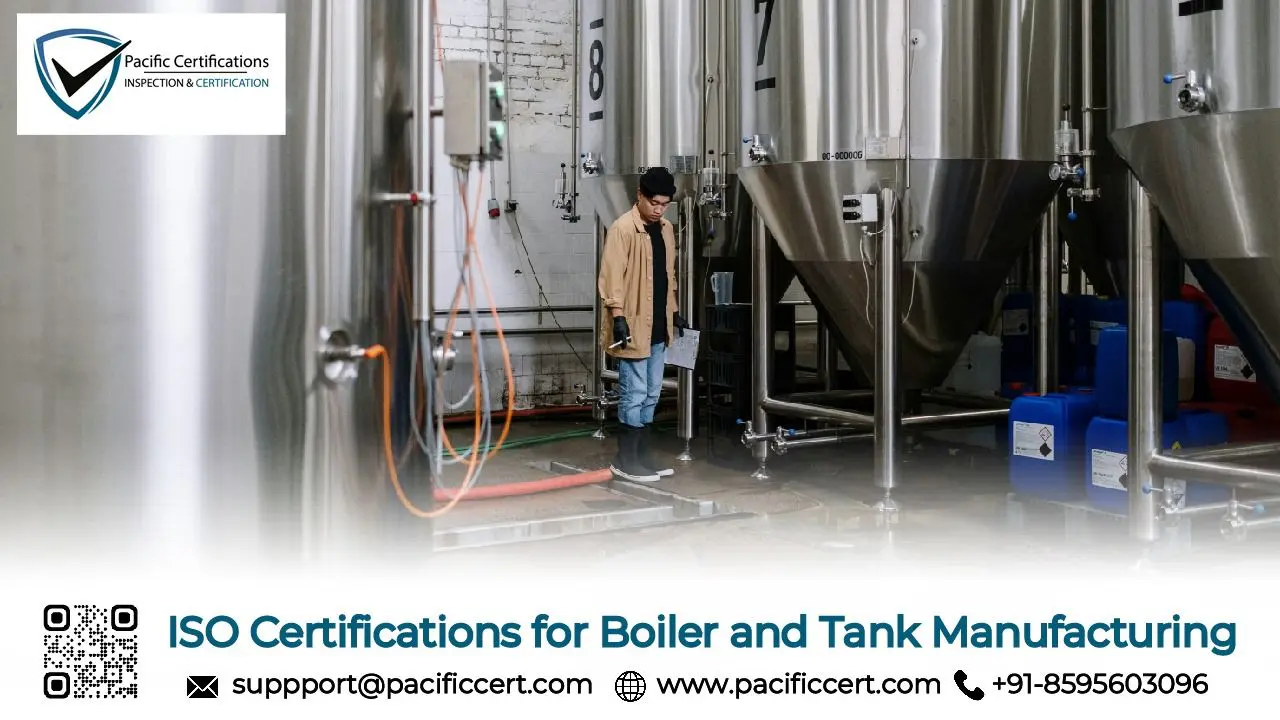
ISO Certifications for Boiler and Tank Manufacturing Businesses, Requirements and Benefits
Introduction
Boiler and tank manufacturing is one of the most safety-critical areas in the global industrial fabrication industry. Companies in this field design and build many types of equipment such as steam boilers, storage tanks, pressure vessels, heat exchangers, cryogenic tanks, and containers used for chemicals, fuel, or other hazardous materials. The work involves heavy plate cutting, forming, welding, weld inspection, pressure testing, coating, and detailed quality documentation based on international design codes. Most of the products made in this industry operate under pressure or contain dangerous substances, and any defect in welding, material strength, or corrosion protection can lead to serious accidents affecting workers, facilities, and even nearby communities. Because of these risks, pressure equipment manufacturing is strictly regulated, and manufacturers must maintain very detailed technical records for every product they produce.
For this reason, ISO certifications have become almost essential for boiler and tank manufacturers that want to work in international markets. Global rules related to pressure equipment, environmental protection, and workplace safety require companies to show that their processes are controlled in a systematic and documented way. ISO standards provide a clear structure for managing quality, safety, environmental impact, and worker protection across all stages of fabrication. They turn good engineering and manufacturing practices into formal management systems that can be audited and improved over time. This gives confidence to customers, inspection agencies, project owners, and regulators that the manufacturer can produce pressure equipment safely and consistently according to international expectations.
Quick Summary
ISO certifications provide boiler and tank manufacturing businesses with internationally recognized frameworks to manage welding quality and fabrication integrity through ISO 3834, production quality through ISO 9001, environmental performance through ISO 14001, worker health and safety through ISO 45001, energy efficiency through ISO 50001, and operational continuity through ISO 22301. These standards collectively address the most critical risk dimensions in pressure vessel and tank fabrication, weld quality assurance, material traceability, hazardous work environment management, and supply chain resilience.
For more information on how we can assist your boiler and tank manufacturing business with ISO certifications, contact us at support@pacificcert.com.
In boiler and tank manufacturing, the integrity of every weld and every vessel is a commitment made long before the hydro-test.
Applicable ISO Standards for Boiler and Tank Manufacturing Businesses
Below are the most relevant ISO standards applicable to industrial boiler manufacturers, pressure vessel and heat exchanger fabricators, storage tank and process vessel producers, and cryogenic and chemical tank manufacturers:
ISO 9001: Quality Management Systems (QMS)
ISO 9001:2015 establishes a documented quality management system that governs all of these activities: incoming material verification, process control through documented work instructions, inspection and test plans tied to design code requirements, nonconforming item management, and customer satisfaction monitoring through structured feedback processes. Manufacturers certified to ISO 9001 demonstrate the process discipline that project owners, engineering contractors, and third-party inspection bodies need to see before awarding fabrication contracts for safety-critical pressure equipment.
ISO 3834: Quality Requirements for Welding
Welding is the single most consequential manufacturing process in boiler and tank fabrication, and ISO 3834 is the internationally recognized standard that governs it. The standard defines quality requirements across the full welding lifecycle, from the review of technical requirements and pre-production planning through welding procedure qualification, welder performance qualification, production welding controls, non-destructive testing, and post-weld heat treatment. ISO 3834-2, which defines comprehensive quality requirements, is specifically cited as the appropriate level for manufacturers producing boilers, pressure vessels, and high-performance welded structures where safety is paramount. For boiler and tank manufacturers, certification to ISO 3834 provides evidence to project owners, inspection bodies, and regulatory authorities that weld quality is managed systematically.
ISO 14001: Environmental Management Systems (EMS)
Boiler and tank fabrication generates a specific and well-defined environmental footprint that requires active management. Welding fumes, grinding dust, plasma and flame cutting emissions, shot blasting abrasive waste, surface coating solvents and overspray, cutting fluids, and the disposal of heat treatment scale all constitute environmental aspects that must be identified, managed, and improved under a structured environmental system. ISO 14001:2015 provides manufacturers with the framework for doing this systematically, setting measurable reduction targets, monitoring compliance against international environmental performance benchmarks, and demonstrating continuous improvement across successive certification cycles.
ISO 45001: Occupational Health and Safety Management Systems (OHSMS)
ISO 45001:2018 requires systematic hazard identification across all the activities, proportionate layered controls, and regularly tested emergency response plans that address the specific incident scenarios present in fabrication environments. For manufacturers operating large fabrication bays with simultaneous multi-vessel projects, the standard's requirements for contractor management and change control are particularly valuable in sustaining safety performance when workforce composition, vessel configurations, and production priorities change frequently.
ISO 50001: Energy Management Systems (EnMS)
ISO 50001:2018 provides a structured approach to establishing energy consumption baselines, identifying significant energy uses, setting improvement targets, and implementing operational controls that reduce waste in high-consumption processes. Manufacturers implementing this standard frequently identify efficiency opportunities in furnace loading optimization, plasma cutting parameter management, and compressed air system performance.
Click here to find out more applicable standards to your industry
What are the Requirements of ISO Certifications for Boiler and Tank Manufacturing Businesses?
Boiler and tank manufacturing businesses seeking ISO certification must establish and maintain documented policies, procedures, and records aligned with the selected ISO standards. Key requirements include the following:
ISO 3834:2021 – Quality Requirements for Fusion Welding of Metallic Materials
Maintain approved welding procedure specifications for all welding processes used in boiler and pressure vessel fabrication
Keep qualification records for welders and welding operators, with renewal tests as required by codes or project specifications
Perform pre-production welding review for each new vessel or project to confirm materials, joint design, heat treatment, and testing requirements
Control non-destructive testing such as radiography, ultrasonic testing, magnetic particle, and liquid penetrant inspection with proper records
Maintain post-weld heat treatment records including time and temperature charts linked to each vessel number
Keep calibration and maintenance records for welding machines, heat treatment equipment, and NDT instruments
ISO 9001:2015 – Quality Management Systems
Define quality objectives for dimensional accuracy, traceability, inspection completion, and delivery performance
Control fabrication using inspection and test plans, work instructions, traveller cards, and approved procedures
Manage non-conforming materials or weld failures with identification, segregation, root cause analysis, and corrective action
Qualify and monitor suppliers of plates, pipes, welding consumables, NDT services, and heat treatment providers
Maintain calibration records for measuring tools, pressure gauges, temperature recorders, and testing equipment
Conduct internal audits and management reviews to monitor quality results and improvement actions
ISO 14001:2015 – Environmental Management Systems
Identify environmental impacts such as welding fumes, cutting emissions, blasting dust, coating chemicals, and waste disposal
Set environmental objectives for waste reduction, energy saving, and control of solvent or chemical use
Monitor waste, emissions, and discharge with documented records
Maintain emergency procedures for chemical spills, fume release, or hazardous waste incidents
Evaluate environmental performance of suppliers, subcontractors, and waste disposal companies
Review environmental performance regularly in management meetings
ISO 45001:2018 – Occupational Health and Safety Management Systems
Identify hazards in welding, cutting, lifting, confined space work, blasting, coating, and pressure testing
Assess risks for crane operation, vessel handling, hot work, chemical exposure, and grinding activities
Apply safety controls such as fume extraction, machine guards, lifting controls, and safe work procedures
Maintain confined space, hot work, and pressure testing safety procedures
Provide proper personal protective equipment for all fabrication activities
Establish emergency plans for fire, crane accidents, pressure test failure, chemical exposure, and confined space rescue
Record incidents, near misses, and safety observations
Review safety performance and corrective actions during management reviews
Tip: Before beginning ISO implementation across your boiler and tank fabrication facility, bring together a cross-functional team including welding engineering, quality, production, health and safety, environmental, and estimating personnel to map your existing inspection and test plans, welding procedure records, and process documentation against the applicable ISO clause requirements.
For more information on how we can assist your boiler and tank manufacturing business with ISO certifications, contact us at support@pacificcert.com.
What are the Benefits of ISO Certifications for Boiler and Tank Manufacturing Businesses?
ISO certifications give boiler and tank manufacturing companies clear operational and commercial advantages. These standards help improve welding quality, fabrication control, safety performance, and compliance with international project requirements. The following benefits apply to industrial boiler manufacturers, pressure vessel and heat exchanger fabricators, storage tank producers, and chemical or cryogenic vessel manufacturers:
Improved weld quality control through ISO 3834 based welding procedures and welder qualification management, helping reduce defects, rework, and weld rejection during third party inspection
Stronger eligibility for project contracts, as EPC contractors, inspection agencies, and project owners often require ISO 3834 and ISO 9001 certification before approving boiler or pressure vessel manufacturers
Better material traceability through inspection plans, traveller records, and nonconformance control, allowing full tracking from raw material certificate to final vessel acceptance
Higher environmental credibility with project owners and investors who review supplier performance for welding fumes, coating chemicals, blasting waste, and overall environmental control
Fewer workplace accidents through ISO 45001 safety management covering welding hazards, confined space work, crane lifting, pressure testing, and chemical exposure during surface treatment
Lower energy costs through ISO 50001 improvements in heat treatment furnaces, cutting systems, compressed air, and other high energy fabrication processes
Stronger business continuity through ISO 22301 planning that helps manage supply delays, equipment breakdown, or shortage of skilled workers without affecting project delivery
Easier compliance with inspection authorities and regulators because ISO systems provide structured documentation accepted in international projects
Reduced documentation burden during third party audits, client inspections, and regulatory reviews because records are already maintained in a standardized format
The global industrial boilers market is projected to reach USD 23.71 billion by 2032, growing at a CAGR of 5.8% over the forecast period. A complementary analysis values the market at USD 16.02 billion in 2024 and projects growth to USD 22.97 billion by 2033 at a CAGR of 4.1%, driven by rising demand from the energy, chemical processing, food and beverage, and district heating sectors. The shift toward cleaner energy sources is reshaping boiler design requirements, with high-efficiency condensing boilers, biomass-fired systems, and waste heat recovery units commanding growing market share as industrial operators seek to reduce fuel consumption and carbon emissions across steam generation infrastructure. Storage tank demand is similarly supported by global petrochemical capacity expansion, water infrastructure investment, and the growing requirement for chemical and hazardous material containment vessels that meet internationally recognized pressure equipment design and fabrication standards. Across both segments, project owners and engineering procurement contractors are raising their fabricator qualification requirements, with ISO 3834 welding quality certification increasingly cited alongside national pressure equipment design codes as a mandatory supplier credential for projects in the energy, power generation, and process industries.
Looking ahead, the boiler and tank manufacturing industry is being shaped by three major changes. Project owners are demanding higher levels of quality and safety, environmental expectations are becoming stricter, and fabrication work is becoming more digital. Companies that use structured ISO management systems often see clear improvements, such as fewer weld repairs, more approvals during third party inspections, and better results when engineering contractors evaluate suppliers. When processes are controlled and documented properly, projects move faster and with fewer costly corrections.
How Pacific Certifications Can Help?
Pacific Certifications, accredited by ABIS, acts as an independent certification body for boiler and tank manufacturing businesses by conducting impartial audits against applicable ISO standards. Our role is to objectively assess whether documented management systems and fabrication practices — including welding quality controls, material traceability systems, inspection and test plan execution, environmental management activities, and occupational safety programs — conform to international ISO requirements, based strictly on verifiable evidence and operational records.
We support boiler and tank manufacturing providers through:
Independent certification audits conducted in accordance with ISO/IEC 17021
Practical assessment of real fabrication operations including welding procedure and welder qualification controls, inspection and test plan implementation, NDT documentation, and post-weld heat treatment records
Evaluation of occupational safety and energy management controls against ISO 45001 and ISO 50001 requirements specific to heavy fabrication and pressure vessel manufacturing environments
Clear audit reporting reflecting conformity status, nonconformance findings, and certification decisions
Internationally recognized ISO certification upon successful compliance demonstration
Surveillance and recertification audits to maintain certification validity
Contact us
If you need support with ISO certification for your boiler and tank manufacturing business, contact us at support@pacificcert.com or +91-8595603096.
Read more: Pacific Blogs