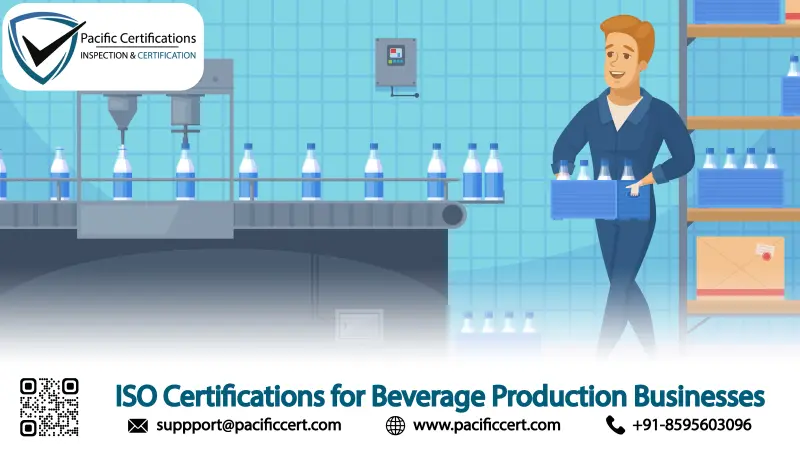
ISO Certifications for Beverage Production Businesses, Requirements and Benefits
Introduction
Beverage production operates within one of the world's most scrutinized food manufacturing environments, where a single safety incident can result in multi-market product recalls, regulatory shutdowns, and consumer trust damage that takes years to rebuild. Producers manage an intricate web of raw material sourcing covering water quality verification, ingredient supplier qualification, and packaging material compliance, while running multi-line production facilities where carbonation control, pasteurization validation, fill-weight accuracy, and sealing integrity are monitored simultaneously across dozens of product formats.
Quality control laboratories analyze every batch for microbiological contamination, pH stability, Brix consistency, and shelf-life performance — and these results directly determine whether product reaches market or is quarantined at dispatch. The challenge is compounding: growing consumer demand for functional ingredients, plant-based formulations, and low-sugar recipes adds formulation complexity while regulatory oversight tightens across every major beverage export market.
With rising consumer awareness, stricter food safety enforcement, export compliance requirements, and sustainability expectations, beverage manufacturers are under increasing pressure to demonstrate robust management systems. ISO certifications have therefore become an essential framework for beverage production businesses to ensure safe products, consistent quality, regulatory compliance, and long-term credibility with retailers, distributors, and consumers.
In beverage manufacturing, consumer trust is bottled long before the product reaches the shelf.
Quick Summary
ISO certifications provide beverage production businesses with internationally recognized frameworks to manage food safety through ISO 22000, product quality through ISO 9001, environmental responsibility through ISO 14001, occupational health and safety through ISO 45001, energy efficiency through ISO 50001, information and traceability controls through ISO/IEC 27001, and business continuity through ISO 22301. These certifications help beverage manufacturers improve product safety, meet regulatory and export requirements, and strengthen brand confidence.
For more information on how we can assist your beverage production business with ISO certifications, please contact us at [email protected].
Applicable ISO Standards for Beverage Production Businesses
Below are the most relevant ISO standards applicable to beverage manufacturing plants and bottling facilities:
ISO 22000: Food Safety Management System (FSMS)
ISO 22000 is the foundation standard for beverage production. It integrates HACCP principles with prerequisite programs to control hazards related to raw materials, water quality, processing, filling, packaging, storage, and distribution, ensuring food safety across the beverage supply chain.
ISO 9001: Quality Management System (QMS)
ISO 9001 supports structured control of formulation consistency, production planning, in-process testing, packaging integrity, customer feedback, and continual improvement, ensuring uniform product quality across batches.
ISO 14001: Environmental Management System (EMS)
Beverage manufacturing involves high water usage, wastewater discharge, packaging waste, and energy consumption. ISO 14001 helps organizations manage environmental impacts and comply with environmental regulations.
ISO 45001: Occupational Health & Safety (OHSMS)
Production plants involve machinery, pressurized systems, chemicals, and manual handling. ISO 45001 provides a framework to manage workplace hazards and improve employee safety.
ISO 50001: Energy Management System (EMS)
Heating, cooling, bottling, and refrigeration are energy-intensive. ISO 50001 enables systematic energy performance improvement and cost reduction.
Click here to find out more applicable standards to your industry
What are the Requirements of ISO Certifications for Beverage Production Businesses?
Beverage manufacturers seeking ISO certification must establish and maintain documented policies, procedures, and records aligned with the selected ISO standards. Key requirements include the following:
ISO 22000:2018 – Food Safety Management Systems Requirements
Define the food safety management system scope covering all production stages from raw material intake through finished goods dispatch, including outsourced concentration and co-manufacturing operations where applicable.
Conduct systematic hazard analysis identifying biological hazards such as Listeria and Salmonella, chemical hazards including pesticide residues and allergen cross-contact, and physical hazards from glass, metal, or plastic foreign body intrusion across all production stages.
Establish Critical Control Points with documented critical limits, continuous monitoring schedules, and corrective action procedures for pasteurization temperature and hold time, carbonation pressure, and final product microbiological testing.
Implement prerequisite programs covering water treatment and quality verification, allergen segregation and labeling, CIP and sanitation validation, pest management, and personal hygiene controls across all areas of the production facility.
Maintain a product traceability system capable of identifying all raw material lots, processing records, and quality test results for any finished product batch within four hours of a traceability exercise or recall trigger.
Document product withdrawal and recall procedures tested through simulation covering contamination scenarios, regulatory notification timelines, and customer and consumer communication protocols.
ISO 9001:2015 – Quality Management Systems Requirements
Define quality acceptance criteria for incoming raw materials — fruit concentrates, sweeteners, water, packaging materials, and closures — with documented inspection procedures and laboratory test requirements before production release.
Control in-process quality parameters across mixing, blending, carbonation, pasteurization, filling, and sealing operations through documented checkpoints with tolerance ranges and defined operator response procedures for out-of-specification results.
Implement nonconforming product procedures that quarantine out-of-specification batches, trigger root cause investigation, and prevent recurrence of quality failures before production restarts or product is dispatched to customers.
Monitor customer quality complaints and product returns through a documented complaint register linked to corrective action management, with closure verification ensuring that the same failure does not recur in subsequent production campaigns.
Conduct internal quality audits across ingredient intake, production, laboratory, packaging, and warehousing areas at defined intervals, with audit findings tracked to verified closure through the corrective action system
ISO 14001:2015 – Environmental Management Systems Requirements
Identify and document significant environmental aspects from beverage production — including wastewater generation and chemical oxygen demand loading, CO₂ usage in carbonation, refrigerant emissions, packaging waste volumes, and energy-related greenhouse gas generation.
Establish measurable environmental objectives and targets for wastewater treatment performance, water consumption per litre of beverage produced, packaging recyclability improvement, and energy-related emissions reduction.
Implement operational controls for effluent treatment system management, chemical storage containment and secondary bunding, waste segregation at source, and refrigerant leak detection programs across production and utility areas.
Monitor key environmental performance indicators including effluent discharge quality parameters, water consumption intensity, waste disposal tonnages by category, and energy-related emissions against annual targets at defined intervals.
Conduct internal environmental audits across production, utilities, warehousing, and water treatment areas annually, with findings linked to corrective actions and verified at subsequent audit cycles.
ISO 45001:2018 – Occupational Health and Safety Requirements
Assess occupational health and safety hazards across all beverage production areas — including high-pressure carbonation systems, pasteurization tunnel access, confined space entry into fermentation or mixing tanks, chemical handling in sanitation, and ergonomic risks in high-speed packaging lines.
Implement engineering controls and safe work procedures for identified high-risk tasks, covering lockout-tagout for maintenance activities, chemical handling protocols for CIP chemicals, confined space entry permits, and ergonomic workstation configurations for repetitive filling and packing tasks.
Establish emergency response procedures covering chemical spill scenarios, ammonia refrigeration leak response, fire in pasteurization areas, and medical emergency protocols with documented drill records maintained across all production shifts.
Manage contractor safety through documented site induction programs, permit-to-work systems, and supervision protocols for all third-party engineering, maintenance, and construction activities within the production facility.
Monitor leading safety performance indicators including near-miss reporting frequency, safety observation completion rates, and corrective action close-out timelines, reviewed alongside lagging indicators in management review cycles.
Tip:Start by mapping your beverage production lifecycle—from water sourcing and formulation to filling, packaging, storage, and distribution—against ISO requirements to identify food safety, quality, and compliance gaps early.
For further information on how we can assist your beverage production business with ISO certifications, contact us at [email protected].
What are the Benefits of ISO Certifications for Beverage Production Businesses?
ISO certifications are suitable for soft drink manufacturers, juice processors, bottled water plants, breweries, distilleries, and dairy beverage producers. Key benefits include:
Improved food safety and hygiene controls, reducing contamination risks.
Consistent taste, quality, and packaging integrity, strengthening brand trust.
Enhanced compliance with food laws and export standards, easing approvals.
Better control of water, energy, and waste, reducing environmental impact.
Safer working conditions for employees, lowering accident risks.
Stronger credibility with retailers, distributors, and regulators, supporting growth.
The global beverage market is projected to grow to USD 2.98 trillion by 2030 at a CAGR of 6.83%, driven by premium product innovation, functional beverage expansion, and health-oriented reformulation across both alcoholic and non-alcoholic segments. Non-alcoholic beverages are growing faster than the overall market at approximately 6.32% CAGR, fueled by consumer health consciousness, sugar reduction trends, and the explosive growth of energy, sports, and plant-based functional drinks. International food safety regulatory frameworks are simultaneously raising the bar, tightening contamination limits, expanding allergen labeling requirements, and embedding mandatory food safety management system certification into import approval frameworks across major developed markets.
In the coming years, regulatory convergence across international food standards bodies will increasingly require beverage producers to demonstrate certified HACCP-based management rather than self-asserted compliance, making ISO 22000 certification a commercial access requirement rather than a voluntary differentiator.
How Pacific Certifications Can Help?
Pacific Certifications, accredited by ABIS, acts as an independent certification body for beverage production businesses by conducting impartial audits against applicable ISO standards. Our role is to objectively assess whether documented management systems and manufacturing practices conform to international ISO requirements, based strictly on verifiable evidence and operational records.
We support beverage manufacturers through:
Independent certification audits conducted in accordance with ISO/IEC 17021
Practical assessment of real food safety, quality, and compliance processes
Clear audit reporting reflecting conformity status and certification decisions
Internationally recognized ISO certification upon successful compliance
Surveillance and recertification audits to maintain certification validity
Contact Us
If you need support with ISO certification for your beverage production business, contact us at [email protected]or +91-8595603096.
Author: Ashish
Read more: Pacific Blogs