ISO Certifications for Accommodation and Food Services, Requirements and Benefits
Introduction
Accommodation and food service centres are a pivotal part of business travel, travel to and from homes and out to local eateries. Examples of these services include hotels, resorts, Cloud Kitchens, catering teams, restaurants, cafés and other types of hospitality. Since repeatable service and safe food handling are critical elements of guest experience, they must be in place even during peak demands on service. From 2026 to 2030, continued strong growth is expected as bookings move to digital sources, more customers use cashless forms of payment and customers increasingly rely on ratings and reviews in their decision-making process regarding where to stay or dine. Each of these changes enhances customer expectations, resulting in the requirement for consistent levels of service quality, timely resolution of guest complaints and visible food safety measures at every service phase.
With increased demand comes an increase in compliance expectations. As a result, hotels and restaurants will continue to experience regular inspections related to aspects such as: hygiene, fire safety, water management, allergen control and staff safety. In addition, the demands for tougher questions by buyers regarding vendors providing corporate stays, corporate events and catering continue to increase.
Today, many decision-makers are looking to confirm that their hotel's or restaurant's food safety management system (FSMS), service control and risk management FSMS's have been independently validated by an ISO certification.
For operators, the objective is straightforward: establish an operational process that ensures safe service delivery, provide mobility through established operational practices, and develop trust with guests, inspectors/auditors and corporate clients/customers.
Get started with your certification process for your hotel and restaurant operations, contact us at [email protected] today!
Quick Summary
ISO certification gives accommodation and food service businesses a structured way to manage food safety, service consistency and site safety. The most relevant standards are ISO 22000 for restaurants and catering services, ISO 9001 for hospitality industry quality control and ISO 45001 for hospitality industry worker safety, with additional options like ISO 14001 for hotels and resorts plus ISO 22301 for disruption readiness. Certification strengthens trust with guests, corporate buyers, delivery platforms and regulators in a fast-changing hospitality market.
Applicable ISO standards for accommodation and food services
Accommodation and food services deal with guest-volume swings, multi-supplier inputs, time-sensitive preparation and high-visibility hygiene expectations. ISO standards help convert those realities into controlled processes with defined roles, records and internal checks.
ISO 22000 for accommodation and food services (Food safety)
ISO 22000 is the go-to standard for food safety certification for catering services and restaurant operations because it builds a structured food safety management system based on HACCP principles. For restaurants, hotels with kitchens, banquets and catering teams, it helps control hazards from receiving and storage through preparation, service and delivery. It supports clear hygiene routines, allergen control, supplier approval, temperature controls, cleaning verification and traceability. ISO 22000 requirements for food service businesses also push consistent records, corrective actions and internal checks so managers can show evidence during inspections and client audits. If your goal is to get ISO certified for hotel and restaurant food operations, ISO 22000 is often the first standard reviewed.
Read more:ISO 22000 certification
ISO 9001 for accommodation and food services (Quality management)
ISO 9001 for hospitality industry operations supports predictable service across front-office, housekeeping, food and beverage, events and guest support. It helps define service standards, escalation rules and response times so teams can deliver the same experience across shifts and locations. It also supports stronger control of outsourced services like laundry, pest control, housekeeping contractors and third-party kitchens through supplier evaluation and performance tracking. For restaurants, ISO 9001 helps tighten order accuracy, service timing and complaint handling which directly affects ratings and repeat bookings. Many operators use ISO 9001 as the foundation to build a fast and structured certification process that stabilizes daily routines and reduces repeated service issues.
Read more: ISO 9001 certification
ISO 45001 for accommodation and food services (Workplace safety)
ISO 45001 for hospitality industry settings helps reduce injuries and incidents by putting safety controls into daily work. In hotels and restaurants, common risk areas include wet floors, hot surfaces, sharp tools, chemical exposure, lifting injuries, fatigue from long shifts and contractor work in guest areas. ISO 45001 supports hazard identification, risk controls, training, incident reporting and corrective action. It also supports emergency planning, fire drills and safe-work controls during events and high-occupancy periods. For hospitality groups, this becomes a practical way to reduce disruptions and show that staff safety is managed in a disciplined way.
Read more: ISO 45001 certification
ISO 14001 for accommodation and food services (Environment and sustainability)
ISO 14001 helps hotels and resorts manage waste, water-use, chemical storage and energy-related impacts through controlled routines and measurable targets. For accommodation operators, it supports better segregation of food waste, plastics, glass and packaging, plus safer chemical handling in housekeeping and maintenance. It also supports supplier controls for eco-friendly consumables and structured monitoring for resource use. For brands that market greener stays or host events, ISO 14001 supports consistent practices across locations and improves readiness for client audits that ask about environmental performance.
Read more:ISO 14001 certification
ISO 22301 for accommodation and food services (Continuity)
ISO 22301 helps hotels, restaurants and catering teams plan for disruptions that can halt service or damage reputation. Disruption examples include power failures, water-supply issues, key equipment failure, supplier delays, transport disruptions, cyber issues affecting reservations and sudden staff shortages. ISO 22301 supports business-impact analysis, recovery priorities and tested response steps so operations can continue or recover quickly. For groups managing multiple sites, it supports consistent playbooks, alternate sourcing plans and communication routines so the team can protect guest experience during unexpected events.
Read more: ISO 22301 certification
Click here to find out more applicable standards to your industry: Pacific Certifications blogs
What are the requirements for ISO certifications in accommodation and food services?
Certification is not just about passing an external audit; it requires hotels, restaurants and catering teams to put structured systems into practice. How to get ISO certified for hotel and restaurant operations starts with choosing the right standards, setting scope, training teams and preparing evidence for the certification audit. Common requirements include:
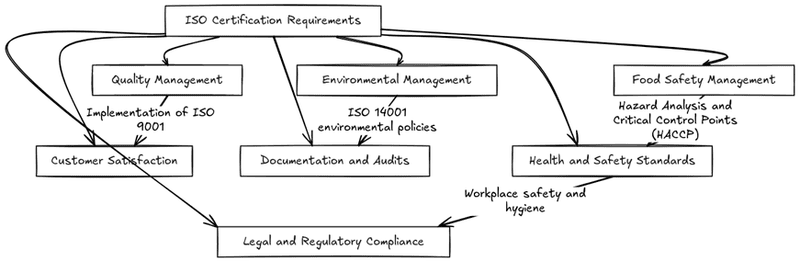
Definingscope: Define what is covered such as hotel operations, restaurant service, banquets, catering, cloud kitchen operations, delivery-only kitchens, multiple outlets or multi-site groups.
Policies and commitments: Set policies for food safety, quality service standards, staff safety and environmental controls based on your chosen standards.
Risk assessment: Identify risks such as cross-contamination, allergen errors, temperature failures, supplier quality failures, unsafe chemical storage, slips and burns, equipment failure, overcrowding during events and payment or guest-data exposure in reservation and POS systems.
Documented processes: Maintain written procedures for supplier approval, receiving checks, storage and rotation, cooking and holding controls, cleaning schedules, allergen labeling, complaint handling, service recovery, incident reporting, emergency response and contractor control.
Staff training: Train teams on HACCP controls, hygiene steps, allergen awareness, safe handling practices, cleaning methods, incident reporting and guest-complaint handling.
Record keeping: Maintain logs for temperature checks, cleaning verification, supplier approvals, pest control, staff training, incident logs, corrective actions, internal audits and management review outputs.
Monitoring and internal audits: Track KPIs such as food safety deviations, complaints, repeat issues, incident trends, audit findings and supplier nonconformities, then review results through internal audits and scheduled management review.
Pro Tip Box:If food handling is central, start with ISO 22000 certification for restaurants and catering because it gives direct control of HACCP and food safety risks. Add ISO 9001 for hospitality industry routines to improve service consistency and complaint closure.
What are the benefits of ISO certifications for accommodation and food services?
ISO certifications bring significant benefits to accommodation and food service businesses, including:
Improved readiness for inspections and client audits through controlled routines and clear evidence
Stronger food safety certification for catering services and restaurant kitchens through HACCP-based controls and verification records
Better service consistency and fewer repeated complaints through ISO 9001 for hospitality industry workflows
Safer workplaces with fewer incidents in kitchens, housekeeping and maintenance through ISO 45001 for hospitality industry controls
Better supplier control for ingredients, packaging and outsourced services which reduces quality variation
Improved brand trust for corporate bookings, events and long-stay contracts where buyers want certified vendors
Better continuity readiness for disruptions such as supply issues, equipment failures and IT outages through ISO 22301 planning
Industry research through 2026-2030 supports continued expansion in hospitality and food services plus higher buyer scrutiny around food safety, service reliability and sustainability. These trends also align with rising expectations for HACCP and ISO 22000 for restaurants, stronger quality management in hotels and structured environmental programs for resorts. (Source: UN Tourism). Many operators use these signals to justify an affordable and fast ISO certification process that supports cost control and stronger guest trust.
ISO certifications cost for accommodation and food services
ISO certification cost for restaurants and hotels varies based on site size, number of outlets, staff count, kitchen complexity and the standards included. A single restaurant applying ISO 22000 only will usually be lower cost than a multi-site hotel group combining ISO 22000, ISO 9001 and ISO 45001 because audit-days and sampling increase. Costs also depend on how mature your existing food safety records are, whether HACCP plans are already used, how supplier controls are managed and how much staff training is needed. Ongoing costs also include surveillance audits during the certification cycle. If your goal is an affordable option, defining the right scope and selecting standards that match your highest risks is the best starting point.
Contact [email protected] for a transparent, affordable ISO certification quote for restaurants, hotels and catering services
ISO certifications timeline for accommodation and food services
ISO certification timeline depends on readiness and scope. A single-site restaurant or catering team can often complete the process in 3-6 months if HACCP routines and records are already stable. Multi-outlet hotels, resorts and groups often need 6-10 months, especially when multiple kitchens, banquets and outsourced services are included. Early steps usually include scope definition, internal gap review, risk assessment and process documentation, followed by implementation, staff training and internal audits. The external audit typically runs in two stages, with Stage 1 focused on documented system review and readiness and Stage 2 focused on on-site verification through records, observation and interviews. Many operators aim to plan audits around peak seasons to keep service disruption low and keep the process fast.
How Pacific Certifications can help?
Pacific Certifications, accredited by ABIS, audits and certifies accommodation and food service businesses of all sizes. Whether you manage hotels, resorts, restaurants, cloud-kitchens or catering operations, we provide independent third-party certification audits that help you align with ISO standards and gain recognition from guests, corporate clients, travel partners and authorities.
Here’s why accommodation and food service businesses should choose us for their ISO certification needs:
Our auditors have experience in hospitality and food service operations across kitchens, banquets and multi-site groups
We provide clear audit plans and transparent audit reports aligned to the standard requirements
We support integrated certification audits for combinations such as ISO 22000 with ISO 9001 and ISO 45001
We schedule audits with operational realities in mind, including night operations, banquet cycles and multi-outlet sampling
We support certification-cycle requirements including surveillance audits and re-certification audits
We focus evidence collection around real controls such as HACCP logs, allergen controls, supplier checks, complaints and incident records
Getting Started with ISO Certification for Your Restaurant or Hotel
Whether you operate a single restaurant, multi-unit chain, boutique hotel, or large resort, getting ISO certified strengthens your competitive position. Start with ISO 22000 certification for restaurants if food safety is your primary concern, or ISO 9001 for hotels if service consistency across departments is the priority. Many operators pursue integrated certification combining ISO 22000, ISO 9001, and ISO 45001 to address food safety, service quality, and workplace safety in one efficient process. Contact Pacific Certifications at [email protected] to discuss the best ISO certification path for your hospitality business.
Contact us
If you need more support with ISO certifications for your accommodation and food services business, contact us at [email protected].
Author: Alina Ansari
Read More at: Blogs by Pacific Certifications