Overview
ISO management system standards provide the internationally recognized frameworks that mining companies use to demonstrate that safety, environmental performance, quality, energy efficiency and business continuity are systematically managed - not merely claimed.
ISO certification in the mining sector serves multiple strategic purposes simultaneously. It satisfies the due diligence requirements of institutional investors and lenders under ESG frameworks. It supports regulatory compliance and license-to-operate obligations in jurisdictions that reference ISO standards in mining legislation or permitting conditions. It provides the governance infrastructure that reduces incident rates, environmental liability exposure and operational downtime. And it signals to customers, communities and regulators that the organization meets internationally benchmarked standards for responsible operation.
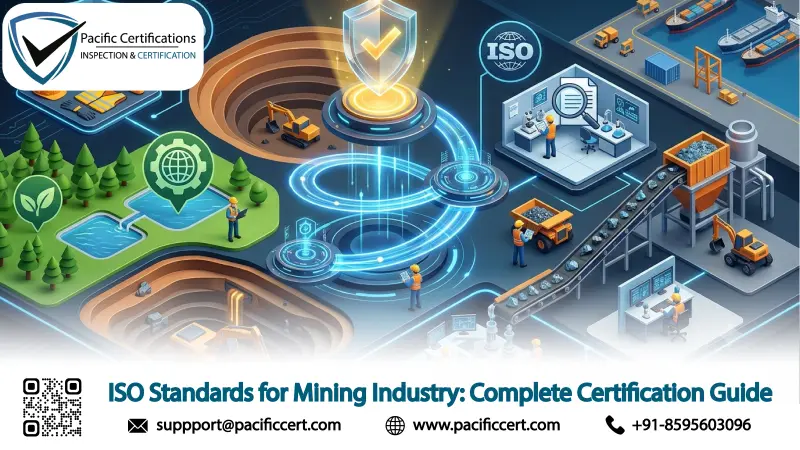
ISO certification helps mining and quarrying organizations control safety, environmental impact, operational quality and compliance risks across high-risk extraction activities - Pacific Certifications
Key ISO Standards for Mining
Together they form the foundation of a comprehensive ISO certification program for any mining organization.
Practical Tip: Choose ISO standards based on the site’s biggest exposure, such as worker safety, environmental impact, equipment reliability, product quality or energy use.
ISO 45001 for Mine Safety
ISO 45001:2018 is the international standard for occupational health and safety management systems and it is the single most critical ISO certification for any mining organization.
ISO 45001 requires organizations to establish a systematic OH&S management system covering hazard identification, risk assessment, legal compliance, worker participation, incident investigation, emergency preparedness and continual improvement.
In a mining context, the standard's requirements translate into documented procedures for every high-hazard activity - from drill-and-blast operations and equipment pre-start inspections to confined space entry and emergency evacuation.
ISO 45001 certification provides mining companies with a formally audited safety management system that satisfies regulatory requirements in many jurisdictions, supports the due diligence requirements of insurers and lenders and demonstrates to workers, communities and regulators that safety is managed through a rigorous, documented and independently verified system.
Read more: ISO 45001 - Occupational Health & Safety Management System
ISO 45001 should be prioritized where blasting, crushing, excavation, heavy equipment, confined spaces and hazardous materials create serious safety risks.
ISO 9001 for Operational Quality
ISO 9001:2015 provides the quality management system framework that ensures operational processes consistently deliver products meeting defined specifications.
In a mining context, ISO 9001 applies across the full operational chain - from ore reserve estimation and mine planning through extraction, crushing, grinding, concentration, dewatering and product dispatch.
The standard's process approach requires organizations to identify, document and control the processes that affect product quality - including sampling procedures, assay laboratory quality controls, process control parameters and product blending and stockpile management.
For mining companies supplying to commodity markets or operating under quality-linked pricing arrangements, ISO 9001 certification also provides the internal quality infrastructure that reduces product rejection, rework and penalty clauses - directly improving revenue realization and operational efficiency.
Read more: ISO 9001 - Quality Management System
Writer’s view: ISO 9001 helps mining and quarrying companies control production consistency, contractor performance, customer specifications and corrective actions.
ISO 14001 for Environmental Performance
ISO 14001:2026 provides the environmental management system framework that mining organizations use to identify, manage and reduce these impacts systematically.
ISO 14001 requires organizations to identify their environmental aspects - the elements of their operations that interact with the environment - and their associated impacts and to establish objectives, programs and controls for managing significant impacts.
In a mining context, this includes water management programs covering discharge quality and volume, dust suppression and monitoring programs, tailings facility management and monitoring, progressive rehabilitation programs and biodiversity management plans.
For mining companies operating in jurisdictions where environmental performance bonds and rehabilitation guarantees are required as conditions of mining licenses, ISO 14001 certification provides credible evidence that environmental management is embedded in organizational practice - which can influence the assessment of environmental liability and the conditions attached to ongoing permits.
Read more: ISO 14001 - Environmental Management System
Tip: ISO 14001 supports better control over dust, waste, water use, land disturbance, emissions and rehabilitation responsibilities.
ISO 50001 for Energy Management
ISO 50001:2018 provides the energy management system framework that mining organizations use to systematically reduce energy consumption, improve energy efficiency and reduce the carbon emissions associated with their operations.
ISO 50001 requires organizations to establish an energy baseline, define energy performance indicators, set energy improvement targets and implement action plans across significant energy uses.
In a mining context, significant energy uses typically include primary crushing circuits, semi-autogenous and ball mill grinding operations, underground ventilation, dewatering pumps and the haul truck fleet. The standard's Plan-Do-Check-Act cycle drives continuous energy performance improvement across all of these areas.
For mining companies with decarbonization commitments, investor ESG requirements, or carbon pricing obligations, ISO 50001 certification provides the management system infrastructure that makes energy and emissions reduction programs auditable, measurable and credible.
It also supports the identification of energy efficiency investments - with documented energy baselines and performance data providing the evidence base for capital expenditure decisions on electrification, variable speed drives, heat recovery and renewable energy integration.
Read more: ISO 50001 - Energy Management System
ISO 50001 helps energy-intensive mining operations monitor fuel, electricity and equipment efficiency with measurable performance improvement.
Risk Management in Mining
ISO 31000:2018 provides the risk management frameworks that mining organizations use to structure, coordinate and continually improve their enterprise risk management programs.
ISO 31000 is a guidance standard rather than a certifiable management system standard, but its principles and framework inform the risk management requirements of ISO 45001, ISO 14001, ISO 9001 and ISO 22301 - making it the conceptual foundation of a comprehensive mining risk program.
Mining companies that apply ISO 31000 establish a consistent risk assessment methodology across all business functions - allowing safety risks, environmental risks, operational risks and financial risks to be evaluated, compared and prioritized within a single enterprise risk framework.
For mining operations that include tailings storage facilities - one of the highest-consequence risk items in the mining industry - ISO 31000-aligned risk assessment provides the structured approach to identifying failure scenarios, quantifying consequence severity and likelihood and designing risk controls proportionate to the identified risk.
This approach supports compliance with the Global Industry Standard on Tailings Management, which references risk-based approaches consistent with ISO 31000.
Writer’s view: ISO 31000 supports better mining decisions by connecting safety, environmental, operational, financial and regulatory risks into one governance approach.
ISO 22301 for Operational Resilience
Mining operations are highly vulnerable to operational disruptions - from equipment failures and power outages to flooding, seismic events and community blockades.
ISO 22301:2019 provides the business continuity management framework that ensures critical mining operations can be maintained or restored within defined timeframes following a disruption. For mining companies with contractual supply obligations, ISO 22301 certification demonstrates to offtake partners and lenders that operational resilience has been formally assessed and managed.
Read more: ISO 22301 - Business Continuity Management System
ISO 45001 and ISO 14001 Integration
For most mining operations, ISO 45001 and ISO 14001 are the two highest-priority certifications - and they are also the two standards most naturally suited to integration into a combined Health, Safety and Environment (HSE) management system.
Both standards follow the ISO High Level Structure (HLS), which means their requirements for context, leadership, planning, support, operations, performance evaluation and improvement follow the same structural framework - enabling a single integrated management system to satisfy both standards simultaneously.
An integrated ISO 45001 and ISO 14001 management system for a mining operation would cover a single set of documented procedures governing hazard and environmental aspect identification, unified risk and impact assessment processes, a combined legal register covering both safety and environmental regulatory obligations, integrated incident and non-conformance management and a single internal audit program covering both management systems.
Integrated certification audits, where both ISO 45001 and ISO 14001 are audited simultaneously by the same certification body reduce total audit days compared to separate certification audits, reducing cost and operational disruption.
Adding ISO 9001 to create an Integrated Management System (IMS) covering quality, safety and environment is common in larger mining operations - providing a single, coherent governance framework covering all three dimensions of operational performance.
Final Remark: ISO 22301 helps mining and quarrying operations prepare for equipment failure, labor shortages, natural disruptions and supply interruptions.
Certification Roadmap for Mining Firms
Phase 1: Foundation Certifications (Months 1-8)
The first phase focuses on the two highest-priority certifications for any mining operation:
ISO 45001 - Establish the OH&S management system covering all site hazards, legal compliance, worker consultation, emergency preparedness and incident investigation. This is the first-priority certification for any mining operation, given the industry's fatality and injury risk profile.
ISO 14001 - Establish the environmental management system covering all significant environmental aspects - water, land, air, waste and rehabilitation obligations. This is typically pursued simultaneously with or immediately after ISO 45001, given the regulatory and community expectations around environmental performance.
Integration of ISO 45001 and ISO 14001 into a combined HSE management system during Phase 1 reduces the total implementation effort and delivers a more coherent governance structure than pursuing them sequentially as separate systems.
Phase 2: Quality and Energy (Months 6-14)
ISO 9001 - Extend the integrated management system to cover quality management, adding process control, product specification management, customer focus and quality improvement to the existing HSE framework.
ISO 50001 - Add energy management, establishing the energy baseline and energy performance program required to deliver ongoing energy cost reduction and carbon emissions management.
Phase 3: Advanced Governance (Months 12-20)
ISO 22301 - Add business continuity management to cover operational disruption scenarios - particularly relevant for operations with contractual supply obligations or critical infrastructure dependencies.
ISO/IEC 27001 - Add information security management as mine automation, remote operations and operational technology connectivity increase the cyber risk exposure of mining operations.
Practical Tip: Map the full mining lifecycle from exploration and extraction to processing, storage, transport and rehabilitation against ISO requirements early.
Certification Cost
A single-site open-cut mining operation with a defined workforce and a focused operational scope will have a more contained audit investment than a multi-site operation with underground workings, processing facilities, tailings storage and a large contractor workforce.
For mining organizations pursuing a full integrated management system covering ISO 45001, ISO 14001, ISO 9001 and ISO 50001 simultaneously, the integrated audit approach delivers the most significant cost efficiency. Additional certifications such as ISO 22301 and ISO/IEC 27001 can be incorporated into the integrated program over time as the organization moves through its certification roadmap. Pacific Certifications provides transparent, fixed-fee proposals covering all certifications in scope, so your organization has full cost visibility before the process begins.
Cost planning should consider employee count, number of sites, quarry or mine complexity, contractor involvement, selected standards and existing system maturity.
Certification Timeline
This includes 1 to 2 months for gap analysis against both standards and documentation of the existing HSE management practices, 3 to 5 months for full management system implementation across all operational areas - covering hazard identification, environmental aspect registers, legal compliance evaluations, procedure development and worker training - and 2 to 4 weeks for Stage 1 and Stage 2 certification audits. Certificate issuance follows within 1 to 2 weeks of a successful Stage 2 outcome.
For organizations extending their certification program to include ISO 9001 and ISO 50001 in a second phase, each additional standard adds approximately 2 to 3 months to the implementation timeline when added to an existing integrated management system - as the core management system infrastructure is already in place and the incremental work covers quality-specific and energy-specific process documentation. A complete integrated management system covering ISO 45001, ISO 14001, ISO 9001 and ISO 50001 - built sequentially from the Phase 1 HSE foundation - can typically be fully certified within 12 to 18 months from the start of the initial gap analysis.
A Practical Tip from Pacific Certifications: Mining and quarrying companies can avoid delays by preparing risk assessments, inspection records, training evidence, environmental controls and internal audit reports early.
How Pacific Certifications Can Help?
Accredited by ABIS, Pacific Certifications conducts impartial, evidence-based audits against applicable ISO standards in full conformance with ISO/IEC 17021.
Our services for mining organizations include:
Independent certification audits for ISO 45001, ISO 14001, ISO 9001, ISO 50001, ISO 22301 and ISO/IEC 27001
Integrated management system audits covering multiple standards in coordinated, efficient audit visits
Stage 1 and Stage 2 audit execution across single and multi-site mining operations
Clear, transparent audit reports with conformity findings and certification decisions
Issuance of internationally recognized ISO certificates upon successful audit completion
Annual surveillance and triennial recertification audits to maintain certificate validity
Pacific Certifications does not provide consultancy - our role is strictly that of an independent auditor, ensuring your certificates carry full credibility with regulators, investors, offtake partners and community stakeholders in every market you operate in.
Contact Us
To get started with your mining industry certification program or initiate your audit, contact us at support@pacificcert.com or +91-8595603096.
For training programs, contact us at trainings@pacificcert.com.
Also Read: ISO certifications for gravel and sand quarrying operations